721 UPREIT investing. Less to manage. More to consider.
Explore a move from managing property to passive real estate ownership. Understand the structure, compare the trade-offs, and prepare for an advisor conversation that starts with your goals.
Illustrative property. Not an actual investment offering.
THE QUESTION ISN'T ONLY WHAT YOU BUY.It is what you would own next.
TALK TO A 721 UPREIT ADVISOR
Talk to a 721 UPREIT advisor
Request a callback to discuss your 1031, DST and 721 options, your timing and what to ask before you commit. Share your name, email and phone below to start the conversation.
No investment commitment or financial documents required. A callback request does not book an appointment or establish an advisory relationship.
An UPREIT is an umbrella partnership real estate investment trust structure. In a qualifying Section 721 transaction, an owner contributes property to its operating partnership in exchange for partnership units, generally deferring recognition of gain at contribution.
Those operating partnership units, often called OP units, are partnership interests. They are not the same as REIT shares or direct ownership of your former building. Your next decisions concern the partnership's investments, your rights, and the conditions for a future exit. Read Section 721 [1].
1031 and 721 are different steps.
Section 1031 concerns qualifying real-property exchanges. A purchase of REIT shares is not a direct substitute for qualifying replacement real estate. A qualifying DST interest may be one possible replacement; a later 721 contribution is a separate transaction. [2][3]
WATCH THE BIG PICTURE
A new structure. A different set of choices.
Start with this 75-second visual introduction, then explore the details below.
Original silent explainer with on-screen text, captions, and transcript. Illustrative, not an offering.
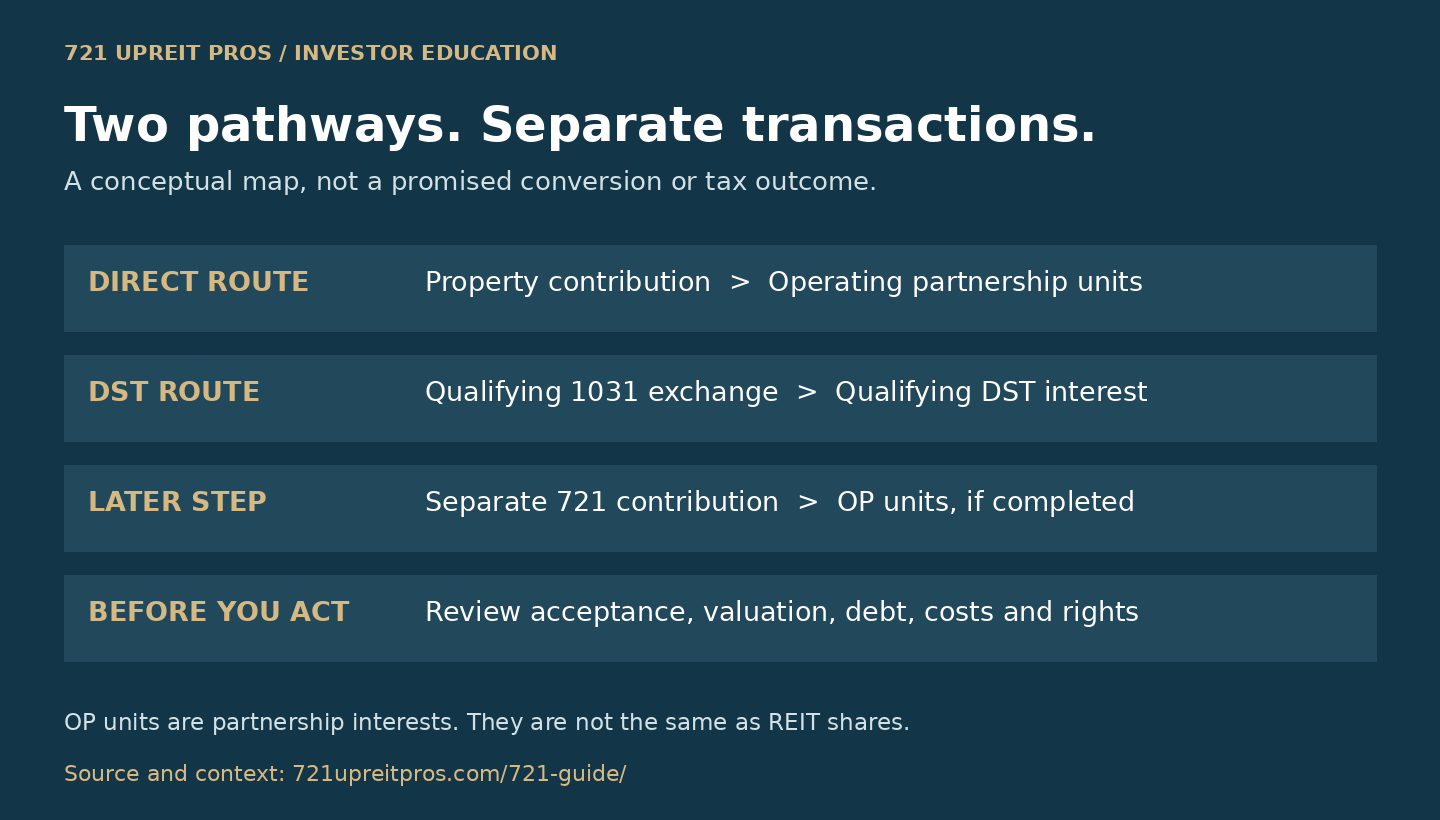
You cannot use REIT shares or UPREIT operating partnership units as direct replacement real estate in a Section 1031 exchange. A direct Section 721 transaction instead involves contributing property for partnership interests. A qualifying DST interest may be a 1031 replacement, with a separate possible 721 transaction later. Evaluate each stage on its own facts.
OP units are interests in the UPREIT's operating partnership. REIT shares are equity in the REIT itself. The partnership agreement determines the rights attached to OP units, including distributions and any transfer or redemption provisions. Do not assume that owning OP units gives you the same liquidity or control as owning publicly traded REIT shares.
No. Conversion is not an automatic feature of a DST. Check whether the offering documents contemplate a 721 transaction, who decides, which conditions apply, and what happens if it does not occur. Ask whether you have an election or consent right and whether other investors' choices affect you.
Section 721 itself does not establish a universal two-year DST-to-721 safe harbor. A sponsor's expected timetable does not settle your tax treatment. Have your tax professional evaluate the actual sequence, ownership intent, and applicable rules alongside the offering documents before relying on a planned conversion date.
There is no universal cash-out date. Read the OP-unit agreement for lockups, redemption request windows, limits, pricing, and suspension rights. A right to request redemption does not mean your request will be fulfilled when you want it. Evaluate potential taxes separately before depending on an exit for planned spending.
There is no single minimum that applies to every 721 UPREIT opportunity. Property acceptance, investor eligibility, and any minimum investment depend on the specific transaction and offering. Request current, dated materials. Compare fees, leverage, valuation, and exit terms along with the amount required to participate. This guide is not a live offering inventory.
Do not equate original cash invested with current tax basis. Partnership distributions, changes in liabilities, and a sale or redemption can have different tax consequences. A qualifying tax-deferred contribution does not make every later payment tax-free. Ask your CPA to analyze the proposed withdrawal and your adjusted basis before acting.
Contact your qualified intermediary and tax professional promptly. How sale proceeds were handled and the exchange deadlines matter. In a qualifying deferred 1031 exchange, replacement property generally must be identified within 45 days and received within 180 days or the tax-return due date, including extensions, if earlier. These deadlines alone do not establish eligibility or repair a completed transaction.
Request current offering materials and compare each opportunity using the same document checklist. Focus on assets, leverage, distribution funding, full-life fees, valuation, conflicts, conversion rights, and exit restrictions. Separate historical results and distribution targets from contractual rights. Availability, eligibility, and terms vary by offering.
Bring your property type and location, sale stage, expected timing, estimated proceeds and debt, cash needs, and any offering materials you have received. Use the planner to record questions for your advisor, CPA, and attorney. Share sensitive financial documents only through a verified secure channel arranged with the firm.
Begin by identifying the transaction you actually have available. The label “721” does not establish property acceptance or determine the terms.
01 / DIRECT CONTRIBUTION
Your property → OP units
A property owner may negotiate a direct contribution to a REIT's operating partnership. Acceptance of the property, valuation, existing debt, contribution terms, and investor eligibility require transaction-specific review.
Would the partnership accept this asset?
How would contributed value and units be determined?
Which restrictions and protections would be contractual?
A negotiated contribution, not a sale followed by a stock purchase.
02 / POTENTIAL DST PATHWAY
1031 exchange → DST → possible 721
A property owner may exchange into a qualifying Delaware statutory trust. Some programs contemplate a later transaction with an operating partnership. The documents, not the illustration, determine who decides and whether that later step occurs.
Does the replacement interest meet exchange requirements?
Is conversion optional, required, or only contemplated?
What is the alternative if the anticipated transaction fails?
Educational pathway map. Arrows show possible transaction stages, not promised conversion or tax treatment. Download and share this graphic.
A DST's name alone does not establish its tax treatment. IRS Revenue Ruling 2004-86 addresses a specific trust structure and facts; other exchange requirements must also be satisfied. [3] For transaction stages in more detail, see how the process works.
WHAT OWNERS ARE TRYING TO SOLVE
A plan for life after the property.
Less direct management
Start by listing the responsibilities you want to leave behind: tenant calls, maintenance oversight, leasing decisions, or repeated property transactions.
Ask who assumes each responsibility and what oversight you retain.
A different investment mix
Review what the partnership actually owns. A broader portfolio can offer a different mix of exposures, but a large property count alone does not establish diversification.
Ask about property types, markets, tenants, leverage, and concentration.
A long-term ownership plan
Bring your spending needs, cash reserves, family goals, and expected holding period into the discussion before comparing a projected distribution rate.
Ask your advisor and CPA to connect the structure to your own circumstances.
COMPARE THE RIGHTS, NOT JUST THE LABELS
What changes as ownership changes?
Choose a structure to highlight its column. This is a general comparison, not an investment recommendation or a description of any specific sponsor.
General ownership comparison. Governing documents control.
Question
Direct property
Qualifying DST interest
UPREIT OP units
What do I own?
A real estate interest.
A beneficial interest in the trust.
A partnership interest.
Who makes property decisions?
You, subject to co-owner, lender, and legal constraints.
The trustee or sponsor under the trust documents.
Partnership management under the agreement.
How do I exit?
Arrange a property sale, subject to market and transaction conditions.
Review transfer limits and the sponsor's eventual disposition plan.
Review transfer, redemption, lockup, pricing, and suspension provisions.
What needs tax review?
Basis, gain, debt, and any intended exchange.
Qualification at entry and the actual exit transaction.
Contribution terms, basis, liabilities, allocations, and later dispositions.
Can I assume another 1031 exchange?
No. The next transaction must meet the rules.
No. Depends on the property interest and exit structure.
No. OP units are partnership interests, not direct replacement real estate.
Different numbers answer different questions. Sale proceeds, contributed value, unit count and tax basis should have separate lines in your planning.
Consider an owner whose investment property sells for an illustrative $2,000,000. Assume a $600,000 loan payoff and $100,000 of selling expenses. The remaining cash is $1,300,000 before other adjustments. That is a cash reconciliation. It does not calculate taxable gain, establish replacement-property requirements, or determine which expenses receive particular tax treatment.
Hypothetical arithmetic only. No actual property, offering or investor result is represented.
Stage
Illustrative input
Arithmetic result
Still needs review
Sale closing
$2,000,000 price less $600,000 debt and $100,000 expenses
$1,300,000 cash before other adjustments
Closing statement, expense classification and exchange structure
Potential replacement
Assume the owner considers a qualifying DST
No investment or exchange conclusion follows from the cash number alone
Property qualification, deadlines, proceeds handling, value and debt
Possible later contribution
Assume $1,350,000 of agreed net contribution value and a $25 issue price
54,000 OP units
Valuation date, liabilities, expenses, unit class and agreement terms
Value after contribution
54,000 units multiplied by an illustrative $23 valuation
$1,242,000 of indicated value
Whether that value is realizable and whether any redemption is available
The assumed $1,350,000 contribution value is an independent hypothetical input, not a prediction that the $1,300,000 investment will appreciate. The unit-count example assumes the net contribution figure already includes all relevant adjustments and that no additional issuance charge applies. A lower unit price creates more units for the same contribution value; it does not by itself create more wealth.
For the full arithmetic, use the OP-unit valuation reconciliation and worksheet. It works from an assumed gross property value through debt and adjustments to the issued units, with a separate price-sensitivity comparison.
Ask for a reconciliation that starts with the property or interest being contributed and ends with the exact class and number of units issued. Have the preparer identify every deduction and its calculation base. Keep the CPA's basis schedule alongside that reconciliation. A negotiated value used to issue units is not automatically a new tax basis. IRS partnership guidance [4].
For the sequence around a sale and exchange, read how the 1031, DST and possible 721 stages work. Discuss the real closing figures with your qualified intermediary and tax professional before assigning cash to an investment.
PUT COSTS ON THE SAME BASIS
What can a DST-to-721 investment cost?
Request the complete compensation and expense picture. A single headline percentage rarely answers every cost question.
A useful comparison follows the investment through entry, operation, any contribution transaction, partnership ownership and exit. Ask which charges apply to the specific offering, who receives them, and whether they are paid directly by you or through the property, trust or partnership. A charge paid inside an entity can still affect the economics of your investment.
A document-request framework, not a statement that every offering charges every fee.
Stage
Items to identify
Calculation question
Evidence to request
Entry
Selling compensation, offering costs and acquisition charges
Is the amount based on equity, purchase price or another figure?
Offering fee table and sources-and-uses schedule
Operations
Property management, asset management, financing and affiliated-party charges
What repeats, what can increase, and where is it reflected?
Management agreements, operating statements and compensation disclosure
Contribution
Valuation work, transaction expenses and any transfer-related charges
What reduces the value used to issue units?
Contribution agreement and closing reconciliation
OP-unit ownership and exit
Management, servicing, performance-related compensation and possible exit adjustments
Which class terms, thresholds and pricing provisions apply?
Partnership agreement, class schedule and redemption provisions
For simple arithmetic, a hypothetical 1% annual charge on an unchanged $1,000,000 calculation base equals $10,000 for one year. A hypothetical 1% one-time charge on the same base also equals $10,000, but it does not repeat. Those percentages should not be compared without their time periods. If a fee applies to gross assets instead of investor equity, the dollar amount can differ even when the headline rate is identical.
Do not subtract an expense twice. If a distribution estimate already reflects a particular operating expense, subtracting it again can misstate expected cash flow. Ask the sponsor to mark which fees are included in the illustration, which are charged separately, and which depend on performance or a future transaction. Your comparison should also record the document date and unit class so that older or differently priced terms are not mixed.
For a complete working method, use the fee-comparison ledger and holding-period example. It shows how a lower rate can produce a higher dollar charge, how to distinguish the contractual payer from the economic cost, and how to reconcile fees already included in cash-flow estimates.
A November 3, 2025 public BREIT filing illustrates why multiple documents can matter: it describes advisory, operating partnership and distribution arrangements for a DST program. This historical example is not a current fee quote or an endorsement. Review the actual documents for the opportunity you are considering. Public filing example [7]. See the broader risk and due-diligence guide for questions about incentives and conflicts.
PLAN AROUND CASH YOU CAN ACCESS
Three liquidity questions to resolve early.
Value, income and access to cash are separate parts of an investment decision. Put an expected spending date next to every cash need.
An investor expects a substantial family expense in twelve months. Before committing funds, ask whether the proposed interest can provide cash by that date under the actual documents and under stressed conditions. An anticipated conversion or redemption window is not an adequate cash reserve.
Take the amount and date to the advisor. Discuss alternatives for meeting the expense independently of the investment's eventual exit.
An eligible redemption request
An investor reaches the point when requests are permitted. Ask when the request must arrive, whether it can be reduced or deferred, which valuation date applies, and what form of consideration can be delivered. Distinguish a processing timetable from a contractual obligation to pay.
Keep the submitted request and acknowledgment. Ask for the provisions governing any queue, limit or suspension rather than relying on another investor's experience.
A higher indicated value
An account statement shows appreciation. The owner still needs to determine whether units can be transferred or redeemed and whether the statement value is the price used for that transaction. An indicated value is not a standing cash offer.
If shares might be delivered, identify the share class, trading status and restrictions. Receiving REIT shares does not necessarily mean receiving securities that can be sold immediately on an exchange.
Non-traded REITs can have limited liquidity. Do not apply the trading characteristics of a listed REIT to a different share class or to restricted partnership units. SEC REIT overview [5]. Ask the CPA to evaluate the tax consequences of the actual cash distribution, sale, redemption or exchange being considered. The original amount invested alone is not a complete tax analysis. IRS partnership guidance [4].
If a request is already planned or pending, use the six-gate redemption-request tracker to separate eligibility, receipt, response, settlement form, pricing and payment. The worked example shows why a known process date is not a guaranteed cash date.
These are hypothetical planning situations, not instructions to buy, sell or withdraw. Their purpose is to expose a mismatch between a personal spending deadline and an investment's actual cash-access provisions before the mismatch becomes urgent.
NAME THE PERSON WITH THE CHOICE
Optional for whom?
A potential 721 exit can involve several decisions made by different parties. Identify each one before treating the outcome as part of your plan.
When someone describes a conversion as optional, ask who holds the option. An operating partnership's right to initiate a transaction is different from an investor's right to choose whether to participate. A stated intention to pursue a contribution is different again. A program can contain several of these features, so the labels alone do not classify your rights.
Record the decision-maker, the act they can authorize, the conditions, the notice period and the alternative outcome. Then locate any investor consent, election, voting, transfer or power-of-attorney provisions that affect the same transaction. Ask an attorney to explain how the documents work together, especially if a short marketing description appears inconsistent with the operative language.
One historical example makes the distinction concrete. BREIT's November 3, 2025 filing describes an FMV purchase option held by its operating partnership. That illustrates an option belonging to the partnership. It does not establish an investor's ability to accept or decline any particular offering's transaction. Public filing example [7].
Use the focused DST-to-721 conversion decision-rights worksheet to record the relevant provisions. It includes a comparison framework, original diagram and one-minute explainer. Section 721 supplies a tax framework for qualifying contributions; it does not replace your investment's governing agreements. Section 721 [1].
START WITH THE LIFE YOU WANT TO SUPPORT
Which trade-offs deserve your attention?
The purpose of the first conversation is to clarify your needs and the available structures. It is not to make every property owner fit the same strategy.
Write down your top two priorities before looking at an investment illustration. Reducing maintenance calls may matter most today, while access to cash or the ability to choose a future exit may matter more later. Consider those priorities together. A solution that reduces property work can introduce new limitations on control, concentration or liquidity.
After acquisition or contribution, use the DST and UPREIT annual review checklist to compare current ownership, operations, debt, cash, value, liquidity and tax records with the prior year.
Questions for an advisor discussion. This table does not assess individual suitability.
Your priority
What to clarify
Evidence that helps
An unresolved concern
Less management
Which tasks move to professionals, and which decisions you retain
Management responsibilities and investor voting rights
You want direct authority over property operations
Recurring income
Sources of distributions and the effect of vacancies, debt and expenses
Operating results, cash-flow reconciliation and distribution policy
Your spending depends on a payment that may change
Cash access
Required amounts and dates compared with actual exit provisions
Lockups, redemption terms and a separate spending plan
A major expense arrives before dependable liquidity
Future flexibility
Control over contribution, transfer and exit decisions
Election, option, consent and amendment provisions
You assume another 1031 exchange will remain available
Ask your advisor to compare the relevant alternatives on the same practical questions. Continuing to own property with professional management, evaluating a qualifying DST, and considering a negotiated contribution involve different ownership rights. The availability of a tax-deferral framework is one part of that comparison. It does not settle whether the assets, fees or restrictions meet your needs.
Bring your current ownership and sale information to the conversation, including entity names where relevant. Your qualified intermediary should address exchange handling and timing, your CPA should address the tax analysis, and your attorney should review legal rights. The advisor can help connect the investment's economics and risks to your objectives. Ask who will resolve each unanswered question and which document supports the answer.
Before evaluating a recommendation, clarify the professional's role, compensation, available program menu and continuing service. Use the guide to hiring a 721 UPREIT advisor and its evidence worksheet to prepare for the conversation.
Compare the offering behind the sponsor name
Choosing among Hines, Brookfield and Cantor starts with matching the legal issuer, operating partnership and unit class to dated governing documents. Use the program-document matrix and worked evidence-gap example to prepare your advisor discussion.
PLAN BEFORE THE PROPERTY CLOSES
How does a 721 UPREIT decision fit a property sale and retirement?
Start with the reason for selling: management workload, concentration, a future expense or a retirement-income change. Compare selling with retaining the property under professional management. If selling remains the plan, interview appropriately licensed realtors or commercial brokers about experience with the property type, comparable sales, marketing, fees and closing coordination. No brokerage service or referral relationship is implied here.
Assemble title and ownership information, leases, debt records and a realistic sale timetable. Bring the CPA, attorney and qualified intermediary into a contemplated deferred exchange before closing or receiving sale proceeds. Ask which person is responsible for tax eligibility, fund handling, transaction documents and investment suitability. The advisor hiring guide helps assign those responsibilities.
The IRS describes Section 1031 as a qualifying real-property exchange framework, with potential recognized gain when money or other property is received. It does not make an investment suitable or erase every tax consequence. A qualifying DST interest may be evaluated as replacement property under the actual structure. A separate Section 721 contribution exchanges property for a partnership interest under applicable rules and exceptions. Do not treat OP units or ordinary REIT shares as direct Section 1031 replacement property.
A hypothetical owner wants to reduce management work but expects a large retirement expense next year. That cash need belongs in the plan before an illiquid commitment, even if a presentation discusses future conversion or redemption. Compare costs, control and downside cash flow with the cash-needs worksheet, then review the DST-versus-721 retirement-income comparison. An expected distribution is not a dependable outside reserve.
Place the property decision alongside existing investment accounts, 401(k)s, IRAs, household spending, concentration, beneficiaries and tax estimates. Retirement-account assets are separate from exchange proceeds. A discussion does not presume a rollover, account transfer or advisory engagement is appropriate; evaluate the actual alternatives, services and costs first. Ask your tax and legal professionals which records and estimates require updates.
Define why you may sell and the cash dates you must meet.
Interview the broker and assign tax, legal and intermediary responsibilities before closing.
Compare direct property, a qualifying DST and a separately evaluated 721 proposal.
Document fees, control, distribution risks and the no-conversion outcome.
Connect the decision to accessible reserves and the broader retirement plan.
Talk to a 721 UPREIT advisor or get the seller checklist. Use the basic contact form for an initial request and a verified secure channel for confidential documents. No appointment, investment acceptance or tax result is promised.
MAKE THE CONVERSATION YOURS
Build your advisor discussion checklist.
Choose your stage and biggest priority. Get a short question list to take into a conversation with an advisor, CPA, and attorney.
No contact details required. Choices stay in this page and are not saved or sent to the firm. This tool organizes questions; it does not assess suitability, eligibility, or tax outcomes.
YOUR DISCUSSION STARTER
Start before choosing an investment.
What ownership structure fits the transaction I am considering?
Which decisions would I retain, and which would move to the sponsor?
Which documents should my advisor, CPA, and attorney review together?
Select your stage and priority to tailor these questions.
Your checklist is not automatically transferred. Bring it to the conversation.
TALK TO A 721 UPREIT ADVISOR
Turn your questions into a clear next step
Request a callback to discuss your 1031, DST and 721 options, your timing and what to ask before you commit. Share your name, email and phone below to start the conversation.
No investment commitment or financial documents required. A callback request does not book an appointment or establish an advisory relationship.
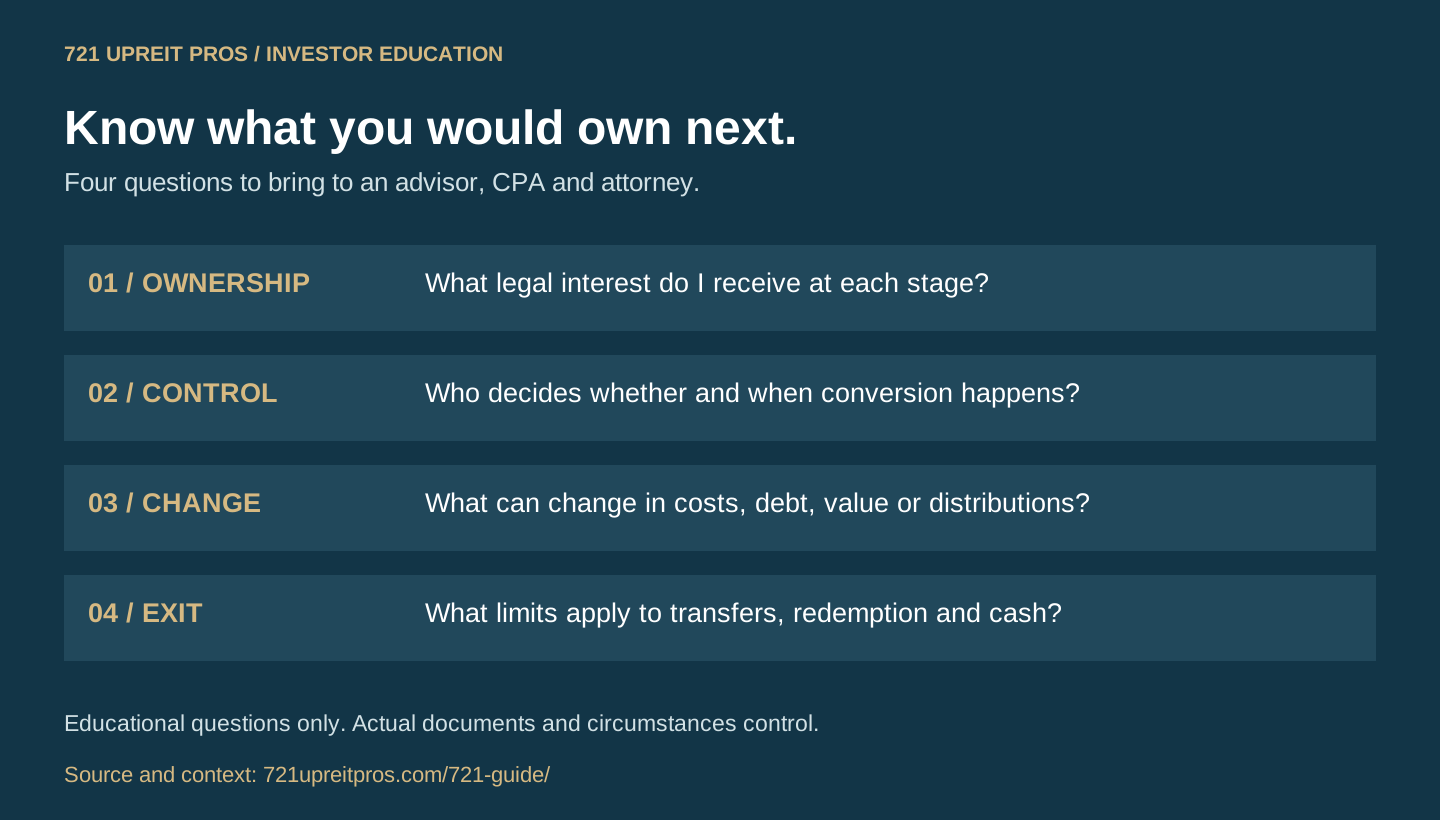
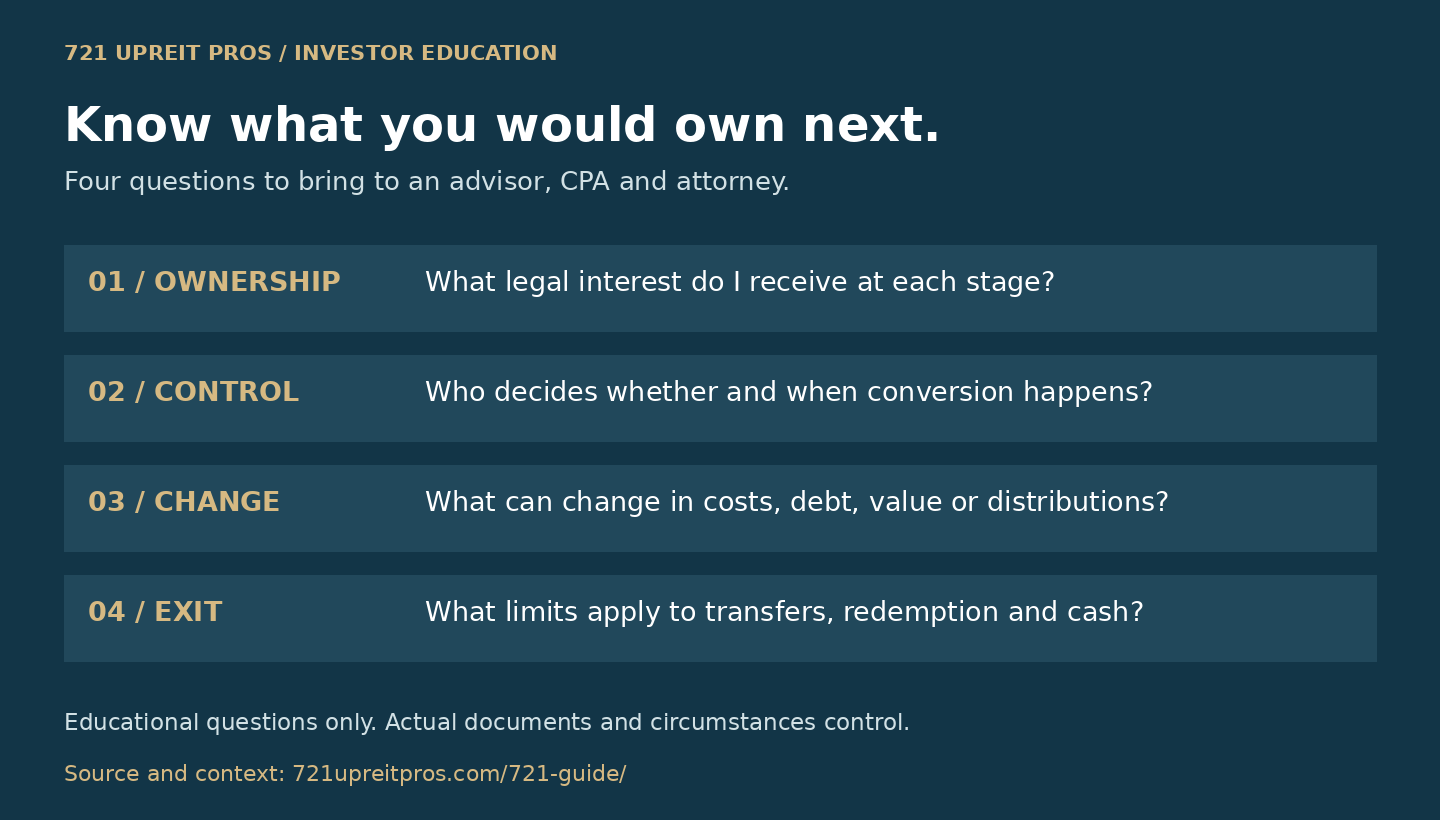
Find the actual election, consent, or option provisions. Ask for the alternative outcome, not just the anticipated one. An attractive plan can still give the investor little control over the eventual transaction.
02
What value becomes how many units?
Request a reconciliation showing contributed value, debt treatment, expenses, unit price, and units issued. Ask who sets each input and how a disagreement is handled. A hypothetical illustration is not your final settlement statement.
03
What does the income figure measure?
Ask whether the stated amount is a target, current distribution, or historical result. Identify how distributions are funded and what could reduce them. A distribution rate is not the same as a total investment return.
04
When could I actually receive cash?
Distinguish the right to submit a request from the obligation to fulfill it. Ask about waiting periods, limits, pricing, and suspension. Non-traded REIT shares can be difficult to sell; do not assume a listed REIT's liquidity applies to restricted OP units. [5]
05
What can create a tax bill later?
Have your CPA evaluate basis, liability allocation, distributions, and the proposed exit. A qualifying contribution does not make every later transaction tax-free. Ask what any tax protection agreement actually covers and excludes. [4]
06
What does it cost across the full journey?
Request one written fee schedule covering entry, management, financing, conversion, and exit, including compensation and affiliated-party charges. Compare documents on the same basis. Do not assume a low headline fee means a lower total cost.
BUILD THE PLAN AROUND THE TRADE-OFFS
Passive ownership still carries risk.
You can lose principal. You may have limited control, uncertain access to cash, leverage exposure, variable distributions, conflicts of interest, and tax complexity. Neither an institutional property nor a large sponsor eliminates those risks.
You may reuse these original educational diagrams with their explanatory notes. Attribution is appreciated. These are resources for readers, not a paid placement or an endorsement. Copy the optional attribution snippet or use the image pack.
FROM RESEARCH TO A REAL CONVERSATION
Let's talk about your next chapter.
A useful conversation starts with what you need from your next investment: less management, clearer cash planning, different property exposure, or a long-term transition.
Review 721 UPREIT capital-call obligations, paid commitments, optional subscriptions and funding risks using dated agreements and an original checklist.
Different co-owner goals for a 721 UPREIT? Review ownership, entity classification, approvals, cash needs and proposed OP-unit registration before signing.
Request a callback to discuss your 1031, DST and 721 options, your timing and what to ask before you commit. Share your name, email and phone below to start the conversation.
No investment commitment or financial documents required. A callback request does not book an appointment or establish an advisory relationship.
Prepared by 721 UPREIT Pros. Substantively updated September 13, 2026. General educational material; no individualized tax opinion or independent expert review is represented. Sources were checked for this update. Governing documents and personal circumstances determine the analysis.
BREIT Form 8-K, November 3, 2025: historical DST-program example of partnership option rights and related agreements. Not a current offering summary or recommendation.