
COSTS / INVESTOR WORKSHEET
How to compare DST and UPREIT fees across the full investment
Compare DST and 721 UPREIT fees by recording dollars, calculation bases, payment timing and the actual class. Follow costs from purchase through any contribution and exit. Separate temporary reductions and possible reimbursement from permanent savings, and avoid counting an embedded charge again as a separate expense.
By 721 UPREIT Pros · Published September 13, 2026 · Updated October 16, 2026 · General investor education
Key takeaways
- Compare dollar costs on consistent bases and periods, not only percentages.
- Record investment-level costs separately from advisor account compensation.
- Separate temporary waivers and repayment provisions from permanent savings.
- Label missing or contingent costs instead of quietly entering zero.

The direct answer
For each charge, record the document and date, recipient, contractual payer, calculation base, frequency, applicable interest or unit class, and where the cost already appears. Convert the documented formula into dollars for the same scenario. Keep unknown and contingent costs visible instead of treating them as zero.
This worksheet helps an investment property owner compare disclosed costs before choosing a passive real estate investment. It supports the 721 risk and due-diligence guide. For the ownership choices themselves, use the main 721 UPREIT guide and advisor planner.
TALK TO A 721 UPREIT ADVISOR
Talk to a 721 UPREIT advisor
Request a callback to discuss the questions raised by this article, your timing and what to ask before you commit. Share your name, email and phone below to start the conversation.
No investment commitment or financial documents required. A callback request does not book an appointment or establish an advisory relationship.
Watch: turn a fee percentage into a useful comparison
Original 60-second silent explainer with on-screen text, English captions and a full transcript.
What belongs in a full-life fee ledger?
A fee table is useful only when you can trace each row to the terms that apply to your interest. Start with the offering package and compensation disclosures, then reconcile them with the trust, management, contribution and partnership agreements. The seven-document checklist helps organize the materials. Keep these fields together:
| Field | Record this | Question it resolves |
|---|---|---|
| Source and status | Document, revision date, section, quoted formula; confirmed, estimated, contingent or unresolved | Is this an applicable term or an assumption? |
| Stage and trigger | Purchase, operation, contribution, OP-unit ownership or exit; the event that starts or ends the charge | When does the cost occur, and can two stages overlap? |
| Recipient and payer | Named recipient, affiliation, contractual paying entity and allocation to your interest | Who is compensated, and who bears the economics? |
| Formula and period | Rate, dollar base, valuation date, frequency, minimum, cap, escalation and any proration | Can the percentage be reproduced in dollars? |
| Class and changes | Current DST interest, expected OP-unit class, eligibility, waiver expiration and amendment provisions | Will the same schedule apply after the transaction? |
| Reconciliation | Where reflected in purchase price, cash flow, NAV, unit issuance or separate billing | Is the charge omitted or counted twice? |
Use a row for a disclosed reimbursement even when it is not labeled a fee. Keep reserves, financing costs, taxes and operating expenses in separate categories so the ledger does not confuse all uses of cash with sponsor compensation. A reserve is not automatically a fee, and a loan principal payment is not the same thing as interest expense.
Can a lower percentage cost more?
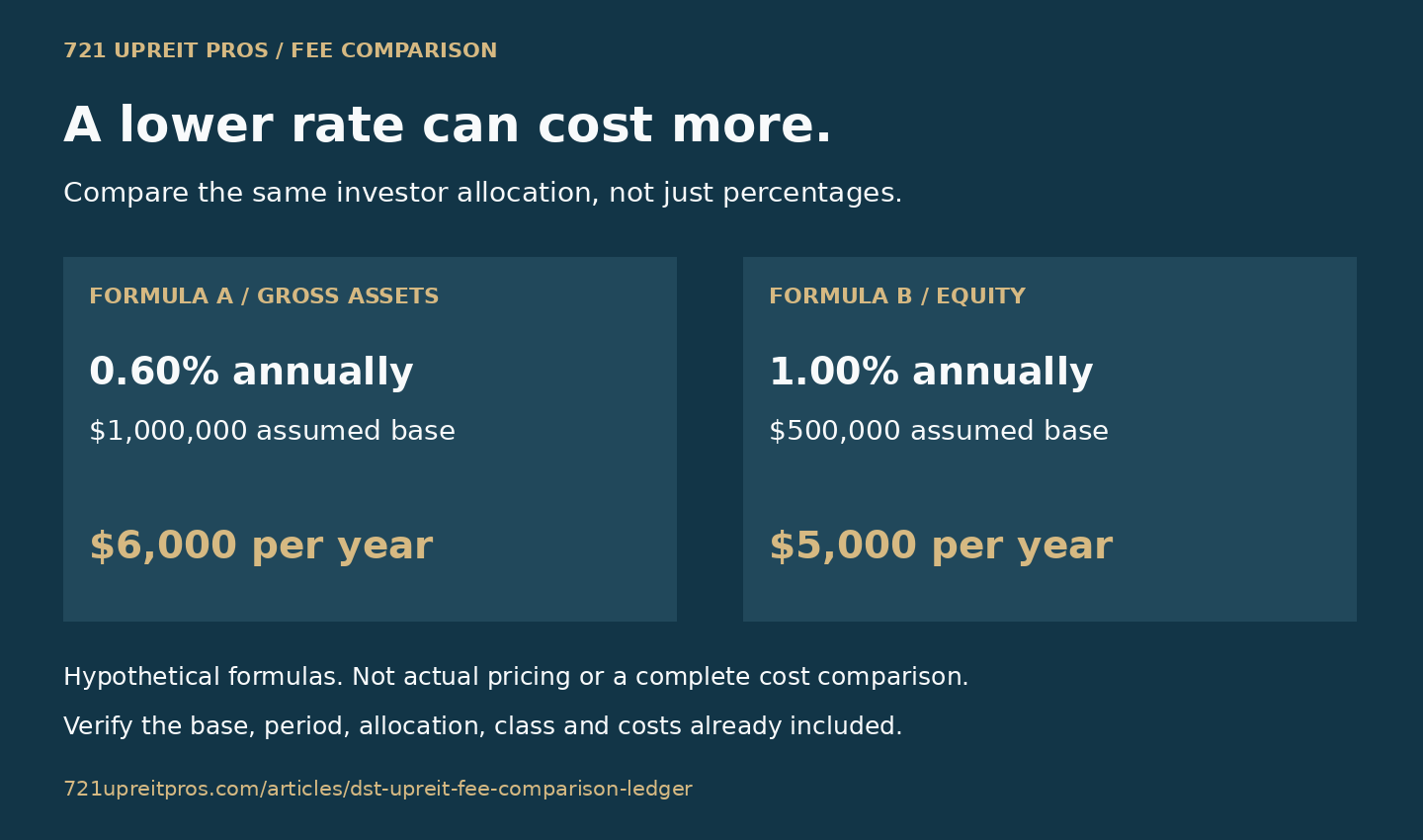
Yes, when the calculation bases differ. Consider two invented annual management formulas. Assume the investor's proportionate gross-asset base is $1,000,000 and the equity base is $500,000. These are assigned inputs, not a statement of typical leverage or any sponsor's current pricing.
- Formula A: 0.60% × $1,000,000 gross-asset base = $6,000 per year.
- Formula B: 1.00% × $500,000 equity base = $5,000 per year.
The smaller rate produces a $1,000 larger annual amount. On the assumed $500,000 equity base, $6,000 is an arithmetic equivalent of 1.20%. That equivalent is a comparison aid, not the contractual formula. If the documents assess fees at the whole-entity level, calculate that fee first and use the actual allocation method. Do not compare an entire property's expense with one investor's account charge.
Ask whether “assets” means acquisition cost, gross asset value, current appraisal or another defined figure. Likewise, net asset value (NAV), contributed equity and original subscription dollars are not interchangeable. Repeat the calculation when the defined base changes.
A worked ledger: why the holding period changes the answer
The following original example compares two fictional fee schedules, not actual DSTs or UPREITs. Assume $500,000 of investor equity, three full DST years, a contribution at the end of year three, and two full OP-unit years with no overlap. Use fixed $1,000,000 gross-asset and $500,000 equity/NAV calculation bases solely to isolate the formulas. They are not forecasts of account value after fees. Assume no compounding, waivers, escalations or partial-year billing.
| Selected charge | Schedule A | Schedule B |
|---|---|---|
| One-time entry charge | 2% × $500,000 = $10,000 | 3% × $500,000 = $15,000 |
| Three DST years | 3 × $6,000 = $18,000 | 3 × $5,000 = $15,000 |
| Assumed contribution charge | Fixed $2,500 | Fixed $2,500 |
| Two OP-unit years | 2 × [(1% + 0.25%) × $500,000] = $12,500 | Same assumed formula = $12,500 |
| Selected-fee subtotal | $43,000 | $45,000 |
| Other expenses and exit costs | Not modeled; must be obtained | Not modeled; must be obtained |
Schedule A has a $2,000 lower subtotal under these assumptions. But if the DST stage lasts six years followed by the same two OP-unit years, A becomes $61,000 and B becomes $60,000. A's $5,000 entry advantage is offset by an extra $1,000 for each DST year. The selected subtotals tie at five DST years, with the same later charges.
This is sensitivity arithmetic, not a recommended holding period or a promise that a contribution will happen. It excludes property operating costs, borrowing costs, taxes, performance compensation, exit adjustments and other possible charges. Different portfolios, leverage, services, investment outcomes and cash timing can outweigh the selected fee difference. A lower subtotal alone does not establish suitability or a better investment.
If the entity pays, does the investor avoid the cost?
Not necessarily. Separate the legal obligation to pay from the economic effect on your interest. For each entity-paid charge, ask where it reduces cash available for distribution, asset value or another measure. Record the allocation method rather than automatically assigning a pro rata amount when the documents specify class-level treatment or a different calculation.
Identify whether the recipient is an affiliate and what service is provided. Affiliation does not by itself prove an unreasonable fee, but it is a reason to examine incentives, approval procedures, related-party disclosures and any offsets against other compensation. The SEC describes potential conflicts when an external REIT manager is compensated according to acquisitions or assets under management. Investor.gov REIT risk overview.
Why do the OP-unit class and current agreements matter?
A historical public filing provides a concrete reason to separate fee layers. BREIT's November 3, 2025 Form 8-K, Item 1.01, describes class-dependent management fees in an advisory agreement, investor servicing charges for certain OP-unit classes, and a performance participation allocation under the partnership agreement. It also describes offering-expense reimbursement. These are distinct provisions, not one universal fee. Read the dated filing and linked agreements.
This is evidence of why a ledger needs multiple rows. It is not a current quote, recommendation or claim that every DST-to-721 program uses those terms. Request the current documents for the actual class you would receive. Check whether any servicing charge ends, whether a waiver can expire, and whether your separate advisory account has an additional charge or offset.
Do not model performance compensation as a flat annual management percentage. Ask for its defined calculation period, return measure, hurdle, catch-up, loss-recovery or high-water-mark provisions, and allocation timing where applicable. A hurdle is a feature of a compensation formula, not a guaranteed investor return. Leave the dollar estimate unresolved until the applicable formula and scenario are understood.
How do you avoid subtracting the same fee twice?
Keep a cost inventory separate from the cash-flow reconciliation. The inventory lists a charge once even if it appears in several disclosures. The reconciliation marks whether that same charge is already included in the starting cash-flow figure.
For example, assume a purely hypothetical $30,000 annual cash-flow estimate already reflects a $5,000 management charge but excludes a separate $1,250 servicing charge. Subtracting the excluded charge produces $28,750. Subtracting both charges again produces $23,750 and counts the management charge twice. Conversely, calling the entire $30,000 “after all fees” would overlook the servicing charge. Neither figure is a distribution forecast.
Ask the preparer to label each line as included, separate, contingent or not yet known. Reconcile any contribution expense to the value used for issuing units. A deduction already included in net contribution value should not be deducted a second time from the resulting unit count.
Does tax deferral make the fees disappear?
No. Section 721 generally addresses nonrecognition on a qualifying property contribution for a partnership interest, subject to exceptions. It does not set an investment's fee schedule. Section 1031 real-property exchange rules are a separate framework, not a rule making all transaction costs deductible or every charge payable from exchange funds without consequences. Section 721; IRS exchange guidance.
Keep the economic ledger separate from the tax treatment of each item. Ask your CPA and qualified intermediary to review actual charges and proceeds handling before closing. For a separate comparison of the ownership paths, review DST versus 721 UPREIT choices after a property sale. For broader background on the stages, see DST Experts' explanation of the DST and 721 pathway.
Take a completed comparison, not just a percentage, to the advisor
Download the fee-ledger worksheet
Fill in one row per charge, mark missing evidence and run the same timing assumptions for each alternative. Before proceeding, resolve the calculation base, your allocated dollar amount, the applicable unit class, all separate account charges and which costs are already included. Request written clarification of unresolved terms and arrange a verified secure channel for sensitive documents.
Read video transcript
0:00 · Compare dollars, not just rates.
0.60% of $1,000,000 is $6,000 annually. 1.00% of $500,000 is $5,000 annually. Hypothetical bases for the same investor allocation.
0:12 · Write one row per charge.
Record the source, recipient and paying entity. Add the formula, period and applicable class. Mark unknown costs as unknown, not zero.
0:24 · Test the holding period.
Entry costs happen once; annual costs repeat. Our five-year selected totals: $43,000 and $45,000. These hypothetical subtotals exclude other costs.
0:36 · Do not subtract a fee twice.
Ask which charges the cash estimate includes. Separate entity expenses from account charges. Check for offsets, waivers and contingent amounts.
0:48 · Bring the ledger to your advisor.
Use the worksheet and actual current documents. Lower selected fees do not mean a better investment. Compare fees, rights and risks together.
Sources and review limits
Primary references were checked September 13, 2026. The dated SEC filing is a historical structural example, not current offering inventory. Calculations, the ledger and the diagram are original hypothetical educational work. No named human financial, legal or tax expert review is claimed. Actual documents, circumstances and current professional advice control. Investments can lose value; conversion, distributions, liquidity and tax outcomes are not guaranteed.
Keep temporary cost changes in a separate schedule
A concession can reduce today's cost while leaving a later rate or reimbursement question unresolved. Add four fields to the ledger: last covered period, earlier ending trigger, post-concession rate and recoverable balance. Do not extend a discounted percentage through the whole holding period without written support.
Compare the covered period, the ordinary schedule afterward and any permitted reimbursement separately. A cap may exclude other important expenses; a deferral may leave an obligation rather than erase it. The fee-waiver expiration example and document worksheet shows the distinction using dated public filings and hypothetical arithmetic.
Frequently asked questions
Why can a lower fee percentage cost more?
The base may be larger. A gross-asset charge and an equity-based charge are not comparable from their percentages alone. Apply each actual formula to the same clearly labeled scenario.
Should I add an embedded commission a second time?
No. Identify where the commission already appears in the disclosed investment cost. Separate costs should be included, but the same charge should not be counted twice.
Does no separate advisor invoice mean no compensation?
No. Compensation may be embedded or paid by another party. Ask who pays, who receives it, how much it is and whether the arrangement changes across alternatives.
How should I compare a temporary waiver?
Calculate the covered period and the later ordinary schedule separately. Read expiration, renewal and recovery provisions rather than assuming the introductory cost lasts throughout the investment.
Are reserves the same as sponsor fees?
Not automatically. Record purpose, ownership, permitted use and any payment to a service provider. Keep operating expenses, loan principal, reserves and compensation in separate categories.
Can this ledger establish the best investment?
No. It organizes disclosed costs and uncertainties. Investor goals, risks, liquidity, tax consequences, services and the actual investment documents require a broader review.
BEFORE YOUR ADVISOR CONVERSATION
Three questions before you commit
This companion briefing covers the professional's identity, compensation and how restrictions fit your cash needs. Use it alongside this article's specific document checks.
Loading the video connects to YouTube. Watch on YouTube · 721 UPREIT Pros channel · Read the full advisor checklist.
Read video transcript
Before you hire a seven twenty-one UPREIT advisor, ask these three questions.
First: who exactly am I hiring? Get the professional's legal name, firm and registration information. Check the record through Investor dot gov and read the firm's relationship summary where applicable. Ask whether this conversation involves brokerage services, investment advice, or both. A marketing title alone does not answer that question.
Second: who gets paid, and how much? Request a written cost breakdown in dollars. Identify the payer, calculation base, payment timing and ongoing charges. Include product expenses and embedded compensation. No separate advisor invoice does not mean there are no costs.
Third: how does this fit my cash needs? Review the actual agreements. Ask who controls a possible conversion and what happens if it does not occur. Separate permission to request redemption from approval, pricing and payment. Do not assume a fixed cash-out date.
Then agree on responsibilities. Your investment professional, CPA, attorney and qualified intermediary can have different roles. Put continuing service and unresolved questions in writing.
Read the complete advisor checklist using the article link in the description. Seven twenty-one UPREIT Pros. Trust the Pros. Educational only. Investments involve risk and may be illiquid. Tax treatment depends on your circumstances.
Educational only. Investments involve risk and may be illiquid. Footage is illustrative; narration is synthetic.
TALK TO A 721 UPREIT ADVISOR
Ready to discuss your 721 options?
Request a callback to discuss the questions raised by this article, your timing and what to ask before you commit. Share your name, email and phone below to start the conversation.
No investment commitment or financial documents required. A callback request does not book an appointment or establish an advisory relationship.