
CONVERSION RIGHTS / INVESTOR WORKSHEET
Who controls a DST-to-721 conversion?
The governing documents determine who can initiate a transaction, whether an investor has an election or consent right, and what happens if the planned contribution does not occur. Start with those provisions before treating a possible 721 exit as part of your financial plan.
By 721 UPREIT Pros · Published September 13, 2026 · General investor education

The direct answer
Ask “optional for whom?” An option held by an operating partnership is different from an investor's ability to choose whether to participate. A sponsor's anticipated strategy is different again. These features can coexist, so a label such as “optional 721” is not a substitute for reviewing the actual agreements.
This article helps you prepare a decision-rights worksheet. For definitions and the broader investment comparison, start with the 721 UPREIT investor guide. For the transaction sequence, see how the 1031, DST and possible 721 stages work.
TALK TO A 721 UPREIT ADVISOR
Talk to a 721 UPREIT advisor
Request a callback to discuss the questions raised by this article, your timing and what to ask before you commit. Share your name, email and phone below to start the conversation.
No investment commitment or financial documents required. A callback request does not book an appointment or establish an advisory relationship.
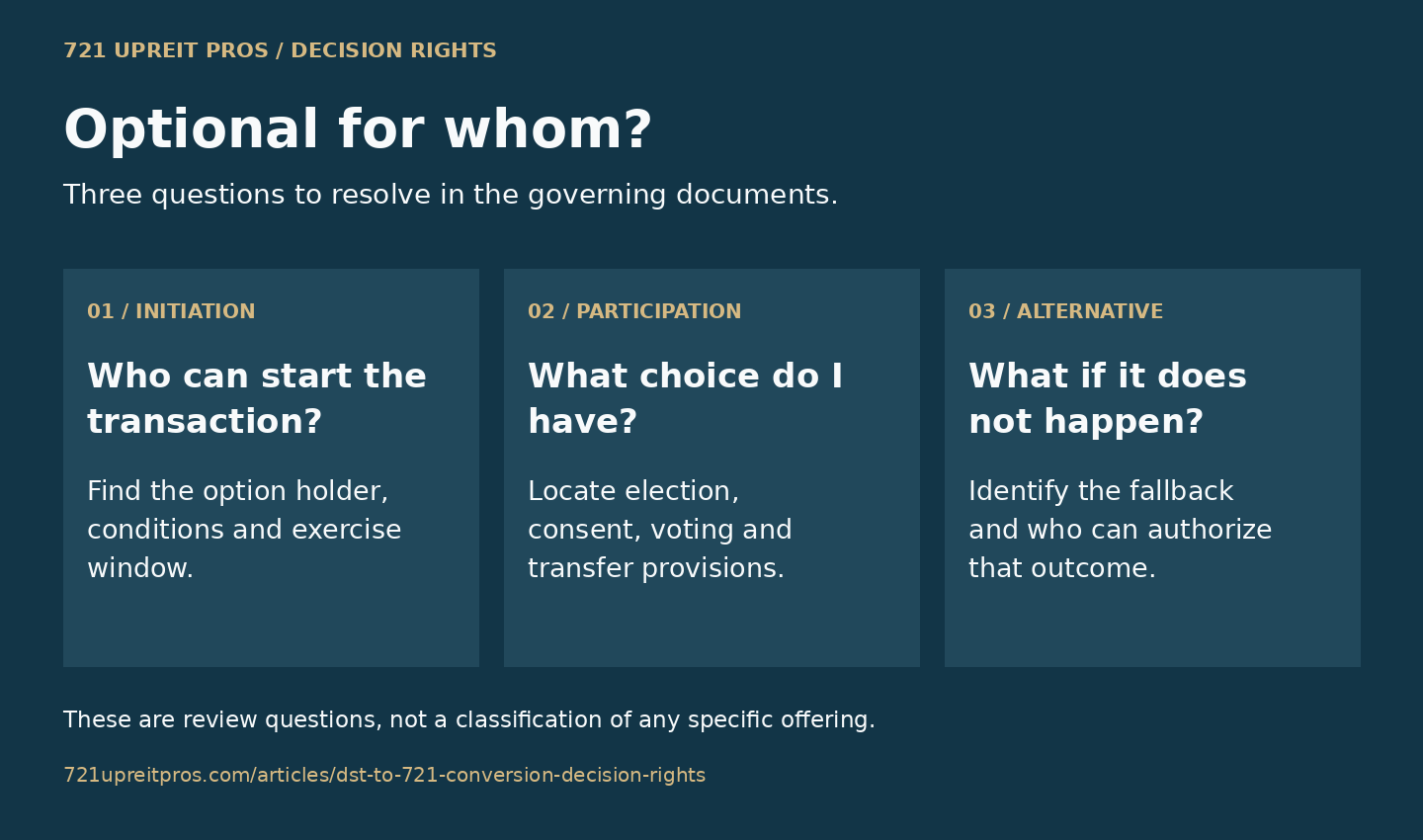
Watch the one-minute decision-rights explainer
Original silent video with on-screen text, captions and a complete transcript below.
Separate three decisions that are often blended together
The first decision is whether someone can initiate a transaction. The second is whether you can choose to participate or must act under rights already granted in the documents. The third is what happens after the transaction, including your ownership interest and any future exit rights. Getting an answer to only one of these questions leaves the others unresolved.
| Question | Where to look | What to record |
|---|---|---|
| Who can initiate? | Purchase option, contribution agreement or transaction authority | The named party, exercise window, conditions and ability to extend or waive them |
| Do I have a choice? | Election, consent, voting, transfer and power-of-attorney provisions | What you can accept or decline, what action is required, and what happens if you do nothing |
| What happens next? | Closing terms, partnership agreement and alternative-exit provisions | The consideration received, new restrictions and the fallback if the planned transaction fails |
A notice that a transaction is approaching does not by itself establish a right to opt out. A signature request also needs context: it may seek a new election, confirm information or implement an obligation already described in the documents. Have your attorney explain what the particular communication does before relying on its appearance.
A public filing shows why the option holder matters
Blackstone Real Estate Income Trust's November 3, 2025 Form 8-K describes a DST program in which the operating partnership holds an FMV purchase option. The filing describes the partnership's ability, during a defined period, to acquire DST interests for OP units or, in some cases, cash. This is a historical example of a choice assigned to the partnership. It is not a current inventory of offerings or a conclusion about any investor's individual opt-out rights. Read the filing, Item 1.01.
The practical lesson is to identify the subject of each operative sentence: who has the right, who must perform, and which conditions qualify the action. Then follow the defined terms and referenced agreements. A public summary can identify questions, but it does not replace the current offering package and the agreements applicable to your interest.
Build a decision-rights worksheet from the documents
Use the same worksheet for each opportunity so that you are comparing equivalent rights. Record the document title, revision date and page or section for every answer. “The representative said it was optional” is a question to resolve, not a completed document reference.
Name the actor and the action
Write the exact party named in the provision. Separate a sponsor's role from that of a trustee, an operating partnership or an investor. Record whether the action concerns a purchase of DST interests, a property contribution, a vote or another step. Similar marketing descriptions can refer to different legal mechanics.
Find the conditions and the clock
Locate the earliest exercise date, expiration date, notice requirements, delivery method and any extension authority. Ask which conditions must be satisfied and which party can waive them. Put document deadlines on a separate list from your exchange deadlines so that one timetable is not mistaken for another.
Identify your affirmative rights
Find any election, consent, approval or information rights. Ask what happens if you decline or fail to respond. If a power of attorney or transfer obligation is involved, have your attorney explain its scope. Do not infer an individual veto from the existence of a voting provision without reading how the vote operates.
Trace value into consideration
Record the valuation date and method, the treatment of debt and transaction expenses, and the class of units or other consideration you might receive. Ask whether a dispute mechanism exists. A right to obtain information about pricing is different from a right to prevent the transaction.
Write the fallback in plain language
Ask what the trustee or sponsor can do if the planned transaction does not happen. Identify any continued holding, sale or other contemplated outcome and the authority behind it. Do not assume a delayed contribution creates immediate liquidity or restores an earlier investment choice.
Download the decision-rights worksheet
A planning example: the missing opt-out assumption
Suppose a hypothetical investor wants less property management but wants to choose a later exit personally. The investor reads that an operating partnership “may” initiate a future transaction and assumes the investor can decide whether to participate. That word identifies a possible action; it does not identify every party's rights.
The useful next step is to request the documents that answer three questions: who decides whether to exercise the option, what the investor agreed to do if it is exercised, and whether there is a documented alternative. Until those answers are established, the investor should not treat personal exit control as a confirmed feature of the investment. This is an illustrative document-review scenario, not a description of a real client or sponsor.
A second hypothetical investor actively prefers a planned transition into an operating partnership. That preference still does not eliminate the need to understand conditions and fallback outcomes. A plan that fits the investor's preference may still be uncertain. Neither investor should use a hoped-for conversion date as proof of future cash access.
Keep tax qualification separate from contractual choice
Section 721 provides the general nonrecognition rule for qualifying property contributions for partnership interests, subject to applicable rules and exceptions. It does not tell you which investor election is in your offering. The earlier Section 1031 exchange also has its own requirements.
Have your CPA and attorney coordinate their reviews. A transaction might be contemplated in the contracts but still require tax analysis for your circumstances. Conversely, the availability of a tax provision does not establish that a sponsor must accept your property or complete a particular transaction. For the broader tax and liquidity discussion, see DST Experts' 721 UPREIT guide.
Bring specific questions to your advisor
Send a concise list of unresolved questions using a verified contact channel. Ask the team to identify the governing provisions and who will explain their legal and tax implications. Start with: “Which party controls the conversion decision, what participation rights do I retain, and what happens if the expected transaction does not occur?”
Video transcript
0:00 · Optional for whom?
A partnership option and an investor election are different rights. Start with the actual agreements.
0:12 · Who can initiate?
Name the party with the right to act. Check the conditions and the exercise period. An anticipated plan is not a promised outcome.
0:24 · What choice do I have?
Locate election, consent and voting provisions. Ask what happens if you decline or do nothing. Have your attorney explain how the terms interact.
0:36 · What happens next?
Identify the units or other consideration received. Review restrictions and alternative outcomes. Conversion does not promise access to cash.
0:48 · Bring a specific question.
Who decides, what can I choose, and what if it fails? Use the article worksheet with your advisor. Preserve the answer and controlling section.
BEFORE YOUR ADVISOR CONVERSATION
Three questions before you commit
This companion briefing covers the professional's identity, compensation and how restrictions fit your cash needs. Use it alongside this article's specific document checks.
Loading the video connects to YouTube. Watch on YouTube · 721 UPREIT Pros channel · Read the full advisor checklist.
Read video transcript
Before you hire a seven twenty-one UPREIT advisor, ask these three questions.
First: who exactly am I hiring? Get the professional's legal name, firm and registration information. Check the record through Investor dot gov and read the firm's relationship summary where applicable. Ask whether this conversation involves brokerage services, investment advice, or both. A marketing title alone does not answer that question.
Second: who gets paid, and how much? Request a written cost breakdown in dollars. Identify the payer, calculation base, payment timing and ongoing charges. Include product expenses and embedded compensation. No separate advisor invoice does not mean there are no costs.
Third: how does this fit my cash needs? Review the actual agreements. Ask who controls a possible conversion and what happens if it does not occur. Separate permission to request redemption from approval, pricing and payment. Do not assume a fixed cash-out date.
Then agree on responsibilities. Your investment professional, CPA, attorney and qualified intermediary can have different roles. Put continuing service and unresolved questions in writing.
Read the complete advisor checklist using the article link in the description. Seven twenty-one UPREIT Pros. Trust the Pros. Educational only. Investments involve risk and may be illiquid. Tax treatment depends on your circumstances.
Educational only. Investments involve risk and may be illiquid. Footage is illustrative; narration is synthetic.
TALK TO A 721 UPREIT ADVISOR
Ready to discuss your 721 options?
Request a callback to discuss the questions raised by this article, your timing and what to ask before you commit. Share your name, email and phone below to start the conversation.
No investment commitment or financial documents required. A callback request does not book an appointment or establish an advisory relationship.