
721 UPREIT PROS / ANNUAL INVESTOR REVIEW
DST and UPREIT annual review checklist: what changed this year?
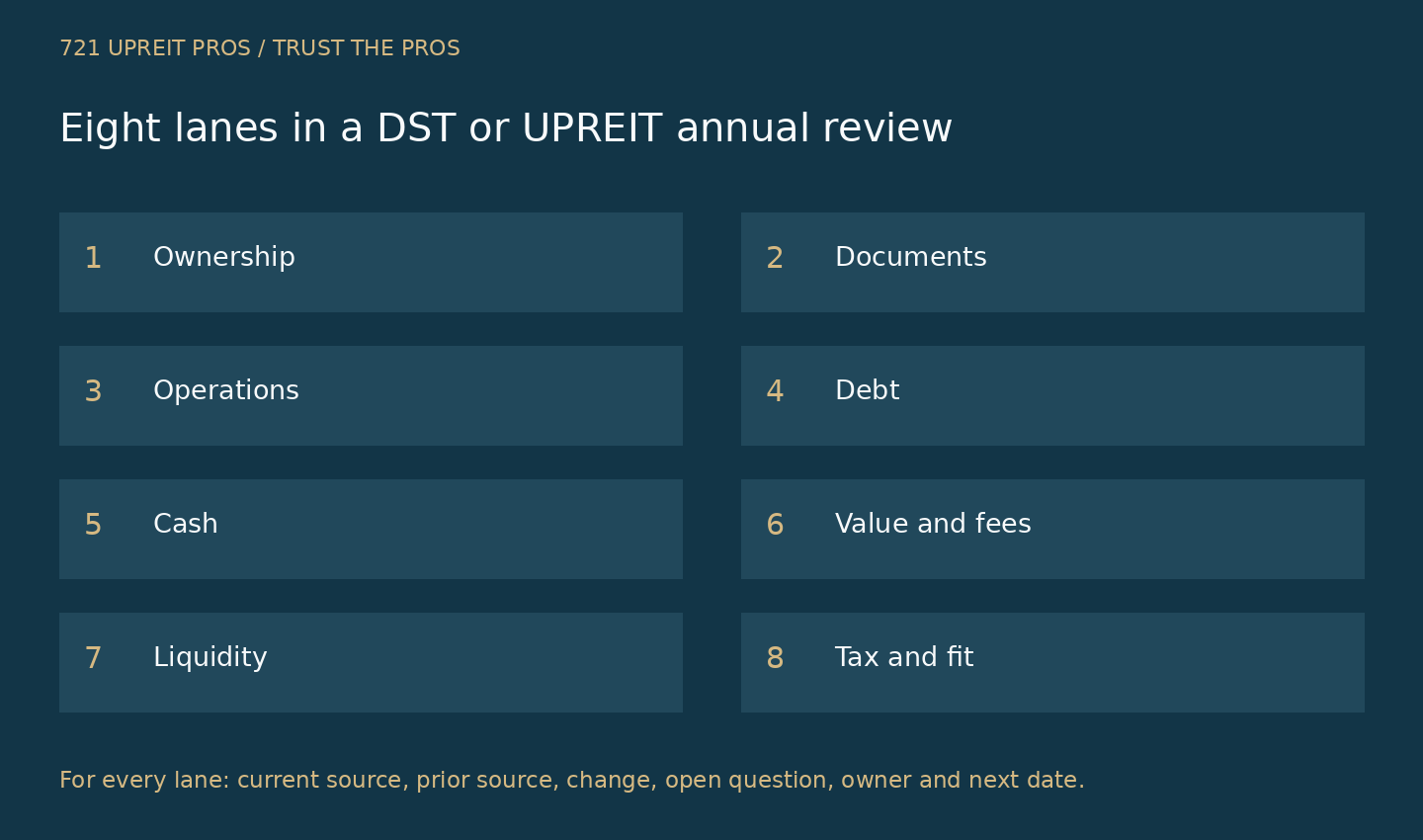
A useful DST or UPREIT annual review compares the current year with the prior year across eight areas: ownership, governing documents, property or portfolio operations, debt, actual cash distributions, value and fees, liquidity rights, and tax records plus investor needs. Use dated source documents, show every calculation and assign each unresolved question to a person and a next date.
By 721 UPREIT Pros · September 21, 2026 · Year-over-year investor review

This checklist answers a recurring investor question: what should I review each year after acquiring a DST interest or receiving operating partnership units? It is not a second pre-investment due-diligence list. Its purpose is to detect change, preserve evidence and decide which questions require the sponsor, administrator, advisor, CPA or attorney.
A DST interest, an operating partnership unit and a REIT share are different interests. The records, tax forms, control rights and liquidity provisions can differ. Start every annual review by writing down what you actually own at the review date. Do not carry forward last year's label if a contribution, redemption, conversion, transfer or class change occurred.
TALK TO A 721 UPREIT ADVISOR
Talk to a 721 UPREIT advisor
Request a callback to discuss the questions raised by this article, your timing and what to ask before you commit. Share your name, email and phone below to start the conversation.
No investment commitment or financial documents required. A callback request does not book an appointment or establish an advisory relationship.
What belongs in a DST or UPREIT annual review?
Review eight lanes and compare the same measurement dates whenever possible. A current statement without the prior statement shows position, not change. A projected number without an actual result shows an assumption, not performance. A verbal answer without a document source is an open item.
| Review lane | Current evidence to request | Year-over-year question |
|---|---|---|
| 1. Ownership | Latest statement, registered owner, interest type, class and quantity | Did the interest, class, quantity or registered capacity change? |
| 2. Documents and events | Current agreement, amendments, notices, elections and material communications | Which rights, obligations, deadlines or counterparties changed? |
| 3. Operations | Property or portfolio report, occupancy or leasing data, income, expenses, reserves and capital work | Which operating drivers improved, weakened or remain unexplained? |
| 4. Debt | Loan balance, rate, maturity, covenants, refinancings and partner liability allocation when applicable | Did financing risk or a tax-basis input change? |
| 5. Cash distributions | Actual payment ledger, distribution notices and source explanations | How many dollars arrived, when, and from what reported source? |
| 6. Value and fees | Stated value or NAV source, date and method, plus fees paid or accrued | Is the comparison measuring the same interest on a comparable basis? |
| 7. Liquidity and control | Current transfer, redemption and conversion provisions plus request status | Did eligibility, timing, pricing, queue, suspension or approval terms change? |
| 8. Tax records and fit | K-1 or other tax forms, outside-basis workpapers, liability schedules, estate records and a current needs worksheet | Do the records reconcile, and does the investment still fit current cash, time and estate needs? |
Direct answer
Do not grade the year with one number. A distribution rate can rise while actual cash falls. A stated unit value can rise while fees, restrictions or tax liabilities also change. Review the evidence lane by lane, then identify the decisions that the combined record supports.
How should an investor separate facts, calculations and assumptions?
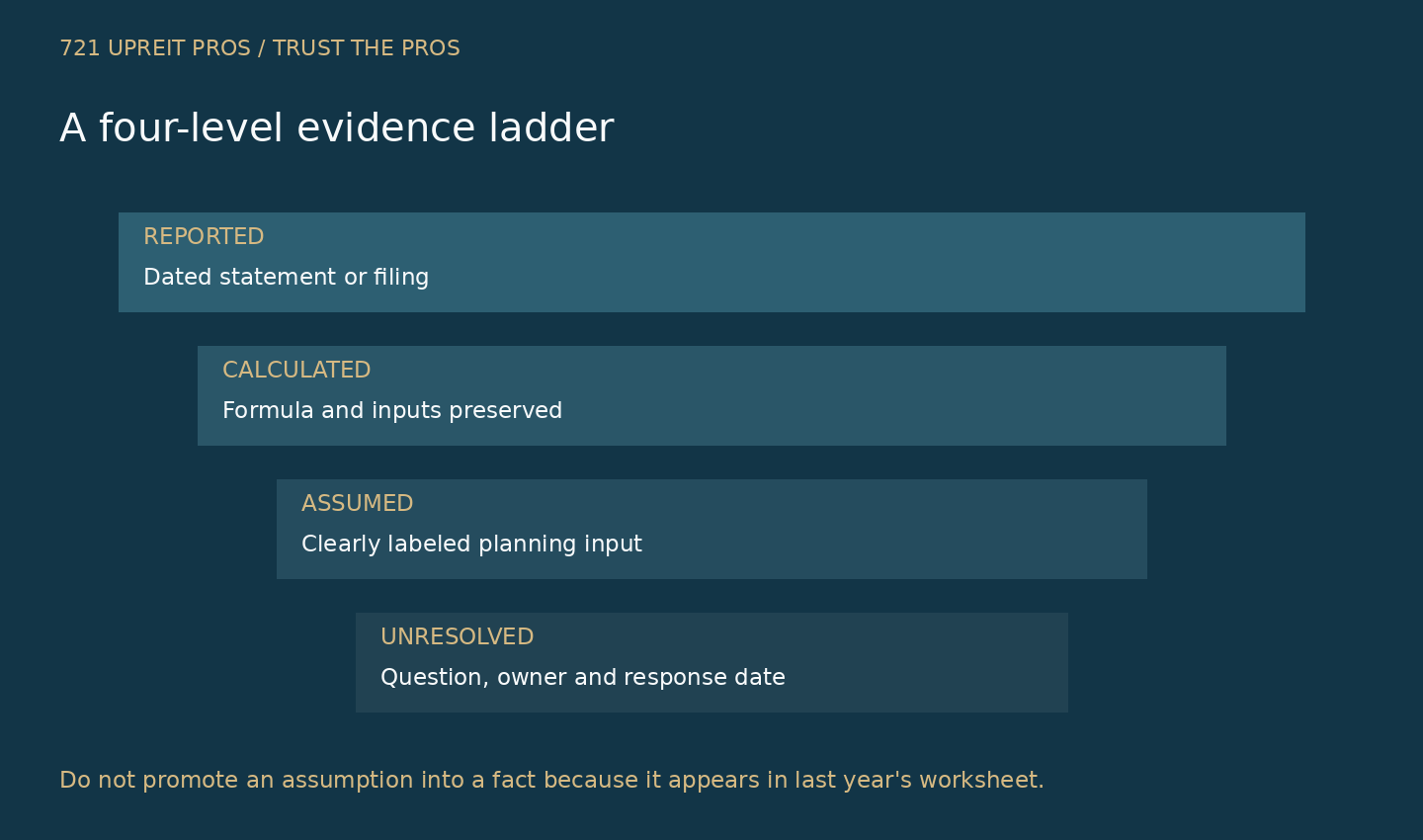
Use a four-level evidence ladder. Label every material number or conclusion as reported, calculated, assumed or unresolved. This makes the file easier for an advisor or CPA to test and reduces the chance that an old projection is mistaken for a current fact.
- Reported: copied from a dated statement, audited report, filing, tax form, governing document or written sponsor communication. Record the page or section.
- Calculated: derived from reported inputs using a visible formula. Preserve the inputs, units and date range.
- Assumed: a planning input that is neither reported nor calculated. State why it is used and what result changes if it is wrong.
- Unresolved: a material question without adequate evidence. Record who will answer it, what source was requested and the next checkpoint.
Which operating and debt changes deserve attention?
Compare the drivers behind the result, not only the result. For a property-level DST, review occupancy, rent collections, lease expirations, tenant concentration, repairs, capital projects, reserves and insurance claims when those records are supplied. For an UPREIT operating partnership, use the reporting package appropriate to the portfolio and unit class. The level of detail available can differ.
Start with the sponsor or issuer's current report. Record the reporting period and whether a figure covers one property, the entire portfolio or only a segment. If the report uses a non-GAAP measure, retain its definition and reconciliation rather than comparing the label alone with a different sponsor's measure.
If the sponsor, adviser, general partner or service provider changed during the year, name the entity and role rather than carrying forward a brand label. The 721 UPREIT sponsor-change continuity review maps approval, fees, conflicts, records and open requests without assuming that an announced transaction has closed.
Questions for the operations file
- Did occupancy, major leases, operating income, expenses or reserves change materially?
- Were planned capital projects completed, delayed, repriced or funded from a different source?
- Did a property sale, acquisition, casualty, tenant event or valuation policy change the comparison?
- Is a decline in cash connected to operations, debt service, reserves, fees or a distribution-policy decision?
Debt deserves its own schedule. Record outstanding principal, interest-rate terms, maturity, extension conditions, covenants and any refinancing or supplemental borrowing. A lower loan balance does not automatically mean lower total risk if maturity is closer, the rate reset or reserves were used.
For OP units taxed as a partnership interest, the partner's share of liabilities can also matter to outside basis. That is a separate tax record from property leverage. Use the OP unit debt and liability worksheet to prepare inputs for the CPA. Do not infer a taxable result from a debt change without the full partner-level facts.
How do you compare distributions, value and fees without double counting?
Reconcile actual dollars received before discussing a distribution rate. List every payment date and amount. Note whether any amount was reinvested, withheld, delayed, returned as capital or described using another source. Then compare the total with the same-length prior period.
A distribution is not the same as total return. It does not, by itself, show whether property value rose or fell, whether the payment came from operations, whether debt increased, or what fees and taxes applied. The distribution-rate and cash-flow example shows how to separate a stated rate from dollars received.
For any annual value, record:
- The exact interest being valued, including class and quantity.
- The valuation date and report publication date.
- The source, method and whether the figure is audited, appraised, sponsor-reported or calculated.
- Any debt, fee, reserve, discount or other adjustment already reflected in the value.
- Whether a redemption or transfer would use that value, a later value or another formula.
A dated public filing illustrates the kind of evidence an investor may encounter. The Brookfield REIT 2024 annual report filed March 18, 2025 includes financial statements and discussion of portfolio, net asset value and leverage. It is one historical issuer report, not a universal reporting package, current offering or recommendation. Use the filings and statements for the actual interest under review.
Track fees on the same timeline. Include acquisition or contribution charges already incurred, ongoing management or administration charges, financing costs, property-level expenses, performance allocations when applicable, and exit or redemption charges. The full-life DST and UPREIT fee ledger helps prevent a property expense, entity fee or unit-class fee from being omitted or counted twice.
What should an annual liquidity review cover?
Read current rights rather than relying on the original sales discussion. Confirm whether transfer, redemption or conversion is permitted, who controls the election, which eligibility and notice rules apply, how pricing is determined, whether payment can be cash or shares, and which queues, caps, delays or suspension rights exist.
If no request is pending, run a planning scenario: what would happen if the investor needed a specified amount of cash in six, twelve or twenty-four months? The answer may be that the interest cannot reliably meet that need. Record the gap rather than assigning an assumed liquidity date.
If a request is pending, use the six-gate UPREIT redemption checklist. Request eligibility, acceptance, pricing, settlement form, payment timing and tax consequences can be separate questions. A statement value is not proof of available cash.
For a DST that contemplates a later Section 721 contribution, verify the plan's current status separately. A contemplated transaction is not a completed transaction. The DST-to-721 fallback plan organizes ownership, authority and alternatives if the expected contribution does not occur.
Which tax and basis records should be updated each year?
Preserve the tax forms and maintain a partner-level basis schedule. The IRS 2025 Partner's Instructions for Schedule K-1 state that a partnership reports a partner's share of income, deductions and credits, and that a partner may owe tax on partnership income whether or not it was distributed. The instructions also place responsibility for applicable limitations on the partner.
For an OP-unit partnership interest, retain the current and prior Schedules K-1, contribution records, distributions, allocations, liabilities and any prior basis workpapers. The IRS Publication 541, revised December 2025 provides general federal partnership-tax guidance. The investor's CPA must apply the rules to the actual agreement, transactions and return.
Do not use the tax-basis capital account, a statement value or a REIT share price as a substitute for outside basis. Ask the CPA to reconcile beginning outside basis, current-year income or loss, contributions, distributions, allocated liabilities and other applicable adjustments. If records do not reconcile, classify the result as unresolved rather than forcing it to match.
Has the investor's situation changed?
An annual review is incomplete without a current needs check. Record changes in household cash needs, emergency reserves, health, time horizon, charitable or estate goals, trust or account contacts, tax residence and willingness to accept illiquidity or reduced control. A structure that matched last year's plan may not match this year's facts.
Bring the evidence file when you Talk to a 721 UPREIT advisor. Use the complete 721 UPREIT guide to confirm how the current ownership stage fits the broader plan. Coordinate tax and legal questions with the appropriate professionals.
What does a year-over-year review look like?
Assume a hypothetical investor holds 50,000 OP units. The review compares the twelve months ended June 30, 2025 with the twelve months ended June 30, 2026. The numbers below are planning examples, not an actual program, return or valuation.
| Item | Prior period | Current period | Documented change and question |
|---|---|---|---|
| Interest | 50,000 Class A OP units | 50,000 Class A OP units | No quantity change shown. Confirm no amendments changed class rights. |
| Actual cash received | $62,500 | $55,000 | Down $7,500, or 12%. Ask which operating, reserve, debt or policy change explains it. |
| Reported unit value | $25.00 at June 30, 2025 | $24.40 at June 30, 2026 | Gross stated value changes from $1,250,000 to $1,220,000. Verify method and whether the figures are comparable. |
| Allocated liabilities | $400,000 | $330,000 | Down $70,000. Send the liability and basis records to the CPA without assuming a tax result. |
| Household cash need | $45,000 | $60,000 | Current distributions cover about 92% of the stated need. Identify the $5,000 gap and other available resources. |
| Liquidity status | No request | No request; terms reviewed | No cash date is assumed. Record eligibility, pricing and suspension provisions for a future scenario. |
The cash calculation is $55,000 divided by a $60,000 annual need, or approximately 91.7%. That is a household-planning ratio, not an investment yield or total-return measure. The gross stated-value calculation is 50,000 units multiplied by $24.40. It does not establish a sale price, redemption payment or net worth.
The review produces four action items: request the current valuation methodology, ask management to explain the distribution change, send the $70,000 liability change to the CPA, and decide how to address the $5,000 cash gap without assuming a redemption will occur. Each action receives an owner and a response date.
What should the completed annual file contain?
- A one-page ownership snapshot with source and date.
- A current-document index and a log of amendments, notices and material events.
- Side-by-side operations, debt, cash, value, fee and liquidity schedules.
- A tax-record inventory with missing items and CPA questions.
- An updated investor-needs worksheet.
- An open-item log showing the question, requested evidence, responsible person, next date and final resolution.
Keep sensitive statements, tax forms and identity documents in an approved secure system. The downloadable worksheet is an organizer, not a place to store account numbers, tax identification numbers or passwords.
Watch the one-minute annual review and download the checklist
Download the annual review checklist ↓
Original silent explainer with on-screen text, English captions and a complete expandable transcript.
Read video transcript
0:00 · Start by confirming what you own now.
Record DST interest, OP unit or REIT share, class and count. Use the latest dated statement and governing document.
0:12 · Compare operations and debt with the prior year.
Review property or portfolio reports, reserves and loan terms. Separate reported facts from your calculations and assumptions.
0:24 · Reconcile actual cash, not just a stated rate.
Total the dollars received and note timing or source changes. Cash distributions are not the same as total return.
0:36 · Update value, fees and liquidity rights.
Record each value's source, date and method. Read current transfer, redemption and conversion terms.
0:48 · Finish with tax records and changing needs.
Preserve K-1, basis and liability records for the CPA. Assign each open question an owner and next date.
Sources checked September 21, 2026. General education by 721 UPREIT Pros with AI assistance. No independent expert review is represented. The example is hypothetical and is not legal, tax or investment advice. Governing documents, current reports and individual facts control. Income, value, liquidity, conversion, redemption and tax results are not guaranteed.
BEFORE YOUR ADVISOR CONVERSATION
Three questions before you commit
This companion briefing covers the professional's identity, compensation and how restrictions fit your cash needs. Use it alongside this article's specific document checks.
Loading the video connects to YouTube. Watch on YouTube · 721 UPREIT Pros channel · Read the full advisor checklist.
Read video transcript
Before you hire a seven twenty-one UPREIT advisor, ask these three questions.
First: who exactly am I hiring? Get the professional's legal name, firm and registration information. Check the record through Investor dot gov and read the firm's relationship summary where applicable. Ask whether this conversation involves brokerage services, investment advice, or both. A marketing title alone does not answer that question.
Second: who gets paid, and how much? Request a written cost breakdown in dollars. Identify the payer, calculation base, payment timing and ongoing charges. Include product expenses and embedded compensation. No separate advisor invoice does not mean there are no costs.
Third: how does this fit my cash needs? Review the actual agreements. Ask who controls a possible conversion and what happens if it does not occur. Separate permission to request redemption from approval, pricing and payment. Do not assume a fixed cash-out date.
Then agree on responsibilities. Your investment professional, CPA, attorney and qualified intermediary can have different roles. Put continuing service and unresolved questions in writing.
Read the complete advisor checklist using the article link in the description. Seven twenty-one UPREIT Pros. Trust the Pros. Educational only. Investments involve risk and may be illiquid. Tax treatment depends on your circumstances.
Educational only. Investments involve risk and may be illiquid. Footage is illustrative; narration is synthetic.
TALK TO A 721 UPREIT ADVISOR
Ready to discuss your 721 options?
Request a callback to discuss the questions raised by this article, your timing and what to ask before you commit. Share your name, email and phone below to start the conversation.
No investment commitment or financial documents required. A callback request does not book an appointment or establish an advisory relationship.