
721 UPREIT PROS / PROGRAM COMPARISON
How to compare Hines, Brookfield and Cantor 721 programs
Compare the exact offering, operating partnership and unit class before comparing sponsor names. Match each proposed investment to its dated governing documents, then review conversion control, valuation, total costs and access to cash on the same basis. A brand name or public REIT prospectus does not establish the terms of a particular DST-to-721 transaction.
By 721 UPREIT Pros · October 1, 2026 · Original program-document comparison worksheet
If you are choosing among Hines, Brookfield and Cantor, the first useful question is: “What exactly am I being offered?” One conversation may concern a DST subscription, another a property contribution, and another a purchase of REIT shares. Those starting points produce different documents and decisions. The comparison becomes useful only when each column identifies the actual interest you would own.

What are you comparing: a platform, a DST, OP units or shares?
A sponsor platform is a source of potential investment programs. A DST is a separate trust with its own property and offering documents. An operating partnership issues partnership interests, often called OP units. A REIT issues shares. Even when the names are related, ownership of one does not mean ownership of another.
TALK TO A 721 UPREIT ADVISOR
Talk to a 721 UPREIT advisor
Request a callback to discuss the questions raised by this article, your timing and what to ask before you commit. Share your name, email and phone below to start the conversation.
No investment commitment or financial documents required. A callback request does not book an appointment or establish an advisory relationship.
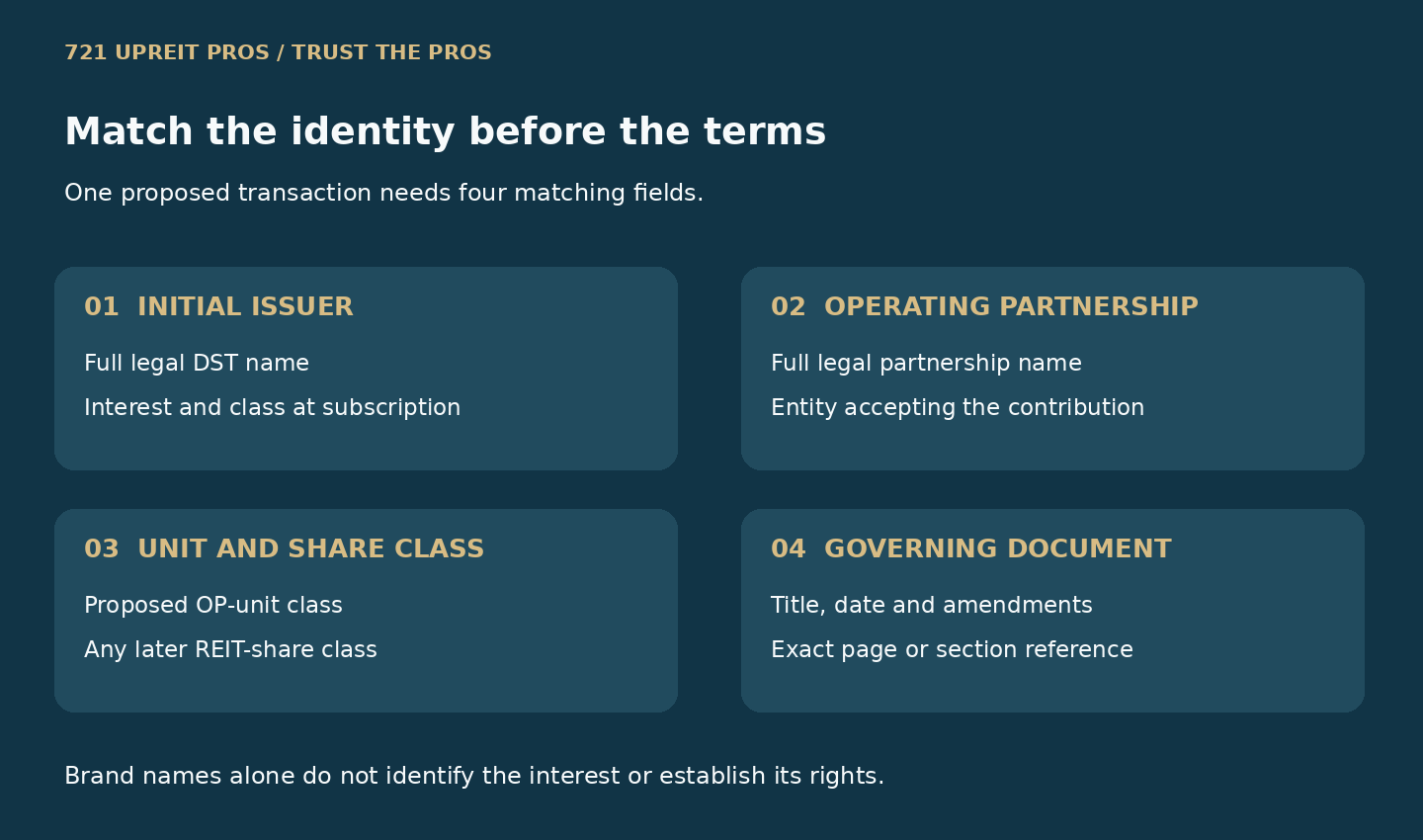
For a proposed DST-to-721 path, record the trust's full legal name, the operating partnership's full legal name and the REIT associated with that partnership. Then record the initial DST class, the proposed OP-unit class and any eventual REIT-share class. A document should identify each transition and the conditions controlling it. Do not fill a missing field from another investor's experience.
A Section 1031 exchange and a Section 721 contribution are distinct transactions. IRS like-kind exchange guidance describes the real-property requirements and excludes partnership interests and securities. Publication 541 explains the general partnership-contribution rule and exceptions. Neither provision means you can simply buy any REIT security as 1031 replacement property. Your CPA and qualified intermediary should evaluate the actual first step before a sale closes.
Use the 721 UPREIT guide and comparison planner for the broad strategy decision. This article addresses a narrower question: whether the evidence supporting three proposals is comparable. For another perspective on the ownership distinction, see DST Experts' explanation of DST and REIT interests.
What do current public sources establish about these sponsors?
The following source review was performed October 1, 2026. It gives starting points for document requests, not a list of investments available today. These sources have different dates and purposes. None is a complete, investor-specific three-way comparison of current offering terms.
| Sponsor | Verified public identity or description | Limit of the evidence | Document to request for your proposal |
|---|---|---|---|
| Hines | Hines' June 9, 2026 SEC-filed release identifies the Hines Real Estate Exchange platform, HREX 8 DST and Hines Global Income Trust, Inc. The release describes completion of the HREX 8 DST offering. | A completed offering is a historical example. The notice does not establish a currently available DST, your unit class, contribution terms or cash-access rights. | The exact proposed DST's current offering package, related option or contribution documents, named OP agreement and class schedule. |
| Brookfield | Brookfield's public 1031/721 page describes a potential DST-to-OP-unit path. A dated SEC-filed agreement identifies Brookfield REIT Operating Partnership L.P. and Brookfield Real Estate Income Trust Inc., with multiple unit classes including Class I and DST-related classes. | The agreement filed September 25, 2024 is a dated example, not confirmation of the controlling version or class for a proposal today. The public page says OP-unit conversion is subject to partnership discretion. | The current agreement and all amendments applicable to the named DST, proposed class, contribution and any successor entity. |
| Cantor | Cantor Fitzgerald Income Trust, Inc.'s April 16, 2026 registration amendment provides a public REIT document starting point. Its March 30, 2026 preferred-stock prospectus also identifies Cantor Fitzgerald Income Trust Operating Partnership, L.P. | The March prospectus concerns preferred stock, not a DST subscription or an investor's OP-unit contribution. Sharing a REIT name does not make different securities interchangeable. | The precise DST offering and OP-unit documents, together with the current REIT disclosure relevant to the proposed eventual share class. |
Sources: Hines June 9, 2026 release; Brookfield's 1031 and 721 overview; Brookfield OP agreement, Exhibit 10.2; Cantor April 16, 2026 registration amendment; and Cantor March 30, 2026 preferred-stock prospectus. Read later filings and actual governing documents before applying any term.
There is no verified uniform minimum, investor fee, distribution rate or withdrawal timetable in this comparison. Those fields remain open until the actual proposals and applicable schedules are supplied. Leaving them blank is more useful than importing a familiar number from a different class or an old brochure.
Build one document matrix for all three proposals
For each answer, record the document title, date, section or page, entity and class. Mark it verified, unresolved or not applicable. “Verified” means the source supports that specific field; it does not mean the investment is safe or appropriate.
| Decision area | Evidence to collect | Comparison question |
|---|---|---|
| Initial ownership | Offering memorandum, trust agreement, subscription and class election | What interest and property exposure do I buy at closing? |
| Conversion control | Purchase option, contribution agreement, consent provisions and applicable amendments | Who can initiate, require, refuse or delay the proposed transaction? |
| Value and units | Valuation policy, contribution formula, adjustment terms and class definitions | Which value, date and conversion formula determine my units? |
| Costs | Initial offering costs, advisor compensation, OP expense provisions and eventual share-class schedule | Which costs apply at each stage, to whom are they paid and on what base? |
| Cash access | OP redemption terms and the separate REIT repurchase policy | When may I request a transaction, who chooses settlement and what can restrict payment? |
| Portfolio and reporting | Property financials, debt terms, REIT reports, valuation disclosures and reporting arrangements | What exposure changes after contribution, and what records will I receive? |
Keep the initial DST costs separate from later OP and REIT costs
Before scoring two provider proposals, separate unavailable alternatives from eligible ones. A public share-class menu is not written confirmation of the OP-unit class you can receive. Ask the administrator to confirm the exact issuer, full class designation, proposed transaction and dated document that supports the assignment. Keep any conditional eligibility visibly unresolved.
Then compare class-specific charges with required account-level costs and the actual control and redemption provisions. A zero class servicing charge can coexist with a separate advisory fee; a cheaper stated layer does not settle the whole decision. The unit-class rights and combined-cost worksheet adds a matched comparison and a fictional value-equivalent conversion example without ranking classes or claiming current access.
Ask the advisor to show dollars as well as percentages and identify whether an amount is one-time, recurring or contingent on an event. Record the denominator: cash invested, asset value, NAV or another contractual base. A headline advisor commission cannot stand in for the total expense structure.
Class labels matter. The dated Brookfield agreement contains provisions for several classes and certain class conversions tied to fees. That is a reason to request the applicable class schedule, not to assume you receive Class I immediately. Likewise, a preferred-stock distribution description in Cantor's March prospectus is not a distribution quote for a DST investor or ordinary OP units.
Use the stage-by-stage fee ledger for calculations once the actual inputs are available. Keep distribution assumptions separate from fees, and ask what sources fund distributions. Expected distributions, total return and tax allocations are different measures.
Compare the right liquidity document for the right interest
During DST ownership, check the restrictions for that trust. After a contribution, read the OP-unit provisions. If a later transaction delivers REIT shares, read the applicable share-repurchase policy. A REIT's policy is not automatically the rule for the earlier DST interest or OP units.
Record at least four different dates: eligibility to submit a request, administrator receipt, a response or processing date, and actual settlement. Conditions and discretion can stand between them. Read the redemption-request checklist and separate holding-period clocks before treating a stated period as a promised cash date.
Worked example: three proposals, three different evidence gaps
Suppose an investor wants to transition out of a rental and receives three folders. The following example is fictional. The labels A, B and C do not represent Hines, Brookfield or Cantor, and no prices, returns or terms are attributed to those firms.
| Proposal | What the investor has | Unresolved question | Useful next action |
|---|---|---|---|
| A | A specific DST subscription and property summary, plus a conversion brochure | Which document establishes who controls conversion, and what happens if it does not occur? | Request the governing option/contribution terms and fallback provisions; match them to this trust. |
| B | A current OP agreement and detailed valuation policy, but no written class assignment | Which unit class and fees would apply to this investor? | Obtain the class election, applicable compensation and expense schedules, and eventual share-class mapping. |
| C | A recognizable REIT prospectus and a verbal statement about future liquidity | Does the document concern the same security and transaction being proposed? | Identify the initial issuer and interest; obtain its documents before applying any REIT-share term. |
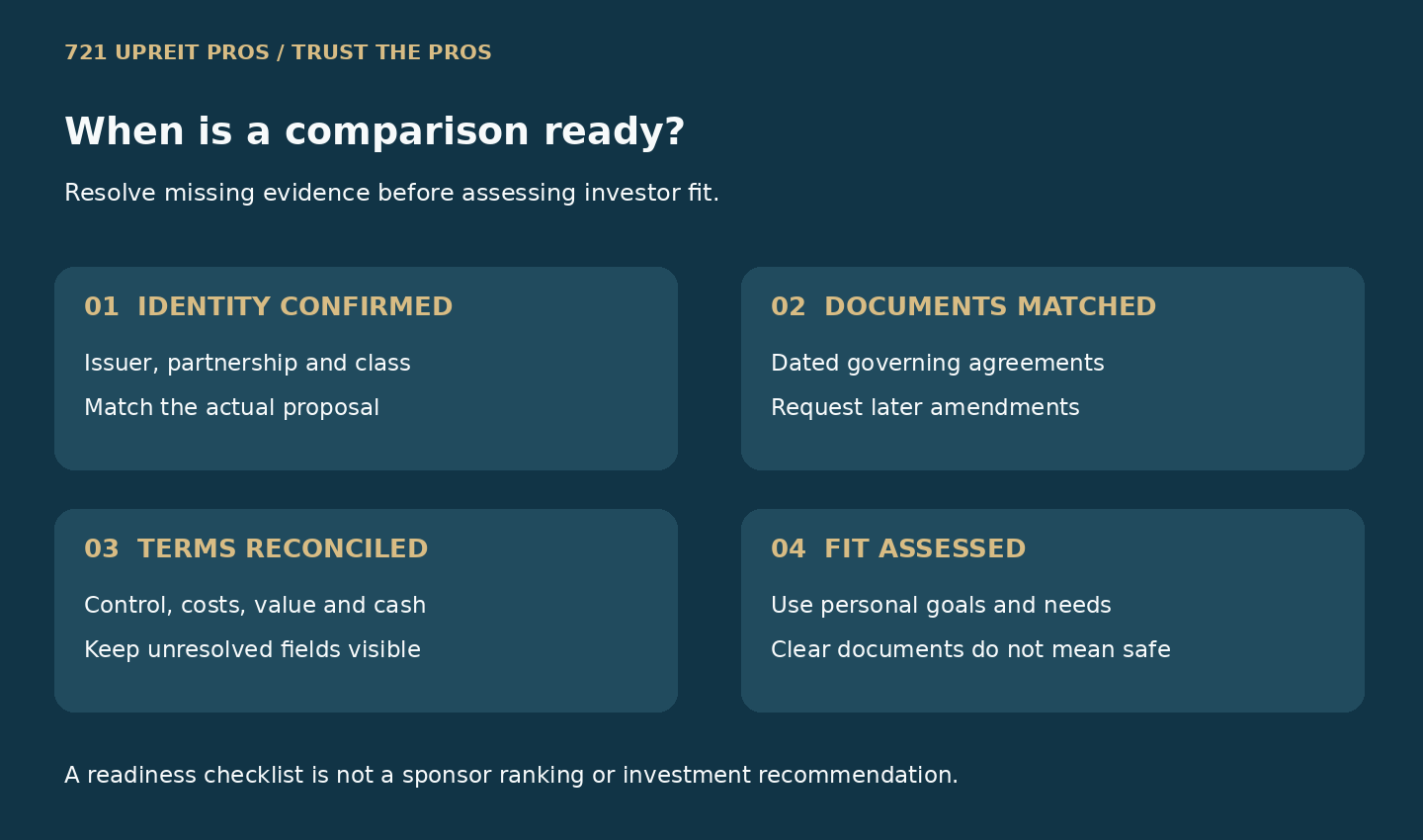
None of the three folders is decision-ready. A has an unanswered control question, B an unanswered class question, and C an unresolved security identity. Counting pages or choosing the most familiar name would not resolve those gaps. The practical comparison is a request log: one unanswered field, one document needed, one person responsible and one follow-up date.
After those gaps are resolved, the investor can compare the actual exposures against personal priorities. A lower cost may not address a near-term cash requirement. A broader portfolio may bring different leverage, valuation and allocation risks. A program can have clear documents and still fail the investor's needs. Review the 721 risk and due-diligence framework alongside the completed matrix.
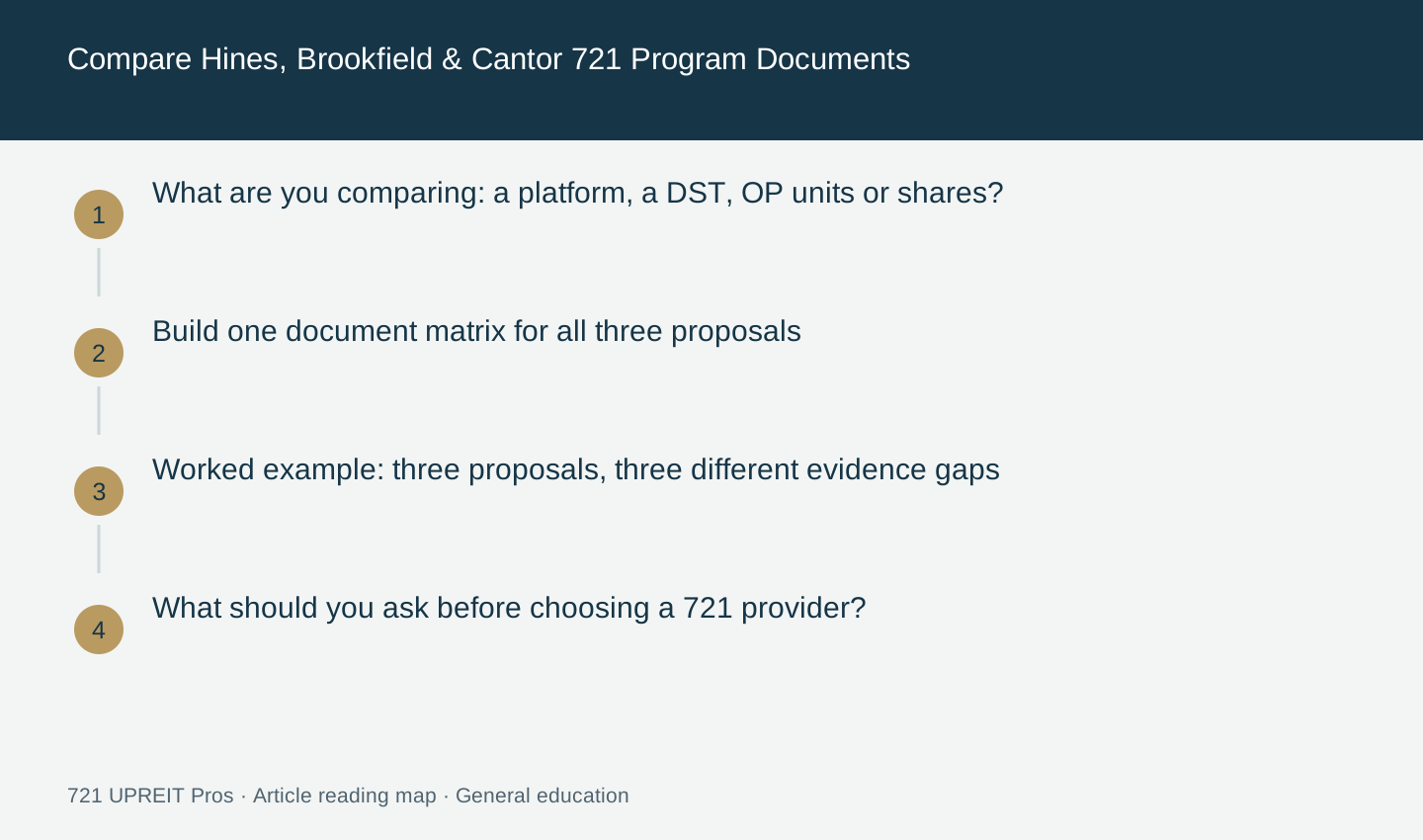
What should you ask before choosing a 721 provider?
- Name the investment. What exact legal entity and interest do I own first, and which class appears in my subscription?
- Identify the possible next step. Which partnership receives the property or DST interest, and what agreement establishes the proposed exchange?
- Locate decision rights. Who controls timing and participation? What choices, consent requirements or fallback outcomes apply?
- Reconcile the value. How do the property value, liabilities, costs and class-specific formula affect the issued units?
- Put costs on one basis. Show initial, ongoing and event-specific costs for the same investment amount and time assumptions.
- Trace access to cash. Distinguish a request right from a fulfilled redemption, and OP rights from share-repurchase policies.
- Keep the tax handoff separate. Who reviews your basis, debt, cash received and reporting before you commit?
- Confirm current access. Is this exact offering available to you through the relevant firm, in your state and at your proposed closing date?
The answer to “Which is best?” should explain fit using documented terms and your objectives. This guide does not designate a winning sponsor, recommend a particular security or verify current offering access. Conversion, liquidity, distributions, returns and tax results remain subject to the actual transaction and its risks.
After matching the program documents, use the offering-identity and payment-verification checklist to connect the professional, issuer, governing package and recipient. Use the advisor-hiring questions to agree on who will obtain and explain missing evidence.
Watch the document-comparison walkthrough
This original one-minute video explains the comparison sequence. It uses on-screen text, English captions and a complete transcript below; there is no narration.
Read video transcript
0:00 · Start with the exact investment
A sponsor brand may cover different trusts, partnerships and securities. Identify what you would own at the first closing.
0:12 · Match four identity fields
Record the issuer, operating partnership, unit class and governing document. Keep document dates and amendments together.
0:24 · Read public evidence in context
A completed DST offering is not a current availability notice. A REIT preferred-stock prospectus is not your DST subscription.
0:36 · Compare the same decision areas
Review conversion control, valuation, costs and access to cash. Request the specific documents for unresolved fields.
0:48 · Assess your own investor fit
Use the completed matrix with your advisor and tax professionals. Clear documents do not guarantee conversion, liquidity or tax results.
Download the program comparison worksheet
Save a separate dated copy for each proposal. Keep document versions, unresolved fields and your advisor's follow-up answers together. Revisit the matrix if the issuer, class, transaction structure or governing documents change.
BEFORE YOUR ADVISOR CONVERSATION
Three questions before you commit
This companion briefing covers the professional's identity, compensation and how restrictions fit your cash needs. Use it alongside this article's specific document checks.
Loading the video connects to YouTube. Watch on YouTube · 721 UPREIT Pros channel · Read the full advisor checklist.
Read video transcript
Before you hire a seven twenty-one UPREIT advisor, ask these three questions.
First: who exactly am I hiring? Get the professional's legal name, firm and registration information. Check the record through Investor dot gov and read the firm's relationship summary where applicable. Ask whether this conversation involves brokerage services, investment advice, or both. A marketing title alone does not answer that question.
Second: who gets paid, and how much? Request a written cost breakdown in dollars. Identify the payer, calculation base, payment timing and ongoing charges. Include product expenses and embedded compensation. No separate advisor invoice does not mean there are no costs.
Third: how does this fit my cash needs? Review the actual agreements. Ask who controls a possible conversion and what happens if it does not occur. Separate permission to request redemption from approval, pricing and payment. Do not assume a fixed cash-out date.
Then agree on responsibilities. Your investment professional, CPA, attorney and qualified intermediary can have different roles. Put continuing service and unresolved questions in writing.
Read the complete advisor checklist using the article link in the description. Seven twenty-one UPREIT Pros. Trust the Pros. Educational only. Investments involve risk and may be illiquid. Tax treatment depends on your circumstances.
Educational only. Investments involve risk and may be illiquid. Footage is illustrative; narration is synthetic.
TALK TO A 721 UPREIT ADVISOR
Ready to discuss your 721 options?
Request a callback to discuss the questions raised by this article, your timing and what to ask before you commit. Share your name, email and phone below to start the conversation.
No investment commitment or financial documents required. A callback request does not book an appointment or establish an advisory relationship.