
721 UPREIT PROS / FINANCING DECISION
721 UPREIT Refinancing Risk: Which Deadlines Matter?
Review 721 UPREIT refinancing risk by comparing loan maturities, interest-rate protection expirations and your own cash needs on separate timelines. A fixed rate does not remove repayment risk at maturity. Ask how each material obligation will be funded, what conditions apply to extensions and which assumptions remain unconfirmed before relying on distributions or liquidity.
By 721 UPREIT Pros · Published October 27, 2026 · Original three-clock worksheet
Key takeaways
- Compare loan maturity, rate-protection expiration and household cash dates separately.
- Treat conditional extensions and expected funding as assumptions until supported.
- Test interest costs and principal funding gaps as separate questions.
- Refinancing does not establish an investor redemption right or personal payment duty.
The investor decision is whether the financing plan remains compatible with the investment you are considering or already hold. A low current interest bill answers only part of that question. Start with the 721 UPREIT risk framework, then request the debt schedule for the exact operating partnership and reporting period. Keep property-level borrowing distinct from partnership or corporate facilities.
This review concerns investment funding and timing. The OP-unit liability and outside-basis worksheet addresses the separate tax-record question. A refinancing can require both reviews, but an economic funding gap and a change in allocated tax liabilities are different measurements. Neither should be inferred from a single leverage percentage or a reassuring summary.
TALK TO A 721 UPREIT ADVISOR
Talk to a 721 UPREIT advisor
Request a callback to discuss the questions raised by this article, your timing and what to ask before you commit. Share your name, email and phone below to start the conversation.
No investment commitment or financial documents required. A callback request does not book an appointment or establish an advisory relationship.

Why compare three clocks instead of one maturity date?
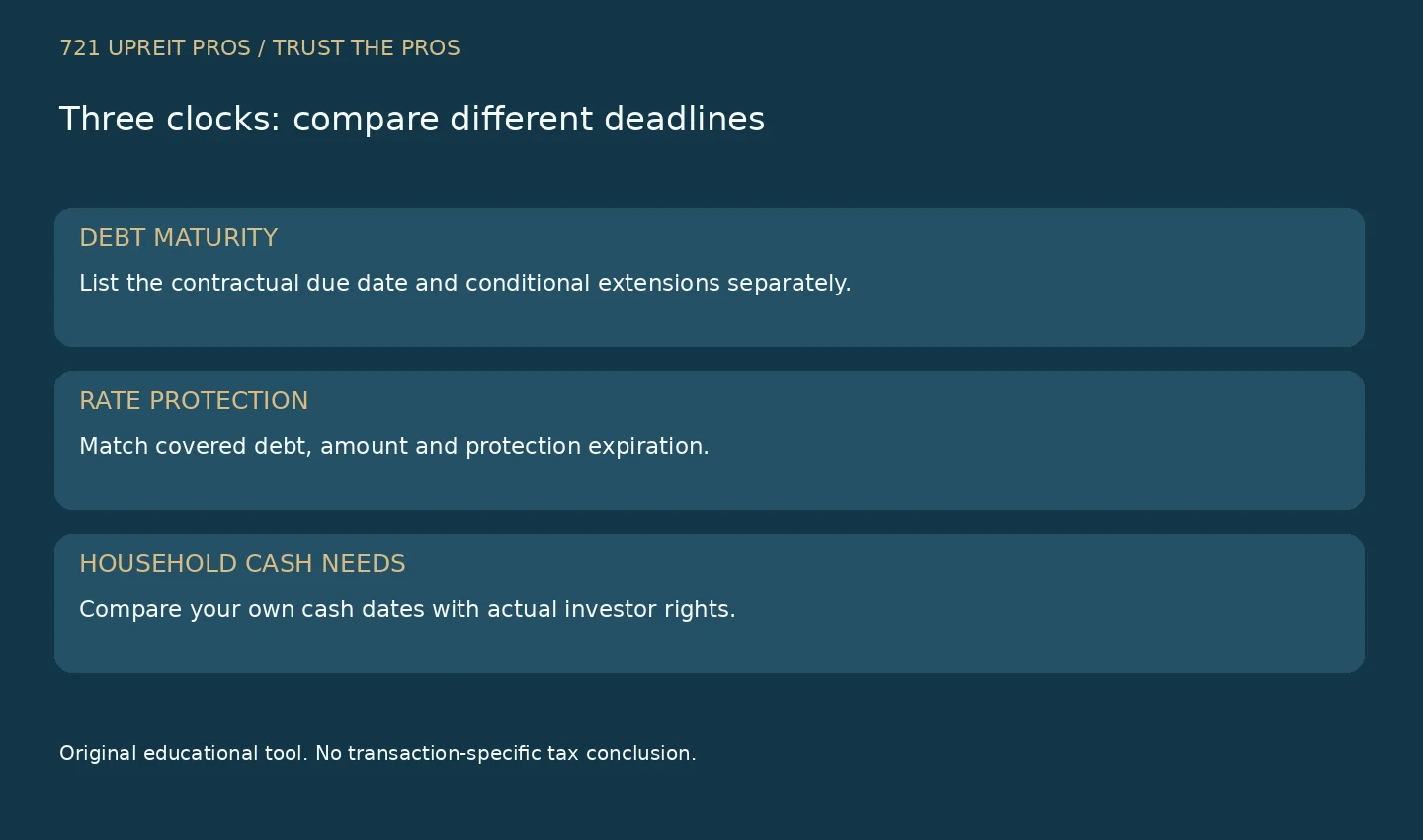
The first clock is the contractual debt timetable: maturity, scheduled principal payments and any extension conditions. The second is the protection timetable: when a cap, swap or other arrangement ends, and which borrowing it covers. The third is your household timetable: when you need spendable cash. Put all three on one page without treating them as interchangeable dates.
For example, a loan may remain outstanding after a protection agreement expires. An investor may need cash before either date. An available extension may require an election, payment or financial test. Record the actual condition and supporting document instead of silently replacing a contractual maturity with a hoped-for extended date. A planning assumption stays an assumption until the relevant evidence supports it.
What does primary disclosure establish?
Brookfield Real Estate Income Trust's 2025 Form 10-K explains that debt service reduces cash available for distributions, refinancing may be unavailable on acceptable terms and lender covenants can constrain operations. It also discusses variable-rate exposure and imperfect hedging. This dated disclosure illustrates categories to investigate, not the present condition of a candidate investment or the terms of your OP units.
The SEC's REIT investor education separately describes liquidity limitations of non-traded REITs. Do not turn a property refinancing into an assumed investor exit. Obtain the actual OP-unit agreement and applicable redemption terms. Public-company examples do not establish a contractual redemption right for an individual holder or promise that a request will be paid.
Which evidence belongs in a financing review?
| Decision input | Evidence to locate | Question to resolve |
|---|---|---|
| Debt becoming due | Dated borrowing and maturity schedule | Which legal borrower owes what amount, when? |
| Possible extension | Loan terms, notice dates and current status | What must happen before the extension is effective? |
| Rate protection | Covered balance, expiration and applicable terms | Which exposure remains uncovered or outlasts protection? |
| Replacement funding | Documented financing, asset-sale or other funding plan | What is committed, conditional or merely proposed? |
| Investor effect | Cash-flow assumptions and unit-holder agreements | What could change for income, value or cash access? |
Use a separate row for each material obligation. A portfolio total can conceal a near-term concentration. Ask the reporting contact to explain differences between gross debt, net debt and the denominator used in any ratio. Do not compare percentages with different definitions or assume an unrestricted cash balance is available to every borrower. Keep unanswered items visible rather than assigning a reassuring score.
How can stable operations still leave a refinancing gap?
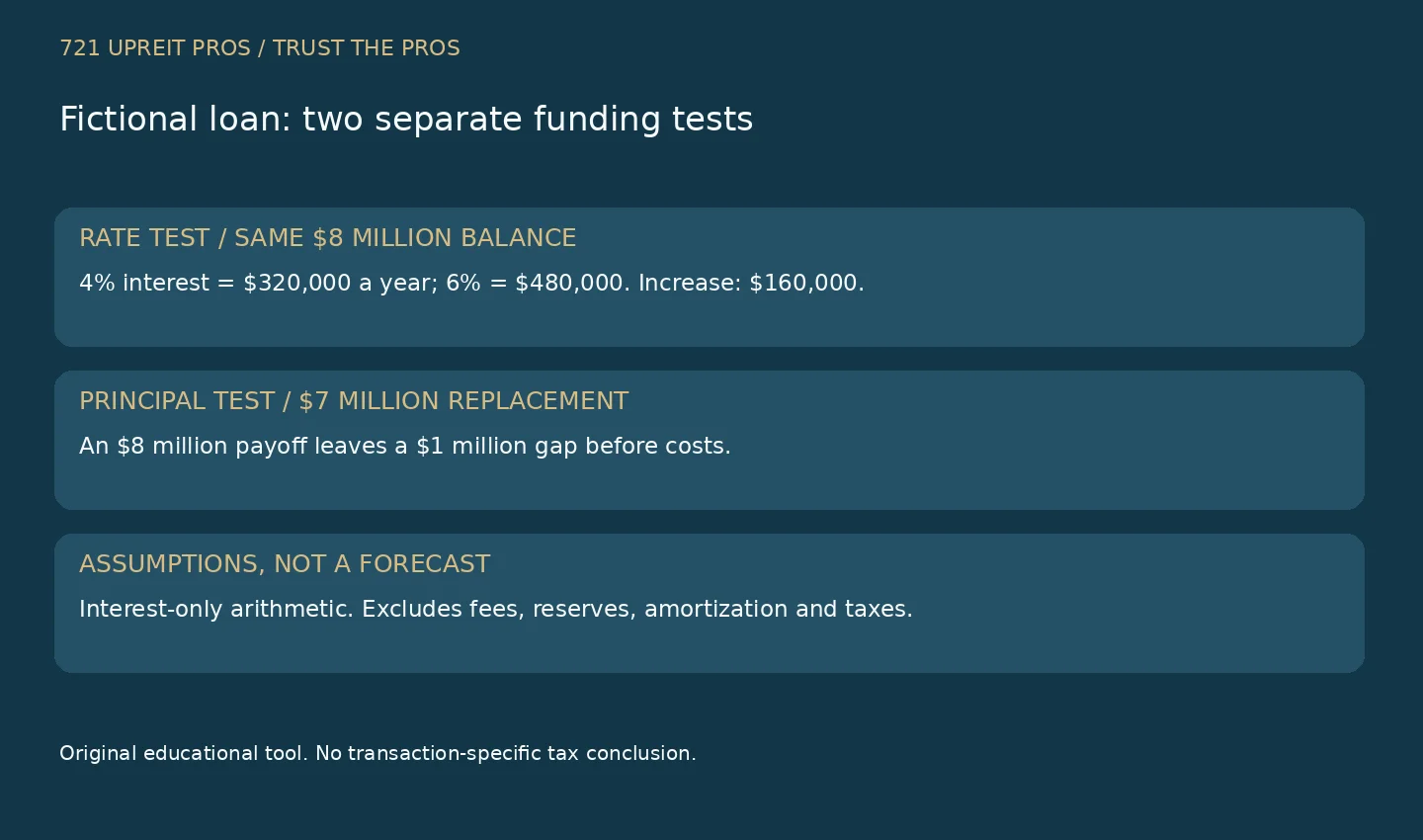
Consider a fictional property with an $8 million interest-only loan. At an assumed 4% rate, annual interest is $320,000. If replacement debt of the same amount cost an assumed 6%, annual interest would be $480,000, an increase of $160,000. This arithmetic holds principal constant and excludes amortization, fees, reserves, taxes, hedging and all other costs. These are chosen assumptions, not current lender quotes or a forecast.
Now change the available proceeds rather than only the rate. Suppose the fictional replacement lender offered $7 million while $8 million remained due. That creates a $1 million principal funding gap before costs. The project must identify a documented source or another resolution; a lower payment on a smaller loan does not make the missing principal disappear. Interest on $7 million at the assumed 6% would be $420,000 annually before other obligations.
Write these as two separate tests: ongoing debt-service capacity and cash required at closing. Ask the issuer how the proposed plan addresses each. Do not conclude that investors personally owe the gap. The capital-call obligation review explains how to distinguish investment funding risk from an actual payment duty. The example does not identify any actual partnership's funding needs or legal obligations.
What should you verify about an extension or hedge?
Ask for the original maturity and any proposed extended date in separate columns. List who must act, the notice deadline, required conditions and evidence of completion. If management says an extension is expected, label it expected. Ask when investors will receive an update if the assumption changes. Do not describe an unexercised or conditional option as completed financing.
For rate protection, record the covered loan or facility, amount, effective period and relevant limitations. Ask what happens if the debt balance changes, the protection expires or the borrowing is replaced. A statement that debt is hedged is a starting point for document review, not evidence that every interest cost is fixed for the entire investment. Have the appropriate professional explain provisions you cannot evaluate.
How does this affect a contribution or an existing holding?
Before contributing property, request the receiving partnership's financing picture, not only the loan on the property you are contributing. Review the canonical 721 UPREIT guide for the ownership framework and establish what information supports the proposed transaction. Planning should begin before a property sale closes when a Section 1031 exchange is being considered; a qualifying DST acquisition and a later Section 721 contribution are separate steps, not assured outcomes.
For an existing holding, compare the newest report with your prior review. Identify changed maturities, protection dates, funding assumptions and investor communications. If distributions change, use the distribution-reduction decision checklist. Keep household cash needs independent of an unconfirmed refinancing or redemption. Missing information calls for clarification; it does not establish either safety or distress.
For related trust-stage planning, the DST debt-replacement explanation addresses exchange funding rather than a partnership maturity ladder. DST Experts' investor-report worksheet helps organize dated operational updates. Neither substitutes for the receiving partnership's actual documents or your professional review.
What belongs on the next-step checklist?
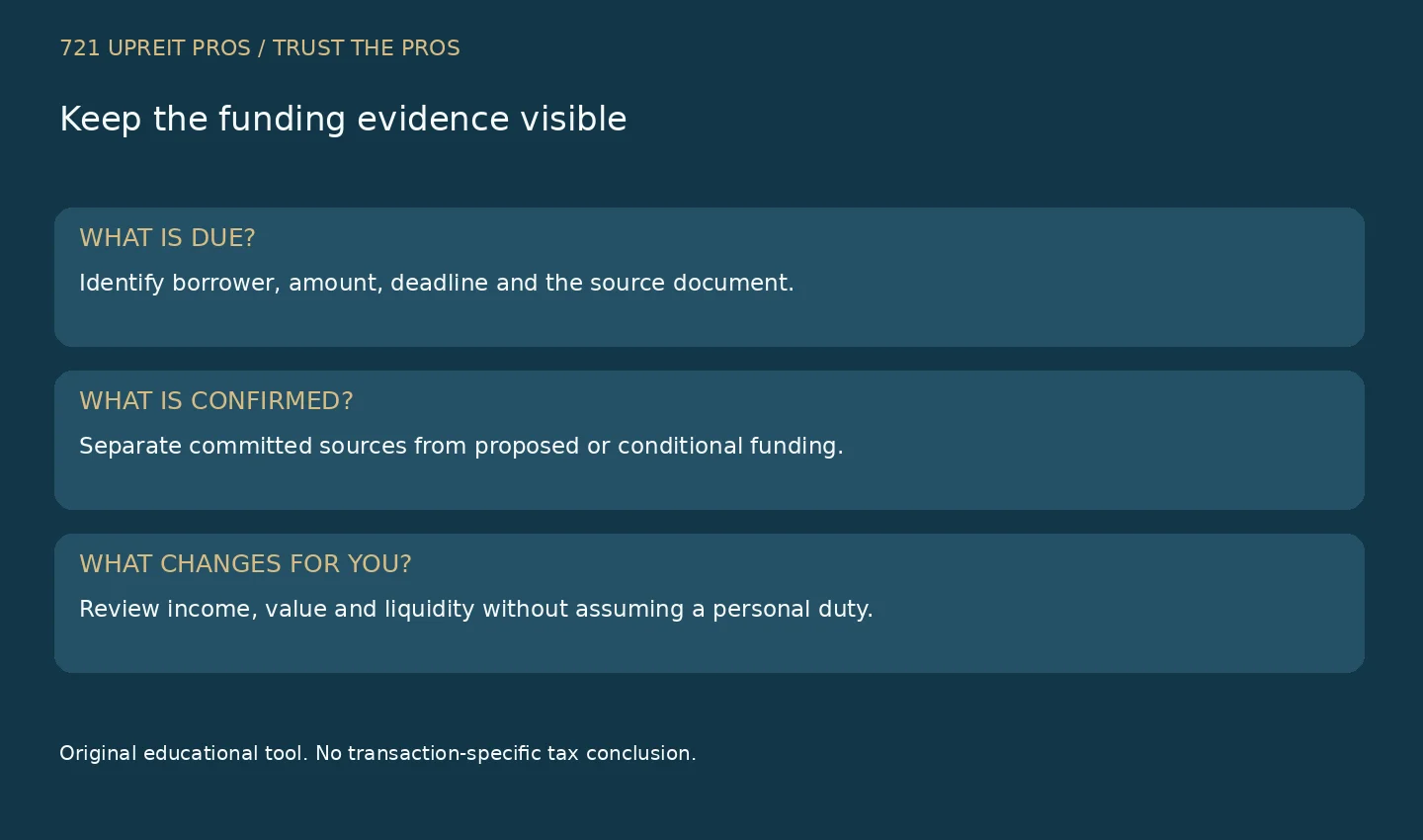
- Identify the borrower, issuer, reporting period and security held.
- Separate original maturity, conditional extensions and completed changes.
- Match protection coverage and expiration to the related debt.
- Test debt service and principal funding separately.
- Record committed sources, unresolved conditions and the next update date.
- Compare the investment timetable with your cash needs and actual rights.
Bring the unresolved rows when you discuss financing risk with a 721 UPREIT advisor or request a callback. A concise question is sufficient for an initial inquiry. Keep private loan agreements, account identifiers and financial statements out of public forms and use an independently verified secure process when documents are needed.
Watch the one-minute financing-timeline review
This original silent video includes English captions and the complete matching transcript below.
Read video transcript
0:00 · Compare three financing clocks
Loan maturity, hedge expiration and cash needs have different jobs.
0:12 · Read conditional extensions
Keep original dates and conditions separate from completed financing.
0:24 · Test rate and principal gaps
Higher interest costs and missing replacement proceeds differ.
0:36 · Ask for documented sources
Record committed funds, conditions and unresolved assumptions.
0:48 · Connect the investor decision
Review income, value and liquidity. No financing outcome is guaranteed.
Download the financing-timeline checklist
Primary evidence checked October 27, 2026. The 2025 filing is a dated illustration, not a current offering recommendation or confirmation of financing. Investments can lose value; distributions, redemption, financing and tax outcomes are not guaranteed.
Frequently asked questions
Does fixed-rate debt eliminate refinancing risk?
No. A fixed interest rate does not resolve how principal will be repaid at maturity. Review the repayment plan, conditions and the investment cash-flow assumptions.
Is an extension option completed financing?
Not automatically. Locate the conditions, required actions and evidence that the extension is effective. Keep the original maturity visible until the status is confirmed.
What if a hedge expires before the loan?
Ask which balance remains exposed, when protection ends and what replacement assumptions apply. Do not infer full protection from a general hedged-debt label.
Why test replacement proceeds separately from interest?
A replacement loan may provide less cash than the existing payoff. That principal gap requires its own funding explanation, even if annual payments appear manageable.
Does a funding gap mean I must contribute cash?
No personal obligation follows from the gap alone. Review the applicable partnership agreement, exceptions and separate signed obligations with the appropriate professional.
Will refinancing make my OP units liquid?
Do not assume it will. Financing decisions and investor redemption terms are separate. Verify actual eligibility, restrictions and payment terms before relying on cash access.
TALK TO A 721 UPREIT ADVISOR
Ready to discuss your 721 options?
Request a callback to discuss the questions raised by this article, your timing and what to ask before you commit. Share your name, email and phone below to start the conversation.
No investment commitment or financial documents required. A callback request does not book an appointment or establish an advisory relationship.