
721 UPREIT PROS / CONTRIBUTION TAX REVIEW
721 UPREIT Rules: The Investment-Company Exception
Section 721 usually allows property contributions to a partnership without immediate gain recognition, but Section 721(b) creates an investment-company exception. Before a 721 UPREIT contribution, ask your tax counsel to review the receiving partnership, its assets and the planned transaction. A real estate label or diversification pitch does not settle that analysis.
By 721 UPREIT Pros · Published October 24, 2026 · Original document matrix and hypothetical review exercise
Key takeaways
- Section 721(b) requires a separate exception review for the actual contribution.
- Identify the receiving partnership, its holdings and the planned transaction steps.
- Economic diversification and the legal tax test answer different questions.
- Keep the professional analysis and its factual assumptions current through closing.
The investor decision is whether the proposed contribution has enough documented tax analysis to proceed. You do not need to turn yourself into a partnership tax lawyer. You do need to know which entity receives your property, what evidence supports the proposed treatment, and which assumptions must remain true through closing.
This question comes after identifying a real proposal. Start with the 721 UPREIT investor guide for the broad framework and the DST contribution eligibility checklist for acceptance questions. This article focuses on one exception, rather than replacing the full contribution, liability, basis and suitability review.
TALK TO A 721 UPREIT ADVISOR
Talk to a 721 UPREIT advisor
Request a callback to discuss the questions raised by this article, your timing and what to ask before you commit. Share your name, email and phone below to start the conversation.
No investment commitment or financial documents required. A callback request does not book an appointment or establish an advisory relationship.

What does Section 721(b) change?
Section 721(a) states the general nonrecognition rule for property exchanged for a partnership interest. Subsection (b) withdraws that protection for gain on a transfer to a partnership that would be an investment company, within the meaning of Section 351, if incorporated. The exception can matter at contribution, before any later redemption or sale.
Read the cross-reference as a request for a separate analysis. The word UPREIT describes a structure; it does not supply a transaction-specific tax conclusion. Likewise, an offering's disclosure that a risk exists does not tell your preparer whether the risk has been addressed for your proposed contribution. Ask for the conclusion, its factual assumptions and the documents supporting those assumptions.
Which entity and assets need to be reviewed?
Identify the receiving operating partnership by its exact legal name. Distinguish it from the REIT above it, a sponsor parent, a selling broker and any intermediary entity. Request a dated ownership chart and asset information tied to the contemplated transaction. The tax analysis should address the relevant entity and holdings rather than treating a brand's website as its balance sheet.
IRS Publication 541, revised December 2025, describes the investment-company contribution rule and an asset-value test generally involving more than 80% in specified investment assets. It says the determination ordinarily looks immediately after the contribution. This is an orientation for asking questions, not a complete worksheet for classifying a particular partnership.
Section 351(e)(1) includes money and numerous financial interests in its asset rules, including REIT interests and specified convertible or exchangeable interests. Counsel should reconcile the current statute with the regulations and applicable entity rules. Do not simply exclude cash because an older regulatory passage does so, or classify every interest using the everyday meaning of real estate.
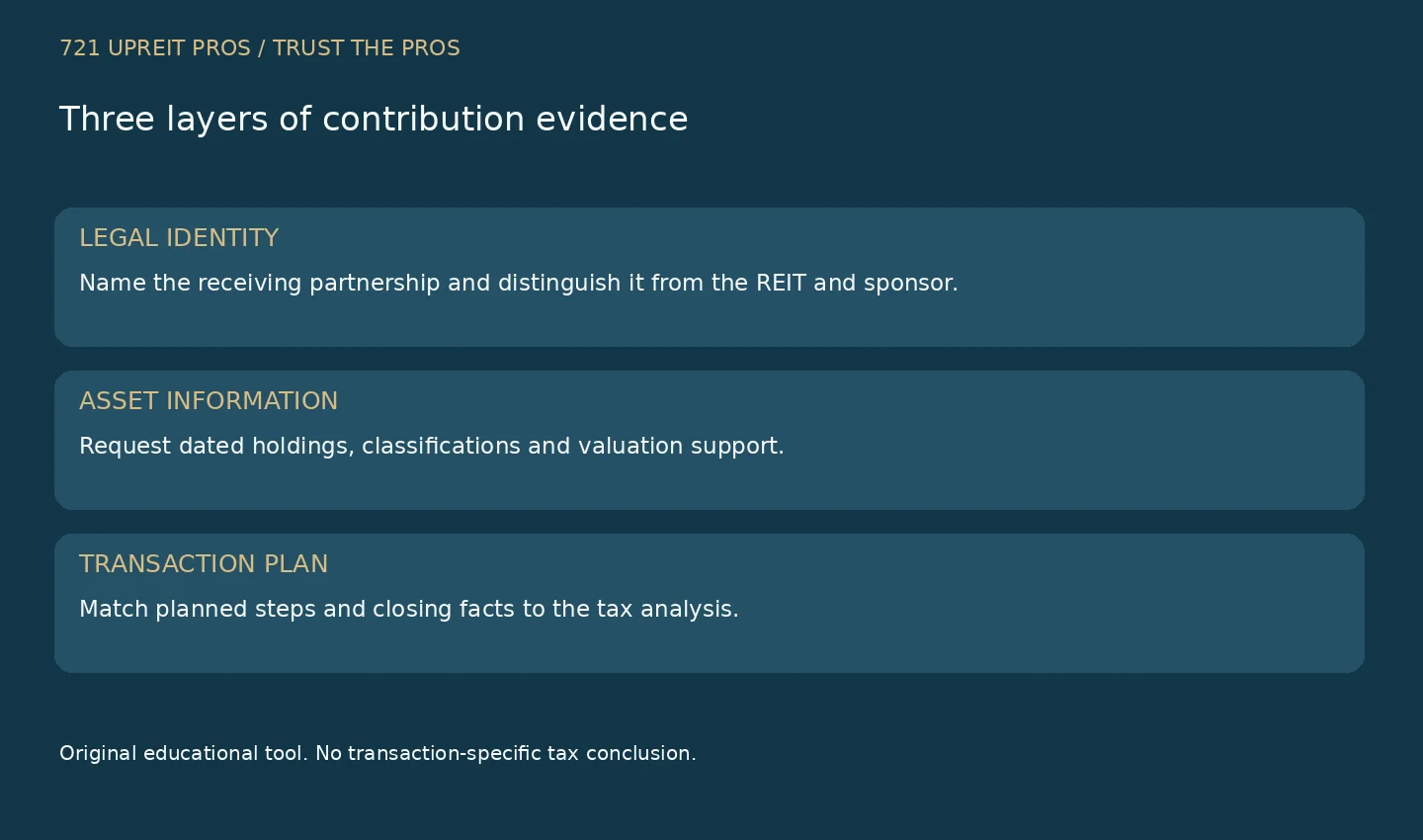
Is investment diversification the same as the tax test?
No. Spreading economic exposure across properties is an investment objective. The tax regulations use diversification in a specific legal framework. Treasury Regulation 1.351-1(c) addresses both investment-company status and diversification, including transfers of nonidentical assets, specified portfolio rules and planned later steps. A marketing statement about diversification cannot substitute for that legal analysis.
Ask two separate questions: how would the investment change your economic exposure, and why does counsel conclude that the contribution receives the intended tax treatment? A useful investment answer can coexist with an unresolved tax question. Conversely, a documented tax conclusion does not establish that the investment is suitable, fairly priced or liquid. Keep both answers visible in your decision file.
What evidence should you request before signing?
| Decision question | Evidence to request | Unresolved condition |
|---|---|---|
| Who receives the property? | Legal entity chart and contribution agreement | Analysis names a different entity |
| What holdings are included? | Dated asset schedule, classifications and valuation support | Only a property marketing list is supplied |
| Which transaction steps matter? | Closing sequence and planned related steps | Material steps are absent from counsel's assumptions |
| What supports the conclusion? | Transaction-specific tax analysis with scope and limitations | A general disclaimer is presented as a conclusion |
| What could change before closing? | Update process for assets, parties and consideration | No one owns the final factual confirmation |
| How will the investor act? | CPA/attorney review and written list of open questions | Execution deadline arrives before review is complete |
The matrix is an organizing tool, not a legal opinion or safe harbor. Keep confidential schedules in the professionals' secure document system. A public callback form is appropriate for a short description of the planning question, rather than account statements, tax returns or ownership documents. Ask the receiving team how the necessary information will be provided securely.
How would an incomplete file change the decision?
Consider a fictional owner offered OP units for an apartment property. Packet A contains a property brochure and a general sentence that Section 721 usually provides deferral. Packet B adds the receiving partnership's legal chart, a dated asset schedule, the proposed closing sequence and a tax memorandum addressing the identified contributor and transaction. Neither packet establishes an investment recommendation by itself.
In Packet A, the owner cannot trace the general statement to the actual entity or closing facts. The next step is to request missing evidence. In Packet B, the owner can ask a CPA and attorney to examine the memorandum's assumptions, limitations and unresolved items. If an asset acquisition or related contribution changes before closing, the owner asks whether the analysis needs updating rather than relying on the old packet.
Label each row as received, under professional review, unresolved or confirmed for the stated facts. Record the reviewer and date without inventing approval. This exercise deliberately assigns no asset percentage, tax rate or expected savings. Those figures require actual valuations, classifications and investor records. Its original value is the decision trail: what is known, what is assumed and what still prevents a supported decision.
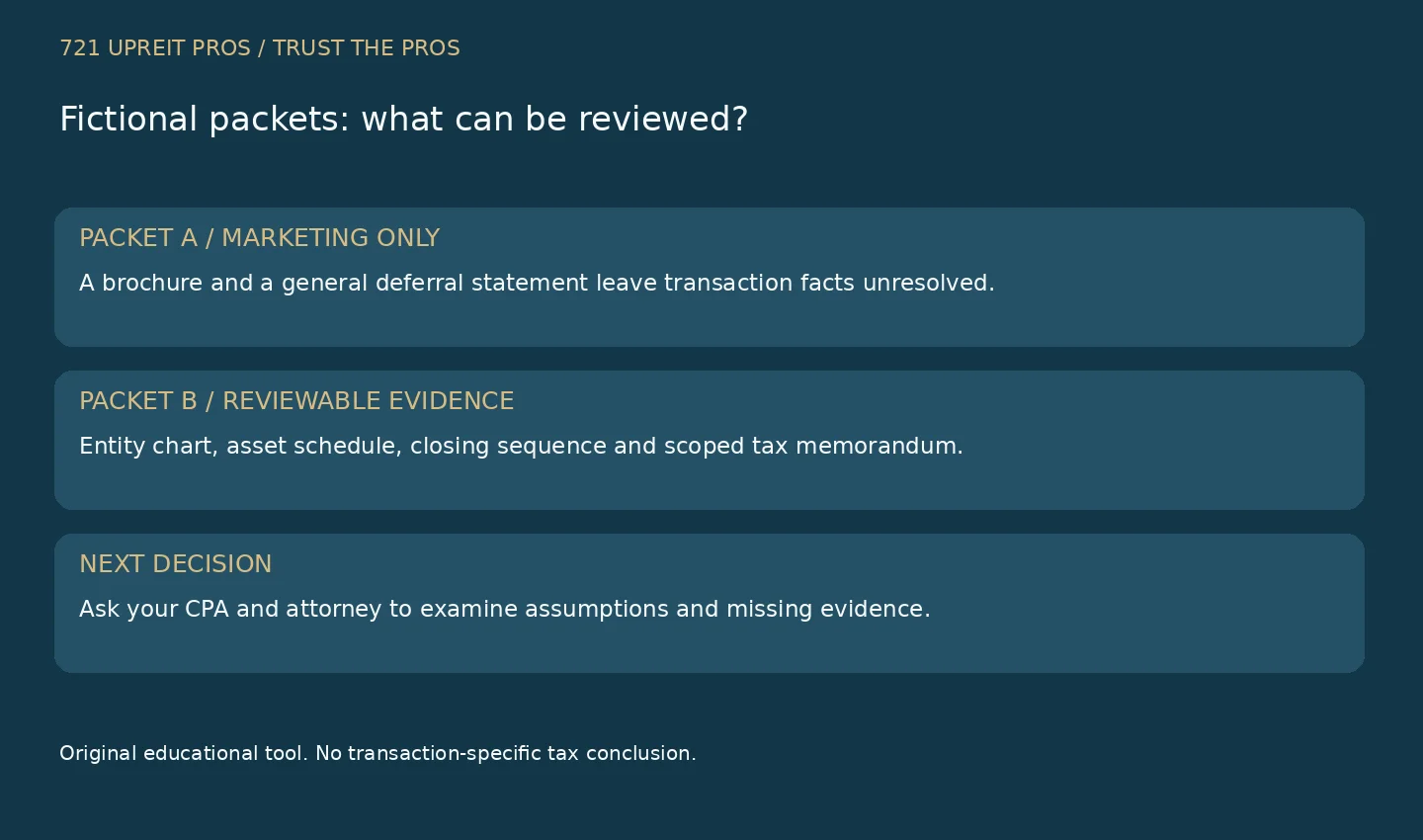
How does this fit a DST or property-sale plan?
A Section 1031 replacement-property review, a DST investment decision and a later Section 721 contribution remain separate stages. The related DST versus 721 property-sale comparison helps frame those stages. For a broader tax timeline, see DST Experts' contribution, basis and exit tax guide. Neither resource determines your Section 721(b) result.
For a prospective seller, raise the proposed path before closing the property sale so the appropriate professionals can coordinate their work. For an investor already holding a DST interest, ask who controls any later contribution and what review occurs when a real proposal becomes available. A future pathway in a presentation is not the same as a completed, eligible transaction.
What should stay on your pre-closing checklist?
- Name the receiving partnership and identify the property or interest being contributed.
- Request the current transaction-specific Section 721(b) analysis and its assumptions.
- Reconcile the entity chart, asset schedule and planned transaction steps with that analysis.
- Have your own CPA and attorney review the scope and unresolved questions.
- Assign responsibility for updating material facts before signing and closing.
- Keep debt, cash consideration, basis, fees and liquidity reviews open separately.
The 721 UPREIT risk framework owns the broader due-diligence decision. The pre-closing change-control checklist helps document updates. Passing one exception review does not resolve every tax rule or guarantee returns, distributions, conversion or access to cash.
Bring a concise list of missing facts when you talk to a 721 UPREIT advisor. Use the callback pathway to discuss who should coordinate the investment-side documents and the separate tax and legal review.
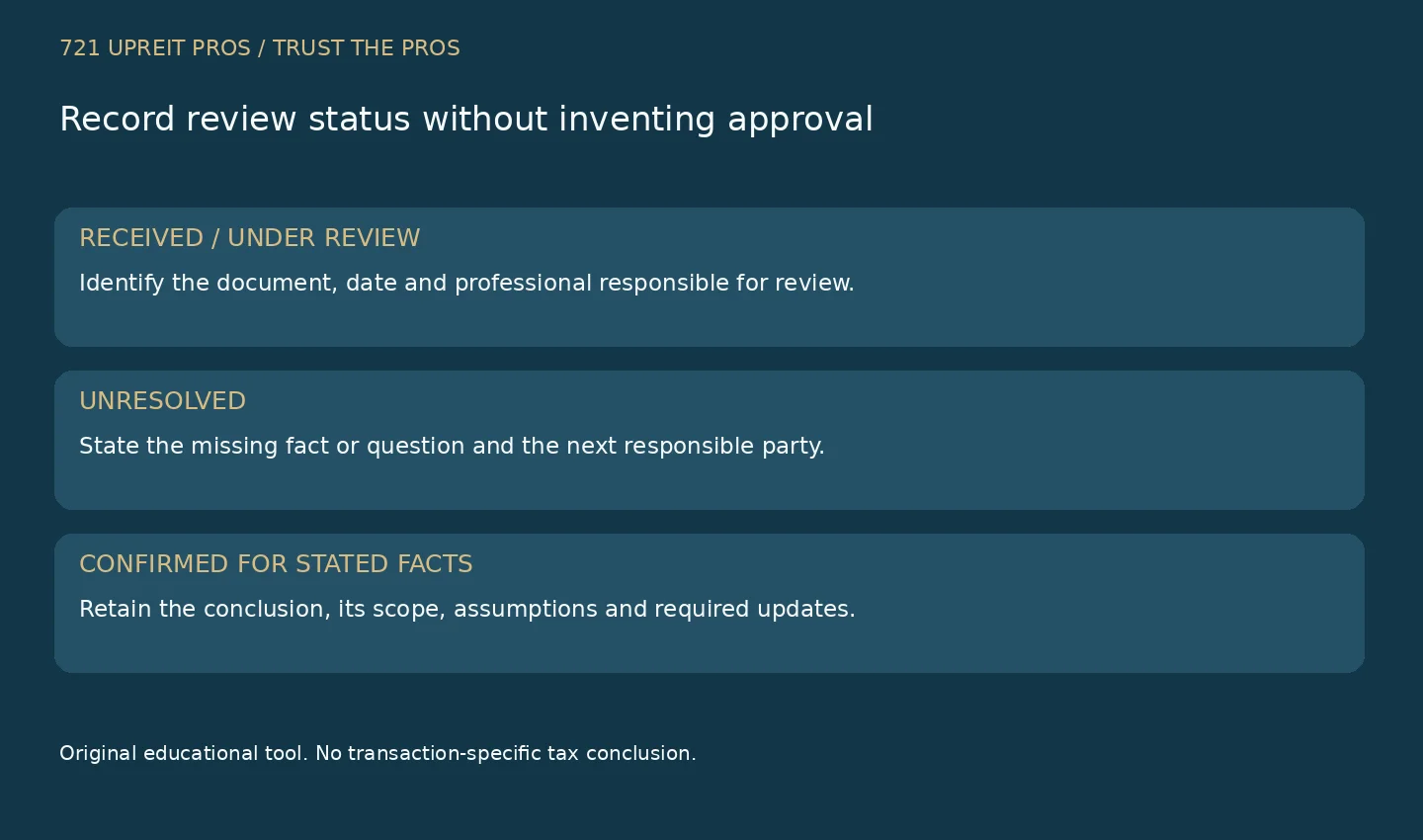
Watch the one-minute exception-review checklist
This original silent video has English captions and the complete matching transcript below.
Read video transcript
0:00 · Review Section 721(b)
A property label does not settle the investment-company exception.
0:12 · Name the receiving entity
Separate the operating partnership from the REIT and sponsor.
0:24 · Gather the actual evidence
Request asset information, planned steps and scoped tax analysis.
0:36 · Compare complete packets
A brochure is not a transaction- specific professional conclusion.
0:48 · Keep assumptions current
Have your CPA and attorney review changes before signing and closing.
Download the contribution-review checklist
Primary law, Treasury regulations and IRS Publication 541 checked October 24, 2026. Educational information, not individualized tax, legal or investment advice. No expert review of a specific transaction is claimed.
Frequently asked questions
Does every 721 UPREIT contribution trigger Section 721(b)?
No universal conclusion follows from the UPREIT label. The actual receiving entity, assets and transaction must be evaluated under the governing rules. Request transaction-specific professional analysis.
Does owning many properties establish investment-company status?
A property count or diversification pitch does not decide the legal classification. Ask counsel to identify the relevant holdings, valuation information and rules used in the analysis.
Should cash be left out of the asset review?
Do not make that assumption. Current Section 351(e)(1) expressly includes money in its asset rules. Have counsel reconcile statutory provisions with the applicable regulations.
Is the REIT the same as the receiving operating partnership?
They are distinct entities in an UPREIT structure. Identify the exact contributor, recipient and interest received, and make sure the tax analysis addresses the actual transaction.
Is a general tax-risk disclosure enough?
A disclosure alerts readers to possible risks but does not itself resolve them for a proposed contribution. Request the analysis, supporting facts, scope, limitations and update procedure.
Does resolving this exception guarantee deferral or liquidity?
No. Other contribution and partnership rules remain relevant, and liquidity depends on the governing investment documents. Keep cash, debt, basis, restrictions and later exits in the separate review.
TALK TO A 721 UPREIT ADVISOR
Ready to discuss your 721 options?
Request a callback to discuss the questions raised by this article, your timing and what to ask before you commit. Share your name, email and phone below to start the conversation.
No investment commitment or financial documents required. A callback request does not book an appointment or establish an advisory relationship.