
721 UPREIT PROS / CHOOSING YOUR ADVISOR
Hire a 721 UPREIT advisor: what to check before you commit
To hire a 721 UPREIT advisor, verify the professional and firm, clarify whether the service is brokerage or investment advice, and request a written comparison of costs, available programs, liquidity and alternatives. Agree on who handles each stage before signing an engagement or investment document.
By 721 UPREIT Pros · September 30, 2026 · Updated October 23, 2026 · Original advisor comparison worksheet
Key takeaways
- Define the actual job: sale planning, investment comparison or an existing contribution decision.
- Verify the individual and firm, then compare written services, compensation and conflicts.
- Coordinate the broker, qualified intermediary, CPA and attorney before a contemplated exchange closes.
- Connect property proceeds and investment restrictions to household reserves and retirement needs.
A productive first conversation should help you decide whether a 721 strategy deserves further review. It should also reveal what the advisor will do, how the advisor is paid and what remains the responsibility of your CPA, attorney or qualified intermediary. You do not need to arrive with a preferred sponsor.
Before listing a property, clarify the broker’s sale responsibilities and the tax, legal and investment questions that must be resolved before closing. If a deferred exchange is contemplated, arrange qualified-intermediary coordination before proceeds are received. This independent educational guide helps compare professional roles; it does not rank advisors or provide a brokerage referral network.
TALK TO A 721 UPREIT ADVISOR
Talk to a 721 UPREIT advisor
Request a callback to discuss the questions raised by this article, your timing and what to ask before you commit. Share your name, email and phone below to start the conversation.
No investment commitment or financial documents required. A callback request does not book an appointment or establish an advisory relationship.

What should a 721 UPREIT advisor help you do?
Start by describing the decision you need help with: selling a rental, evaluating a direct property contribution, choosing a DST that may later convert, or reviewing an existing conversion proposal. These require different work. Ask for a written scope naming the services actually included.
If you already own OP units, ask whether the prospective firm can hold, service or monitor that exact interest, including assets registered directly with the issuer. Record the billing base, information access, notice responsibilities and any excluded services. Changing a professional does not itself transfer the holding or complete an open investor request. Use the 721 UPREIT advisor service-handoff checklist to document acceptance and continuity before signing transfer instructions.
The phrase “721 exchange advisor” describes a focus area; it is not sufficient evidence of registration, competence or a particular legal capacity. An operating partnership, a REIT sponsor, a brokerage firm and an investment adviser have different roles. The person discussing the investment may act through more than one firm or in different capacities. Ask which capacity applies to this recommendation and which agreement documents it. The SEC's Regulation Best Interest guide explains why that capacity matters for a dually registered professional.
| Participant | Work to clarify | Question to ask |
|---|---|---|
| Financial professional | Investment comparison, recommendation, compensation and agreed follow-up | What will you deliver before and after the investment? |
| CPA or tax attorney | Personal tax analysis, basis, liabilities and reporting | Who will evaluate the tax consequences using my records? |
| Qualified intermediary, if using a 1031 exchange | Exchange documentation and coordination within the agreed role | Who confirms the exchange structure and deadlines before closing? |
| Transaction attorney | Legal rights, ownership authority and agreement review | Who explains provisions I cannot change or do not understand? |
| Sponsor or operating partnership | Actual offering, acceptance, contribution and investor reporting terms | Which entity issues the interest and controls the relevant decision? |
A Section 721 contribution generally exchanges property for a partnership interest, subject to exceptions and the actual transaction. It is different from a Section 1031 exchange of qualifying real property. Buying REIT shares is not the same transaction. Use the 721 UPREIT guide and transaction sequence to identify your starting point. The IRS explains contributions in Publication 541 and the real-property scope of exchanges in its like-kind exchange guidance.
How do you verify an advisor before hiring?
Ask for the individual's full legal name, firm name and registration identifier. Use the Investor.gov search tool to reach registration information and the firm's relationship summary. Read the relevant BrokerCheck or Investment Adviser Public Disclosure record, check the current firm and review disclosures. Confirm contact details independently before sending documents or funds. Registration does not guarantee an investment's quality or result.
Read Form CRS where applicable, the relevant advisory brochure and the proposed account or engagement agreement. Compare services, compensation, conflicts and disciplinary disclosures. Ask the professional to explain discrepancies. A marketing title, training badge or a confident explanation of tax deferral is not a substitute for this review. Investor.gov's guide to working with investment professionals recommends comparing services and prices and checking professional registration.
Does “advisor near me” mean the advisor can serve me?
When looking for a 721 exchange advisor in California or near your home, verify whether the individual and firm can provide the proposed service in your jurisdiction. Ask about remote meetings, document security and coordination with your existing professionals. Proximity alone does not establish eligibility, a product's availability or experience with your transaction. A virtual meeting can be convenient, but it does not remove those checks.
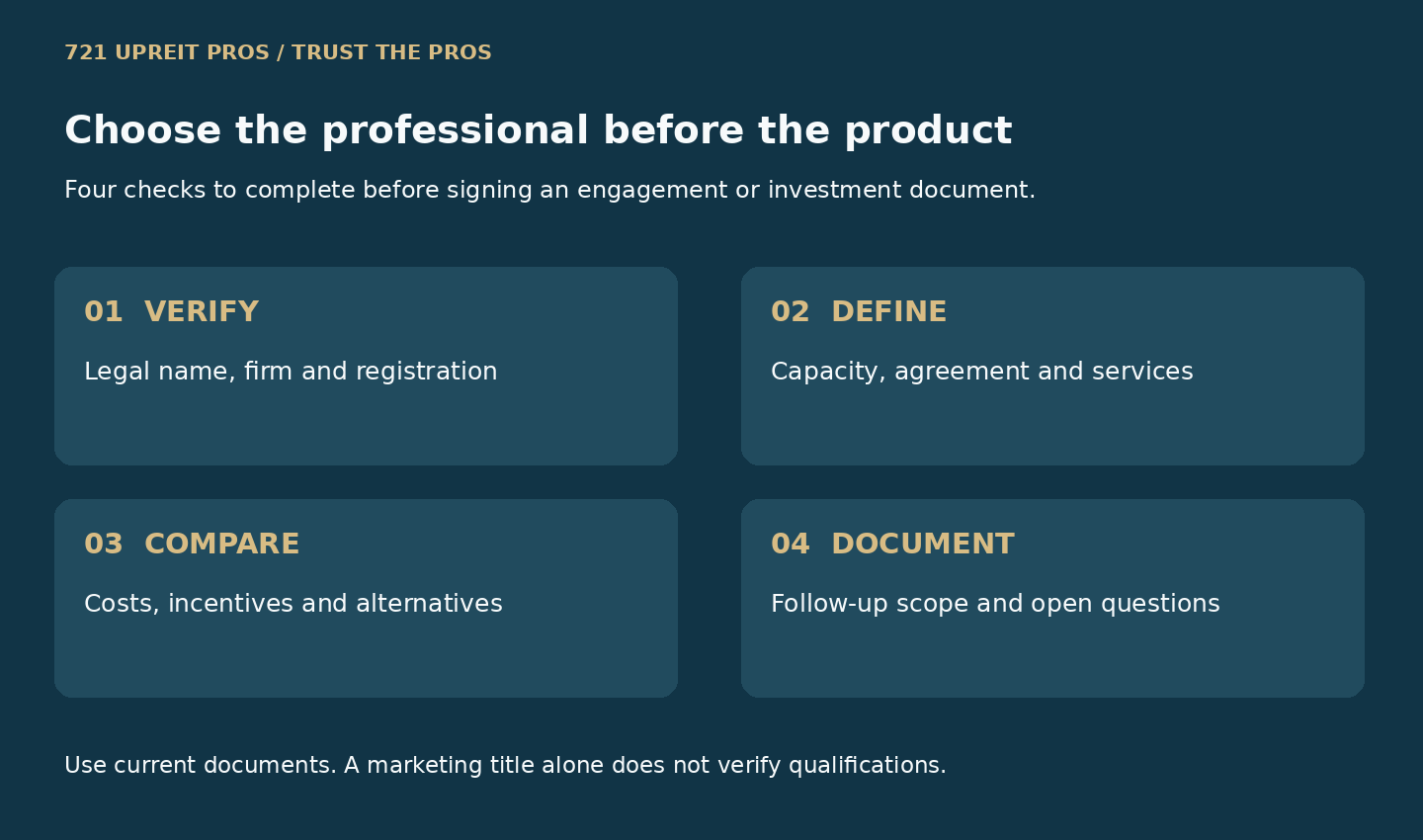
Twelve questions to ask a 721 UPREIT advisor
- In what capacity are you working with me? Identify the firm, account type and standard of conduct that apply. Ask whether the capacity changes between planning and the transaction.
- What comparable work have you actually done? Ask about experience with your pathway and the difficult issues it raised. Request an explanation of the process without asking for another client's confidential information.
- Which alternatives will you evaluate? A useful comparison can include continued ownership, a taxable sale, a qualifying 1031 replacement and a direct contribution where feasible. Ask why an alternative was excluded.
- Which programs can your firm actually offer or evaluate? Ask whether the menu is restricted and whether the advisor receives different compensation across it. Access to several sponsors is not proof of access to every suitable option.
- Who gets paid, by whom and when? Obtain advisor, distribution, sponsor and transaction charges, their calculation bases and any ongoing fees. Identify embedded compensation as well as direct invoices.
- What would make this unsuitable for my needs? Ask the advisor to describe a cash need, time horizon or concentration concern that would change the recommendation.
- Who controls a possible DST conversion? Ask for the agreement section covering exercise rights, investor elections and the outcome if the contribution does not occur.
- How would I get money out? Separate eligibility to submit a request from acceptance, pricing and payment. Ask about suspension rights and settlement in shares rather than cash.
- Who checks valuation and issued units? Request the contribution-value calculation, deductions, unit class, pricing date and supporting documents.
- Who handles my tax and legal questions? Identify the professionals who will analyze liabilities, basis, built-in gain, future exchanges and possible taxable events.
- What service continues afterward? Put reporting assistance, review meetings, changes in distributions and redemption support into the scope. Do not assume that a transaction payment includes indefinite monitoring.
- What will I receive before making a decision? Request a dated written comparison, source documents, compensation explanation and list of unresolved questions. Leave unknowns visible.
For the underlying investment, use our risk and due-diligence framework, conversion decision-rights guide and redemption checklist. The advisor worksheet organizes the hiring decision; it does not replace investment review.
How much does a 721 UPREIT advisor cost?
There is no single price established by the label “721 UPREIT advisor.” Ask for a transaction-specific written quote. A proposal can involve a commission, a separately billed planning fee, an asset-based advisory fee or other disclosed arrangements. The absence of a separate advisor invoice does not establish that no compensation is paid. Product expenses can remain even when an advisor's stated fee is zero.
The SEC's Form CRS bulletin explains the relationship summary's role in describing services, fees and conflicts. Use those disclosures alongside the offering and engagement documents. Ask how the professional's compensation differs if you choose another investment, retain the property or do not proceed.
A hypothetical comparison on the same dollar base
Suppose two fictional proposals each use a $1 million starting amount. Proposal A lists a 4% one-time charge and no separate annual advisor fee. Proposal B lists a 1% one-time charge and a 0.60% annual advisor fee on an assumed constant $1 million base for five years.
| Assumed charge | Proposal A | Proposal B |
|---|---|---|
| One-time charge | $40,000 | $10,000 |
| Annual advisor charge | $0 separately stated | $6,000 per year |
| Five-year annual charges | $0 separately stated | $30,000 |
| Total of these assumed charges | $40,000 | $40,000 |
The same arithmetic total does not make the proposals equivalent. Payment timing, service scope, the actual fee base, embedded expenses and investment terms may differ. This simple example excludes compounding, changing values, taxes and every other product cost. It illustrates why comparing only the first percentage can be misleading. Do not add a sales commission again if it is already included in another quoted total. Use the full-life fee ledger for the complete investment-cost review.
How do you compare the best 721 exchange advisors for your needs?
Treat “best” as a question about fit and documented service. A directory position or search ranking does not establish professional quality. The following original worksheet uses evidence statuses instead of a numerical score that could hide a critical unresolved question.
| Decision area | Evidence to request | Status choices |
|---|---|---|
| Identity and role | Current registration record, named firm, capacity and agreement | Verified / needs explanation / missing |
| Pathway fit | Written comparison of your feasible alternatives | Compared / incomplete / not addressed |
| Program access | Actual offering names, available classes and menu limits | Documented / uncertain / unavailable |
| Compensation | Dollar amounts, bases, payers, timing and conflicts | Reconciled / unclear / missing |
| Liquidity fit | Personal cash calendar beside contractual restrictions | Reviewed / conflict unresolved / missing |
| Continuing service | Named contact, scope, review timing and fees | Agreed / verbal only / excluded |
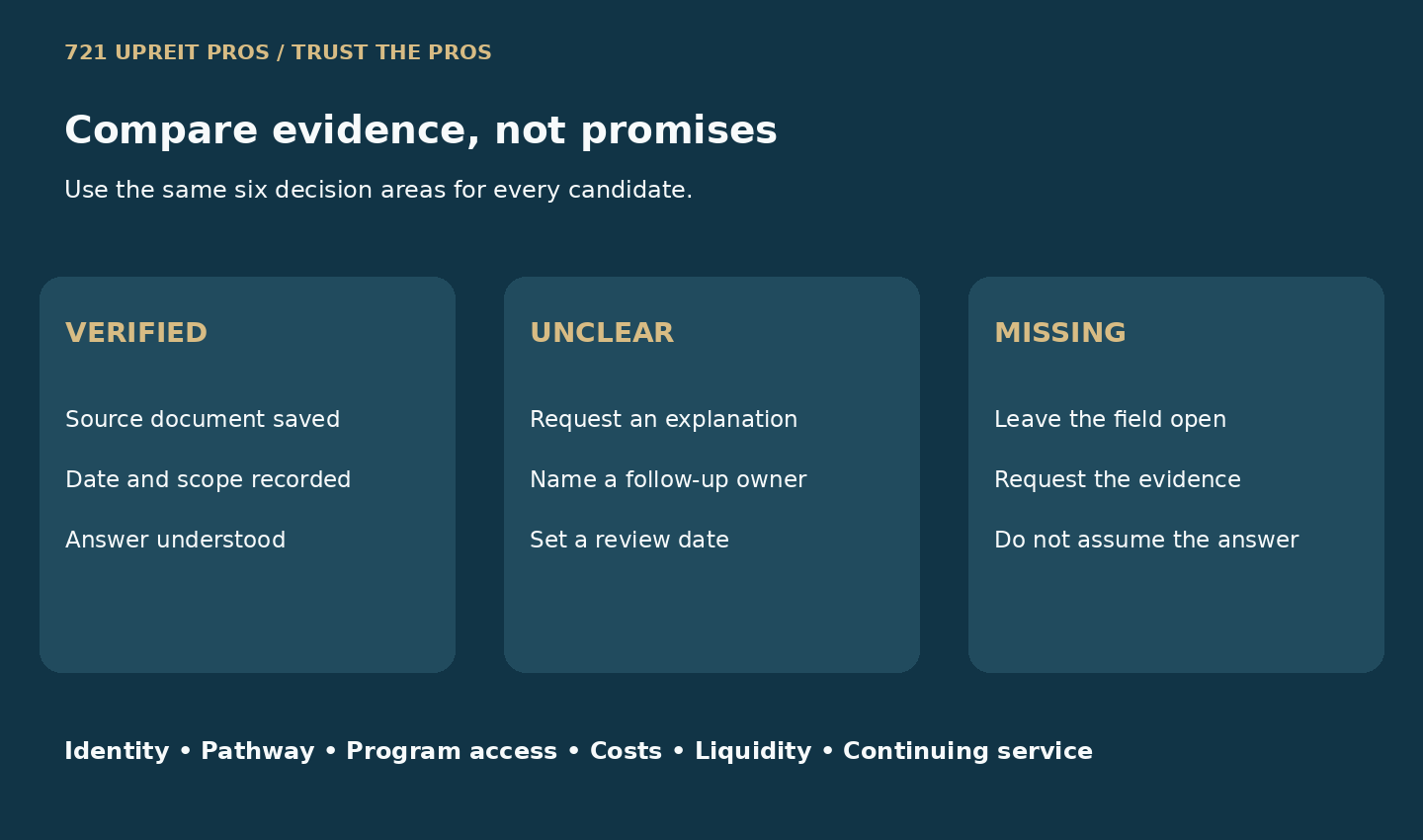
For example, Candidate A may provide a detailed cost schedule but no written description of help after a conversion. Candidate B may describe extensive service but leave the compensation base unclear. Neither gap is solved by counting how many boxes each candidate checked. Request the missing evidence and compare the same scope before deciding.
What if I want to compare Hines, Brookfield and Cantor programs?
Use the program-document comparison and dated source matrix to identify the issuer, operating partnership and class behind each proposal before comparing terms.
Ask for each exact offering's legal name, current documents, issue date, unit or share class, eligibility and availability through the firm. A sponsor name alone does not identify the investment you would own. Request a side-by-side comparison of conversion rights, valuation, all cost layers, distribution assumptions, redemption terms and tax questions. This article does not establish that any particular program is currently available or that an advisor can offer all three.
What should you bring to a 721 exchange consultation?
Bring a one-page planning summary: property type and state, ownership entity, sale stage, approximate value and debt, expected deadlines, income goals, cash reserves and the names of professionals already involved. Label estimates clearly. Keep adjusted tax basis separate from market value and equity; your tax professional needs the actual records for a tax analysis.
A useful initial agenda is to identify your goals, establish which pathways are feasible, explain compensation and agree on the next documents to review. Ask beforehand whether the meeting carries a charge, who will attend and whether it involves a product recommendation. Request a secure channel before sharing tax returns or account records. A website contact request is not an engagement, investment commitment or confirmed appointment.
Can I hire one person to handle everything?
Ask which services are covered by that person's actual role and which require a separate engagement. Even when professionals work together, responsibility for investment selection, exchange administration, legal interpretation and tax reporting should be explicit. Obtain permission and a secure process for coordination among your professionals.
What should make me pause?
Pause when essential answers remain unsupported: the firm cannot be independently verified, compensation is unexplained, documents conflict with a sales explanation, or access to cash is presented as certain despite restrictions. An advisor should be willing to explain downside scenarios. FINRA notes that some alternative investments are illiquid and can involve limited information in its alternative-products overview. A tax-deferral concept does not guarantee the quality of an individual investment or eliminate fraud risk.
One-minute briefing and advisor comparison worksheet
Use the video to prepare for the first call, then record the actual answers in the downloadable worksheet.
Read video transcript
0:00 · Start with the hiring decision
Define the help you need before choosing an investment. Clarify your property, sale stage and cash needs.
0:12 · Verify the person and the firm
Check registration using Investor.gov and read the applicable disclosures. Ask which capacity and agreement apply.
0:24 · Put costs into dollars
Ask who is paid, by whom, on what base and when. Separate advisor compensation from product expenses.
0:36 · Compare the same evidence
Review alternatives, available programs and liquidity limits. Mark each answer verified, unclear or missing.
0:48 · Agree on the next steps
Document continuing service and the role of your CPA, attorney and intermediary. Use the worksheet before making a commitment.
Download the advisor comparison worksheet
Talk through your property transition
Sources reviewed September 30, 2026: SEC and Investor.gov professional-selection, Form CRS and capacity guidance; IRS Publication 541 and like-kind exchange guidance; and FINRA's alternative-products overview. The hiring framework, hypothetical fee example and worksheet are original educational material. No named human expert review or independent advisor ranking is represented. Investment, tax, conversion and liquidity outcomes depend on the actual facts and documents.
Frequently asked questions
Should I choose the realtor or the 721 UPREIT advisor first?
The roles can be evaluated in parallel. A licensed broker handles the property sale within the agreed scope, while an investment professional helps compare investment options. Arrange qualified-intermediary and tax coordination before a contemplated deferred exchange closes.
Does a 721 UPREIT advisor replace my CPA?
No. Ask who is responsible for personal tax analysis, basis and reporting, and who reviews legal terms. Document each professional’s scope rather than assuming one engagement includes every role.
How do I compare two advisors who quote different fees?
Request the payer, dollar base, timing, ongoing costs and embedded compensation for the same proposed service and investment amount. A lower headline commission does not establish a lower total cost.
Can the advisor guarantee that a DST will convert?
No. Ask for the actual option, consent, valuation and contribution provisions and the alternative if a transaction does not occur. Tax rules do not create a sponsor obligation to complete a contribution.
Do I have to transfer my IRA or 401(k) to discuss a property sale?
No account transfer is assumed. A planning conversation can review cash needs, concentration and existing retirement accounts. Any proposed rollover or advisory engagement needs its own review of alternatives, services, costs and appropriateness.
What should I bring to the first conversation?
Bring the ownership structure, anticipated sale timing, approximate debt and cash needs, plus questions about fees and liquidity. Use a verified secure channel for confidential statements and tax records.
BEFORE YOUR ADVISOR CONVERSATION
Three questions before you commit
This companion briefing covers the professional's identity, compensation and how restrictions fit your cash needs. Use it alongside this article's specific document checks.
Loading the video connects to YouTube. Watch on YouTube · 721 UPREIT Pros channel · Read the full advisor checklist.
Read video transcript
Before you hire a seven twenty-one UPREIT advisor, ask these three questions.
First: who exactly am I hiring? Get the professional's legal name, firm and registration information. Check the record through Investor dot gov and read the firm's relationship summary where applicable. Ask whether this conversation involves brokerage services, investment advice, or both. A marketing title alone does not answer that question.
Second: who gets paid, and how much? Request a written cost breakdown in dollars. Identify the payer, calculation base, payment timing and ongoing charges. Include product expenses and embedded compensation. No separate advisor invoice does not mean there are no costs.
Third: how does this fit my cash needs? Review the actual agreements. Ask who controls a possible conversion and what happens if it does not occur. Separate permission to request redemption from approval, pricing and payment. Do not assume a fixed cash-out date.
Then agree on responsibilities. Your investment professional, CPA, attorney and qualified intermediary can have different roles. Put continuing service and unresolved questions in writing.
Read the complete advisor checklist using the article link in the description. Seven twenty-one UPREIT Pros. Trust the Pros. Educational only. Investments involve risk and may be illiquid. Tax treatment depends on your circumstances.
Educational only. Investments involve risk and may be illiquid. Footage is illustrative; narration is synthetic.
TALK TO A 721 UPREIT ADVISOR
Ready to discuss your 721 options?
Request a callback to discuss the questions raised by this article, your timing and what to ask before you commit. Share your name, email and phone below to start the conversation.
No investment commitment or financial documents required. A callback request does not book an appointment or establish an advisory relationship.