
721 UPREIT PROS / CAPITAL OBLIGATION REVIEW
721 UPREIT Capital Calls: Could You Owe More Money?
Whether a 721 UPREIT investor must provide more capital depends on the actual partnership agreement, contribution commitments, applicable law and separate signed obligations. Some agreements restrict additional contributions after the initial commitment is paid. Verify the exceptions and amendment rules; no capital call does not mean no investment loss or funding risk.
By 721 UPREIT Pros · Published October 26, 2026 · Original payment-request classification matrix
Key takeaways
- Read the actual partnership agreement, exceptions and separate signed obligations.
- Distinguish unpaid commitments, additional demands and optional unit subscriptions.
- No personal capital call does not eliminate investment funding, distribution or value risk.
- Verify unexpected notices and obtain written authority while keeping deadlines visible.
The practical decision is whether you have a further payment obligation, an optional investment opportunity or a funding problem that affects the investment without requiring a personal payment. Those are different questions. A message headed “additional capital” is a reason to read the supporting documents, not enough evidence to decide which situation applies.
Start with the 721 UPREIT risk framework and identify the exact operating partnership and unit class. This article focuses on the investor's possible obligation to provide funds. The separate new-capital dilution guide explains what an issuance can change economically, even when existing holders do not contribute additional money.
TALK TO A 721 UPREIT ADVISOR
Talk to a 721 UPREIT advisor
Request a callback to discuss the questions raised by this article, your timing and what to ask before you commit. Share your name, email and phone below to start the conversation.
No investment commitment or financial documents required. A callback request does not book an appointment or establish an advisory relationship.

What does a capital call actually ask you to do?
For this checklist, a capital call means a demand to fund an additional contribution under an asserted obligation. An invitation to subscribe for more units is a different request. So is a reminder to complete an amount you already committed to contribute. Ask the issuer or administrator to identify the payer, amount, deadline, governing clause and consequence of not paying.
Keep that request separate from a property-level repair budget, refinancing update or use of partnership reserves. Those events can be relevant to your investment without creating a personal invoice. Record the exact legal entity making the request and the interest you hold. A sponsor name may cover several entities and investment programs with different agreements.
What do dated partnership agreements show?
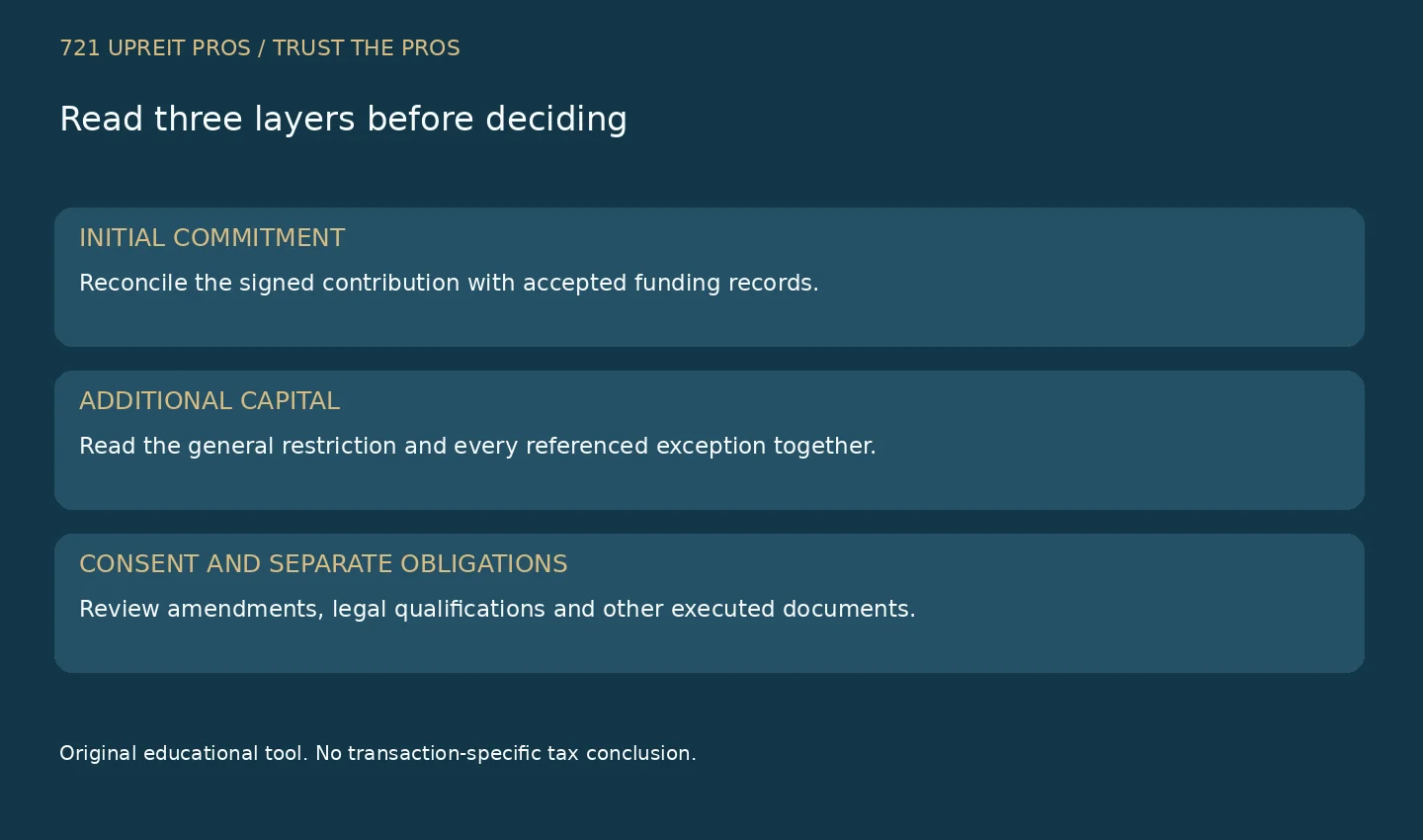
The HGIT Properties LP agreement dated January 5, 2026 provides an illustrative document trail. Section 4.3 addresses additional contributions and cross-references exceptions. Section 8.3 states that after the initial contribution is fully paid, a limited partner is not required to provide further capital or loans, except as required by the applicable Act. Article 11 also addresses written consent for specified amendments affecting an individual limited partner.
The Cantor Fitzgerald Income Trust Operating Partnership agreement dated January 1, 2026 separately addresses additional contributions in Section 4.2, limited-partner liability in Section 8.1 and amendments in Article 11. Its provisions also distinguish a fully paid contribution from additional funding and retain legal and contractual qualifications. Read the linked sections together rather than copying a single protective sentence.
These are dated public examples, not confirmation of your contract, current offering availability or a universal rule for all 721 UPREIT investments. Obtain the agreement actually applicable to your holding, its amendments and your signed contribution or admission documents. Ask counsel which provisions control and whether another document creates a separate obligation.
Which requests should you classify separately?
| What arrived? | Evidence to request | Question before acting |
|---|---|---|
| Unpaid initial commitment reminder | Executed commitment and funded-amount reconciliation | Is the amount already due under a prior agreement? |
| Purported additional capital call | Exact authority, calculation and notice provisions | What creates an obligation for this holder? |
| Optional new-unit subscription | Offering terms, acceptance procedure and rights | Is participation voluntary and suitable? |
| Request under a separate agreement | Executed guarantee, indemnity or other cited obligation | Does it apply, and what is its actual scope? |
| Partnership funding update | Reserve, borrowing or issuance plan and investor effects | Is this an economic risk rather than a personal demand? |
The rows organize a professional review. They do not establish that every listed obligation exists in your program. Ask for the document and relevant section when a request relies on a separate promise or legal exception. Do not translate “limited partner” into a conclusion that no payment can ever be owed for any reason.
Does no additional contribution obligation remove funding risk?
No. Separate the question “must I send money?” from “how will the partnership fund its needs?” Review the proposed use of reserves, borrowing, asset sales, new capital or other documented sources. Ask what assumptions support the plan and which uncertainties remain. A contract that limits investor contributions does not itself fund repairs or protect unit value.
Consider household effects too. A lower distribution can leave a cash-flow gap even if no capital call exists. A new issuance may change percentages, rights or priority. Use the distribution-reduction decision checklist for the income question and the dilution guide for issuance economics. Neither is proof of a personal funding duty.
Before contributing property, compare accessible household reserves with illiquid investment exposure. Keep emergency funds and known expenses distinct from projected distributions or hoped-for redemptions. The cash-needs and control worksheet helps frame that discussion. It does not prescribe a reserve amount or guarantee that redemption will be available when needed.
How would three similar-looking notices differ?
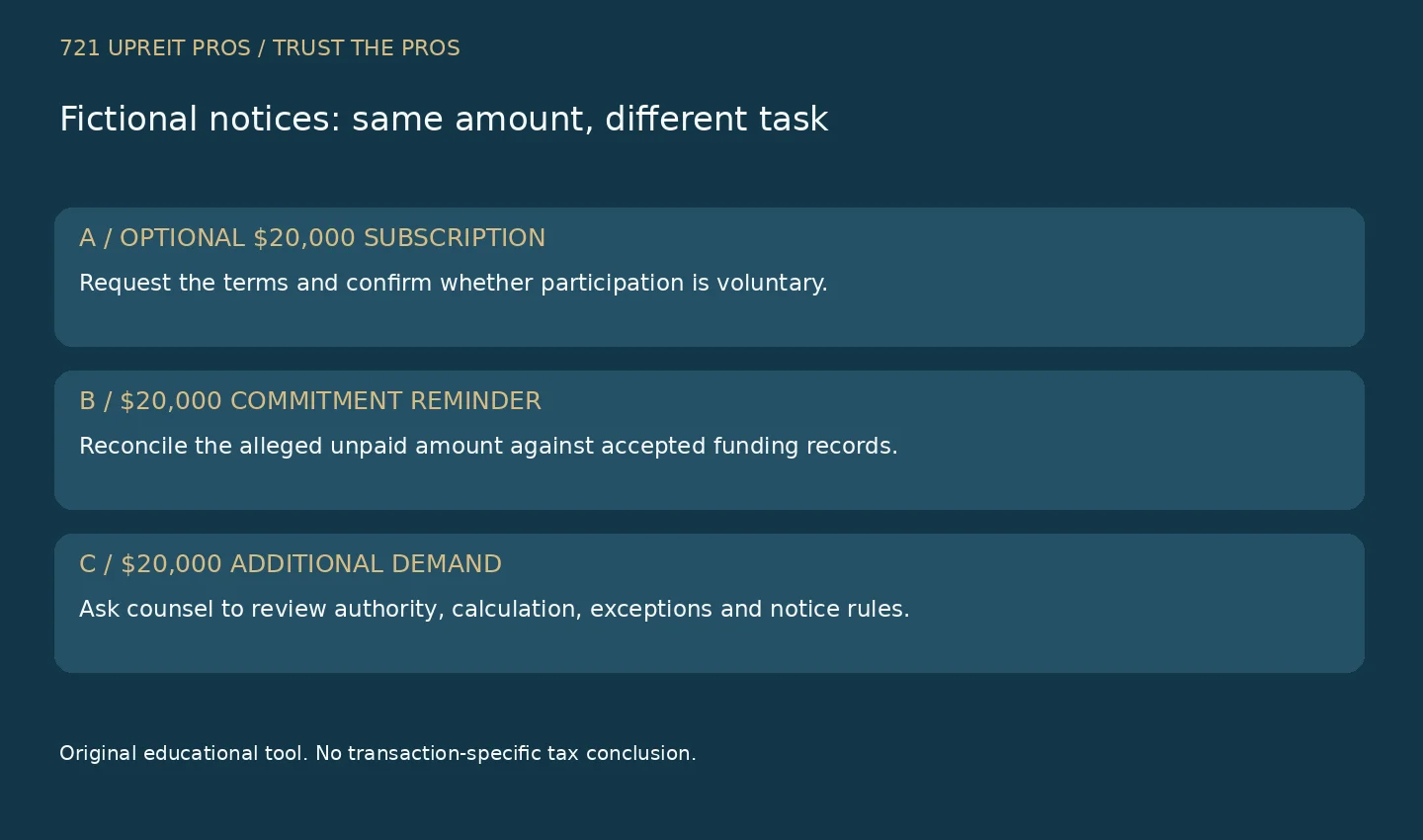
Consider a fictional OP-unit holder who has fully funded the documented initial contribution. Notice A offers an optional $20,000 subscription for new units. Notice B says $20,000 remains due on the original commitment. Notice C demands $20,000 for an additional contribution and cites a partnership-agreement clause. These are hypothetical descriptions, not actual notices or an assumption that any amount is owed.
For A, the investor requests the new investment terms and confirms the invitation is voluntary. For B, the investor reconciles the executed commitment against accepted funding records and asks the administrator to explain the discrepancy. For C, the investor asks counsel to review the cited authority, exceptions, notice requirements and any separate agreements. The same dollar amount produces three different evidence tasks.
The original worksheet records request type, cited document, funded amount, deadline, issuer contact, unresolved question and next responsible person. If the documents do not support a conclusion, the row stays unresolved. The investor does not treat an optional purchase as a bill, or dismiss a demand solely because a general presentation described the investment as passive.
What should you do with an unexpected funding request?
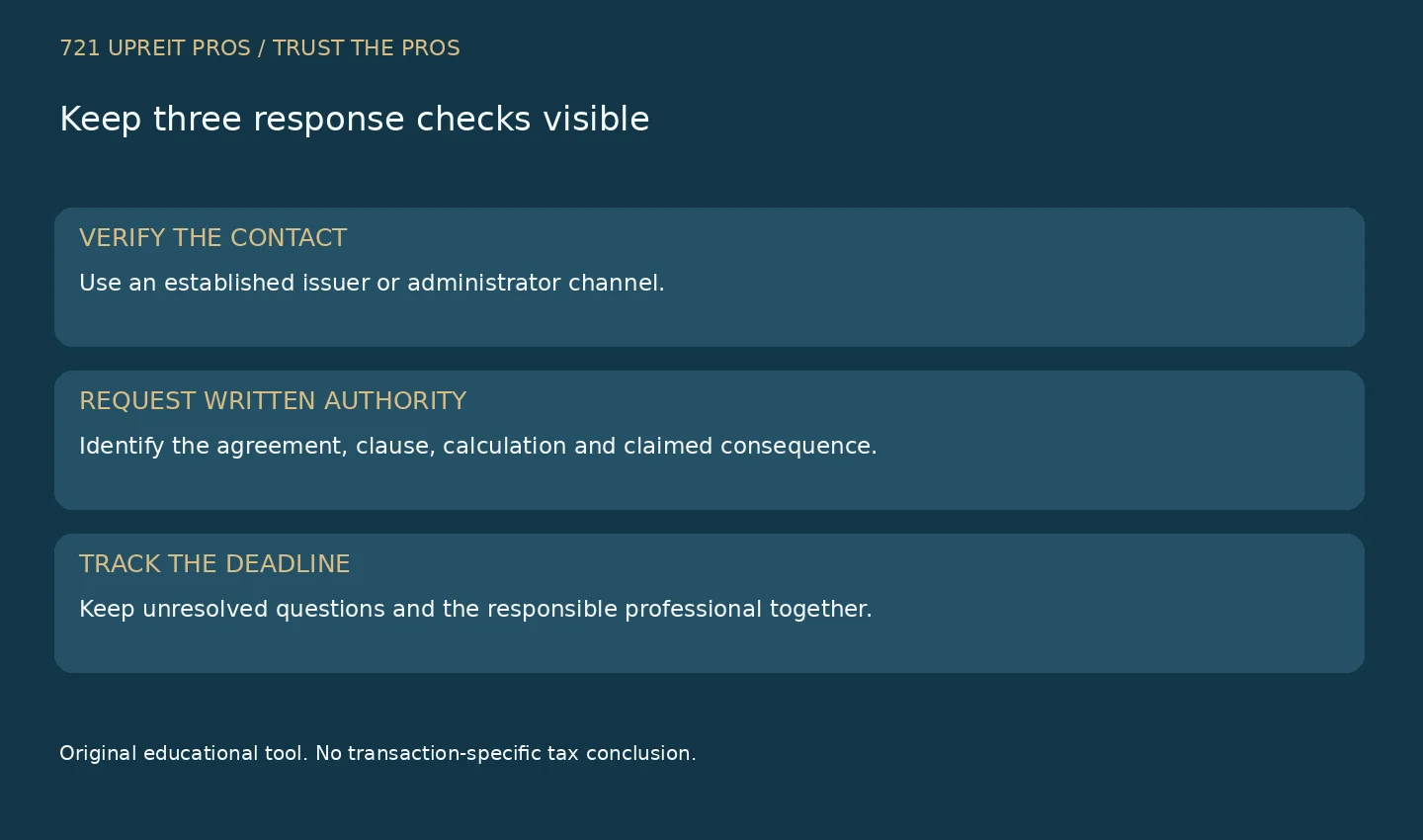
Preserve the complete notice and independently verify the issuer or administrator contact using an established channel. Request the contractual basis and calculation in writing. Keep the stated deadline visible while your attorney or advisor helps clarify the request. Do not treat an unresolved question as permission to ignore a genuine deadline or use unverified payment instructions.
Ask what happens if the request is not funded and where that consequence appears in the controlling documents. If an amendment or consent is proposed, have counsel explain what would change for your actual holding. A summary email should not replace the executed agreement. Keep final answers and any updated documents with the original request.
Are DST funding restrictions the same as OP-unit terms?
No. A qualifying Section 1031 DST investment and a later Section 721 partnership contribution are different ownership stages. The relevant DST capital-call and funding-shortfall guide concerns the trust-stage question. DST Experts' reserve and capital-repair worksheet helps organize property funding evidence. Neither replaces the agreement governing OP units after a contribution.
Return to the canonical 721 UPREIT guide if the stages or legal entities are unclear. A tax-deferral framework is not a promise about capital calls, fees, liquidity, distributions or investment performance. Review the exact proposal with the appropriate professionals before accepting those trade-offs.
What belongs in your final obligation-review file?
- Identify the legal issuer, holder and unit class.
- Obtain the applicable executed agreement and amendments.
- Reconcile the initial commitment with accepted contributions.
- Read additional-capital restrictions with every referenced exception.
- List separate signed obligations for counsel to evaluate.
- Check amendment, consent, notice and deadline provisions.
- Separate personal payment duties from investment funding and liquidity risks.
Bring the open questions when you talk to a 721 UPREIT advisor or use the callback pathway. A brief description is enough for an initial inquiry; provide private agreements or account records only through a verified secure process. No expert determination of an individual obligation is claimed here.
Watch the one-minute capital-obligation review
This original silent video includes English captions and the complete matching transcript below.
Read video transcript
0:00 · Could you owe more capital?
Read your actual agreement and signed obligations before deciding.
0:12 · Separate the requests
Initial commitments, extra demands and optional purchases differ.
0:24 · Read the full document trail
Check exceptions, amendment rules and separate signed promises.
0:36 · Funding risk can remain
No personal capital call does not guarantee investment value or cash.
0:48 · Verify and clarify the notice
Ask for written authority and keep real deadlines visible.
Download the payment-request review checklist
Primary SEC-filed agreements checked October 26, 2026; their stated effective dates are January 5 and January 1, 2026. Examples are dated evidence, not current availability or individual legal advice. Investments can lose value and be illiquid; no tax or investment outcome is guaranteed.
Frequently asked questions
Does every 721 UPREIT require capital calls?
No universal answer follows from the label. The applicable agreement, paid commitment, legal exceptions and separate executed documents determine the analysis for an actual holding.
Is an optional subscription a capital call?
An invitation to buy more units is different from an asserted payment obligation. Ask the issuer to confirm whether participation is voluntary and request the actual offering terms.
Why check whether the initial contribution is fully paid?
A reminder to complete an existing commitment differs from a demand for new capital. Reconcile signed terms with accepted funding records before deciding what the notice means.
Can no capital call still mean investment losses?
Yes. A restriction on additional investor funding does not protect value, ensure sufficient reserves or guarantee distributions. Evaluate partnership funding and household liquidity separately.
Can the agreement be amended to impose an obligation?
Read the actual amendment and consent provisions with counsel. Dated public agreements illustrate that consent protections can differ; neither example proves what governs your units.
What if I receive an unexpected payment demand?
Keep the notice, verify the issuer through an established channel and request the cited authority and calculation. Have the appropriate professional review unresolved questions while tracking the stated deadline.
TALK TO A 721 UPREIT ADVISOR
Ready to discuss your 721 options?
Request a callback to discuss the questions raised by this article, your timing and what to ask before you commit. Share your name, email and phone below to start the conversation.
No investment commitment or financial documents required. A callback request does not book an appointment or establish an advisory relationship.