
721 UPREIT PROS / CO-OWNER DECISIONS
721 UPREIT Co-Owners: What If You Want Different Paths?
Co-owners cannot assume that each person can independently choose cash, a 1031 exchange or 721 UPREIT units from the same transaction. First establish who owns and contributes the property, its tax classification, required approvals and the proposed consideration. Different goals need coordinated legal, tax, lender and receiving-partnership review before commitments.
By 721 UPREIT Pros · Published October 25, 2026 · Original ownership-and-goals matrix
Key takeaways
- Reconcile legal title, tax classification and the actual contributor before comparing paths.
- Personal preferences do not establish independent transaction elections.
- Identify who would receive OP units and which owner, lender and partnership approvals apply.
- Bring different cash needs and planned ownership changes to coordinated tax and legal review.
Start with the disagreement you need to resolve. One owner wants to stop managing real estate and receive OP units. Another needs spendable cash. A third wants to investigate a qualifying real-property exchange. Those preferences describe desired outcomes, but they do not yet identify which person or entity can take each step.
Use this guide to prepare a joint planning meeting before accepting an offer or signing contribution documents. The 721 UPREIT investor guide explains the overall ownership stages. The direct-property acceptance checklist covers the asset and receiving partnership. Here the distinct question is how to organize different owner objectives without treating personal preferences as approved transaction rights.
TALK TO A 721 UPREIT ADVISOR
Talk to a 721 UPREIT advisor
Request a callback to discuss the questions raised by this article, your timing and what to ask before you commit. Share your name, email and phone below to start the conversation.
No investment commitment or financial documents required. A callback request does not book an appointment or establish an advisory relationship.

Do you own real estate directly or an interest in an entity?
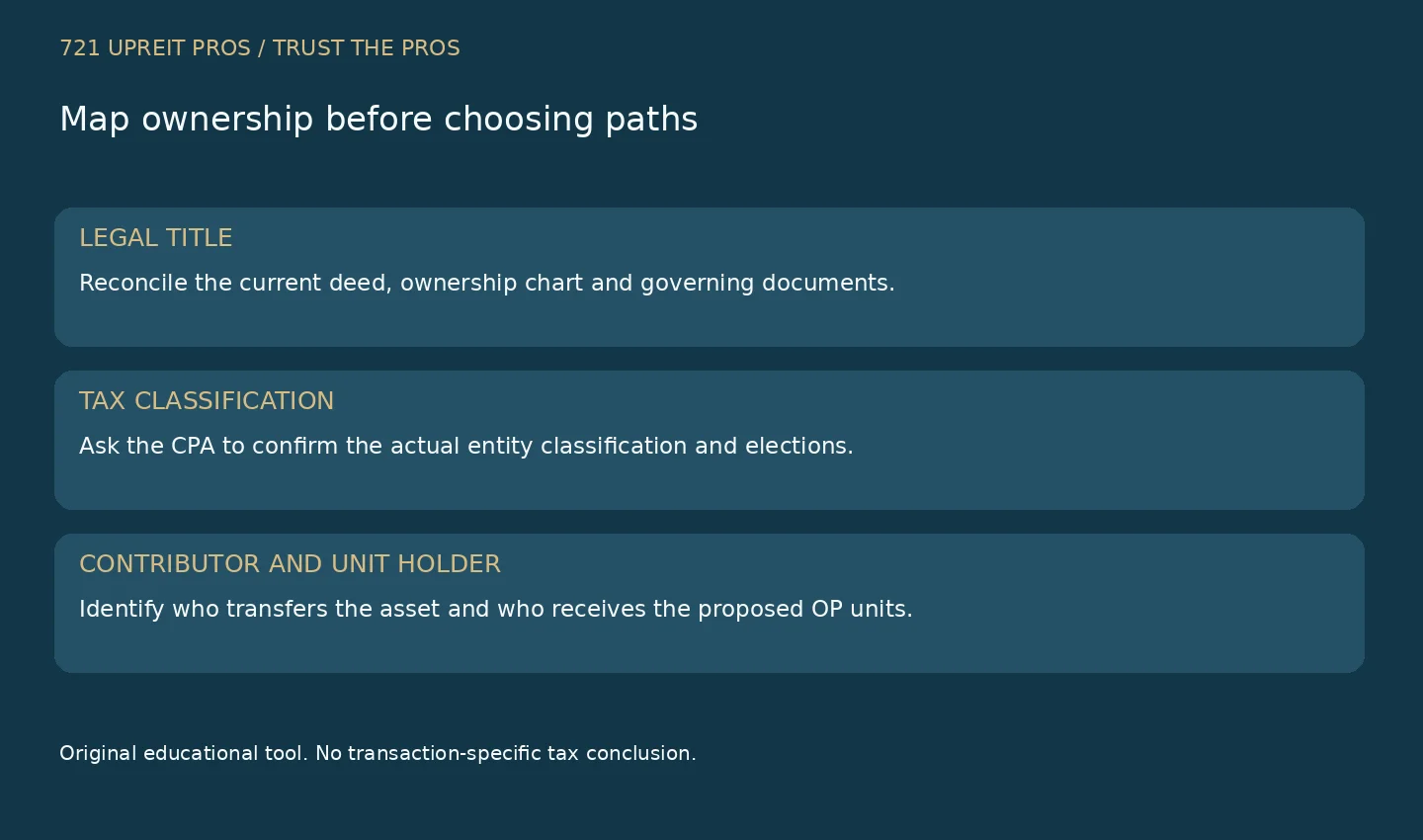
Gather the current deed, ownership schedule, operating or co-ownership agreement and relevant tax records. Ask your attorney and CPA to reconcile legal title with federal tax classification. A property can be described conversationally as “our building” while the deed names an LLC and the people hold membership interests rather than separate recorded interests in the building.
The IRS explanation of LLC classification says a domestic LLC with at least two members is generally treated as a partnership for federal income tax purposes unless it elects corporate treatment. A single-member LLC generally has different default treatment. Verify the actual elections and facts instead of inferring classification from the letters LLC.
IRS Publication 541 also distinguishes a partnership from certain arrangements involving mere co-ownership or expense sharing. That distinction needs factual review. Do not assume that a tenancy-in-common label, separate checks or an informal agreement settles the tax classification. Put the professional's conclusion and supporting records in the meeting file.
Who contributes the property and who receives the OP units?
Section 721 generally addresses property contributed to a partnership for a partnership interest, subject to exceptions. The contribution agreement should identify the transferor, property and interest issued. An entity's contribution is not automatically a separate contribution by each person who owns part of that entity.
Ask the receiving operating partnership to describe the transaction it would consider. Will it review the whole property, a particular undivided interest, an entity interest or some other defined proposal? Who would be named as the OP-unit holder? These are questions for the actual proposal, not a claim that every receiving partnership accepts every structure.
If the proposed unit holder is the existing LLC, ask what each member would own after closing and how decisions would be made inside that LLC. If documents instead name individuals, have counsel explain every step that produces that result. A spreadsheet allocating unit values among people does not itself transfer legal ownership or establish the tax treatment.
Which approvals and constraints should the group verify?
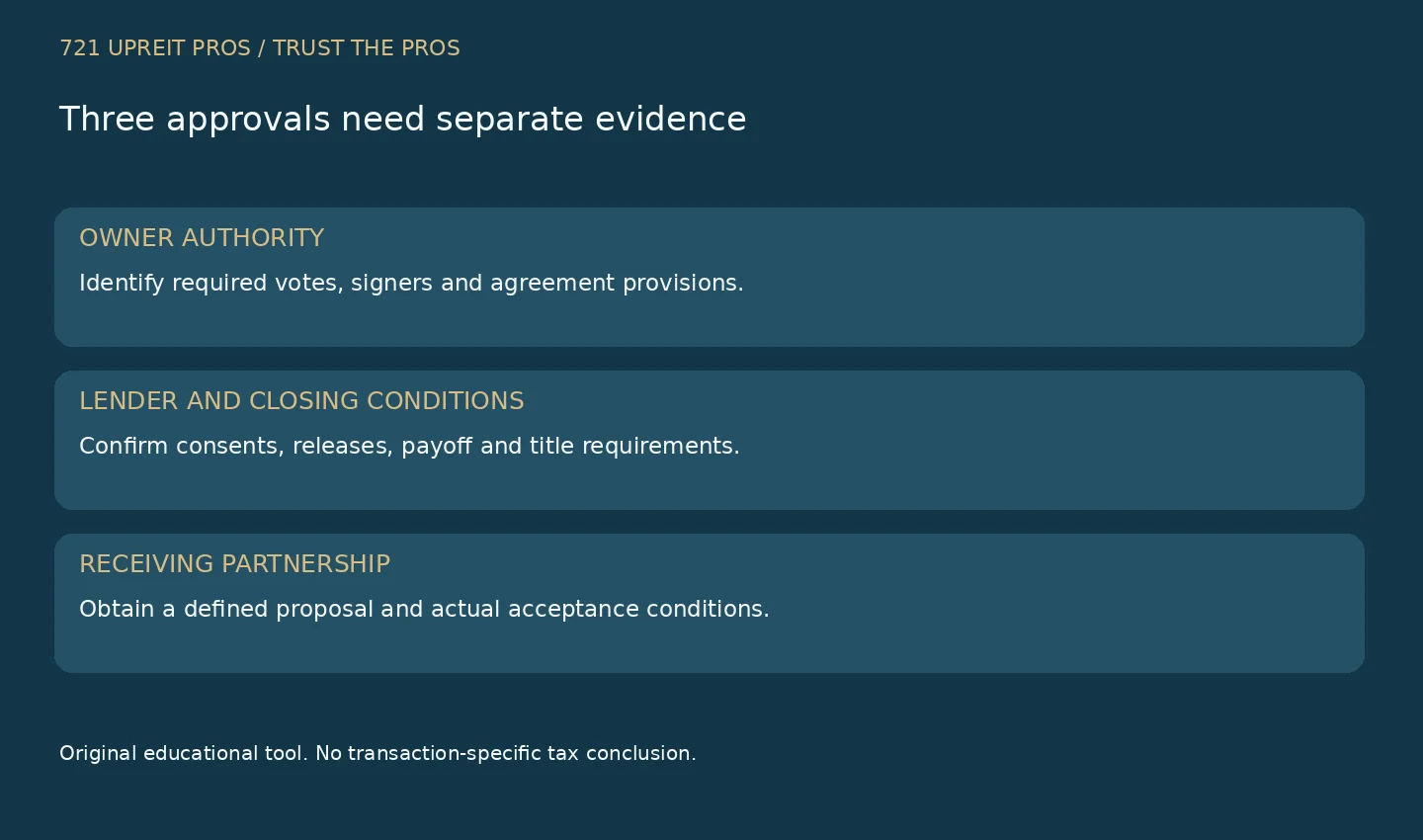
Build an approval list from the documents, rather than assuming a majority vote or unanimous consent. Ask counsel to identify who can negotiate, sign, approve a transfer, amend an agreement or bind the ownership entity. Record where the answer appears. An owner agreeing with the investment idea is different from providing a legally effective authorization.
Include the loan and title work in this discussion. Ask the lender and closing professionals which consents, releases, payoff steps or guarantees apply to the proposed transaction. Keep the receiving partnership's acceptance conditions separate from the owners' internal approvals. One side being ready does not establish that the other conditions have been satisfied.
| Question | Evidence to gather | Decision to resolve |
|---|---|---|
| Who owns the asset? | Deed, ownership chart and entity documents | Identify the actual transferor and interest |
| How is it taxed? | Returns, elections and CPA analysis | Confirm classification rather than assuming it |
| Who wants what? | Separate written goals and cash timing | Distinguish preference from an available right |
| Who can approve? | Agreement provisions and consent requirements | Name signers and outstanding approvals |
| What is being offered? | Contribution terms and unit-holder registration | Reconcile the proposal with each owner's goal |
| What changes the analysis? | Cash, liability, ownership or timing changes | Request an updated professional review |
Can one owner take cash while another receives units?
That outcome requires a documented, accepted structure and individualized analysis. Ask whether a proposal includes a property sale, a contribution, an owner buyout, a partnership distribution or several related transfers. Identify who pays, who receives, and which obligation each payment satisfies. “Cash out my share” is an instruction to investigate, not a complete closing description.
Publication 541 explains that contributions, related cash transfers, partnership distributions and liability changes can involve different tax rules. Avoid applying a simple 1031 boot analogy to every contribution-side payment. Our cash and other consideration evidence checklist helps organize the payment trail; it does not approve the desired split or compute anyone's tax.
Keep the household cash question concrete. Does an owner need money at closing, a recurring distribution or access to capital later? Those are different needs. OP units are not a substitute for confirmed closing cash, and an anticipated redemption is subject to the actual contract. Record each person's deadline before comparing a proposal with the group's priorities.
Does a separate 1031 preference solve an entity-level disagreement?
No automatic solution follows. IRS Publication 544 explains that exchanges of partnership interests generally do not qualify as like-kind real-property exchanges. The classification of the actual interest matters. A person cannot assume that exchanging a membership interest follows the same rules as exchanging separately owned qualifying real estate.
If someone proposes distributing property, changing title or buying out another owner before a sale or contribution, have the tax and legal team review the entire sequence before acting. This guide supplies no holding-period shortcut, drop-and-swap recipe or assurance that a last-minute restructuring qualifies. A disagreement is a reason to investigate earlier, not evidence that a particular workaround is available.
A qualifying DST acquisition in a 1031 exchange and a possible later 721 contribution are also separate decisions. The related DST versus REIT ownership comparison explains why the interest received matters. DST Experts' contribution-to-exit tax timeline provides broader context without deciding a co-owner's transaction.
How would three owners prepare a useful meeting?
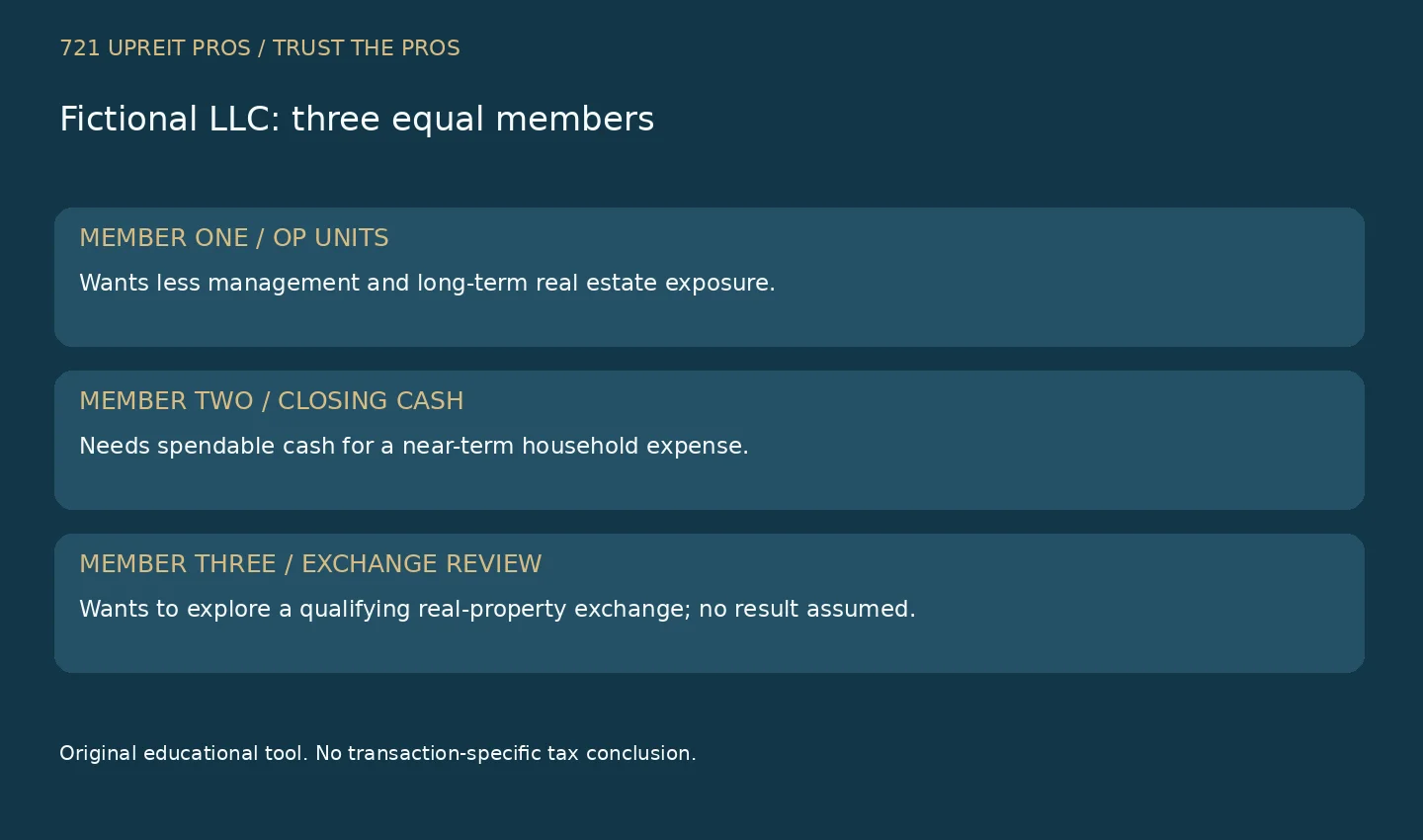
Consider a fictional LLC with three equal members that owns an apartment property. One member wants long-term OP-unit exposure, one needs cash for a near-term expense, and one wants to explore a 1031 exchange. Assume no receiving partnership has accepted a proposal and no restructuring has occurred. Equal membership percentages are the only economic assumption.
The group first writes down the current deed holder and asks its CPA to confirm classification. Next it lists who would contribute the asset and receive units under each proposal. Finally, it records approvals, lender conditions, personal cash deadlines and unresolved tax questions. It does not divide an estimated property value by three and treat the result as each member's available election.
The meeting output is a decision file, not a forced agreement. One column identifies a proposed path, a second identifies the facts and approvals required, and a third identifies what remains unresolved. The group can then ask the receiving partnership and professionals which proposals deserve further work. The exercise makes no claim that cash, units and a 1031 exchange can all be delivered together.
What should you verify before making a commitment?
- Reconcile the deed, ownership chart and federal tax classification.
- Describe each owner's goal, cash need and deadline separately.
- Identify the contributor, asset transferred and proposed unit holder.
- Read the approval, transfer, lender and closing requirements.
- Have the CPA and attorney review cash, debt and any planned ownership changes.
- Request an updated proposal when a material assumption changes.
- Record unresolved conditions before authorizing signatures or closing.
The pre-closing change-control checklist helps preserve the version history. Use the 721 UPREIT risk review for investment restrictions, and the advisor-selection questions to clarify who coordinates investment-side work. No acceptance, conversion, liquidity, distribution or tax result is guaranteed.
Bring a short description of the ownership arrangement and the different goals when you talk to a 721 UPREIT advisor or use the callback pathway. Share tax returns, agreements and sensitive ownership records through a verified secure process with the appropriate professionals.
Watch the one-minute co-owner planning checklist
This original silent video has English captions and a complete matching transcript.
Read video transcript
0:00 · Different co-owner goals?
Start with the actual ownership, not an assumed personal election.
0:12 · Name the contributor
Confirm title, tax classification and the proposed unit holder.
0:24 · Write down each goal
Separate OP-unit exposure, closing cash needs and exchange questions.
0:36 · Gather approval evidence
Review owner authority, lender conditions and partnership terms.
0:48 · Coordinate before signing
Ask tax and legal professionals to review the complete proposal.
Download the co-owner meeting checklist
Primary sources checked October 25, 2026: Section 721, IRS Publications 541 and 544, and IRS LLC classification guidance. Educational information, not individualized tax, legal or investment advice. No actual transaction or expert-review approval is claimed.
Frequently asked questions
Can each member of an LLC choose a separate 721 or 1031 path?
Do not assume so. Determine what the LLC owns, its tax classification, who would transfer the asset and who would receive the consideration. Individual goals require review within the actual transaction.
Is direct co-ownership always a partnership?
No universal conclusion follows. IRS Publication 541 distinguishes certain co-ownership arrangements from partnerships. Ask your CPA to apply the classification rules to the actual facts.
Who receives OP units when an entity contributes property?
Read the contribution agreement and proposed registration. If the existing entity is the named contributor and unit holder, do not assume the individuals automatically become direct OP-unit owners.
Can one owner receive cash at closing?
Only an actual accepted proposal and the applicable legal and tax analysis can answer that. Identify the payer, recipient, consideration, authority and any related transfers before making a commitment.
Can changing title immediately before closing solve the disagreement?
A title change can introduce additional legal, tax, lender and timing questions. This guide provides no automatic qualification, holding-period shortcut or recommended restructuring sequence.
What should the first joint meeting produce?
A reconciled ownership chart, separate goal and cash-deadline statements, proposed contributor and unit holder, approval list and professional review of unresolved conditions. It need not produce an immediate agreement.
TALK TO A 721 UPREIT ADVISOR
Ready to discuss your 721 options?
Request a callback to discuss the questions raised by this article, your timing and what to ask before you commit. Share your name, email and phone below to start the conversation.
No investment commitment or financial documents required. A callback request does not book an appointment or establish an advisory relationship.