
721 UPREIT / CONTRIBUTION VALUE WORKSHEET
OP unit valuation: reconcile a 721 UPREIT contribution from value to units
To check the number of OP units issued in a 721 UPREIT contribution, reconcile the value allocated to units after the agreement's applicable adjustments, then divide by the issue price for the correct unit class and date. The difficult part is establishing those inputs, not doing the division.
By 721 UPREIT Pros · Published September 15, 2026 · General investor education
The short answer
For a simple single-class issuance: net contribution value allocated to units ÷ applicable price per OP unit = units issued, subject to the agreement's rounding and settlement rules. Do not start with a gross property appraisal if the agreement starts with an already-net interest value. Do not substitute original investment cost, tax basis, a different share class's NAV or a later redemption price.
This worksheet helps an owner check a proposed contribution schedule or an investor review a potential DST-to-UPREIT conversion. It extends the basic example in the 721 UPREIT guide and advisor planner. It is an economic reconciliation, not a valuation opinion or calculation of tax due. Actual terms can use a different formula, multiple classes, cash consideration or other adjustments.
TALK TO A 721 UPREIT ADVISOR
Talk to a 721 UPREIT advisor
Request a callback to discuss the questions raised by this article, your timing and what to ask before you commit. Share your name, email and phone below to start the conversation.
No investment commitment or financial documents required. A callback request does not book an appointment or establish an advisory relationship.

Watch the one-minute value-to-units example
Original 60-second silent explainer with on-screen text, English captions and a complete transcript.
Which value belongs at the top of the calculation?
Use the value for the asset or interest actually being contributed, under the governing transaction documents. A whole-property value and the value of one investor's beneficial interest are different starting points. Establish the valuation perimeter before entering numbers.
Write down the legal owner, the asset description, the ownership percentage or allocation method, the effective valuation date and whether the stated amount is gross or net of debt and other obligations. If the transaction includes several properties, reserve accounts or entities, ask which are included. A number taken from a prior statement may describe a different asset, date or purpose.
A useful opening question is: “Does this amount already reflect liabilities, closing costs or retained cash?” A second question is: “Which signed provision converts that amount into the value used for my unit issuance?” Keep the answer beside the number. If a component is not yet known, label it estimated and request the missing supporting schedule.
How does a $2 million property become 45,000 OP units?
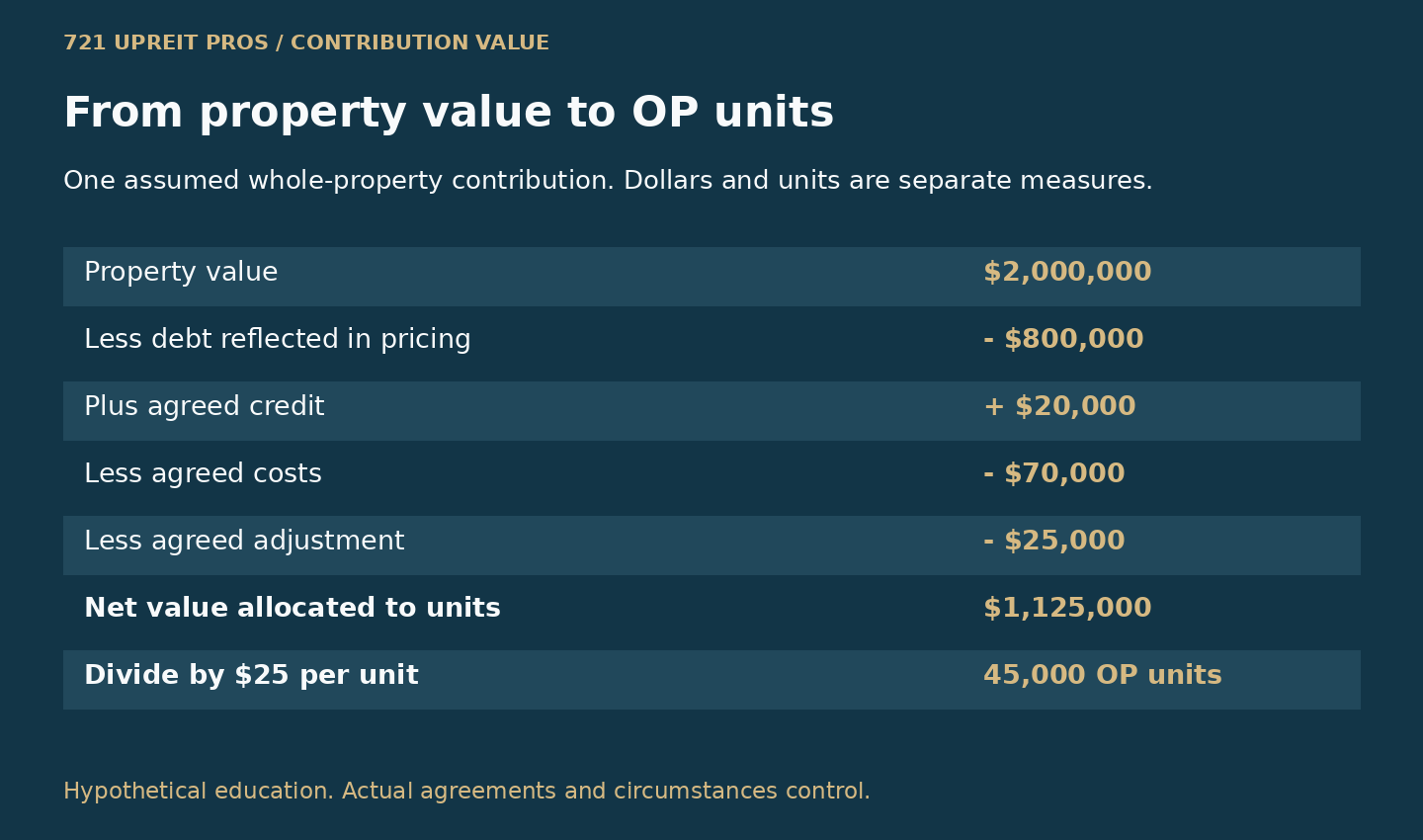
In the following fictional whole-property transaction, the parties agree to the economic adjustments shown below and allocate the remaining value entirely to one OP-unit class. Assume no additional issuance charge, cash payment to the contributor, holdback, fractional-unit issue or other adjustment. These assumptions isolate the arithmetic; they do not describe any available investment.
| Line | Assumed adjustment | Running value | Evidence to request in a real transaction |
|---|---|---|---|
| Agreed property value | $2,000,000 | $2,000,000 | Agreed valuation and effective date |
| Debt reflected in pricing | Subtract $800,000 | $1,200,000 | Debt treatment and supporting balance |
| Agreed closing credit | Add $20,000 | $1,220,000 | Credit schedule and entitlement |
| Agreed transaction costs | Subtract $70,000 | $1,150,000 | Itemized costs and contractual payer |
| Negotiated repair adjustment | Subtract $25,000 | $1,125,000 | Signed adjustment provision |
| Value allocated to OP units | No other assumed consideration | $1,125,000 | Final contribution schedule |
| Applicable issue price | Divide by $25 per unit | 45,000 OP units | Class, pricing method and pricing date |
The arithmetic is ($2,000,000 − $800,000 + $20,000 − $70,000 − $25,000) ÷ $25 = 45,000 units. The economic amount attributed to those units at the assumed issuance price is 45,000 × $25, or $1,125,000. That multiplication checks the schedule; it does not establish a resale value, distribution rate or amount available to withdraw.
The $800,000 line means debt is reflected once in this fictional pricing reconciliation. It does not say the investor's tax allocation of partnership debt becomes zero, nor does it determine whether debt relief triggers tax. The costs and repair adjustment are stipulated example inputs. Their treatment in a real contribution must come from the actual agreement and tax analysis.
What changes when the starting figure is a DST-interest value?
If the proposed value already represents your net interest, do not subtract the entire property's mortgage again. Ask for a bridge from the trust-level numbers to your own contribution amount and identify what has already been deducted.
For a deliberately simplified allocation example, assume a trust's distributable contribution value is $10,000,000 and the documents allocate exactly 5% to one investor, with no investor-specific adjustments. That investor's amount is $500,000. At an assumed $25 per OP unit, the result is 20,000 units. Multiplying 5% by the underlying gross property appraisal instead would ignore the stipulated net allocation basis.
This 5% example assumes proportional rights and a single allocation pool. An actual trust or contribution agreement may distinguish classes, reserves, expenses or investor elections. The worksheet should have two levels when necessary: the transaction-wide schedule and the investor allocation schedule. Ask the preparer to show how the two connect rather than filling the gap with an assumed percentage.
For broader context on the earlier exchange and possible later contribution, see DST Experts' explanation of the 1031, DST and 721 pathway. A qualifying 1031 exchange into a DST and a later Section 721 transaction require separate analysis; this arithmetic does not establish either one's eligibility.
Which unit price and class should you use?
Use the class and pricing date specified for the issuance. Confirm whether the price is negotiated, determined by a stated NAV method or established through another contractual formula. Do not assume that a website's displayed REIT share value is the applicable OP-unit issue price.
A dated public example illustrates why definitions matter. BREIT's November 3, 2025 operating partnership agreement defines Agreed Value by reference to the noncash contribution's fair market value at contribution, agreed between the partner and general partner. It also defines NAV per unit by class and monthly valuation, and its Section 4.2 identifies different unit classes. These provisions are reasons to inspect the relevant definitions, not a universal pricing formula. Read the filed agreement, definitions and Section 4.2.
The accompanying November 3, 2025 Form 8-K describes a partnership-held FMV option to acquire DST interests for units or, in some cases, cash, and addresses class selection. It does not provide the final pricing schedule for an individual investor. Read the historical program disclosure, Item 1.01. These are historical document examples, not current offering terms or recommendations.
- Record the exact OP-unit class, including any suffix.
- Attach the price notice and applicable valuation policy.
- Identify the date that fixes the price and the date units are issued.
- Ask whether a delayed closing changes the price or requires another calculation.
- Confirm whether a later class conversion uses a separate exchange ratio.
Does a lower issue price make the contribution more valuable?
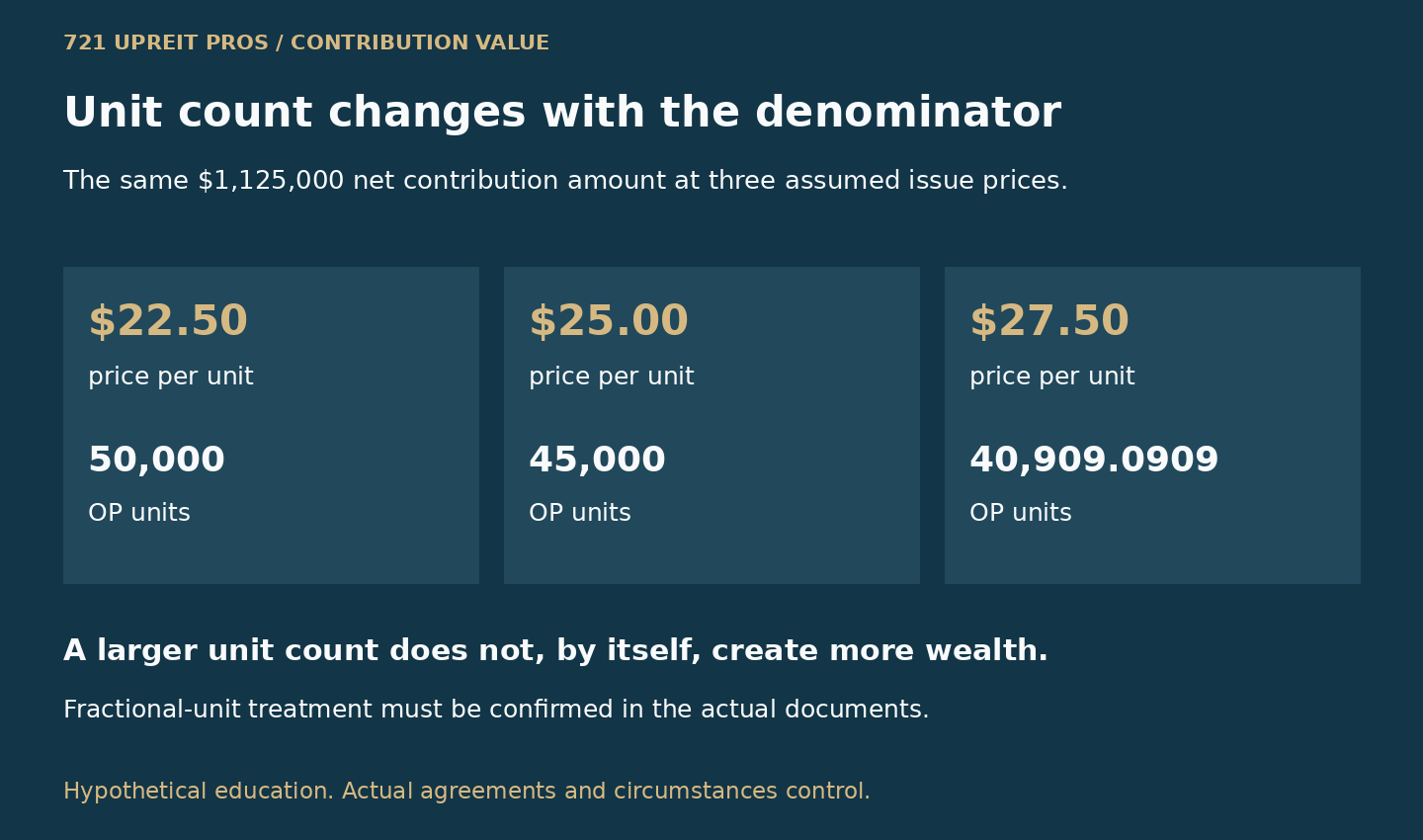
No. Holding the numerator fixed, a lower price creates more units. The amount represented at that same issue price remains the same. Compare the economic value and rights received, not unit count alone.
| Net value | Price per unit | Calculated units |
|---|---|---|
| $1,125,000 | $22.50 | 50,000 |
| $1,125,000 | $25.00 | 45,000 |
| $1,125,000 | $27.50 | 40,909.0909, approximately |
Both sides of the fraction can also move. Suppose the assumed property value falls 10%, from $2,000,000 to $1,800,000. Hold debt and the three other adjustments constant. The value allocated to units falls to $925,000, a decline of about 17.78%. At $25 per unit, that produces 37,000 units. If the unit price also falls 10% to $22.50, the count becomes approximately 41,111.1111 units. Neither calculation restores the original $1,125,000 economic amount.
The example shows sensitivity, not a forecast or a mechanical relationship between real estate prices and REIT NAV. The property valuation and destination-unit valuation can move differently. A complete comparison needs both source dates and both sets of assumptions.
How do you catch duplicate deductions and unexplained differences?
Give each deduction one source, one payer and one place in the reconciliation. If a cost is already included in a net value, a second subtraction understates the amount allocated to units.
In the whole-property example, mistakenly subtracting the assumed $70,000 costs twice reduces the result from $1,125,000 to $1,055,000. At $25 per unit, the error is 2,800 units. The cure is not to delete every cost line. It is to establish whether each cost is already embedded and whether it belongs to the contributor under the actual agreement.
For each disputed line, ask the preparer to identify the provision, invoice or calculation schedule; show the amount before and after the adjustment; and explain whether a later true-up is possible. Ask who receives any reserve release and whether it changes cash, units or neither. Use the full-life DST and UPREIT fee ledger for broader cost comparisons. This contribution worksheet should not double-count the fee ledger's later ongoing expenses as an immediate closing deduction.
Does the closing unit count fix your future ownership percentage?
No. The closing reconciliation establishes the units issued under that transaction's inputs; it does not establish a permanent percentage of the operating partnership. Keep the closing schedule, but request a separate dated capitalization schedule when additional interests are issued. Identify the comparable class or equivalent-unit basis before dividing your units by a reported total.
Separate a quantity change from a value change. A new investor may contribute assets or cash at the same time that the denominator grows; expenses and different rights can also matter. The 721 UPREIT new-capital and dilution comparison shows three hypothetical scenarios. It extends this closing worksheet without treating the original issue price as a guaranteed future value or redemption price.
Is contribution value the same as OP-unit tax basis?
No. An agreed economic value or unit issuance amount does not automatically establish a new tax basis. Section 721 generally provides nonrecognition for qualifying property contributions in exchange for partnership interests, subject to exceptions. Section 721 does not prescribe the $25 issue price or deductions in our example.
IRS Publication 541 explains partnership-interest basis and the effects of liabilities. It also distinguishes adjusted basis from capital or equity amounts shown in partnership books. Have your CPA maintain the basis schedule and analyze liability changes separately from the pricing reconciliation. See IRS Publication 541, Basis of Partner's Interest and Effect of Partnership Liabilities.
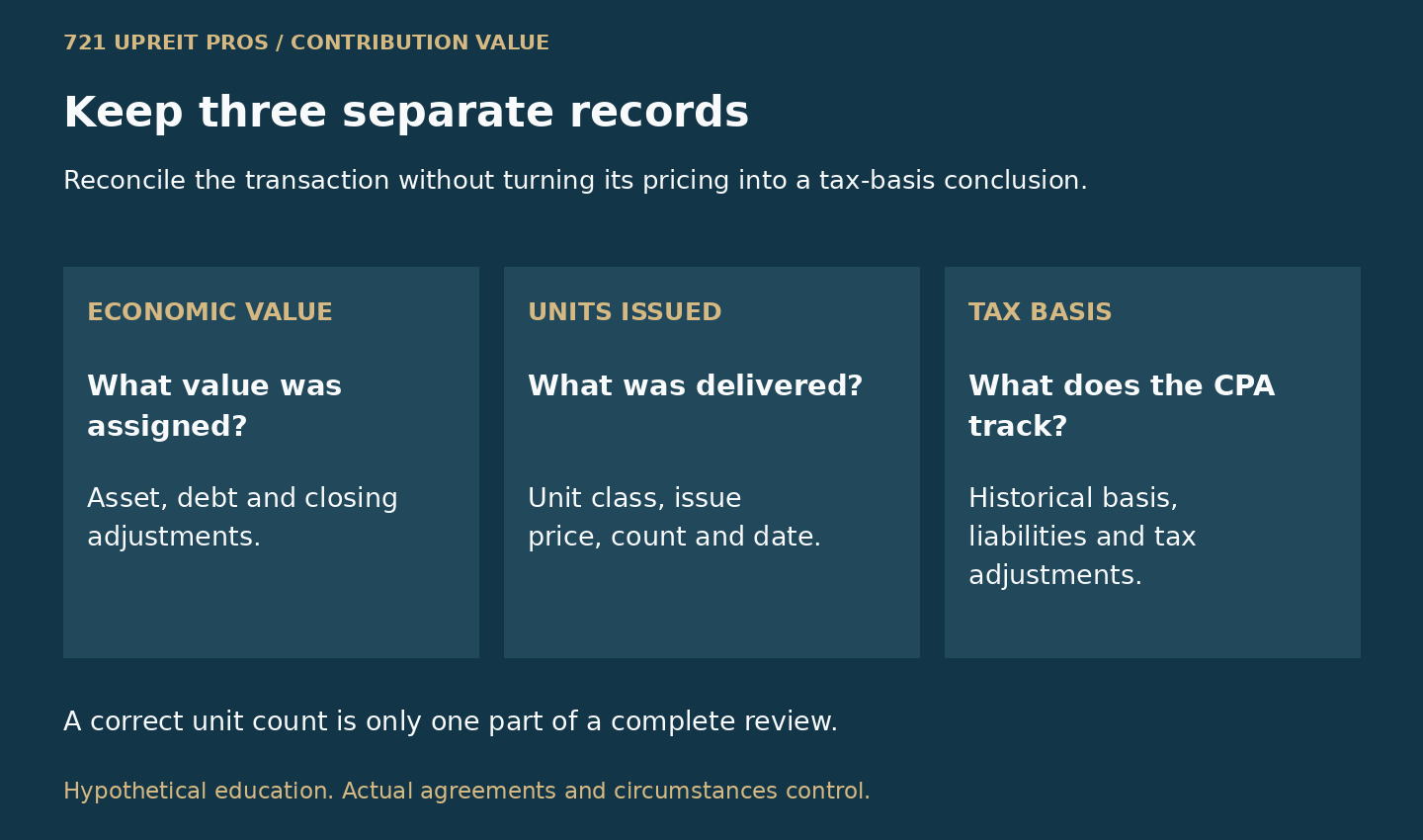
For a practical handoff, keep three folders or clearly separated schedules: the economic contribution statement, the unit issuance confirmation and the tax-basis records. Attach the earlier acquisition and exchange records where relevant. Do not overwrite historical basis with the latest portal value. This article does not calculate taxable gain, depreciation deductions or future tax consequences.
What should match when the units arrive?
The final contribution schedule and the custodian or partnership confirmation should reconcile by account, class, date and unit count. An estimate is not the final issuance record.
- Asset and owner: match the contributor and the asset or interest transferred.
- Economic amount: trace the final valuation and every adjustment to the signed documents.
- Consideration: separate units from any cash, holdback or contingent amount. Ask the CPA to analyze mixed consideration.
- Pricing: verify the unit class, price, method and effective date.
- Rounding: use the actual fractional-unit rule. Document any cash in lieu or adjustment rather than assuming ordinary rounding.
- Receipt: compare calculated units with delivered units and retain the statement.
- Open items: log unresolved differences, responsible parties and the agreement's notice or objection deadlines.
For example, the $27.50 scenario generates a repeating decimal. If a fictional system retained only four decimal places, 40,909.0909 units would multiply back to $1,124,999.99975. That tiny computational difference is a rounding issue. An unexplained $70,000 adjustment is an economic issue. Treat them differently, and follow the real agreement for both. A reader should not infer a right to object, a deadline or a rounding convention from this worksheet.
Download the contribution-to-units worksheet
Download the valuation worksheet
The worksheet has spaces for document references, gross-versus-net checks, investor allocation, unit class, pricing date, adjustments and final reconciliation. It includes the hypothetical example so you can follow the arithmetic, then replace every assumption with verified inputs. It is a preparation tool, not a valuation service.
Before treating issued units as accessible cash, read the redemption-request checklist and risk overview. Unit issuance does not guarantee future conversion, liquidity, distributions, returns or tax results.
Read video transcript
0:00 · How many OP units will you receive?
Start with the actual contribution agreement. Match the asset, valuation date and unit class. This example is hypothetical, not an offering.
0:12 · Reconcile the dollar amount first.
$2 million property value less $800,000 debt. Add $20,000; deduct $70,000 and $25,000. Assumed net value for units: $1,125,000.
0:24 · Then divide by the issue price.
$1,125,000 divided by $25 equals 45,000 units. Confirm which class and pricing date apply. Do not subtract debt twice from a net value.
0:36 · Check both sides of the fraction.
At $22.50 per unit, the same value buys 50,000. More units alone do not create more wealth. Confirm rounding and any later adjustments.
0:48 · Keep tax basis in a separate record.
Transaction value is not automatically tax basis. Reconcile the final units to the closing record. Bring the agreement and worksheet to your advisor.
Sources and editorial scope
Sources checked September 15, 2026: the linked November 3, 2025 BREIT agreement and Form 8-K, Section 721, and IRS Publication 541 (December 2025 revision). The examples, diagrams and worksheet are original hypothetical educational work by 721 UPREIT Pros. No named human expert review, client transaction or current offering quote is represented. Use current transaction-specific documents before acting.
BEFORE YOUR ADVISOR CONVERSATION
Three questions before you commit
This companion briefing covers the professional's identity, compensation and how restrictions fit your cash needs. Use it alongside this article's specific document checks.
Loading the video connects to YouTube. Watch on YouTube · 721 UPREIT Pros channel · Read the full advisor checklist.
Read video transcript
Before you hire a seven twenty-one UPREIT advisor, ask these three questions.
First: who exactly am I hiring? Get the professional's legal name, firm and registration information. Check the record through Investor dot gov and read the firm's relationship summary where applicable. Ask whether this conversation involves brokerage services, investment advice, or both. A marketing title alone does not answer that question.
Second: who gets paid, and how much? Request a written cost breakdown in dollars. Identify the payer, calculation base, payment timing and ongoing charges. Include product expenses and embedded compensation. No separate advisor invoice does not mean there are no costs.
Third: how does this fit my cash needs? Review the actual agreements. Ask who controls a possible conversion and what happens if it does not occur. Separate permission to request redemption from approval, pricing and payment. Do not assume a fixed cash-out date.
Then agree on responsibilities. Your investment professional, CPA, attorney and qualified intermediary can have different roles. Put continuing service and unresolved questions in writing.
Read the complete advisor checklist using the article link in the description. Seven twenty-one UPREIT Pros. Trust the Pros. Educational only. Investments involve risk and may be illiquid. Tax treatment depends on your circumstances.
Educational only. Investments involve risk and may be illiquid. Footage is illustrative; narration is synthetic.
TALK TO A 721 UPREIT ADVISOR
Ready to discuss your 721 options?
Request a callback to discuss the questions raised by this article, your timing and what to ask before you commit. Share your name, email and phone below to start the conversation.
No investment commitment or financial documents required. A callback request does not book an appointment or establish an advisory relationship.