
721 UPREIT PROS / ADVISOR SERVICE CONTINUITY
721 UPREIT Advisor Changes: Who Handles Your Account?
Changing a 721 UPREIT advisor does not automatically move your OP units, change their registered owner or create liquidity. Before signing transfer instructions, identify the issuer, servicing firm, custodian and tax contact. Obtain written acceptance and a responsibility checklist for holdings, fees, distributions, notices and pending requests through the handoff.
By 721 UPREIT Pros · Published October 23, 2026 · Original service-handoff matrix and worked example
Key takeaways
- Identify the actual service, custody or ownership change before signing forms.
- Obtain receiving-firm acceptance for the exact OP interest and service scope.
- Keep fees, payment instructions, notices and pending requests visible during the handoff.
- Close each task with written evidence; a service change does not create liquidity.
Start with the investment you already own. An operating-partnership interest may appear on a consolidated statement while its ownership record is maintained elsewhere. Ask where the units are registered and whether the proposed change concerns advice, brokerage servicing, custody, recordkeeping or ownership. Those are different instructions, even when one professional helps coordinate them.
The SEC's account-transfer bulletin explains that private-placement limited partnerships may be held at the issuer rather than the selling firm and may not transfer with ordinary brokerage assets. This is a reason to verify your particular arrangement, not a conclusion that every OP unit is nontransferable.
TALK TO A 721 UPREIT ADVISOR
Talk to a 721 UPREIT advisor
Request a callback to discuss the questions raised by this article, your timing and what to ask before you commit. Share your name, email and phone below to start the conversation.
No investment commitment or financial documents required. A callback request does not book an appointment or establish an advisory relationship.

What is actually changing in your 721 UPREIT relationship?
Write one sentence describing the requested change before completing forms: “I want a new professional to advise on an existing holding,” for example, or “I want the receiving firm to hold and service this identified interest.” A change in the person answering questions may require different documents from a transfer between custodians. An ownership assignment, redemption or exchange into another security introduces another decision.
Identify each legal entity and role. The issuer or its recordkeeper maintains the relevant ownership records. A broker-dealer may provide transaction or servicing functions. An investment adviser may provide agreed monitoring or planning. A custodian may hold assets or report positions. A CPA handles the tax engagement you agreed to. Confirm the actual arrangement instead of assigning all five responsibilities to the new advisor.
Use our advisor hiring questions to evaluate the professional and the 721 UPREIT risk framework for broader due diligence. Use this handoff checklist after identifying the proposed relationship. A change to the sponsor, adviser of the investment or operating-partnership controller belongs in the separate sponsor and management-change review.
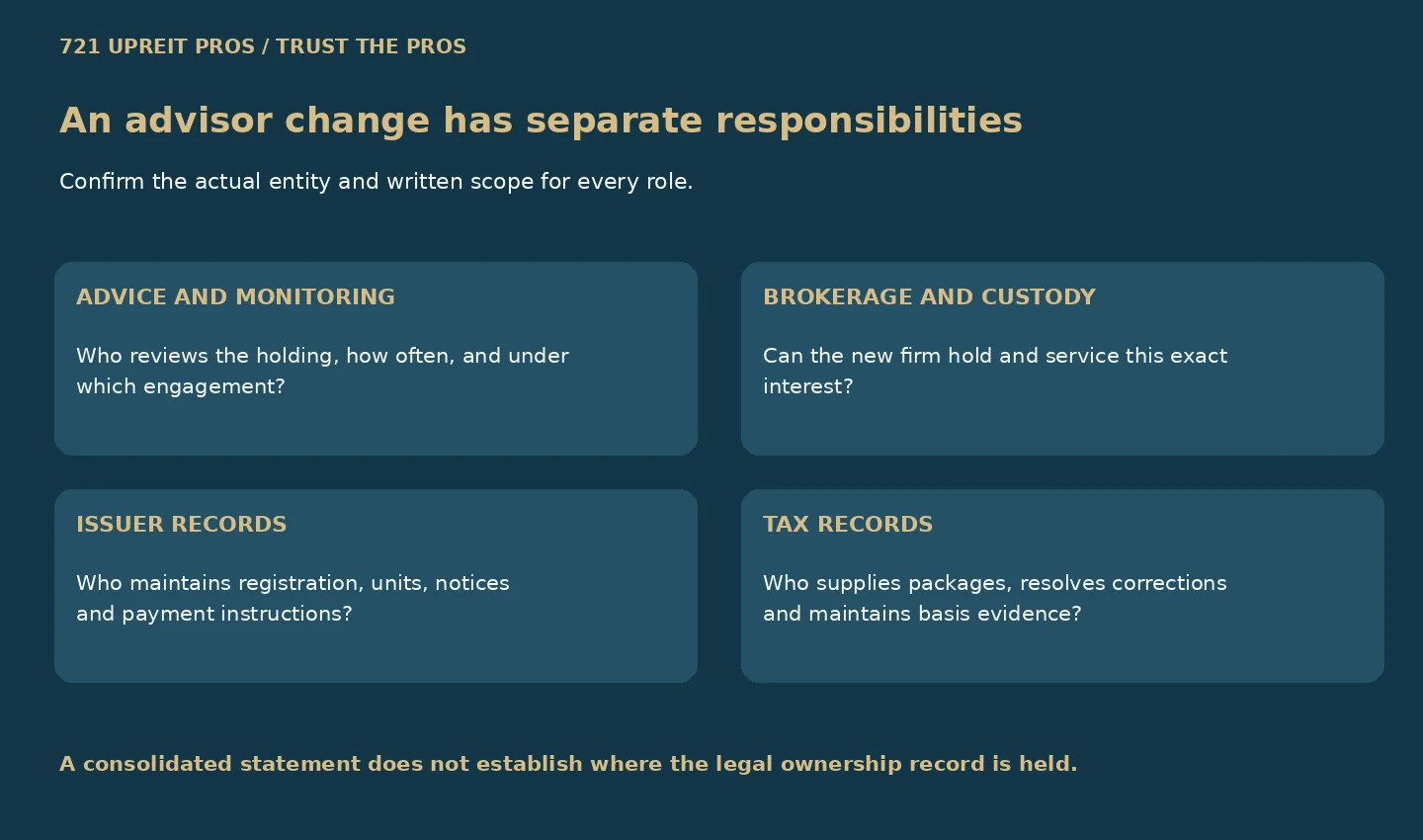
Will the new firm accept and service the existing OP units?
Ask the receiving firm for an asset-specific answer using the legal issuer, class, quantity and registration. “We work with alternative investments” does not confirm acceptance of your interest. Clarify whether the firm can hold the asset, display it as externally held, provide advice on it, service it through the issuer, or perform only some of those tasks.
FINRA Rule 11870 addresses customer-account transfers and nontransferable assets, including limited partnerships held directly in the customer's name. Its procedures do not make every private interest eligible for automated transfer. Ask both firms which process applies, what documents are needed and which holdings will remain outside the transfer. Avoid using a general transfer estimate as the completion date for your OP units.
| Task | Written evidence to request | Completion check |
|---|---|---|
| Ownership and registration | Issuer statement, class and quantity; location of legal record | Same holding reconciles across the relevant records |
| Receiving-firm acceptance | Asset-specific acceptance and scope of services | Firm confirms the tasks it can and cannot perform |
| Fees and monitoring | Old and new agreements, billing dates and fee bases | Overlap, termination and excluded holdings are resolved |
| Cash and distributions | Current payment instructions and any separate change request | Next payment is checked against the authorized destination |
| Open investor request | Original request, acknowledgment, deadline and responsible party | Issuer confirms status and any required further action |
| Tax and investor notices | Delivery contact, secure access and historical packages | Owner knows who will deliver and resolve missing records |
Which fees and service gaps should you resolve first?
Compare the old and new relationship agreements before terminating either. Ask whether an externally held OP interest is included in the advisory billing base, excluded from management, monitored for an additional charge or shown for information only. Record when old billing ends and new billing begins, any transfer or closure charge, and whether a reimbursement has conditions.
Investor.gov's Form CRS explanation describes the relationship summary's services, fees, conflicts and registration information. Read it with the actual engagement documents. A useful follow-up question is: “If these units remain registered with the issuer, what will you monitor, how will you obtain the information, and what will I pay?” Record the answer beside the fee schedule.
Keep investment-level expenses separate from the professional relationship. A new advisor's lower charge does not establish that sponsor, property or unit-class expenses changed. Our full-life fee ledger helps compare the complete cost picture. The related DST advisor questions on compensation and follow-up provide additional prompts if a DST interest is also part of the handoff.
What happens to distributions, notices and a pending redemption?
Do not bundle a servicing change with new banking instructions unless you intend both. Confirm who receives investor notices, where cash is sent and which party can change those settings. The SEC and FINRA holding-your-securities bulletin explains why issuer-held and brokerage-held records can produce different communication paths. Confirm your OP's actual recordkeeping and payment procedures separately.
If a redemption, distribution election or other request is pending, retain the submitted form, timestamp, acknowledgment, stated conditions and current status. Ask the issuer or administrator whether a professional change affects the contact person, authorization, deadline or further paperwork. A new advisor's welcome message is not confirmation that the issuer received or preserved an earlier request. The redemption-request checklist covers the separate request-to-payment process and its limits.
Maintain access to historical statements, contribution documents, tax-protection agreements and K-1 packages. Confirm who can supply a missing or corrected document after the handoff. The new firm's displayed value or cost field is not a substitute for the CPA's outside-basis records. IRS Publication 541 explains partnership basis and dispositions; use professional tax review if the proposed move includes a sale, distribution, ownership change or other transaction.
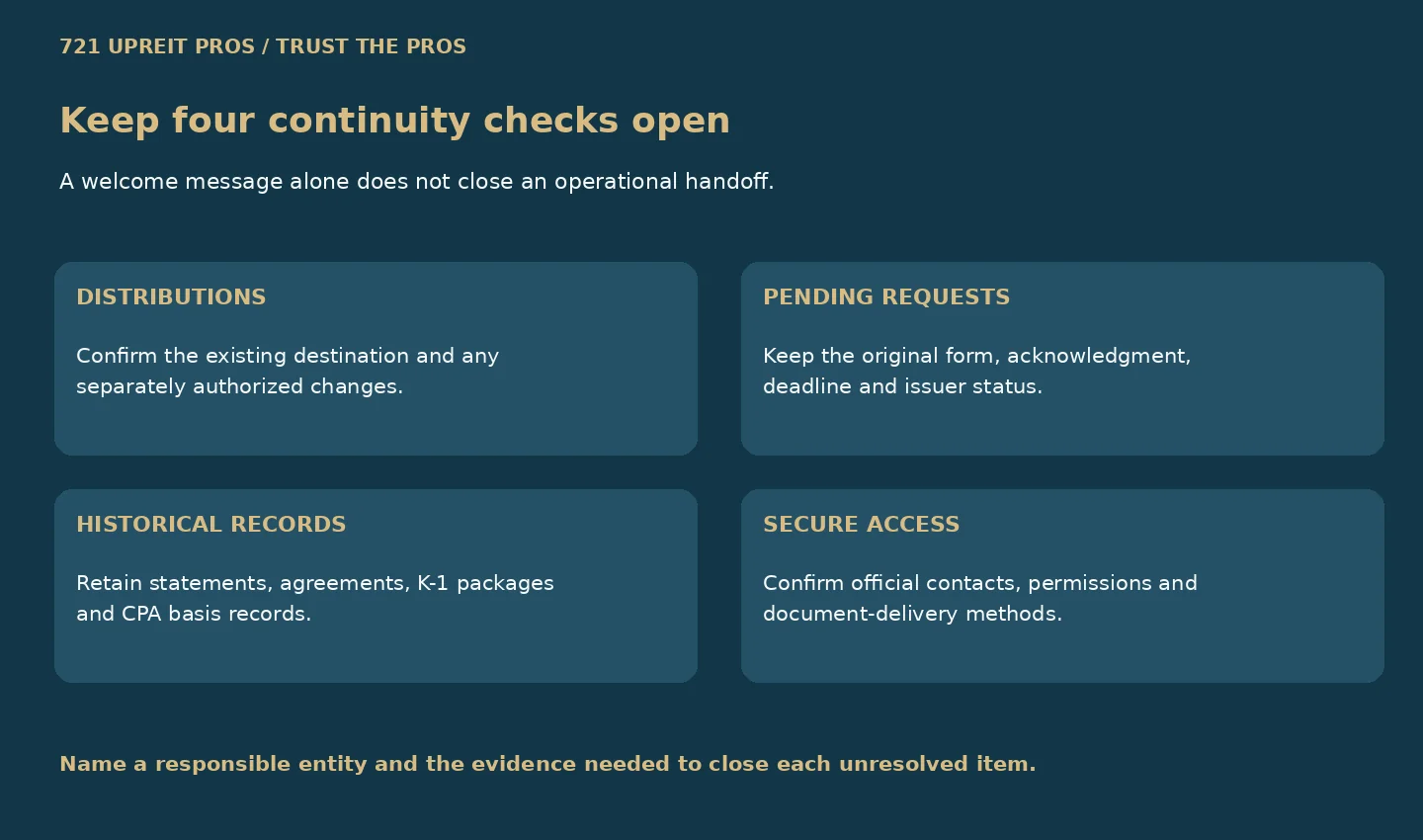
How would a partial handoff work in practice?
Consider a fictional investor with a brokerage account and 12,000 OP units registered directly with an issuer. The investor wants to work with a new advisor. The receiving firm accepts the brokerage assets but confirms that it will only display the OP units as an externally held position. The issuer requires a separate service-contact form. These assumptions illustrate a workflow, not a standard program policy.
The investor creates three completion rows. Row one tracks the brokerage transfer and reconciles the first new statement with the last old statement. Row two tracks the issuer's acknowledgment of the service-contact change while confirming the 12,000-unit registration and class. Row three names the professional responsible for monitoring the externally held interest under the new engagement.
Suppose a previously submitted redemption inquiry remains open and a distribution is due shortly. The investor obtains an issuer response identifying the request's status, checks that existing cash instructions remain in force and records who will investigate a missed notice. Until those items are resolved, the handoff is partly complete even if the brokerage account has moved. No units have been assumed sold, converted or made liquid by the service change.
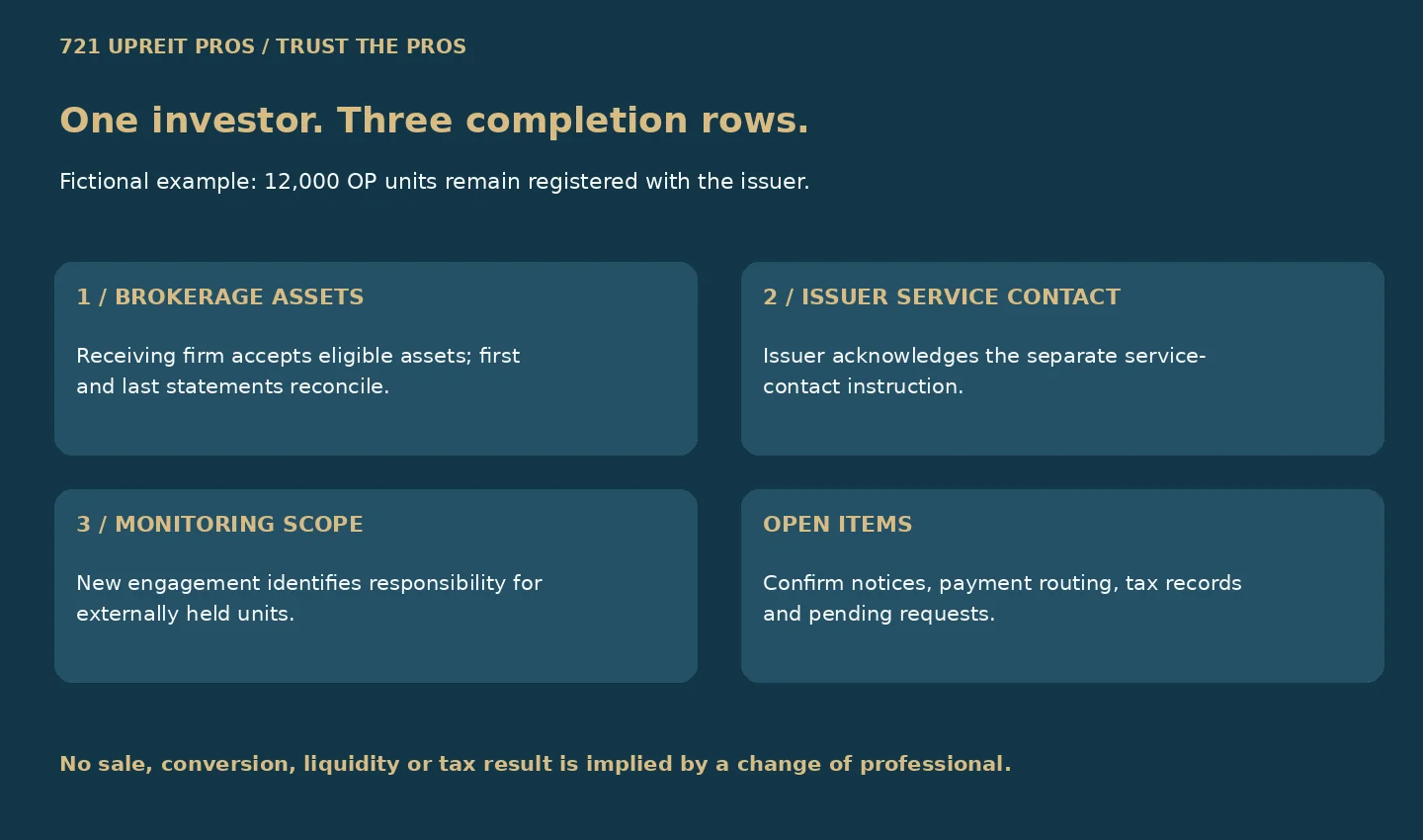
What should you confirm before closing the handoff file?
- Identify the legal holding, class, quantity, registered owner and recordkeeper.
- Describe the proposed service, custody or ownership change precisely.
- Obtain the receiving firm's acceptance, exclusions and monitoring scope.
- Reconcile fees, billing dates and any account left at the former firm.
- Preserve payment instructions and separately authorize intended changes.
- Assign each pending request, notice and tax-document issue to a named responsible entity.
- Compare the first post-change records with the last confirmed baseline and close only supported items.
Return to the 721 UPREIT investor guide if ownership stages are unclear. A property sale and qualifying Section 1031 exchange into a DST, a later Section 721 contribution for partnership units, and a subsequent advisor change are separate events. For related role definitions, see DST Experts' sponsor and adviser directory. Neither a service change nor a transfer request guarantees conversion, liquidity, distributions, returns or tax treatment.
Use the matrix to prepare your questions when you talk to a 721 UPREIT advisor. Share a summary of the unresolved tasks through the advisor callback pathway; provide sensitive account documents only through the receiving firm's verified secure process.
Watch the one-minute advisor-handoff review
This original silent video has English captions and the complete matching transcript below.
Read video transcript
0:00 · Changing your 721 UPREIT advisor?
Identify what is changing before signing transfer instructions.
0:12 · Map the responsibilities
Separate advice, servicing, custody and issuer ownership records.
0:24 · Confirm acceptance and fees
Ask about this exact holding, monitoring scope and billing dates.
0:36 · Preserve open requests
Check payments, notices, deadlines and historical tax documents.
0:48 · Close each row with evidence
Brokerage transfer and issuer service changes are separate checks.
Download the advisor service-handoff checklist
Primary sources checked October 23, 2026. The account-transfer bulletin is dated June 27, 2014; the holding-securities bulletin July 12, 2023; Publication 541 is revised December 2025. Current FINRA Rule 11870 and Investor.gov Form CRS guidance were also reviewed. Educational information, not individualized investment, tax or legal advice.
Frequently asked questions
Do my OP units automatically follow my advisor to a new firm?
No. Confirm where the units are registered, whether the new firm accepts the interest and what issuer forms apply. A professional's move does not establish that every holding transferred.
Can an advisor monitor OP units that stay with the issuer?
That depends on the firm's services and your engagement. Obtain written confirmation of monitoring responsibilities, information access, billing and exclusions for externally held interests.
Does changing the service contact change ownership?
Do not assume it does. Distinguish service-contact instructions from an assignment, ownership transfer, redemption or conversion. Ask the issuer which records and approvals each action requires.
Will distribution instructions move with the account?
Confirm the applicable procedure. Preserve current instructions and separately authorize any intended banking or election change. Check the next payment against the confirmed destination.
What happens to a pending redemption request?
Retain the original request and acknowledgment, then obtain the issuer's current status and any further requirements. Do not assume the advisor change preserves, cancels or accelerates it.
Should I sell units if the new firm cannot accept them?
A receiving firm's limitation alone does not determine whether to sell. Review available servicing arrangements, actual sale or redemption rights, costs and tax consequences with the appropriate professionals before deciding.
TALK TO A 721 UPREIT ADVISOR
Ready to discuss your 721 options?
Request a callback to discuss the questions raised by this article, your timing and what to ask before you commit. Share your name, email and phone below to start the conversation.
No investment commitment or financial documents required. A callback request does not book an appointment or establish an advisory relationship.