
721 UPREIT PROS / INVESTOR DECISIONS
Before a 721 UPREIT: build your cash-needs and control worksheet
A 721 UPREIT decision should start with the money you need to access, when you need it and which decisions you are willing to delegate. Build a dated cash plan before relying on a potential distribution, conversion or redemption.
By 721 UPREIT Pros · Published September 15, 2026 · Educational planning example
This worksheet turns broad priorities into a concrete advisor discussion. It is for investment-property owners considering passive real estate who want fewer operating responsibilities but still need to pay household expenses. It does not select an investment, calculate your exchange requirements or determine suitability. For definitions and the overall structure, start with the 721 UPREIT investor guide.
If the first question is how to leave day-to-day property management while evaluating a taxable sale, 1031 exchange, DST or Section 721 contribution, use the landlord-exit and tax-path decision matrix. Management relief and tax deferral require separate evidence.
TALK TO A 721 UPREIT ADVISOR
Talk to a 721 UPREIT advisor
Request a callback to discuss the questions raised by this article, your timing and what to ask before you commit. Share your name, email and phone below to start the conversation.
No investment commitment or financial documents required. A callback request does not book an appointment or establish an advisory relationship.

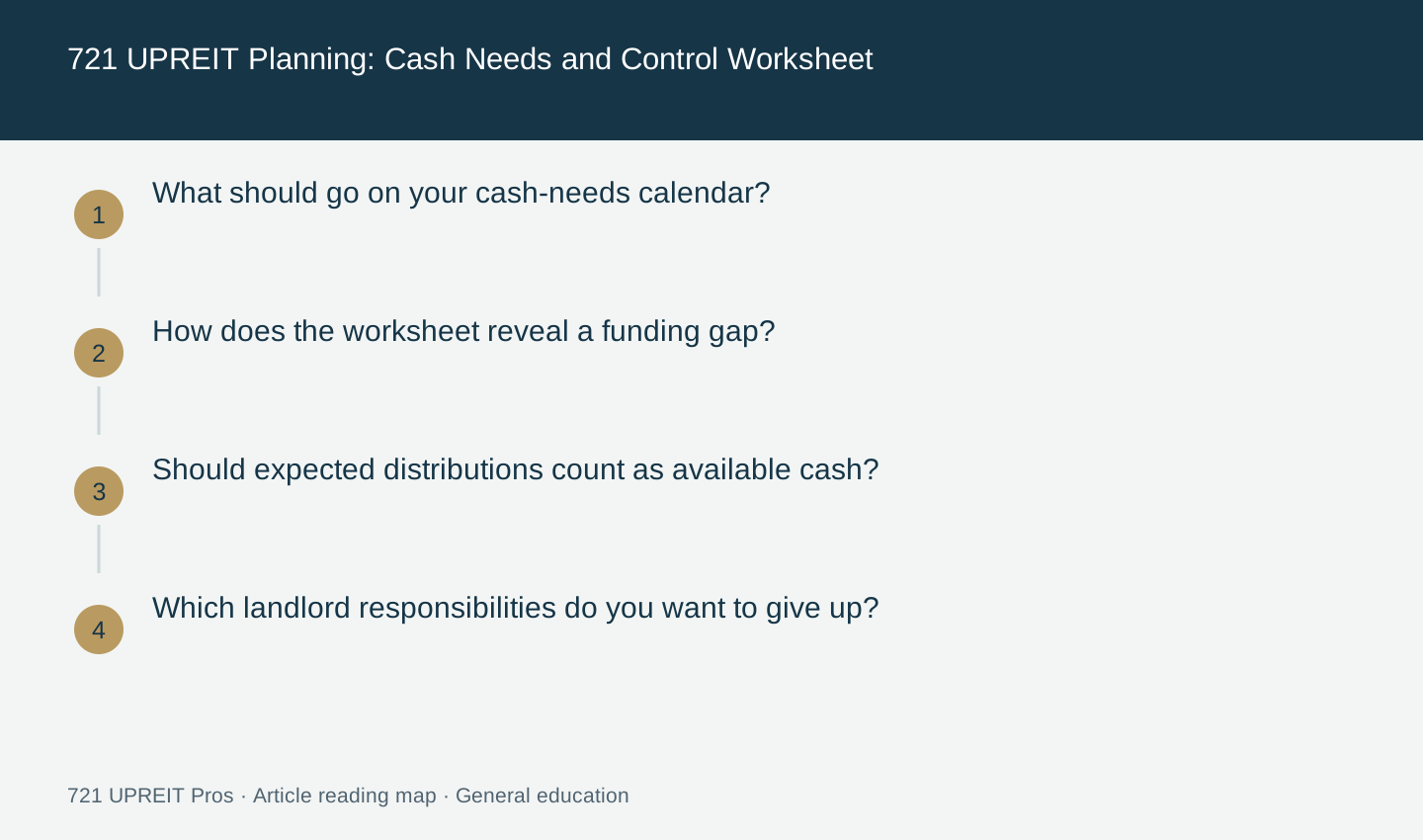
What should go on your cash-needs calendar?
Record each required payment, its due date, the source intended to fund it and whether that source is available when needed. A statement value or anticipated exit belongs in a separate column until its availability is established.
Start with household spending after dependable outside income, then add known one-time expenses. Keep an emergency reserve distinct from the money already earmarked for those payments. Specify whether your figures are before or after tax, and use the same basis for income and spending. Do not count the same savings account both as an emergency reserve and as funding for a scheduled expense.
Choose the planning horizon with your advisor. Twelve months below is an arithmetic example, not a recommended reserve duration. A property owner with uneven business income or substantial planned expenses may need a very different horizon. Investor.gov identifies time horizon and risk tolerance as important allocation inputs in its asset-allocation guidance.
| Entry | Write this down | Question to resolve |
|---|---|---|
| Amount | Estimated dollars and tax basis of the estimate | Is tax already included, or does it need a separate estimate? |
| Date | Month or exact payment deadline | Can the expense move if the investment cannot pay? |
| Funding source | A named account or dependable income source | Is the money accessible and already committed elsewhere? |
| Fallback | A practical alternative if the source fails | Does the fallback introduce debt, tax or another forced sale? |
How does the worksheet reveal a funding gap?
Before totaling available cash, label each proposed source: accessible outside cash, restricted exchange proceeds, contingent contribution payments, expected distributions or a proposed borrowing. Record who controls it, the earliest verified access date and what must happen first. A promised reimbursement or possible redemption is not interchangeable with an uncommitted bank balance. Keep unresolved access conditions visible beside the amount and due date.
Subtract available, uncommitted outside cash from the needs you have explicitly budgeted. Then test the result without assuming the proposed investment makes distributions or pays an exit request on time.
Consider a fictional household with $7,000 in monthly spending and $4,500 in dependable monthly outside income. Both figures are assumed to be after tax. The uncovered $2,500 per month totals $30,000 over twelve months. The household also expects a $20,000 expense in month nine and wants to retain a separate $25,000 emergency reserve. It has $60,000 of accessible outside cash, separate from any exchange proceeds and not pledged or committed to other needs.
| Input | Calculation | Dollars |
|---|---|---|
| Uncovered household spending | ($7,000 − $4,500) × 12 | $30,000 |
| Known month-nine expense | Assumed amount | $20,000 |
| Separate reserve to retain | Assumed floor | $25,000 |
| Total planned coverage | $30,000 + $20,000 + $25,000 | $75,000 |
| Uncommitted outside cash | Verified starting balance | $60,000 |
| Unfunded amount | $75,000 − $60,000 | $15,000 |
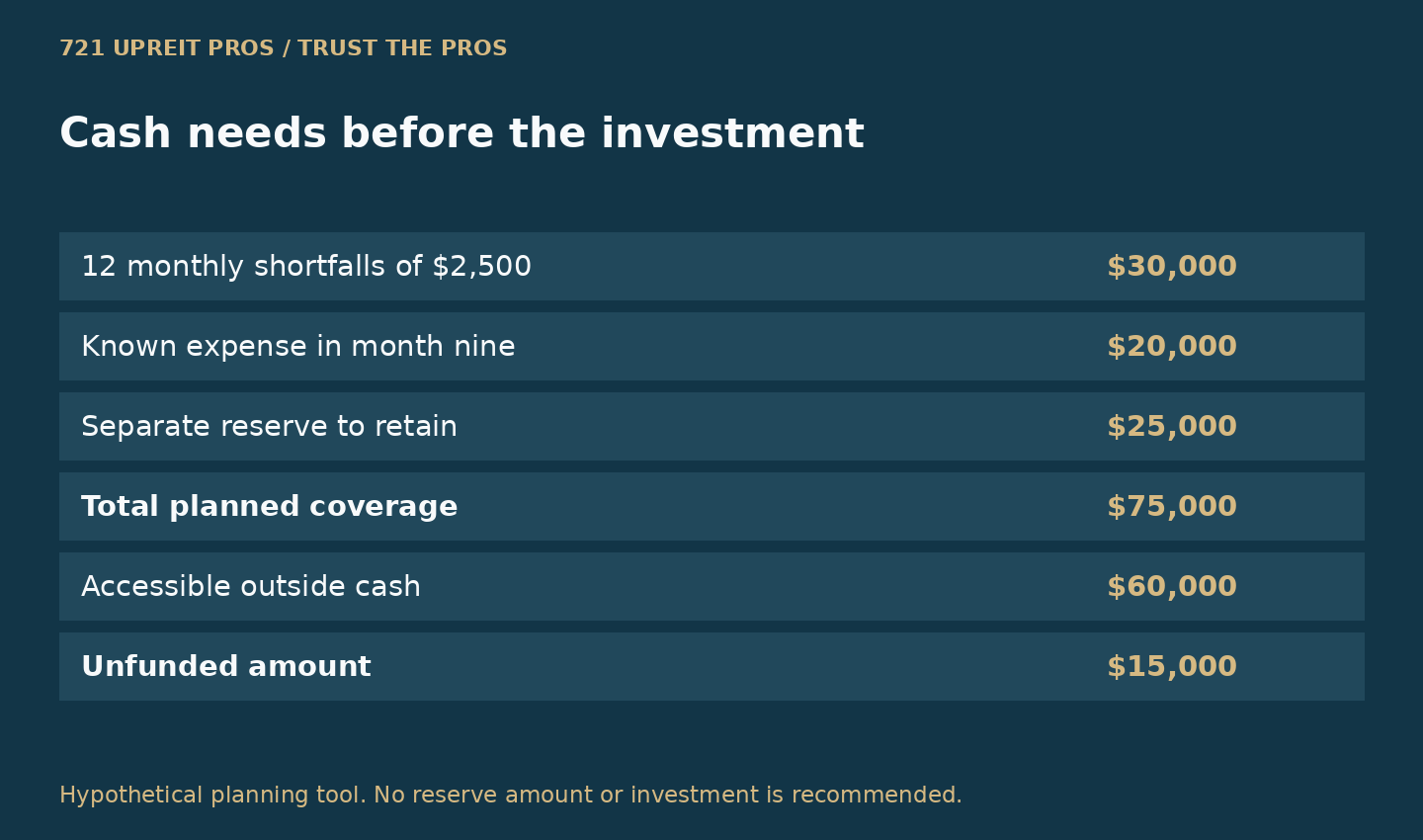
The gap does not establish that a 721 strategy is unsuitable. It establishes a specific unresolved funding question. The household could evaluate changing spending, postponing a discretionary expense, identifying another reliable source or reconsidering how much capital it can restrict. Each alternative has consequences that deserve its own review.
If the investor is deciding between a DST interest and a possible later OP-unit stage, use the retirement-income cash-source comparison to connect this household worksheet with the legal asset, distribution authority, principal-access terms and tax reporting.
Timing adds another insight. With no new investment distributions, the $60,000 falls to $37,500 after nine months of $2,500 shortfalls. Paying the $20,000 expense then leaves $17,500, below the assumed $25,000 reserve floor. The year-end gap is not the first warning: the month-nine payment is where this hypothetical plan first breaches that floor. Interest, inflation, tax changes and unplanned expenses are omitted, so this is a transparent starting worksheet rather than a complete forecast.
Should expected distributions count as available cash?
Show them separately and test the plan if they are reduced or absent. Expected distributions and a contractual ability to request redemption are different from cash already available in your account.
The SEC's REIT overview explains liquidity risks of non-traded REITs and notes that distributions can come from offering proceeds or borrowing. Those observations do not describe every OP-unit agreement or guarantee any particular distribution. Read the actual structure's documents.
For the fictional household, add three blank columns: the proposed distribution estimate, half that estimate and no distribution. Label the estimate's source, date, tax assumption and whether it is a target or historical figure. The zero-distribution version above isolates the question: can this household meet the selected obligations independently of this investment? A stress scenario is not a probability forecast.
If the plan depends on selling units or receiving shares, use the redemption request-to-cash checklist to examine the separate payment conditions. Do not put an assumed exit date into the available-cash column merely because an initial holding period has ended.
Which landlord responsibilities do you want to give up?
Review investment concentration separately from this spending plan. A pooled real-estate interest may spread property exposure while leaving a household heavily invested in the same sector or asset class. The 721 UPREIT diversification example compares original-property, sector and household weights without treating any of them as a promise of cash access.
Name the tasks you want to delegate and the decisions you still want to influence. Wanting relief from maintenance calls does not automatically mean you are comfortable surrendering control over sales, borrowing or the timing of an exit.
A building photograph shows the physical asset. It does not show an investor's legal rights. Depending on the ownership and management agreement, hiring a property manager may leave important decisions with a direct owner. A passive interest can allocate those decisions differently. Compare actual documents rather than assume every passive structure grants the same rights.
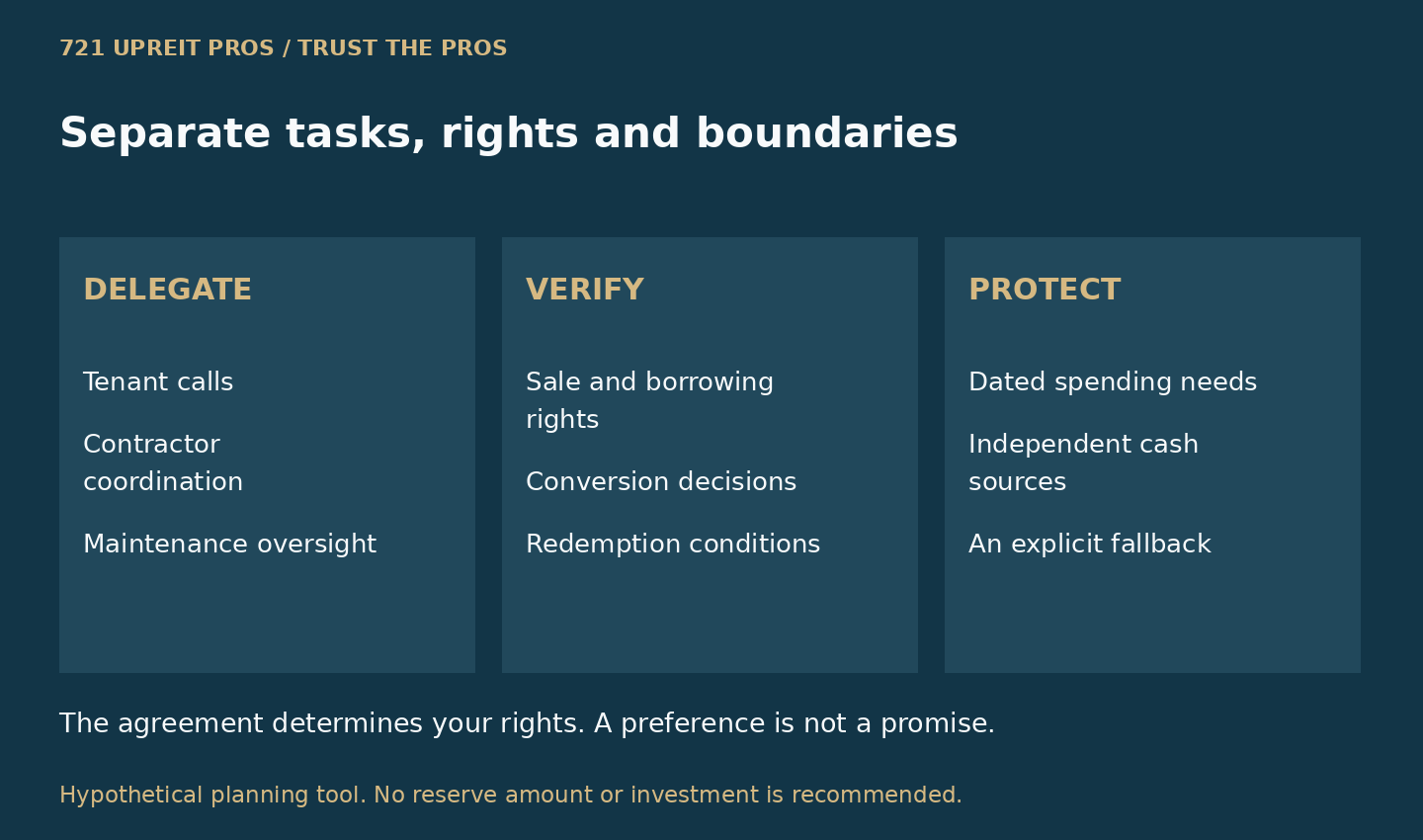
- Delegate: list concrete tasks such as tenant calls, contractor coordination and routine maintenance oversight.
- Verify: identify who may approve refinancing, property disposition, major capital spending and any conversion or redemption.
- Set boundaries: record the cash deadlines or other constraints you cannot accommodate if those decisions are outside your control.
For each boundary, add an evidence field. “I want access in two years” is a preference. “My tuition payment is due in August, funded from this separate account” is a plan. “The sponsor usually does a conversion” is not a verified right. The conversion decision-rights guide helps locate the relevant provisions without duplicating them here.
Can you simply keep exchange proceeds to fill the gap?
Do not treat exchange proceeds as unrestricted outside cash without resolving the exchange and tax consequences first. Cash received in an otherwise qualifying exchange can create recognized gain. The IRS like-kind exchange guidance explains that money or non-like-kind property received can require gain recognition.
The $60,000 in this article is expressly outside the exchange. If your only reserve source would be sale proceeds, bring that conflict to your qualified intermediary and CPA before choosing a replacement strategy. This worksheet does not calculate boot, debt replacement, basis or the amount you must reinvest. Review the transaction sequence and the related DST Experts guide to the potential DST-to-721 pathway for context. A 1031 exchange, a DST investment and a later Section 721 contribution are distinct steps, not interchangeable labels or guaranteed outcomes.
What should you bring to the advisor conversation?
Bring one dated page of numbers and unresolved decisions, supported by the relevant statements and agreements. Keep sensitive account details in your own secure records rather than placing them in a public form.
Download the cash and control worksheet
The worksheet includes monthly shortfalls, expense dates, reserve assumptions, double-counting checks, distribution scenarios and control boundaries. Mark each input verified, estimated or unknown. Assign an owner and follow-up date to every unknown that could change the decision.
Watch: build the plan before choosing the structure
One-minute silent explainer with on-screen text and English captions. Hypothetical educational example.
Read video transcript
0:00 · Start with your cash calendar.
List household shortfalls and dated expenses. Keep the emergency reserve separate. Verify each funding source before committing.
0:12 · Work a simple coverage example.
$30,000 shortfall plus a $20,000 expense. Add a separate $25,000 reserve. Total planned coverage is $75,000.
0:24 · Find the gap and its timing.
$60,000 outside cash leaves a $15,000 gap. In this example the reserve falls short in month nine. No investment distribution is assumed.
0:36 · Separate tasks from decision rights.
List the landlord tasks you want to delegate. Verify who controls sales, debt and your exit. Write down the constraints you cannot change.
0:48 · Bring the worksheet to your advisor.
Label every input verified, estimated or unknown. Review exchange cash with your QI and CPA. Do not assume a conversion or cash payment.
Sources and scope
Sources checked September 15, 2026: the linked SEC Investor.gov REIT and asset-allocation explanations and IRS like-kind exchange guidance. The household, arithmetic, diagrams and worksheet are original hypothetical educational material. No client case, investment result or named human expert review is represented. Investments can lose value; distributions, liquidity, conversion and tax outcomes are not guaranteed.
BEFORE YOUR ADVISOR CONVERSATION
Three questions before you commit
This companion briefing covers the professional's identity, compensation and how restrictions fit your cash needs. Use it alongside this article's specific document checks.
Loading the video connects to YouTube. Watch on YouTube · 721 UPREIT Pros channel · Read the full advisor checklist.
Read video transcript
Before you hire a seven twenty-one UPREIT advisor, ask these three questions.
First: who exactly am I hiring? Get the professional's legal name, firm and registration information. Check the record through Investor dot gov and read the firm's relationship summary where applicable. Ask whether this conversation involves brokerage services, investment advice, or both. A marketing title alone does not answer that question.
Second: who gets paid, and how much? Request a written cost breakdown in dollars. Identify the payer, calculation base, payment timing and ongoing charges. Include product expenses and embedded compensation. No separate advisor invoice does not mean there are no costs.
Third: how does this fit my cash needs? Review the actual agreements. Ask who controls a possible conversion and what happens if it does not occur. Separate permission to request redemption from approval, pricing and payment. Do not assume a fixed cash-out date.
Then agree on responsibilities. Your investment professional, CPA, attorney and qualified intermediary can have different roles. Put continuing service and unresolved questions in writing.
Read the complete advisor checklist using the article link in the description. Seven twenty-one UPREIT Pros. Trust the Pros. Educational only. Investments involve risk and may be illiquid. Tax treatment depends on your circumstances.
Educational only. Investments involve risk and may be illiquid. Footage is illustrative; narration is synthetic.
TALK TO A 721 UPREIT ADVISOR
Ready to discuss your 721 options?
Request a callback to discuss the questions raised by this article, your timing and what to ask before you commit. Share your name, email and phone below to start the conversation.
No investment commitment or financial documents required. A callback request does not book an appointment or establish an advisory relationship.