
LIQUIDITY / PENDING REQUEST CHECKLIST
UPREIT redemption request pending? Check these six gates before relying on cash
A submitted redemption request is not the same as an approved cash payment. Confirm eligibility, receipt, response, settlement form, pricing and payment before assigning the expected proceeds to a spending plan.
By 721 UPREIT Pros · Published September 14, 2026 · General investor education

The direct answer
Ask for written confirmation of the request's current status and the agreement section controlling the next event. Record whether the request is eligible, when it was received, who can approve or reduce it, whether settlement may be cash or REIT shares, the valuation date and the earliest contractual payment date. Until those questions are resolved, treat the amount and timing as uncertain.
This guide is for an investor who owns operating partnership units and has submitted, or expects to submit, a redemption request. It supports the 721 risk and due-diligence page. If you need the broader ownership distinctions first, use the 721 UPREIT guide and advisor planner.
TALK TO A 721 UPREIT ADVISOR
Talk to a 721 UPREIT advisor
Request a callback to discuss the questions raised by this article, your timing and what to ask before you commit. Share your name, email and phone below to start the conversation.
No investment commitment or financial documents required. A callback request does not book an appointment or establish an advisory relationship.
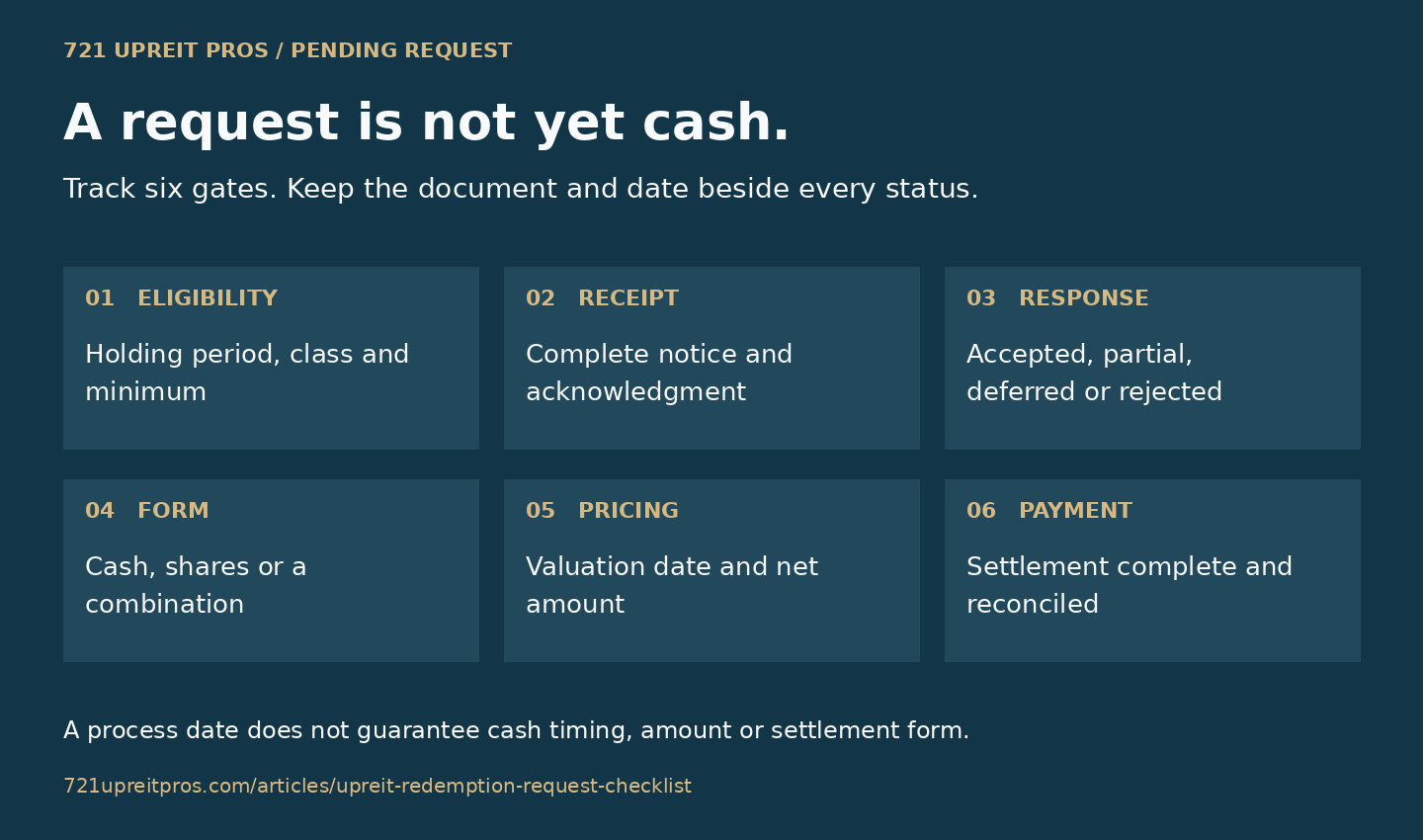
Watch: a request is not yet cash
Original 60-second silent explainer with on-screen text, English captions and a complete transcript.
What are the six gates between a request and spendable cash?
| Gate | Question to resolve | Evidence to keep |
|---|---|---|
| 1. Eligibility | Has the holding period ended, is the unit class eligible, and do minimum or frequency rules apply? | Current partnership agreement, side letter, unit schedule and account statement |
| 2. Receipt | Did the correct party receive a complete notice through the required delivery method? | Signed notice, delivery proof, acknowledgment, unit count and account details |
| 3. Response | Must the partnership respond by a stated date, and can it accept only part or none of the request? | Written response, allocation notice, queue or capacity policy and governing provision |
| 4. Settlement form | Who chooses cash, REIT shares or a combination? Are the shares listed, non-traded or restricted? | Election notice, partnership agreement, share-class terms and transfer restrictions |
| 5. Pricing | Which valuation date and formula apply? Can deductions, withholding or later adjustments change the net amount? | NAV or pricing notice, calculation worksheet, tax forms and fee schedule |
| 6. Payment | What is the specified settlement date, can it be delayed, and when are funds actually available? | Settlement confirmation, wiring instructions verified independently and bank receipt |
A request can be validly delivered and still leave the dollar amount or settlement form unresolved. Keep each status separate. “Received” should not be translated into “approved,” and “approved for redemption” should not be translated into “cash available.”
Which document controls the request?
Start with the agreement attached to the units you actually own. The partnership agreement may be supplemented by a contribution agreement, side letter, unit-class designation or later amendment. A REIT share repurchase plan is not automatically the same as an OP-unit redemption provision. If OP units are exchanged for REIT shares, a later sale or share repurchase can create another process with different limits and tax consequences.
Use the DST-to-721 document checklist to locate the full package. Record the provision and revision date beside every answer. A portal status or representative's email is useful evidence of administration, but it does not silently replace the governing terms.
Publicly traded REIT shares, non-traded REIT shares and restricted OP units can have different exit paths. Investor.gov cautions that non-traded REIT shares generally cannot be sold readily on an open market. Read the SEC's REIT overview. That general risk statement still does not determine your agreement.
Two public agreements show why generic timelines fail
These dated SEC-filed agreements are structural examples, not current offering recommendations or promises about any investor's units.
| Example | Selected terms | Planning lesson |
|---|---|---|
| Core University Living REIT OP agreement, May 14, 2026 | Section 8.5 describes at least a one-year holding period for ordinary limited partners, a notice process, a response within 15 days, general-partner choice of cash, shares or both, no more than two notices per calendar year for ordinary limited partners, and a 1,000-unit minimum unless all units are tendered. Its quarterly definition of the specified redemption date changes depending on whether notice arrives within the first 45 days of the quarter. A cash settlement date can be delayed up to an additional 180 days when financing is required under the stated provision. | A known waiting period does not establish the settlement date. Frequency, minimums, response, settlement form and delay rights each need a separate row. |
| Brookfield REIT Operating Partnership agreement, September 25, 2024 | Section 8.5 describes a request after twelve full months for ordinary limited partners, but states that the partnership may redeem some or none of their tendered units in the general partner's discretion. It describes a written response within 15 days and a specified date based on 45 days after receipt and later month-end timing. Cash settlement is described within three business days after the specified date for U.S. accounts. | A detailed timetable can coexist with discretion to fulfill only part or none of a request. Process dates and payment certainty are different questions. |
Sources: Core University Living REIT OP agreement, Exhibit 10.5 and Brookfield REIT Operating Partnership agreement, Exhibit 10.2. Read each complete agreement and later amendments before applying a term.
Worked timeline: one delivery date can change the quarter
Consider the Core University Living agreement solely as a public-document exercise. Its defined term says a notice received within the first 45 days of a calendar quarter uses the first business day of the next quarter as the specified redemption date. A notice received later uses the first business day of the second succeeding quarter.
- Illustrative notice received October 20, 2026: this falls within the first 45 days of the fourth quarter, so the defined date points to the first business day of the first quarter of 2027.
- Illustrative notice received November 20, 2026: this falls after the quarter's first 45 days, so the defined date points to the first business day of the second quarter of 2027.
The one-month change in delivery date moves the defined date by a quarter under this example. It does not establish that cash will be paid then. Eligibility, a complete notice, the response, settlement form, legal restrictions and the agreement's possible financing delay still need review. Calendar calculations should also respect the agreement's business-day definition and any amendments.
Do not import these dates into another sponsor's process. The Brookfield example uses a different formula. Build the timeline from the defined terms in your own documents, and ask the administrator to confirm it in writing.
How should you track a pending request?
Use a status log instead of a single estimated payment date. The downloadable worksheet below provides one row per event. At minimum, record:
Eligibility confirmed
List the original issuance or contribution date, end of any holding period, unit class, minimum unit amount and remaining number of requests allowed. Note who confirmed the calculation and the document supporting it.
Complete notice acknowledged
Record the units tendered, delivery method, recipient, received timestamp and confirmation number. Ask whether a missing tax form, ownership representation, signature or account instruction can prevent completion.
Response due and received
Calculate the response date from the actual agreement. Record accepted, partially accepted, deferred, rejected or still pending. If only part is accepted, retain the exact allocation and ask whether the balance remains in a queue or requires a new notice.
Settlement form selected
Name the party with the choice. Record cash, the exact REIT share class, or a combination. If shares will be delivered, do not call that cash. Ask where the shares will be held and what sale or repurchase restrictions apply next.
Value and net proceeds calculated
Record the valuation date, units accepted, price or formula, fees, withholding and expected net amount. Keep an estimate labeled as an estimate until the final statement arrives.
Settlement completed
Confirm the actual date and form delivered. Verify wiring instructions through an established contact before sending account information. Reconcile the bank or custody receipt to the final statement, then send the transaction record to the CPA.
What if the response offers REIT shares instead of cash?
Identify whether the documents give you, the partnership, the general partner or another party the settlement choice. Then identify the share class, number or formula, valuation date, registration status, listing status, custody process and transfer restrictions. Shares in a listed REIT may have market liquidity after delivery and subject to restrictions, but their market price can change. Shares in a non-traded REIT are not equivalent to exchange-listed stock and may depend on a separate repurchase plan with its own capacity and suspension provisions.
Do not assume that one share received for one OP unit produces the same dollars as the prior account statement. Verify the class and the agreement's conversion or redemption formula. If part is cash and part is shares, maintain two settlement rows and ask the CPA to analyze each component.
What if the request is reduced, delayed or not fulfilled?
Ask for the cited provision and the status of the untendered or unfulfilled units. Questions include whether the remainder carries forward, returns to the account automatically, loses priority, or requires a new notice. Confirm whether a rejected request counts against an annual frequency limit and whether distributions continue on the units that remain outstanding.
If the expected cash is tied to taxes, health care, a property closing or another dated obligation, arrange a separate source of liquidity. Do not borrow, commit funds or waive another option solely because a request was acknowledged. A redemption process may create a path to liquidity, but it is not the same as a cash reserve.
What should the CPA review before settlement?
Ask the CPA to reconcile adjusted basis, partnership liabilities, prior distributions and the proposed form of settlement. Section 721 generally addresses gain or loss on a qualifying property contribution for a partnership interest, subject to exceptions. It does not make later cash, share delivery or sale automatically tax-free. Read Section 721 and use IRS Publication 541 for general partnership tax background.
If the original path involved a 1031 exchange into a DST, keep that earlier transaction separate from the later OP-unit redemption analysis. For broader background on both stages, review DST Experts' 721 UPREIT guide. A tax-deferred earlier transaction does not supply a universal rule for later cash access.
Download the pending-request tracker
Download the redemption-request tracker
Complete the tracker with the current agreements and keep it beside the signed notice, response and final settlement record. Bring the unresolved items to your attorney, CPA and advisor. Do not send sensitive tax documents, signatures or bank instructions through an unverified channel.
Read video transcript
0:00 · A request is not yet cash.
Received is not approved. Approved may not mean cash. Track each status separately.
0:12 · Start with eligibility and receipt.
Confirm the holding period and unit class. Keep the complete notice and acknowledgment. Record the agreement section beside the date.
0:24 · Then document the response.
Accepted, partial, deferred, rejected or pending? Ask what happens to units not fulfilled. A process date is not a guaranteed payment.
0:36 · Confirm form and pricing.
Who chooses cash, shares or a combination? Which valuation date and formula apply? Listed and non-traded shares are not the same.
0:48 · Close only when settlement arrives.
Reconcile cash or shares to the final statement. Send records to the CPA. Keep a separate plan for time-sensitive cash needs.
Sources and review limits
Primary references were checked September 14, 2026. The public SEC-filed agreements are dated examples of different contract terms, not sponsor comparisons, current offering quotes or interpretations of an investor's actual rights. The timeline, status map and tracker are original educational tools. No named human legal, tax or financial expert review is claimed. Read the complete current agreements and obtain appropriate professional advice. Investments can lose value. Redemption, settlement form, liquidity, value and tax outcomes are not guaranteed.
BEFORE YOUR ADVISOR CONVERSATION
Three questions before you commit
This companion briefing covers the professional's identity, compensation and how restrictions fit your cash needs. Use it alongside this article's specific document checks.
Loading the video connects to YouTube. Watch on YouTube · 721 UPREIT Pros channel · Read the full advisor checklist.
Read video transcript
Before you hire a seven twenty-one UPREIT advisor, ask these three questions.
First: who exactly am I hiring? Get the professional's legal name, firm and registration information. Check the record through Investor dot gov and read the firm's relationship summary where applicable. Ask whether this conversation involves brokerage services, investment advice, or both. A marketing title alone does not answer that question.
Second: who gets paid, and how much? Request a written cost breakdown in dollars. Identify the payer, calculation base, payment timing and ongoing charges. Include product expenses and embedded compensation. No separate advisor invoice does not mean there are no costs.
Third: how does this fit my cash needs? Review the actual agreements. Ask who controls a possible conversion and what happens if it does not occur. Separate permission to request redemption from approval, pricing and payment. Do not assume a fixed cash-out date.
Then agree on responsibilities. Your investment professional, CPA, attorney and qualified intermediary can have different roles. Put continuing service and unresolved questions in writing.
Read the complete advisor checklist using the article link in the description. Seven twenty-one UPREIT Pros. Trust the Pros. Educational only. Investments involve risk and may be illiquid. Tax treatment depends on your circumstances.
Educational only. Investments involve risk and may be illiquid. Footage is illustrative; narration is synthetic.
TALK TO A 721 UPREIT ADVISOR
Ready to discuss your 721 options?
Request a callback to discuss the questions raised by this article, your timing and what to ask before you commit. Share your name, email and phone below to start the conversation.
No investment commitment or financial documents required. A callback request does not book an appointment or establish an advisory relationship.