
721 UPREIT PROS / EXCHANGE COORDINATION
1031 closing handoff checklist: who confirms what before a DST purchase?
Before either closing, put the taxpayer, deadlines, identification, funding instructions and proof of ownership in one handoff record. Assign a named professional to each unresolved item and retain their confirmation. A potential later 721 UPREIT contribution does not complete today's 1031 exchange.
By 721 UPREIT Pros · Published September 16, 2026 · Educational coordination tool
This checklist is for an investment-property owner pursuing a forward deferred exchange into a potential DST replacement. Its purpose is to prevent a task from falling between the qualified intermediary (QI), closing agent, tax professional and investment advisor. It is not a legal closing instruction, an identification notice or a tax opinion. Reverse exchanges, construction exchanges and complex ownership changes need their own professional plan.

Who owns each closing handoff?
The investor coordinates the open-item list, while each professional confirms the matters within their engagement. A QI's exchange administration is not an advisor's investment recommendation, and neither substitutes for tax counsel's analysis.
TALK TO A 721 UPREIT ADVISOR
Talk to a 721 UPREIT advisor
Request a callback to discuss the questions raised by this article, your timing and what to ask before you commit. Share your name, email and phone below to start the conversation.
No investment commitment or financial documents required. A callback request does not book an appointment or establish an advisory relationship.
Ask each participant to accept their role before relying on the table below. It is a proposed responsibility map, not a description of every firm's services. Where two people share a task, designate one person to collect the final evidence. “The team is handling it” leaves no clear recipient for a missing document.
| Checkpoint | Ask these participants | Evidence to retain |
|---|---|---|
| Seller and replacement owner | Tax professional, counsel and closing agent | Exact taxpayer/entity names and written resolution of any ownership mismatch |
| Exchange setup before sale | QI and sale closing agent | Executed exchange documents, required assignments/notices and agreed proceeds instructions |
| Deadline calendar | QI and tax preparer | Confirmed transfer date, identification date, exchange end date and return-extension assumption |
| Replacement identification | Investor and QI or other permitted recipient | Final signed notice, property description, delivery evidence and acknowledgment |
| Replacement readiness | Advisor, sponsor/transfer team, QI and closing agent | Accepted documents, available allocation, funding requirements and outstanding conditions |
| Completed acquisition and tax file | Closing/transfer team and tax preparer | Evidence of receipt/ownership, final statements and reconciled transaction records |
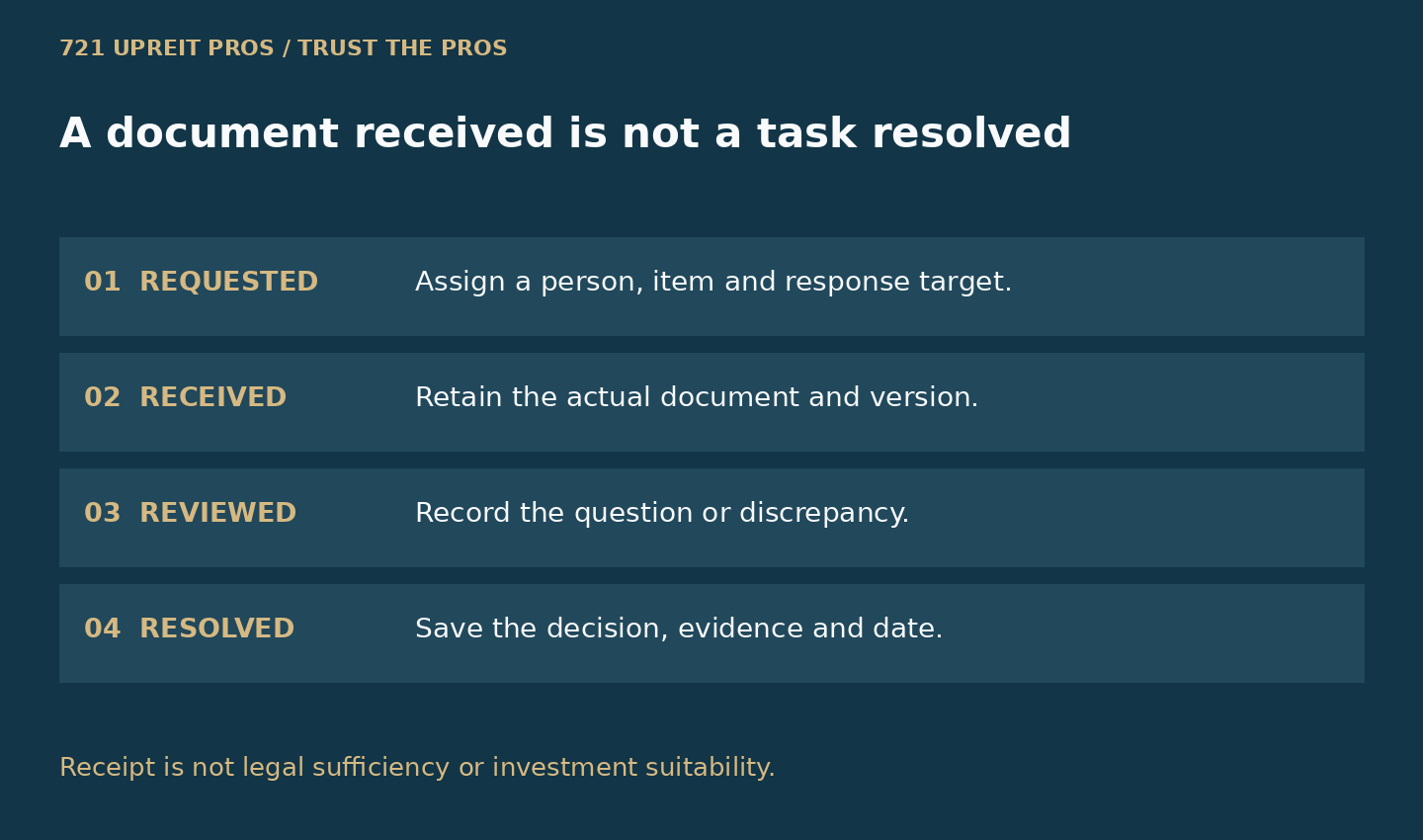
Use four statuses: requested, received, reviewed and resolved. A file arriving in an inbox is not evidence that an inconsistency has been resolved. Record the decision, responsible person and timestamp next to the document version.
What needs to happen before the relinquished-property closing?
Have the exchange professionals finalize the intended structure and proceeds handling before the property transfers. Do not assume a normal sale followed by reinvestment can be relabeled as an exchange afterward.
The IRS explains that actual or constructive receipt of proceeds can undermine deferred-exchange treatment. Its like-kind exchange fact sheet also describes written identification and delivery requirements. This older fact sheet is used only for these procedural points, alongside the current Form 8824 instructions below, not its pre-2018 personal-property discussion.
- Give the QI the current contract and closing contact, then ask what documents and notices must be completed before transfer.
- Ask the closing agent to confirm the transaction's proceeds instructions with the QI. Do not independently redirect exchange money to a personal account.
- Resolve spelling, entity and ownership discrepancies with the tax/legal team. A marketing name, trust name and taxpayer identity may not be interchangeable.
- Confirm the actual transfer date after closing. If the scheduled date changes, replace the provisional calendar and notify every person using it.
- Retain the final sale statement, debt payoff details and exchange account record through the team's secure channel.
A practical control is a short pre-closing call with a written unresolved-items list. Set an internal response target earlier than the legal deadline, leaving time for corrections. That target is a workflow choice, not an extension of a tax deadline.
How does a dated handoff calendar work?
Start both exchange clocks from the actual transfer date, then ask the tax preparer whether the tax-return deadline shortens the exchange period. Do not add 180 days after the identification period.
The IRS Instructions for Form 8824 (2025), Deferred Exchanges, available when checked September 16, 2026, state the 45-day identification requirement and receipt by the earlier of 180 days or the tax-return due date, including extensions. Have your professionals confirm any applicable special relief and the precise dates for your taxpayer.
| Event | Example date | Handoff question |
|---|---|---|
| Relinquished property transfers | September 16, 2026 | Does the closing evidence establish this actual transfer date? |
| 45 calendar days later | October 31, 2026 | Who receives the signed identification, through what channel, with what evidence? |
| 180 calendar days later | March 15, 2027 | Is an earlier return due date controlling? Is an extension relevant and valid? |
| Assumed planned replacement receipt | December 10, 2026 | Which documents establish receipt, rather than merely an application or wire? |
For this example only, assume the applicable tax-return due date is later than March 15, 2027, there is no special relief, and one relinquished property is involved. October 31 is 45 days after September 16; March 15 is 180 days after it. The planned December 10 receipt is a fictional operational target, not a promise of allocation or closing. A calendar entry alone establishes none of those facts.
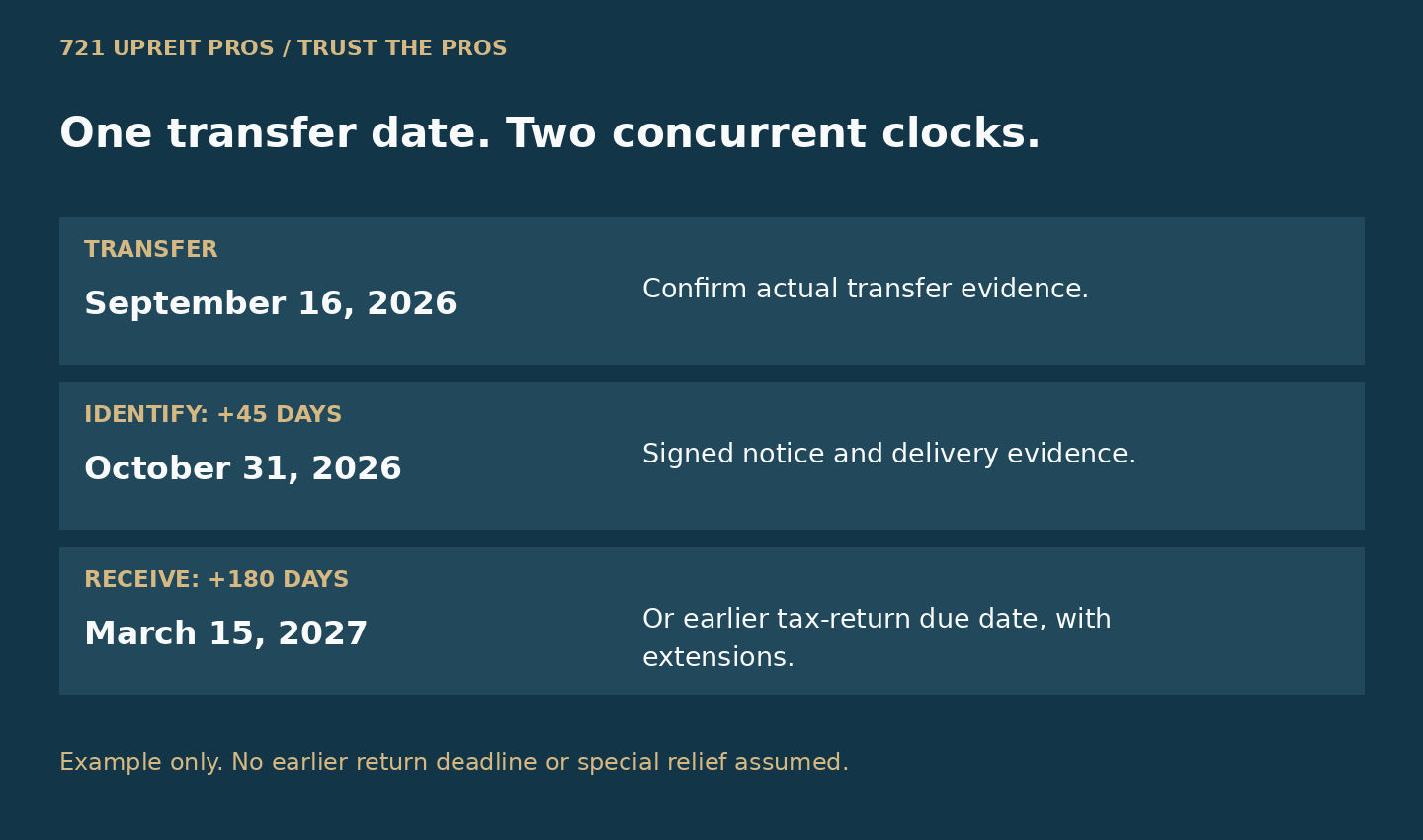
Use the professional-confirmed deadline, not this illustration, on your actual worksheet. Ask about delivery cutoffs and availability ahead of time. An office closure, unanswered message or anticipated extension should never be treated as permission to wait. If a date is disputed, escalate immediately rather than choose the more convenient one.
Does an advisor email count as replacement identification?
Do not equate an investment discussion with a valid identification notice. Have the QI confirm the required signed description, permissible recipient and delivery procedure, including rules governing multiple properties.
The IRS fact sheet describes identification as written, signed and delivered to a qualifying person involved in the exchange; notifying only an agent such as your accountant is insufficient. Save the actual final notice and its delivery evidence. An acknowledgment is useful operational proof but does not cure a deficient description, wrong recipient or missed deadline.
A useful record distinguishes these four events: “advisor suggested an investment,” “investor selected a candidate,” “identification delivered,” and “replacement received.” None should be automatically checked off because the previous event occurred. For related exchange and DST topics, explore the DST Experts learning center. This checklist adds a closing responsibility and evidence record, rather than another general investment-selection guide. Use the linked IRS sources and your professionals for the actual tax requirements.
What must be reconciled before a DST replacement closing?
Match the intended replacement, accepted investment documents and funding instructions to the exchange file. Ask the transfer team what must occur for the investor to receive the interest; submitting a subscription is not by itself proof of completed acquisition.
The IRS's Revenue Ruling 2004-86 addresses a particular DST structure and conditions under which its interests are treated as interests in real property. It does not say every trust bearing the DST label qualifies. Your tax/legal team must evaluate the actual structure and transaction.
- Match the replacement: compare its legal description and ownership details with the identification and approved documents. Escalate any substitution rather than assume a similar name is enough.
- Resolve conditions: obtain the current outstanding-items list, acceptance status, allocation availability and expected transfer evidence from the responsible team.
- Reconcile dollars: ask the QI and tax preparer to compare sale proceeds, debt, additional cash, acquisition costs and any money returned. A dollar balance does not itself prove full tax deferral.
- Confirm funding securely: verify payment instructions using an independently established contact channel. Do not use a changed bank account solely because it appears in a new email.
- Document receipt: retain the final ownership or transfer confirmation and closing records. Have the exchange professionals determine the relevant completion date.
For example, if the signed subscription uses one entity name but the exchange file uses another, mark the item unresolved and route it to counsel and the tax preparer before funding. Do not silently edit one document to make the names match. Likewise, a sponsor's target close date should remain a target until the actual transfer evidence is available.
What goes to the CPA after closing?
Deliver a reconciled record of what transferred, when, for how much and with what liabilities and costs. Keep corrected documents with an explanation of what changed, rather than overwrite the original without a trail.
A proposed tax-file package includes both final closing statements; exchange agreements and transaction history; the signed identification and receipt evidence; acquisition/ownership confirmation; debt and fee details; historical basis and depreciation records; and notes on any cash received or ownership changes. Ask the preparer for their secure intake list rather than email sensitive records to a general inbox.
Form 8824 is filed with the return for the year the relinquished property was transferred. The current instructions cover recognized gain and replacement basis as well as deferred gain. A later-year replacement closing does not justify forgetting the sale-year reporting discussion. This article supplies organization, not completed tax calculations.
Where does a possible 721 UPREIT contribution fit?
Keep it in a separate future-transaction file. The current 1031 closing and a contemplated later Section 721 contribution have different conditions, documents and tax questions.
IRS Publication 541 explains general nonrecognition for property contributed for a partnership interest and exceptions. A 721 UPREIT pathway generally involves an operating partnership interest, not a 1031 purchase of ordinary REIT shares. A possible future contribution does not cure a missed exchange requirement, guarantee an exit or establish liquidity.
The transaction-sequencing guide shows how the stages differ. The 721 UPREIT guide and advisor planner covers the ownership decision. For the later transaction, retain the conversion decision-rights worksheet separately from today's closing checklist.
Download the handoff record
Download the closing handoff worksheet ↓
For each item, record the responsible person, document version, date requested, date received, unresolved question and final disposition. The download contains the example dates and blank fields. It is not a substitute identification form and does not send anything to a QI or advisor.
Watch the one-minute handoff briefing
Original silent explainer with on-screen text and English captions. Open the transcript only if you want the full text.
Read video transcript
0:00 · Assign the handoff before closing.
Name the person responsible for each open item. Confirm exchange documents and proceeds handling. Keep tax and investment questions distinct.
0:12 · Confirm the actual transfer date.
Example transfer: September 16, 2026. 45 days later: October 31, 2026. 180 days later: March 15, 2027.
0:24 · Check the earlier tax-return deadline.
Both exchange clocks start at transfer. The return due date, with extensions, can shorten the period. Ask your professionals about actual dates and relief.
0:36 · Retain evidence at every handoff.
Keep the signed identification and delivery record. Match accepted replacement documents and funding. An application or wire alone is not proof of receipt.
0:48 · Close the record, not just the inbox.
Keep final ownership evidence and closing statements. Send reconciled records through a secure tax channel. A possible later 721 contribution is a separate step.
What is the next useful conversation?
Sources checked September 16, 2026. Prepared as general education by 721 UPREIT Pros; no independent expert review or individualized tax opinion is represented. Investments may lose value and be illiquid; timing, conversion and tax results are not guaranteed.
BEFORE YOUR ADVISOR CONVERSATION
Three questions before you commit
This companion briefing covers the professional's identity, compensation and how restrictions fit your cash needs. Use it alongside this article's specific document checks.
Loading the video connects to YouTube. Watch on YouTube · 721 UPREIT Pros channel · Read the full advisor checklist.
Read video transcript
Before you hire a seven twenty-one UPREIT advisor, ask these three questions.
First: who exactly am I hiring? Get the professional's legal name, firm and registration information. Check the record through Investor dot gov and read the firm's relationship summary where applicable. Ask whether this conversation involves brokerage services, investment advice, or both. A marketing title alone does not answer that question.
Second: who gets paid, and how much? Request a written cost breakdown in dollars. Identify the payer, calculation base, payment timing and ongoing charges. Include product expenses and embedded compensation. No separate advisor invoice does not mean there are no costs.
Third: how does this fit my cash needs? Review the actual agreements. Ask who controls a possible conversion and what happens if it does not occur. Separate permission to request redemption from approval, pricing and payment. Do not assume a fixed cash-out date.
Then agree on responsibilities. Your investment professional, CPA, attorney and qualified intermediary can have different roles. Put continuing service and unresolved questions in writing.
Read the complete advisor checklist using the article link in the description. Seven twenty-one UPREIT Pros. Trust the Pros. Educational only. Investments involve risk and may be illiquid. Tax treatment depends on your circumstances.
Educational only. Investments involve risk and may be illiquid. Footage is illustrative; narration is synthetic.
TALK TO A 721 UPREIT ADVISOR
Ready to discuss your 721 options?
Request a callback to discuss the questions raised by this article, your timing and what to ask before you commit. Share your name, email and phone below to start the conversation.
No investment commitment or financial documents required. A callback request does not book an appointment or establish an advisory relationship.