
721 UPREIT PROS / RETIREMENT INCOME DECISIONS
Is a DST or a 721 UPREIT better for retirement income?
Neither is automatically better. A DST interest ties the investor to the economics and governing documents of specific real estate. After a Section 721 contribution, OP units represent a partnership interest whose distributions, tax reporting, conversion rights and access rules can be different. Compare the cash source, control, principal access and household reserve before comparing a quoted rate.
Prepared by 721 UPREIT Pros · Published October 5, 2026 · General education

This article owns one narrow decision: how an investor who wants retirement cash flow can compare a DST stage with a possible later OP-unit or REIT-share stage. It does not repeat the broader cash-needs and control worksheet or the separate distribution-rate arithmetic example. Start with the 721 UPREIT guide if the transaction sequence is unfamiliar.
Which structure is better for retirement income?
A DST may fit an investor who accepts sponsor control and illiquidity in exchange for exposure to the economics of identified property. OP units may fit an investor willing to exchange property-specific ownership for an interest in a larger operating partnership, subject to different distribution, transfer, redemption and tax rules. Neither structure promises a payment level, payment duration, conversion, liquidity or tax result.
TALK TO A 721 UPREIT ADVISOR
Talk to a 721 UPREIT advisor
Request a callback to discuss the questions raised by this article, your timing and what to ask before you commit. Share your name, email and phone below to start the conversation.
No investment commitment or financial documents required. A callback request does not book an appointment or establish an advisory relationship.
The useful comparison is not “Which label has the higher yield?” It is “What legal asset would I own, what produces cash, who can change the payment, and what happens if I need principal?” A stated distribution rate is only one input. Retirement spending also requires timing, accessible reserves, tax estimates and a fallback if a payment is reduced or delayed.
Keep three stages separate
A DST interest, an OP unit received after a Section 721 contribution and a REIT share received after a later redemption or conversion are not interchangeable. The legal rights, source of payments, reporting forms and liquidity analysis can change at each stage.
Follow the retirement cash to its source
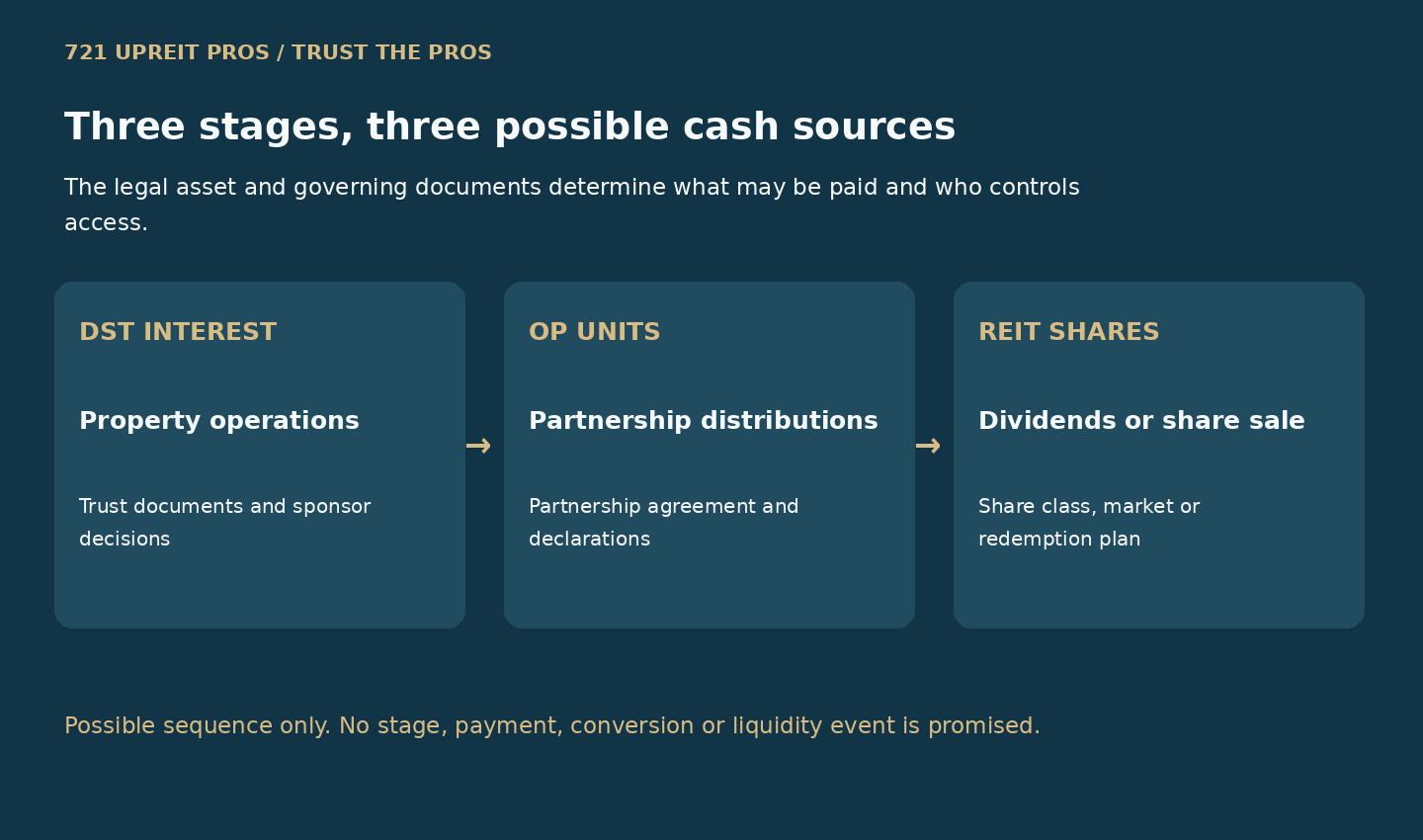
| Stage | What may produce cash | What the investor must verify |
|---|---|---|
| DST interest | Cash available from the identified property's operations after expenses, debt service, capital needs and reserves, as administered under the trust and offering documents | Lease and tenant exposure, debt, reserve policy, sponsor powers, distribution policy, transfer limits and property-sale process |
| UPREIT OP units | Distributions declared by the operating partnership under the partnership agreement and applicable unit terms | Unit class, declaration authority, distribution priority, withholding, transfer limits, redemption or conversion rights, and whether payments can differ from taxable allocations |
| REIT shares, if later received | Dividends declared on the shares and, separately, proceeds from a permitted sale or redemption | Listed versus non-traded status, share class, dividend policy, market access, redemption plan limits, pricing and suspension rights |
IRS Revenue Ruling 2004-86 treated the particular DST described in the ruling as an investment trust and, under its restricted facts, permitted an interest to qualify as real property for Section 1031 if the other requirements were met. That ruling does not promise income and does not classify every trust bearing a DST label.
For OP units, IRS Publication 541, revised December 2025, explains that a partnership generally passes income and loss through to its partners. Cash distributed and taxable items allocated are related but not identical measurements. A retirement plan that spends every dollar received without estimating the associated tax burden can create a separate cash problem.
Compare six retirement needs, not two headlines
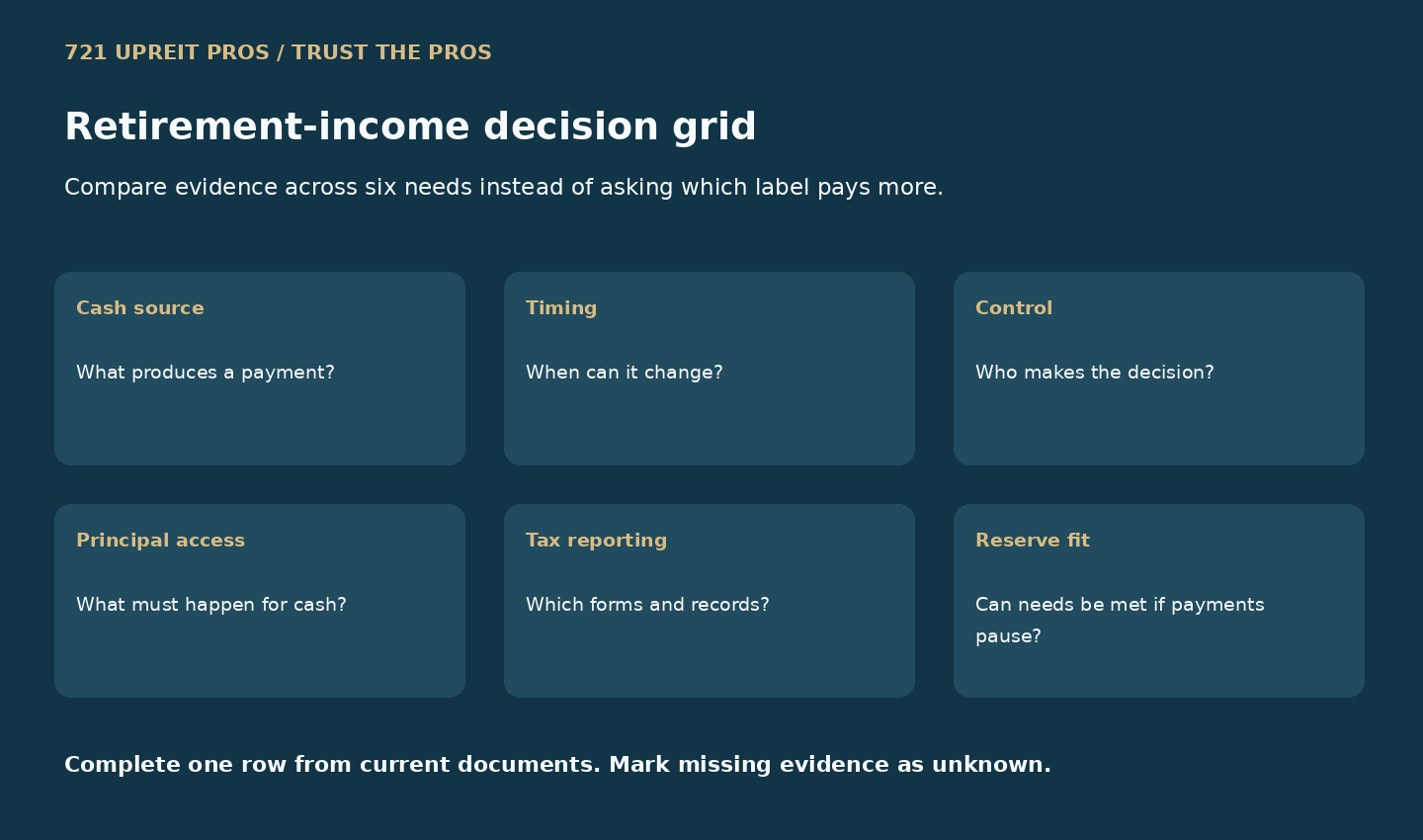
- Cash source: identify the property operations, partnership declaration or share dividend supporting the payment. Ask whether proceeds, borrowing or another source may also be used.
- Timing and variability: record the actual declaration and payment process. Do not turn an annualized illustration into a monthly obligation.
- Control: identify who can change reserves, borrow, sell property, suspend a plan, approve a contribution or declare a distribution.
- Principal access: separate ordinary payments from a sale, transfer, redemption or conversion. A right to request cash is not necessarily an obligation to provide it.
- Tax reporting: identify the reporting entity, expected form, estimated tax timing and the records your preparer needs. OP-unit holders commonly receive partnership reporting, while a later share stage can have different reporting.
- Reserve fit: decide which household expenses must be funded even if the investment pays less, pays later or pays nothing for a period.
The SEC's Investor.gov REIT overview notes special risks for non-traded REITs, including limited liquidity, redemption-plan limits and the possibility that distributions may be funded from sources other than operating cash flow. Those points do not describe every OP unit or share class, so verify the actual documents instead of importing a general rule.
Worked example: cover the household gap before counting a distribution
This is a fictional budgeting example, not an income forecast or reserve recommendation. Taylor and Jordan estimate $8,000 of monthly household spending after tax. Social Security, a pension and other dependable income total $5,500 per month. The uncovered spending need is $2,500 per month, or $30,000 for twelve months.
They decide to test a separate twelve-month cash reserve for that gap. They do not enter a DST distribution or OP-unit distribution as guaranteed income. Instead, the investment payment remains a scenario line: expected from documents, reduced by half, delayed for six months, or zero.
| Input | Calculation | Planning result |
|---|---|---|
| Monthly spending | Assumption | $8,000 |
| Dependable outside income | Assumption | $5,500 |
| Monthly uncovered need | $8,000 minus $5,500 | $2,500 |
| Twelve-month cash need | $2,500 times 12 | $30,000 |
| Investment-payment stress case | Use zero to test independence | $0 counted as available |
If the household cannot meet the $30,000 gap without selling, borrowing or receiving an investment payment, the decision is not automatically “no.” It is a documented dependency. The investor should then examine how quickly principal could actually become cash, what could interrupt a payment, and what other assets or spending changes form the fallback.
Use the redemption request checklist for principal access and the taxable-income-without-cash guide for the reserve question. Distribution income, principal access and cash available for tax are three separate planning lanes.
Which documents answer the retirement-income question?
Ask for the current documents that apply to the exact interest, class and date. A brochure, old presentation or another investor's statement is not a substitute.
| Question | DST evidence | OP-unit or share evidence |
|---|---|---|
| What can pay me? | Offering memorandum, lease summary, property financials and distribution notices | Partnership agreement, unit schedule, declarations, financial reports and any share-class materials |
| Who can change it? | Trustee and sponsor powers, reserve and debt provisions | General partner or board authority, priority and amendment provisions |
| Can I access principal? | Transfer limits, property-sale mechanics and secondary-market disclosures | Lockup, transfer, redemption, conversion, pricing, queue and suspension terms |
| How is it reported? | Trust tax materials and annual reporting package for the actual structure | Schedule K-1 and attached statements for partnership ownership; applicable dividend and sale reporting if shares are later held |
The 2025 Partner's Instructions for Schedule K-1, published April 30, 2026, show why the partnership package matters. An investor should preserve the K-1 and attached statements and let a tax professional connect them with outside basis, liabilities, passive activity and state reporting. Do not infer taxable income from the bank deposit alone.
Download the retirement-income comparison checklist
For broader background on the possible DST-to-721 path, DST 1031 Experts provides a DST and 721 UPREIT overview. Treat it as education, not evidence that a particular sponsor will accept property, complete a contribution or provide a stated payment. Then talk to a 721 UPREIT advisor with your household worksheet and current documents.
One-minute video: compare the cash source before the rate
Read video transcript
General education by 721 UPREIT Pros with AI assistance. No independent professional review is represented. The comparison does not determine suitability or predict a distribution, income level, conversion, redemption, property sale, tax result, return, indexing or ranking.
BEFORE YOUR ADVISOR CONVERSATION
Three questions before you commit
This companion briefing covers the professional's identity, compensation and how restrictions fit your cash needs. Use it alongside this article's specific document checks.
Loading the video connects to YouTube. Watch on YouTube · 721 UPREIT Pros channel · Read the full advisor checklist.
Read video transcript
Before you hire a seven twenty-one UPREIT advisor, ask these three questions.
First: who exactly am I hiring? Get the professional's legal name, firm and registration information. Check the record through Investor dot gov and read the firm's relationship summary where applicable. Ask whether this conversation involves brokerage services, investment advice, or both. A marketing title alone does not answer that question.
Second: who gets paid, and how much? Request a written cost breakdown in dollars. Identify the payer, calculation base, payment timing and ongoing charges. Include product expenses and embedded compensation. No separate advisor invoice does not mean there are no costs.
Third: how does this fit my cash needs? Review the actual agreements. Ask who controls a possible conversion and what happens if it does not occur. Separate permission to request redemption from approval, pricing and payment. Do not assume a fixed cash-out date.
Then agree on responsibilities. Your investment professional, CPA, attorney and qualified intermediary can have different roles. Put continuing service and unresolved questions in writing.
Read the complete advisor checklist using the article link in the description. Seven twenty-one UPREIT Pros. Trust the Pros. Educational only. Investments involve risk and may be illiquid. Tax treatment depends on your circumstances.
Educational only. Investments involve risk and may be illiquid. Footage is illustrative; narration is synthetic.
TALK TO A 721 UPREIT ADVISOR
Ready to discuss your 721 options?
Request a callback to discuss the questions raised by this article, your timing and what to ask before you commit. Share your name, email and phone below to start the conversation.
No investment commitment or financial documents required. A callback request does not book an appointment or establish an advisory relationship.