
721 UPREIT PROS / SPONSOR CHANGE REVIEW
721 UPREIT Sponsor Changes: What Should You Review?
A 721 UPREIT sponsor change should trigger a document and continuity review, not an automatic buy, hold or exit decision. Identify the exact legal entity and role that changed, confirm whether the change is proposed or completed, then compare authority, fees, conflicts, investor rights, records and service responsibilities before acting.
By 721 UPREIT Pros · Published October 21, 2026 · Original role map and continuity ledger
Key takeaways
- Identify the exact legal entity and role before judging a sponsor change.
- Separate a proposal, approval, legal closing and operational handoff.
- Compare authority, fees, conflicts, rights and records in current documents.
- A management change does not guarantee distributions, liquidity, tax treatment or performance.
The word “sponsor” can hide several different roles. A parent-company owner, investment adviser, operating partnership general partner, property manager and transfer agent may be related, but they do not necessarily have the same authority. Start with the exact issuer and interest in your records, then use the main 721 UPREIT guide to distinguish OP units from REIT shares.
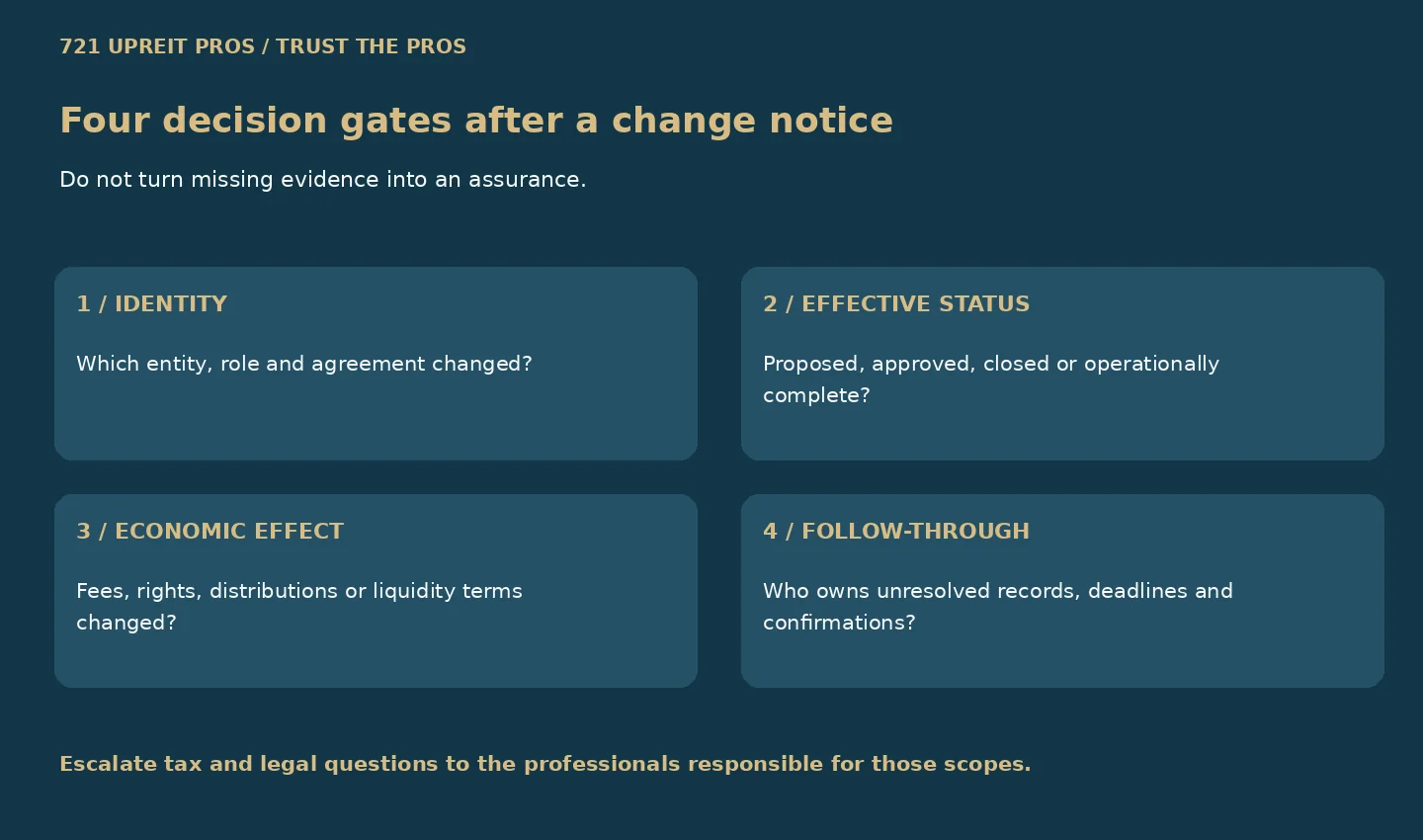
The practical question is whether the change alters who controls a decision, what you pay, which terms apply, or how an existing request and record will be handled. A press release or announcement date is not proof that a transaction closed. Keep proposed, approved, effective and operationally complete as separate statuses.
TALK TO A 721 UPREIT ADVISOR
Talk to a 721 UPREIT advisor
Request a callback to discuss the questions raised by this article, your timing and what to ask before you commit. Share your name, email and phone below to start the conversation.
No investment commitment or financial documents required. A callback request does not book an appointment or establish an advisory relationship.

What does “sponsor change” actually mean?
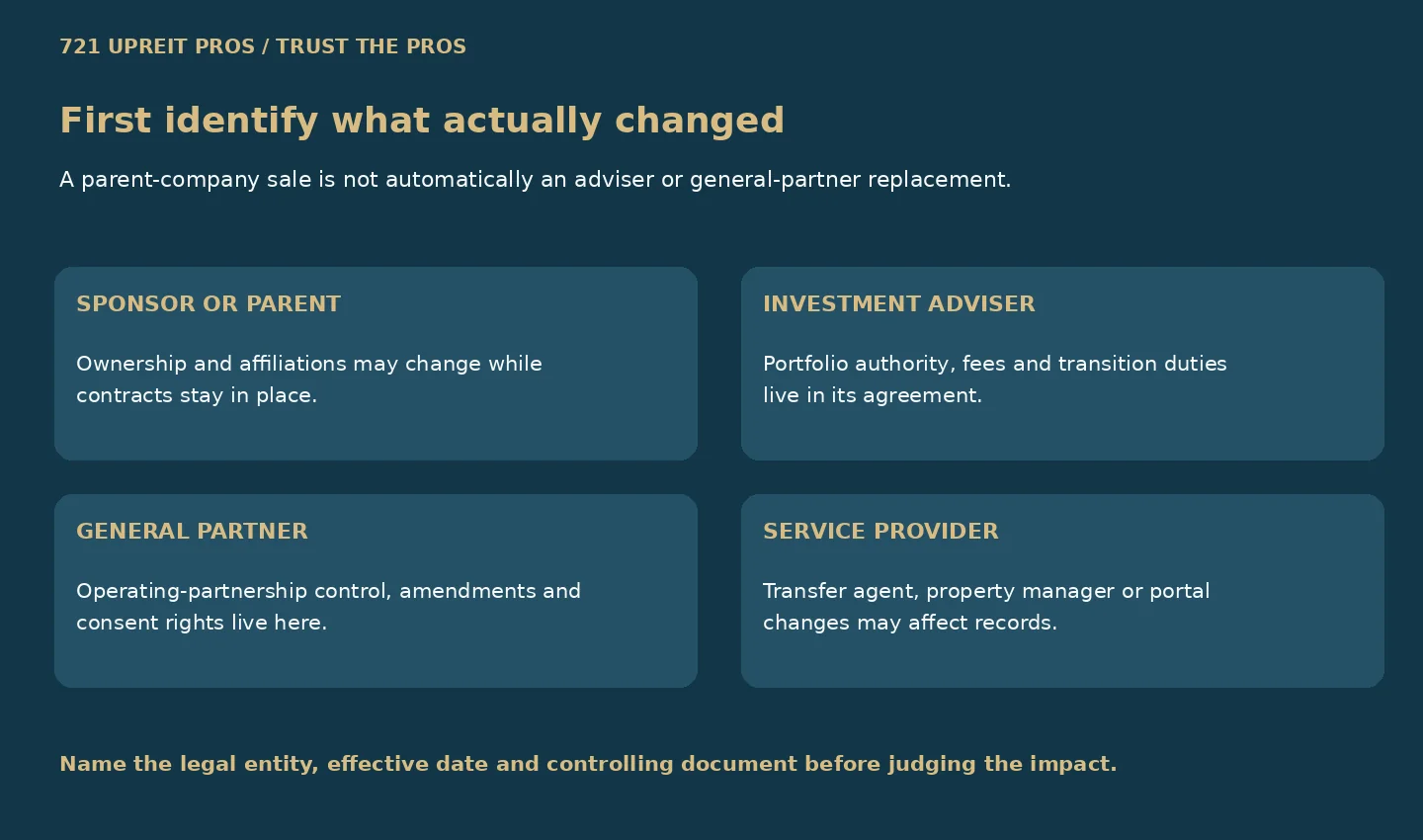
First name the legal entity and its role. A sponsor's parent might be acquired while the same operating partnership, general partner and advisory contract continue. In another transaction, the investment adviser may be assigned to an affiliate or replaced. A third event might substitute a general partner. A fourth may only replace a property manager, portal provider or transfer agent. These events can produce very different approval, fee and continuity questions.
| Possible change | Document to check | First investor question |
|---|---|---|
| Sponsor or parent ownership | Transaction announcement, closing evidence, current ownership disclosure | Did any contract, controller or affiliate relationship also change? |
| Investment adviser | Advisory agreement and board approval | Which duties, fees, conflicts and transition obligations changed? |
| General partner or controller | Operating partnership agreement and amendments | What substitution, merger, consent and notice provisions apply? |
| Service provider | Servicing, property-management or transfer-agent notice | Where do records and pending requests go, and on what effective date? |
Do not treat a brand name as the contracting party. Record the former and new legal names, agreement titles, filing or notice dates, stated effective date, and the source that confirms completion. If the notice is only a proposal, record the approval conditions and leave the closing status unresolved.
Which agreements control the change?
Read the documents in the order of the actual role. A current operating partnership agreement may address merger, consolidation, transfer of a general-partner interest, admission of a substitute general partner, amendment powers and limited-partner consent. An advisory agreement may separately define adviser assignment, board approval, termination, fees and delivery of records after termination.
These provisions vary. For example, an operating partnership agreement filed with the SEC in August 2026 describes different consent rules for certain mergers and amendments, while also addressing substitute general partners. The filing is a dated example, not a statement of your rights or a current offering recommendation.
A separate July 31, 2026 advisory agreement filed with the SEC permits assignment to an adviser affiliate with specified director approvals, allows termination under stated conditions, and requires an outgoing adviser to provide an accounting, deliver assets and documents, and cooperate in an orderly transition. Those terms illustrate what to look for. They do not apply universally.
Ask counsel which agreement and amendment controls the event you received. Then separate an individual right from a board, general-partner or majority-holder power. Notice does not necessarily create a vote. A vote on one amendment does not necessarily create a veto over an adviser assignment or parent-company transaction.
How do you build a before-and-after continuity ledger?
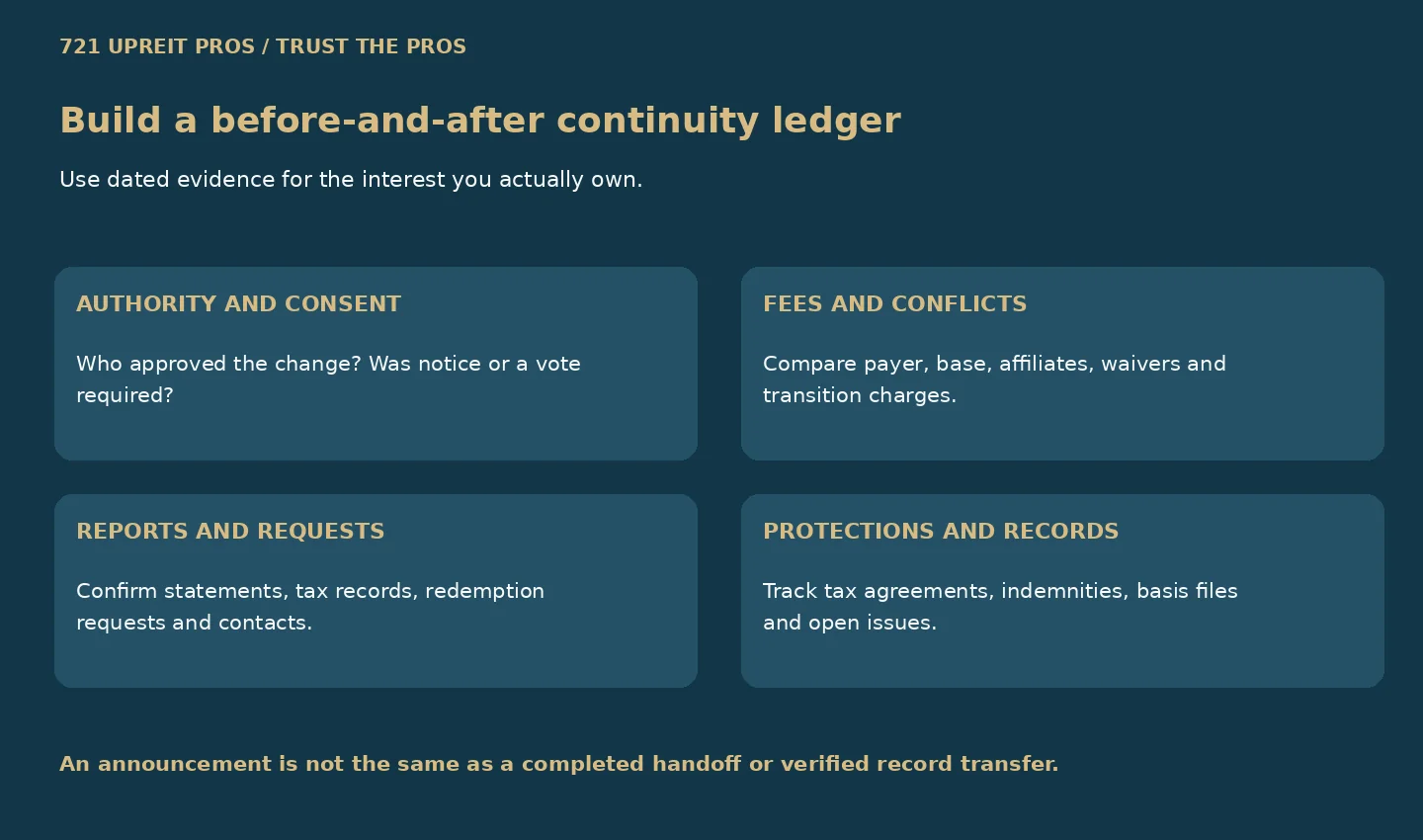
Use one dated row for each item that could be affected. The goal is not to predict whether new management will perform better. It is to establish what changed, what stayed the same, and what evidence remains missing. Attach the source and document version to each conclusion.
| Review item | Before | After or unresolved | Evidence |
|---|---|---|---|
| Issuer and exact security | Legal entity, class and account title | Confirm unchanged or state replacement | Statement, agreement, amendment |
| Decision authority | Board, adviser and general-partner roles | Name the new responsible party | Governing agreements and approval |
| Fees and expense support | Payer, base, rate and waiver | Changed, continued or not yet known | Fee schedule and executed amendment |
| Distributions and valuation | Current policy and reporting source | Do not infer a change without evidence | Declaration, valuation policy, report |
| Liquidity requests | Pending request, queue or restriction | Responsible contact and preserved date | Written acknowledgment and current terms |
| Tax and contributor records | Basis files, K-1 history, protection terms | Custodian, retention and open questions | Record-transfer confirmation |
The SEC's REIT investor bulletin explains that externally managed non-traded REITs can present conflicts when manager compensation depends on acquisitions or assets under management. That is a reason to compare compensation and affiliations, not proof that a particular change is adverse.
Could the change affect fees, distributions or liquidity?
Possibly, but do not infer the result from the announcement alone. Compare the old and new payer, calculation base, affiliated-service arrangements, expense reimbursements, waivers and any termination or transition amounts. If a fee is described as unchanged, ask whether the underlying asset, net asset value or other calculation base changed.
Review distributions separately. Management may state an intention or expectation, but only a supported declaration and current terms establish the relevant payment. If cash changes, use the distribution-reduction reconciliation to distinguish a changed declaration from unit eligibility, routing or settlement issues.
A sponsor transaction also does not create an automatic redemption right or guarantee that a pending request will be honored on the original schedule. Preserve the original request, acknowledgment, queue position or restriction, then confirm the party now responsible. The OP-unit redemption checklist keeps contractual eligibility, value, timing and tax review separate.
For the earlier DST ownership stage, this guide to evaluating a DST sponsor can help organize sponsor, offering, fee and conflict questions. A DST interest and later OP units are different ownership interests. Do not import DST voting, servicing or liquidity provisions into an operating partnership.
What tax and contributor records need continuity?
A management change does not, by itself, prove a taxable disposition, eliminate built-in gain or reset outside basis. The legal transaction and your own facts control. Preserve contribution documents, liabilities, K-1s, capital-account reports, prior correspondence and any tax-protection agreement while your CPA and counsel determine whether a specific event has tax consequences.
If a tax-protection agreement exists, confirm the party obligated to perform, permitted transfers or successor provisions, covered property, notice procedures and claim deadlines. Do not assume that a corporate successor automatically assumes every side agreement or that a change automatically triggers payment. Use the tax-protection agreement review for the separate contract analysis.
Keep confidential records out of an ordinary contact form. Ask the new administrator how to transfer files securely and request written confirmation of receipt. Retain prior contact details and a checksum or inventory of the documents sent so that a portal migration does not become a break in your evidence chain.
How can two similar announcements lead to different reviews?
Consider two fictional existing OP-unit holders. In Case A, the sponsor's parent is acquired, but filings confirm that the operating partnership, general partner, adviser agreement, fee schedule and transfer agent remain unchanged on the effective date. The investor records the ownership change and monitors any later amendments. That does not prove performance will improve or decline.
In Case B, the adviser agreement is assigned and a new affiliate assumes portfolio services on closing. The notice says the base rate is unchanged, but the investor still compares reimbursable expenses, conflicts, personnel responsibilities and transition duties, and confirms the destination of a pending redemption request. The headline “sponsor change” is similar; the operational work is not.
Neither case determines suitability. An existing holder may need continuity and risk review, while a prospective contributor should also decide whether the revised organization fits the property-sale timeline, household liquidity and retirement plan. If a sale is contemplated, coordinate the broker, qualified intermediary, CPA, attorney and investment professional before closing. A 1031 exchange, DST purchase and separate potential Section 721 contribution are not one automatic transaction.
What should you verify before making a decision?
- Identify the exact issuer, security, changed entity and its role.
- Record whether the transaction is proposed, approved, closed and operationally complete.
- Obtain the current operating partnership, advisory and relevant service agreements plus amendments.
- Map approval, consent, notice and successor provisions to the actual event.
- Compare fees, conflicts, valuation and distribution policies without assuming an outcome.
- Confirm ownership of statements, tax records, open requests and secure document transfer.
- Assign unresolved tax, legal, investment and service questions to the professional responsible for each scope.
Bring the completed ledger to the 721 UPREIT risk framework and your professional team. For a coordinated investment conversation, talk to a 721 UPREIT advisor. No article or advisor can guarantee sponsor performance, distributions, liquidity, tax treatment or principal.
Watch the one-minute sponsor-change review
This original silent video has English captions and a complete transcript. It explains the review sequence and makes no claim about a specific sponsor.
Read video transcript
0:00 · 721 UPREIT sponsor changes
Start with the exact entity, role and effective status.
0:12 · Map the role
Sponsor, adviser, general partner and service provider are not synonyms.
0:24 · Compare current documents
Check authority, consent, fees, conflicts and transition duties.
0:36 · Protect continuity
Confirm records, requests, tax files and responsible contacts.
0:48 · Keep unknowns visible
Proposed is not completed. No liquidity or tax result is guaranteed.
Download the sponsor-change continuity worksheet
Sources checked October 21, 2026. Dated issuer examples illustrate document terms and are not current offering recommendations. Educational only, not tax, legal or investment advice.
Frequently asked questions
Does a sponsor's sale automatically change my OP units?
No. Identify the legal entities, agreements and transaction steps. A parent-company ownership change may occur without changing the operating partnership or unit terms, while another transaction may amend contracts or substitute a controller.
Do limited partners always vote on a new sponsor or general partner?
No universal rule applies. Voting, consent, notice and substitution rights depend on the current operating partnership agreement, amendments and transaction. A notice does not by itself create an individual veto.
Does an unchanged fee rate mean my costs are unchanged?
Not necessarily. Confirm the calculation base, reimbursable expenses, affiliate services, waivers and any transition amounts. Compare consistent periods and avoid double counting.
Will a pending redemption request carry over automatically?
Do not assume it will. Preserve the original request and acknowledgment, then obtain written confirmation of the responsible party, preserved date, queue position, restrictions and settlement terms.
Does a management change trigger tax on my OP units?
The change label alone does not establish a taxable event. The actual legal transaction, your interest, liabilities and applicable agreements matter. Give the current documents to your CPA and counsel.
What evidence should I request first?
Request the transaction status, current entity chart, controlling agreements and amendments, board or partner approvals, before-and-after fee terms, service-transition plan and written confirmation for records and open requests.
TALK TO A 721 UPREIT ADVISOR
Ready to discuss your 721 options?
Request a callback to discuss the questions raised by this article, your timing and what to ask before you commit. Share your name, email and phone below to start the conversation.
No investment commitment or financial documents required. A callback request does not book an appointment or establish an advisory relationship.