
721 UPREIT PROS / INCOME PLANNING
721 UPREIT passive income: what does a distribution rate actually pay?
A 721 UPREIT distribution rate is not a guaranteed paycheck or a total-return figure. To estimate cash, identify the applicable unit class, calculation base, declared payment, record date and cash election. Then reconcile actual deposits with distributions reinvested and changes in investment value.
By 721 UPREIT Pros · Published September 17, 2026 · Updated October 17, 2026 · Educational worked example
Key takeaways
- Identify whether a rate is projected, declared, historical or annualized, and name its calculation base.
- Cash received depends on eligible units, the period, elections and shown deductions.
- Distributions are not total return and do not establish principal protection.
- Check payment sources, partnership tax allocations and liquidity separately.

A property owner considering a 1031-to-DST pathway and possible later Section 721 contribution often asks one practical question: how much could reach my bank account? The useful answer begins with dated investment documents. The label on a marketing rate alone cannot establish timing, sustainability or the money available to spend.
How much monthly income would a hypothetical 5% rate produce?
If $500,000 is the stated calculation base, 5% is an annualized rate, and it remains unchanged for a full year, the simple annual estimate is $25,000. Dividing by twelve gives about $2,083.33 per month. Those assumptions do not establish a monthly payment obligation.
TALK TO A 721 UPREIT ADVISOR
Talk to a 721 UPREIT advisor
Request a callback to discuss the questions raised by this article, your timing and what to ask before you commit. Share your name, email and phone below to start the conversation.
No investment commitment or financial documents required. A callback request does not book an appointment or establish an advisory relationship.
| Step | Calculation | Result |
|---|---|---|
| Full-year estimate | $500,000 × 5% | $25,000 |
| Monthly equivalent | $25,000 ÷ 12 | $2,083.33 |
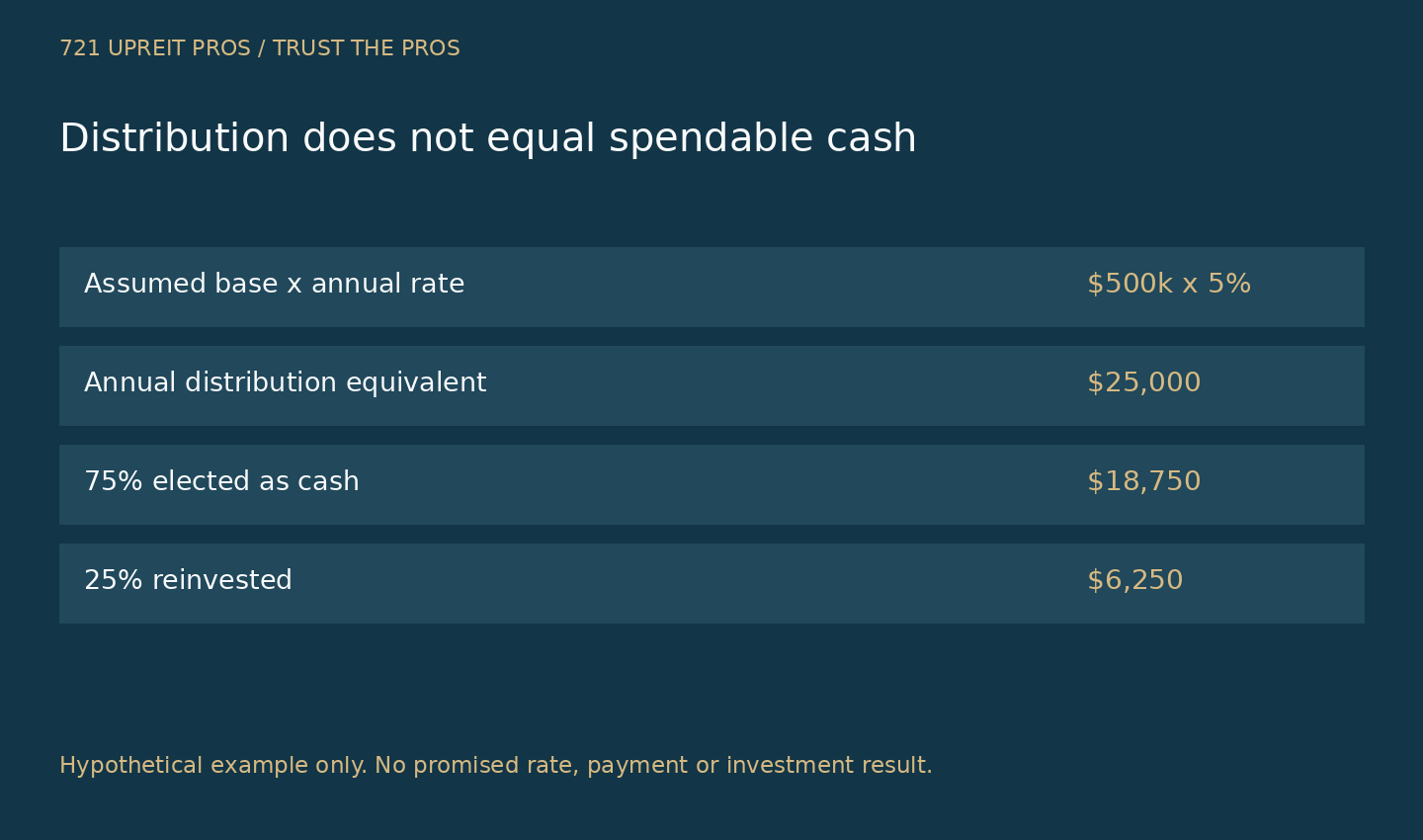
| Illustrative 75% cash election | $25,000 × 75% | $18,750 cash |
| Illustrative 25% reinvestment | $25,000 × 25% | $6,250 reinvested |
| Monthly cash equivalent | $18,750 ÷ 12 | $1,562.50 |
The split election is hypothetical and may not be available in a particular program. Reinvestment purchases or credits additional interests under the program's terms; it is not spendable cash in your checking account. Partial periods, changing unit balances, fees, withholding, suspensions and the actual declared amount can change the result.
Is the rate based on invested dollars, NAV or units?
Use the denominator stated in the current document. A percentage of original investment, a yield calculated from current net asset value and a declared dollar amount per unit can describe different things.
For example, a hypothetical $0.10 distribution per eligible unit multiplied by 12,000 eligible units is $1,200 for that declared period. You still need the record date, payment date, unit class and eligibility rules. Annualizing one payment assumes repetition that the documents may not promise. Ask whether a quoted percentage is historical, targeted, declared or annualized from the latest payment.
What if the next payment is smaller?
Separate the declared per-unit amount from the cash deposited. Compare the same class and period, eligible units, reinvestment and withholding before calling a smaller deposit a rate reduction. Then reconcile the transfer with the bank. A changed election or a settlement issue requires a different inquiry from an issuer's lower declaration.
Ask for the governing distribution provision and dated explanation rather than treating the prior rate as an obligation. Use the 721 UPREIT reduced-payment reconciliation for a worked counterexample and response checklist. A reduction does not itself establish total investment performance, reduce a partnership tax allocation or create a new redemption right.
Do not silently subtract an expense twice. Some reported amounts already reflect certain entity-level expenses, while other fees may be charged separately. Use the full-life fee ledger to identify the payer and where a charge appears before adjusting the estimate.
Can a 5% distribution accompany a negative total return?
Yes. Distributions are one component of an investment's economic result. A decline in value can exceed the cash distributed.
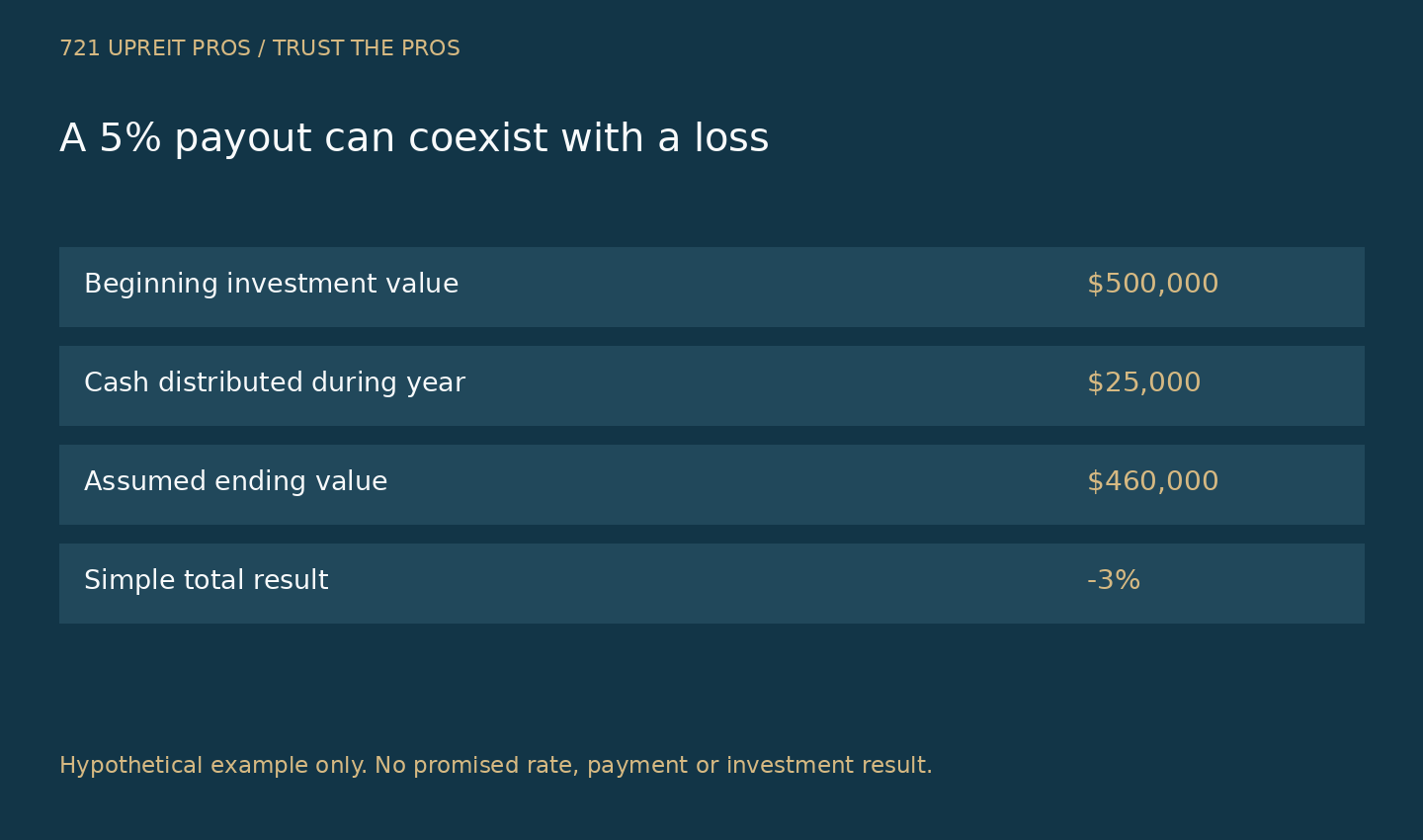
Assume a $500,000 starting investment, $25,000 in cash distributions and a $460,000 ending value, with no additional contributions, no reinvestment, no withdrawals of principal and no separately charged fees. The simple one-year result is ($460,000 + $25,000 − $500,000) ÷ $500,000 = −3%. The distribution-to-starting-value ratio is 5%, while this simplified total return is negative.
The ending value may be an estimate rather than an available sale price. A redemption can involve limits, adjustments or a different valuation date. For a cash-access decision, use the redemption request checklist separately. Distribution income and principal access solve different household needs.
What actually funds the distribution?
Ask whether payments are supported by property operations or funded partly from other sources. The SEC's Investor.gov REIT overview warns that non-traded REIT distributions can exceed funds from operations and use offering proceeds or borrowing. This is a reason to inspect the specific issuer's financial statements, not proof that every OP-unit program uses those sources.
Request the distribution-source disclosure and the relevant reporting period. Ask how property vacancies, capital expenditures, debt service and reserves affect available cash. Cash flow from operations, funds from operations and adjusted measures are different definitions; identify the reported measure and its reconciliation. A high distribution percentage by itself does not establish strong underlying operations.
Does a tax-deferred 721 contribution make future distributions tax-free?
No. The tax treatment of the contribution and the ongoing tax reporting of partnership ownership are separate questions. A cash payment is not a complete measure of taxable income.
IRS Publication 541 explains partnership income and distribution rules. Partners can have taxable allocations even without matching cash distributions; distribution treatment depends on basis and other rules. A later holding of REIT shares uses a different reporting framework from OP units. Ask your CPA which entity and interest you own, which tax forms apply, and how much cash to reserve for taxes.
A “return of capital” description also needs context. Its tax meaning does not prove the investment is earning enough to sustain the payment. Use the debt and outside-basis worksheet for basis questions rather than infer the tax result from a bank deposit.
Which records should an investor compare?
- Current declaration: amount, period, class, eligible units and payment date.
- Rate definition: denominator, annualization method and whether the figure is historical or projected.
- Election confirmation: cash, reinvestment or permitted split, plus the effective date.
- Cash evidence: actual deposit, any withholding and separately charged fees.
- Operating support: financial statements, sources of distributions and debt obligations.
- Value and tax records: valuation date, valuation limits, K-1 or other applicable forms and CPA basis schedule.
Keep one row per payment period. Label the amount estimated until a declaration and deposit support it. If the statement shows $2,000 distributed but only $1,500 reached the bank, reconcile reinvestment, withholding, fees and timing before treating the difference as a missed payment.
How does this fit the DST-to-721 decision?
Build separate cash-flow assumptions for the DST stage and any later operating-partnership stage. A contemplated contribution does not guarantee a new distribution rate, an immediate payment increase or a particular conversion date. Start with the 721 UPREIT guide and planner, then compare the actual governing documents.
For a household decision, pair the arithmetic here with the DST versus 721 UPREIT retirement-income grid. It separates the source of a payment, who controls it, principal access, tax reporting and the reserve needed if cash is delayed or reduced.
Watch the cash-flow briefing and use the worksheet
Download the distribution worksheet ↓
Original one-minute silent video with on-screen explanations and English captions.
Read video transcript
0:00 · Read the rate definition first.
Check the unit class, base and reporting date. A quoted rate is not a guaranteed paycheck.
0:12 · Turn the rate into dollars.
Hypothetical $500,000 times 5% is $25,000 a year. The monthly equivalent is about $2,083.33.
0:24 · Separate cash from reinvestment.
A hypothetical 75% cash election pays $18,750. The remaining $6,250 is reinvested, not spendable cash.
0:36 · Include the change in value.
$500,000 start plus $25,000 cash and $460,000 end. That is a simplified negative 3% total result.
0:48 · Reconcile actual records.
Read the declaration, election and source disclosures. Compare deposits and tax records with your professionals.
Sources checked September 17, 2026. General education by 721 UPREIT Pros, with AI assistance. No independent expert review is represented. All numbers are hypothetical, not available offerings or forecasts. Investments may lose value and distributions, liquidity and tax results are not guaranteed.
Before changing where your next payment goes, use the cash-or-reinvestment election guide to confirm the security purchased, effective payment period and cash reserve.
Frequently asked questions
Does a stated 5% distribution mean a 5% total return?
No. Total economic results also reflect changes in value, contributions, withdrawals and costs. A distribution can coexist with a decline in investment value.
Is an annual rate a promise of equal monthly payments?
No. Dividing an annual assumption by twelve is only a budgeting calculation. The actual declaration, period, class and payment rules determine the entitlement.
Which amount should I use to calculate income?
Use the base and formula defined in the actual current documents, together with eligible units and the relevant period. Original capital, current value and per-unit declarations are not interchangeable.
Why might the bank deposit fall without a rate cut?
Reinvestment, withholding, eligible quantity, a different period or a settlement problem can change cash received. Compare the full declaration-to-bank record before drawing a conclusion.
Does reinvestment make the distribution an investment gain?
No. Reinvestment directs a payment into another purchase under the plan's terms. It is not by itself proof of a gain, and it does not automatically remove applicable tax reporting.
Can distribution projections replace a retirement cash reserve?
No payment is guaranteed. Review lower and interrupted payments, tax needs and restricted access to principal when planning cash reserves with your professionals.
BEFORE YOUR ADVISOR CONVERSATION
Three questions before you commit
This companion briefing covers the professional's identity, compensation and how restrictions fit your cash needs. Use it alongside this article's specific document checks.
Loading the video connects to YouTube. Watch on YouTube · 721 UPREIT Pros channel · Read the full advisor checklist.
Read video transcript
Before you hire a seven twenty-one UPREIT advisor, ask these three questions.
First: who exactly am I hiring? Get the professional's legal name, firm and registration information. Check the record through Investor dot gov and read the firm's relationship summary where applicable. Ask whether this conversation involves brokerage services, investment advice, or both. A marketing title alone does not answer that question.
Second: who gets paid, and how much? Request a written cost breakdown in dollars. Identify the payer, calculation base, payment timing and ongoing charges. Include product expenses and embedded compensation. No separate advisor invoice does not mean there are no costs.
Third: how does this fit my cash needs? Review the actual agreements. Ask who controls a possible conversion and what happens if it does not occur. Separate permission to request redemption from approval, pricing and payment. Do not assume a fixed cash-out date.
Then agree on responsibilities. Your investment professional, CPA, attorney and qualified intermediary can have different roles. Put continuing service and unresolved questions in writing.
Read the complete advisor checklist using the article link in the description. Seven twenty-one UPREIT Pros. Trust the Pros. Educational only. Investments involve risk and may be illiquid. Tax treatment depends on your circumstances.
Educational only. Investments involve risk and may be illiquid. Footage is illustrative; narration is synthetic.
TALK TO A 721 UPREIT ADVISOR
Ready to discuss your 721 options?
Request a callback to discuss the questions raised by this article, your timing and what to ask before you commit. Share your name, email and phone below to start the conversation.
No investment commitment or financial documents required. A callback request does not book an appointment or establish an advisory relationship.