
721 UPREIT PROS / CONVERSION FALLBACK
Planned DST-to-721 conversion did not happen: what now?
If a planned DST-to-721 conversion is delayed, terminated or never completed, first confirm what you still own and which signed documents control. Then record the current operating plan, decision authority, deadlines, cash expectations and realistic alternatives. Do not assume the DST became OP units, that Section 721 tax treatment occurred, or that an immediate exit is available.
By 721 UPREIT Pros · September 19, 2026 · Fallback-control worksheet

The failure of a projected conversion is not one single outcome. The transaction may be postponed, a closing condition may remain unsatisfied, a sponsor may choose another path, an investor may not qualify or elect, or the proposed transaction may be terminated. Those states can lead to different rights and next steps.
This guide is intentionally narrower than our DST-to-721 decision-rights guide. That article asks who can initiate or decline a transaction. This one asks how an investor should organize the facts after the expected transaction does not occur.
TALK TO A 721 UPREIT ADVISOR
Talk to a 721 UPREIT advisor
Request a callback to discuss the questions raised by this article, your timing and what to ask before you commit. Share your name, email and phone below to start the conversation.
No investment commitment or financial documents required. A callback request does not book an appointment or establish an advisory relationship.
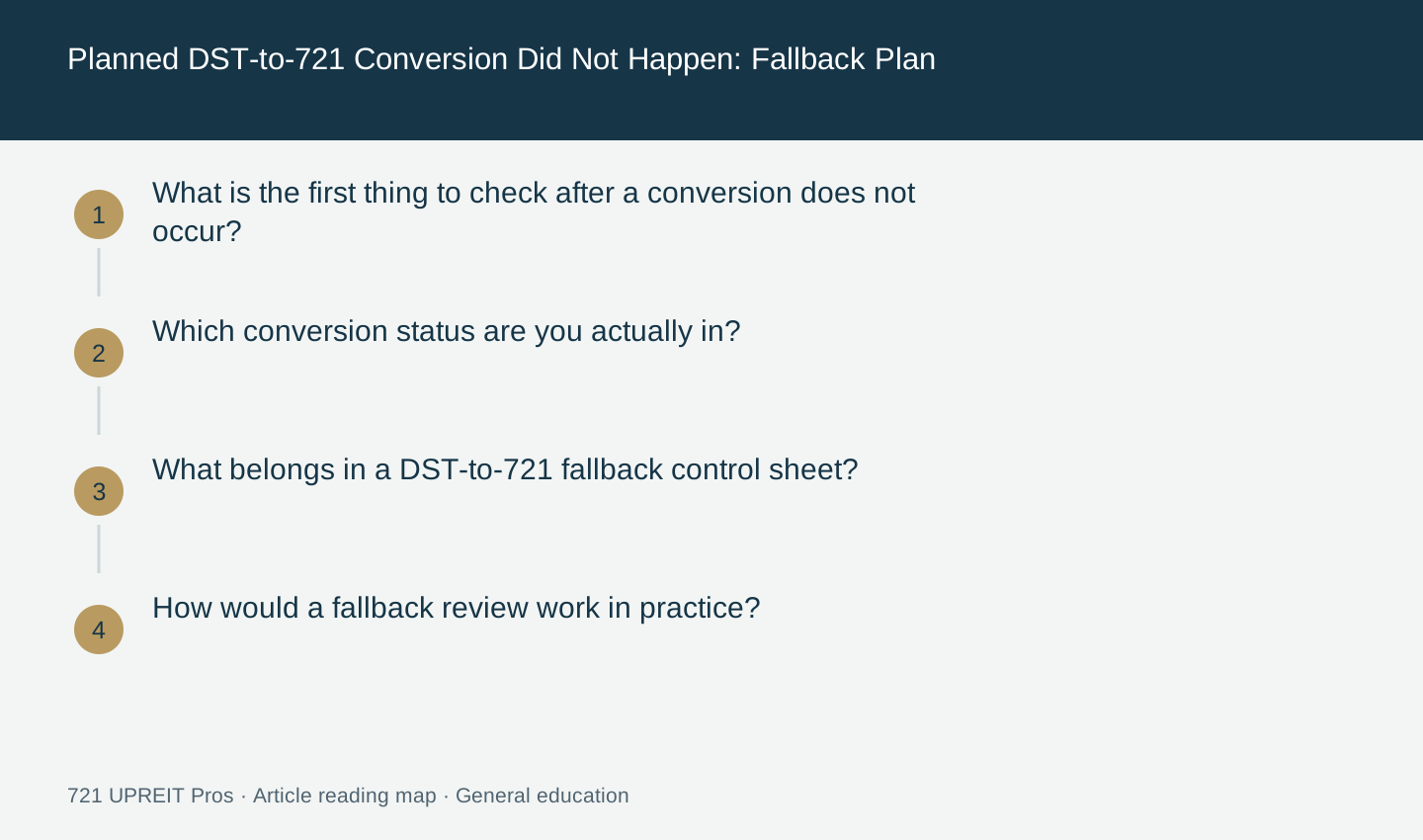
What is the first thing to check after a conversion does not occur?
Identify the asset and legal interest you own today. Use the latest account statement, ownership register, trust or entity records, executed amendments and any transaction notice. A marketing timeline or verbal update does not replace the current legal record.
If no property contribution to an operating partnership occurred, do not label the investment OP units. Internal Revenue Code Section 721 generally addresses a contribution of property to a partnership in exchange for a partnership interest. A possible future contribution is not the same as a completed contribution.
Direct answer
A failed or delayed plan does not automatically create a taxable event, complete a Section 721 contribution, reverse a prior 1031 exchange or provide cash. The actual event, governing documents and investor-specific tax facts determine the result.
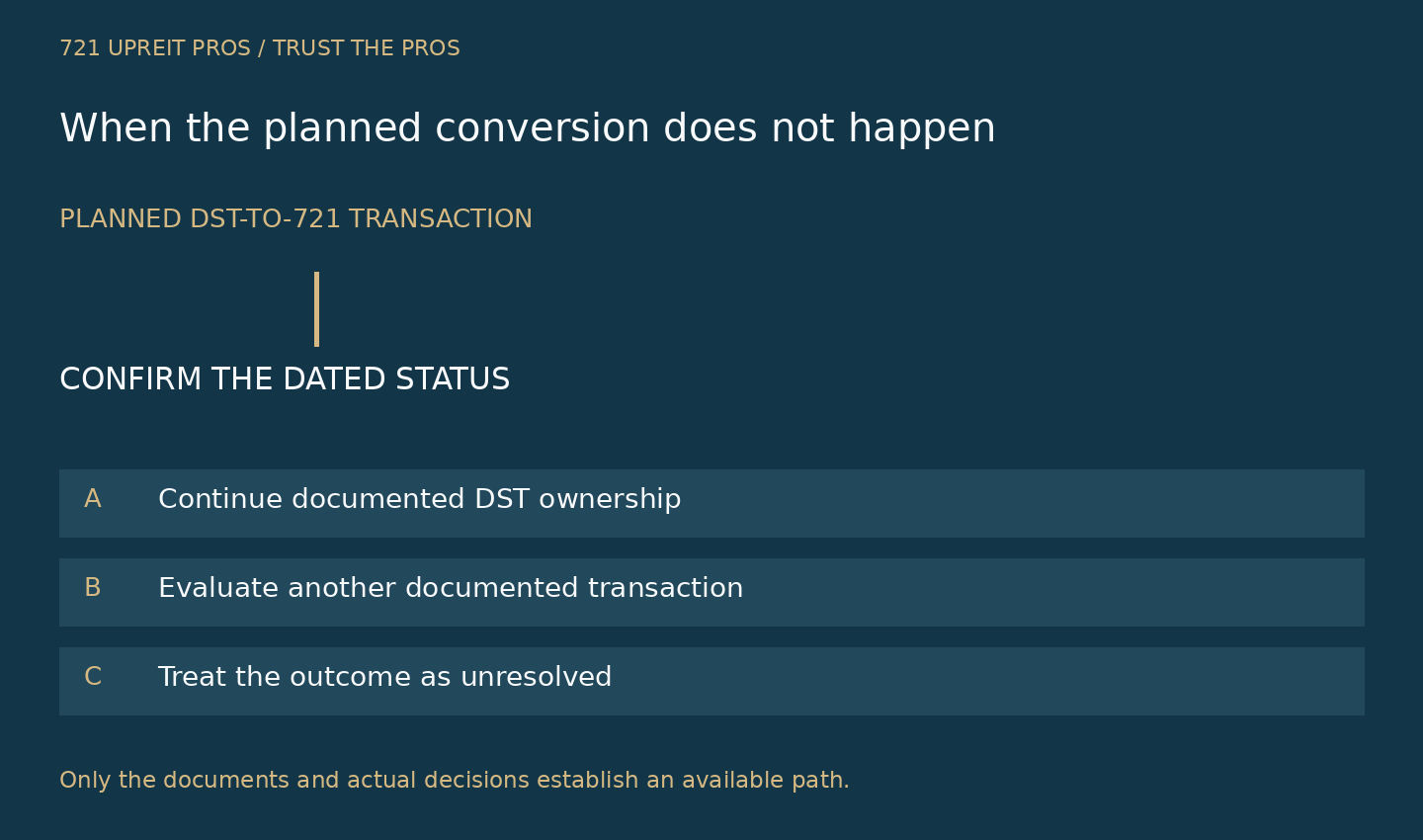
Which conversion status are you actually in?
Ask for a dated written status and the document supporting it. Avoid compressing every uncertainty into the phrase “the conversion failed.”
| Status | Evidence to request | Immediate planning question |
|---|---|---|
| Still contemplated | Current written plan, unmet conditions and next review date | What changed, and can the timetable change again? |
| Extended or amended | Executed amendment and updated investor notice | Which rights, economics and deadlines changed? |
| Condition not met | Condition language and written status | Can it be cured, waived or left unresolved, and by whom? |
| Investor not participating | Eligibility, election or allocation record | What interest remains, and are transfer or liquidity rights different? |
| Transaction terminated | Termination notice and surviving provisions | What is the operating and exit plan for the existing investment? |
Record “unknown” when the evidence is unavailable. An assumed answer can be more dangerous than an unresolved item because it may find its way into a cash-flow or tax plan as if it were confirmed.
What belongs in a DST-to-721 fallback control sheet?
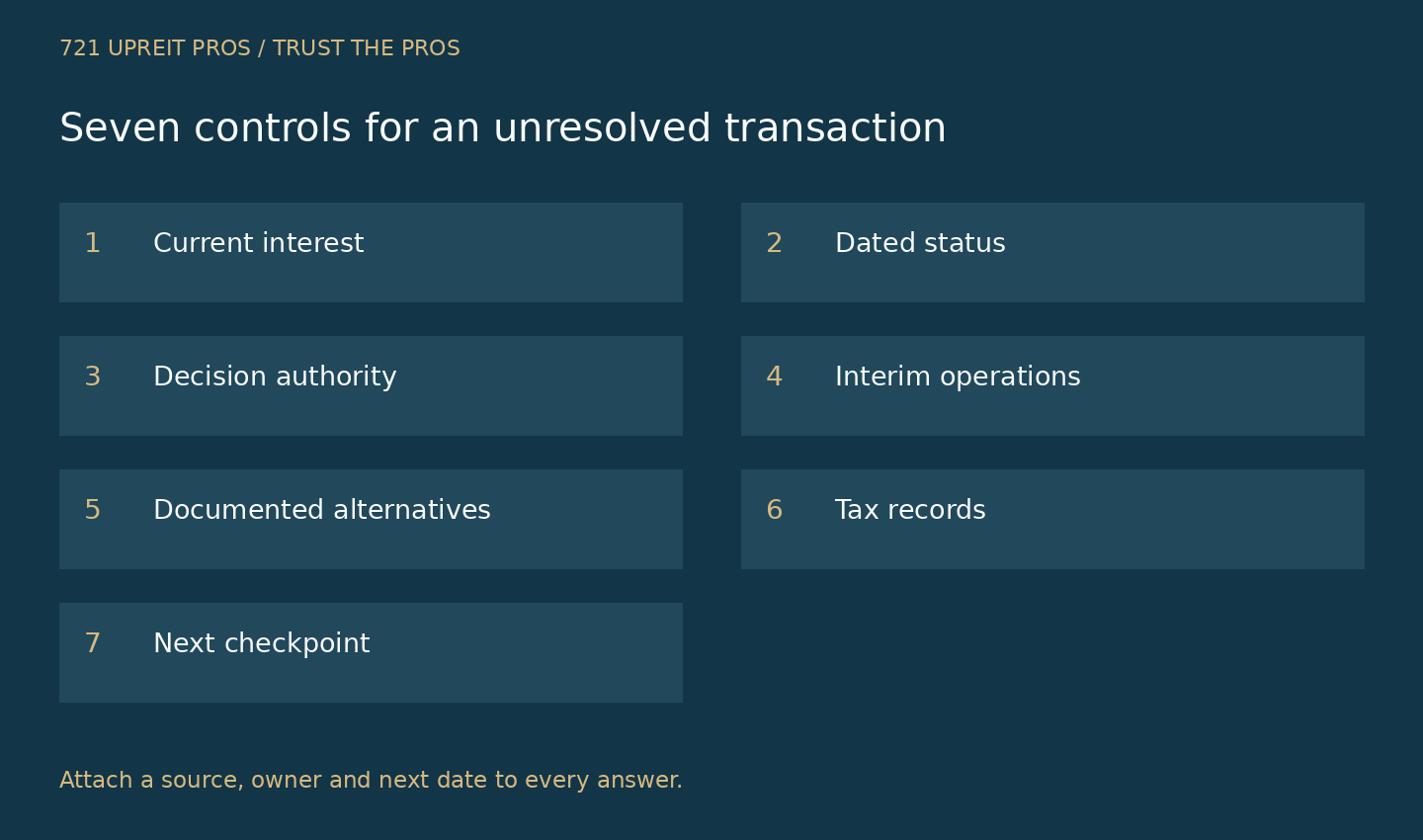
A useful control sheet links each conclusion to evidence, an owner and a date. Complete it with the sponsor or asset manager, then route tax and legal questions to the appropriate professional.
| Control | What to record | Why it matters |
|---|---|---|
| 1. Current interest | Exact owner, entity, units or percentage, property and statement date | Prevents planning around an asset you do not yet own |
| 2. Current status | Dated status, reason and supporting notice or clause | Separates delay, nonparticipation and termination |
| 3. Decision authority | Who can extend, waive, terminate, sell or propose another transaction | Shows which outcomes the investor can and cannot control |
| 4. Interim operations | Property plan, debt maturity, reserves, material leases and distribution policy | The existing real estate risk continues while the plan is unresolved |
| 5. Alternatives | Only documented options, conditions, costs and responsible party | A possible sale, hold or other transaction is not an investor election unless documents say so |
| 6. Tax records | 1031 file, basis records, debt allocations, distributions and proposed transaction documents | Later tax analysis depends on the actual sequence and numbers |
| 7. Next checkpoint | Named contact, requested evidence, response date and escalation date | Turns an indefinite promise into a reviewable process |
How would a fallback review work in practice?
Assume an investor owns a hypothetical $700,000 DST interest. The offering materials described a potential later transaction, but a May update says closing conditions have not been satisfied. No operating partnership interest appears on the investor's statement, and no termination notice has been delivered. A September review is promised.
The investor should not record the planned transaction as completed or project a redemption of OP units. A disciplined file would show:
- Current asset: the investor's latest evidence still shows the DST interest.
- Status: the proposed transaction remains unresolved, based on the dated May update.
- Missing evidence: the exact unsatisfied conditions, whether they can be waived and who decides.
- Interim economics: current property performance, debt and distribution records, without treating a projected distribution as guaranteed.
- Next action: request a written update before the September review and ask what notice will be provided if the transaction is extended or terminated.
This example does not decide whether the investor should hold, transfer or sell. Those choices may not be available at the investor's election. It shows how to prevent an uncertain future event from being mistaken for current ownership or cash.
Does a failed DST-to-721 conversion change the earlier 1031 exchange?
Do not answer that question from the word “failed.” The earlier 1031 exchange and a later Section 721 contribution are separate transactions. Section 1031 addresses qualifying exchanges of real property and includes identification and completion rules. IRS Revenue Ruling 2004-86 concludes, for its specific facts, that a DST interest was treated as an interest in real property for Section 1031 and emphasizes the trust's restricted powers.
The absence of a later contribution does not, by itself, prove that an earlier exchange was valid or invalid. Preserve the qualified intermediary file, identification notice, settlement records, DST closing evidence and tax returns. Ask your CPA to analyze the completed exchange and any later transaction using the actual sequence, not the original marketing plan.
What if the DST property is eventually sold?
A property sale, liquidation, transfer or other transaction has its own legal, tax and cash consequences. Ask who controls it, what liabilities and expenses are paid first, what records will be issued and what choices, if any, the investor has. Do not assume that another 1031 exchange, a Section 721 contribution or an immediate cash distribution will be offered.
What if the conversion is only delayed?
Continue underwriting the investment you currently own. Update the control sheet when a new notice, amendment, financing event or property report arrives. If the proposed contribution later resumes, compare the new terms with the prior version rather than relying on the old summary.
Use the DST-to-721 document checklist to rebuild the source file and the 1031, DST and Section 721 process guide to keep the stages separate. DST Experts' 721 UPREIT guide provides related pathway context, while our risk review helps identify current liquidity, property, financing and control questions.
Which questions should you send in writing?
- What investment and legal interest do my latest records show that I own?
- Is the contemplated transaction delayed, amended, unavailable to me or terminated?
- Which signed provision or notice supports that status?
- Which conditions remain unmet, and who can satisfy or waive them?
- Who controls the current property, debt, sale and distribution decisions?
- What alternatives are actually authorized, rather than merely possible?
- What notice should I expect next, from whom and on what date?
- Which records should my attorney and CPA review now?
Watch the one-minute fallback review and download the worksheet
Download the fallback-control worksheet ↓
Original silent explainer with on-screen text, English captions and a complete expandable transcript.
Read video transcript
0:00 · The plan did not happen. Start with ownership.
Use the latest statement, register and signed notices. Do not label a DST interest as OP units before a contribution.
0:12 · Name the actual status.
Is the transaction delayed, amended, unavailable or terminated? Ask for the dated document supporting the answer.
0:24 · Keep underwriting the current asset.
Review property operations, debt, reserves and distributions. An unresolved conversion does not remove real estate risk.
0:36 · List only documented alternatives.
Record who controls each option and every condition. Do not assume an investor can force a sale, exchange or contribution.
0:48 · Set the next evidence checkpoint.
Give each open item an owner and response date. Bring tax and legal questions to the right professionals.
Sources checked September 19, 2026. General education by 721 UPREIT Pros with AI assistance. No independent expert review is represented. The worked example is hypothetical and is not an offering, legal conclusion or individualized tax advice. Conversion, liquidity, distributions, tax treatment and investment outcomes are not guaranteed.
BEFORE YOUR ADVISOR CONVERSATION
Three questions before you commit
This companion briefing covers the professional's identity, compensation and how restrictions fit your cash needs. Use it alongside this article's specific document checks.
Loading the video connects to YouTube. Watch on YouTube · 721 UPREIT Pros channel · Read the full advisor checklist.
Read video transcript
Before you hire a seven twenty-one UPREIT advisor, ask these three questions.
First: who exactly am I hiring? Get the professional's legal name, firm and registration information. Check the record through Investor dot gov and read the firm's relationship summary where applicable. Ask whether this conversation involves brokerage services, investment advice, or both. A marketing title alone does not answer that question.
Second: who gets paid, and how much? Request a written cost breakdown in dollars. Identify the payer, calculation base, payment timing and ongoing charges. Include product expenses and embedded compensation. No separate advisor invoice does not mean there are no costs.
Third: how does this fit my cash needs? Review the actual agreements. Ask who controls a possible conversion and what happens if it does not occur. Separate permission to request redemption from approval, pricing and payment. Do not assume a fixed cash-out date.
Then agree on responsibilities. Your investment professional, CPA, attorney and qualified intermediary can have different roles. Put continuing service and unresolved questions in writing.
Read the complete advisor checklist using the article link in the description. Seven twenty-one UPREIT Pros. Trust the Pros. Educational only. Investments involve risk and may be illiquid. Tax treatment depends on your circumstances.
Educational only. Investments involve risk and may be illiquid. Footage is illustrative; narration is synthetic.
TALK TO A 721 UPREIT ADVISOR
Ready to discuss your 721 options?
Request a callback to discuss the questions raised by this article, your timing and what to ask before you commit. Share your name, email and phone below to start the conversation.
No investment commitment or financial documents required. A callback request does not book an appointment or establish an advisory relationship.