
721 UPREIT PROS / TAX RECORDS
OP unit debt changes: what should your CPA calculate?
A decrease in a partner's share of partnership liabilities can be treated as a distribution of money under Section 752(b). It does not automatically create taxable gain. Gain can arise when that deemed distribution, together with other money distributions, exceeds the partner's adjusted outside basis immediately before the distribution.
By 721 UPREIT Pros · Published September 17, 2026 · Educational tax-record worksheet
The calculation is partner-specific. The operating partnership's property debt, your allocated share of liabilities, your outside basis and the tax-basis capital account on a Schedule K-1 are related records, but they are not interchangeable. Give your CPA the agreements, debt history, basis records and dates needed to reconcile them.

Separate the CPA liability calculation from investment funding. A maturity or rate-protection expiration can require a financing review even when no investor payment is due. Compare the loan timetable, conditional extensions and household cash dates using the 721 UPREIT refinancing timeline and gap worksheet.
TALK TO A 721 UPREIT ADVISOR
Talk to a 721 UPREIT advisor
Request a callback to discuss the questions raised by this article, your timing and what to ask before you commit. Share your name, email and phone below to start the conversation.
No investment commitment or financial documents required. A callback request does not book an appointment or establish an advisory relationship.
Can a drop in allocated debt create taxable gain?
Yes, but not merely because property debt declined. Internal Revenue Code Section 752(b) generally treats a decrease in a partner's share of partnership liabilities as a distribution of money. The deemed distribution then enters the normal partnership distribution analysis. If money distributed exceeds the adjusted basis of the partnership interest immediately before the distribution, the excess can be taxable gain.
The 2025 Partner's Instructions for Schedule K-1 (Form 1065), checked September 17, 2026, describe beginning and ending liability shares in Item K1 and deemed money distributions from net liability decreases in Box 19, code D. The instructions also explain that the partner, not the partnership, is responsible for maintaining adjusted outside basis.
This is not a promise that a decrease will appear in Box 19 or produce a particular result. Timing, other distributions, current-year income or loss, Section 751 ordinary-income rules and transaction-specific provisions can matter. A contribution followed by related distributions can also raise disguised-sale questions. Your tax professional must apply the current law to the complete transaction.
Which four numbers must be kept separate?
Start by labeling each record. A clean reconciliation prevents a common mistake: using one economic or tax number as if it answered every question.
| Record | What it describes | Why it matters |
|---|---|---|
| Property debt | Loans secured by an individual property or portfolio | Shows financing at the asset level, not automatically the amount allocated to one partner |
| Allocated partnership liabilities | The partner's share of recourse, nonrecourse and qualified nonrecourse financing | Changes can increase or decrease outside basis and can produce deemed money contributions or distributions |
| Outside basis | The partner's adjusted tax basis in the partnership interest | Used to test losses and distributions, including whether money exceeds basis |
| Tax-basis capital | The capital account reported in Item L of Schedule K-1 | Usually excludes liabilities and often differs from outside basis |
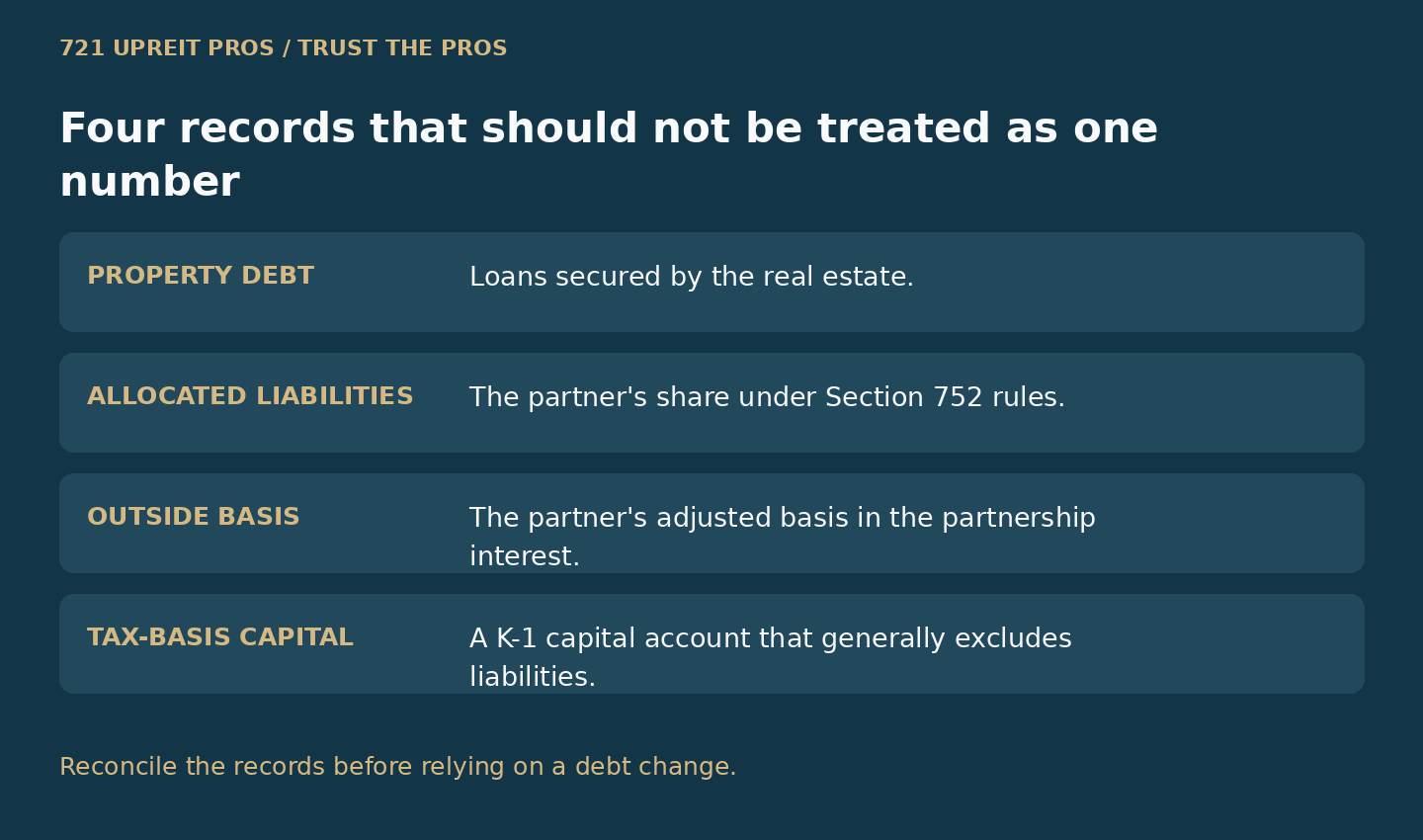
The liability-allocation rules are also not a simple pro rata formula in every case. Treasury Regulation 1.752-2 generally allocates recourse liabilities according to economic risk of loss. Treasury Regulation 1.752-3 provides a layered framework for nonrecourse liabilities. Guarantees, deficit-restoration obligations, Section 704(c) amounts and the partnership's chosen permissible method can affect the allocation.
What events should trigger a new calculation?
Ask for a fresh liability and basis reconciliation whenever an event could change the amount or character of the liabilities allocated to you. Do not wait until a redemption request or tax-return deadline to reconstruct the record.
- A property refinancing, principal paydown, loan payoff or property sale.
- A contribution of real estate or a DST interest to an operating partnership.
- A change in partner percentages, allocation methods or the entity holding the debt.
- The start, amendment, expiration or release of a guarantee, indemnity or deficit-restoration obligation.
- A distribution of cash or property, including a redemption or exchange of OP units.
- A conversion of partnership units into REIT shares, if permitted by the governing documents.
- A year with material income, loss, deductions or additional contributions.
These are review triggers, not conclusions. The governing agreement and the facts determine whether a partner's share changed and when that change is taken into account.
How does a $400,000 liability decrease interact with basis?
Use a two-step worksheet: first calculate the net change in the partner's allocated liabilities; then test the resulting deemed distribution against adjusted outside basis immediately before the distribution. The two hypothetical scenarios below hold the liability decrease constant and change only the starting basis.
| Input or result | Scenario A | Scenario B |
|---|---|---|
| Beginning allocated liabilities | $700,000 | $700,000 |
| Ending allocated liabilities | $300,000 | $300,000 |
| Net decrease, treated here as money | $400,000 | $400,000 |
| Adjusted outside basis immediately before | $1,050,000 | $250,000 |
| Illustrative basis after this item | $650,000 | $0 |
| Illustrative excess over basis | $0 | $150,000 |
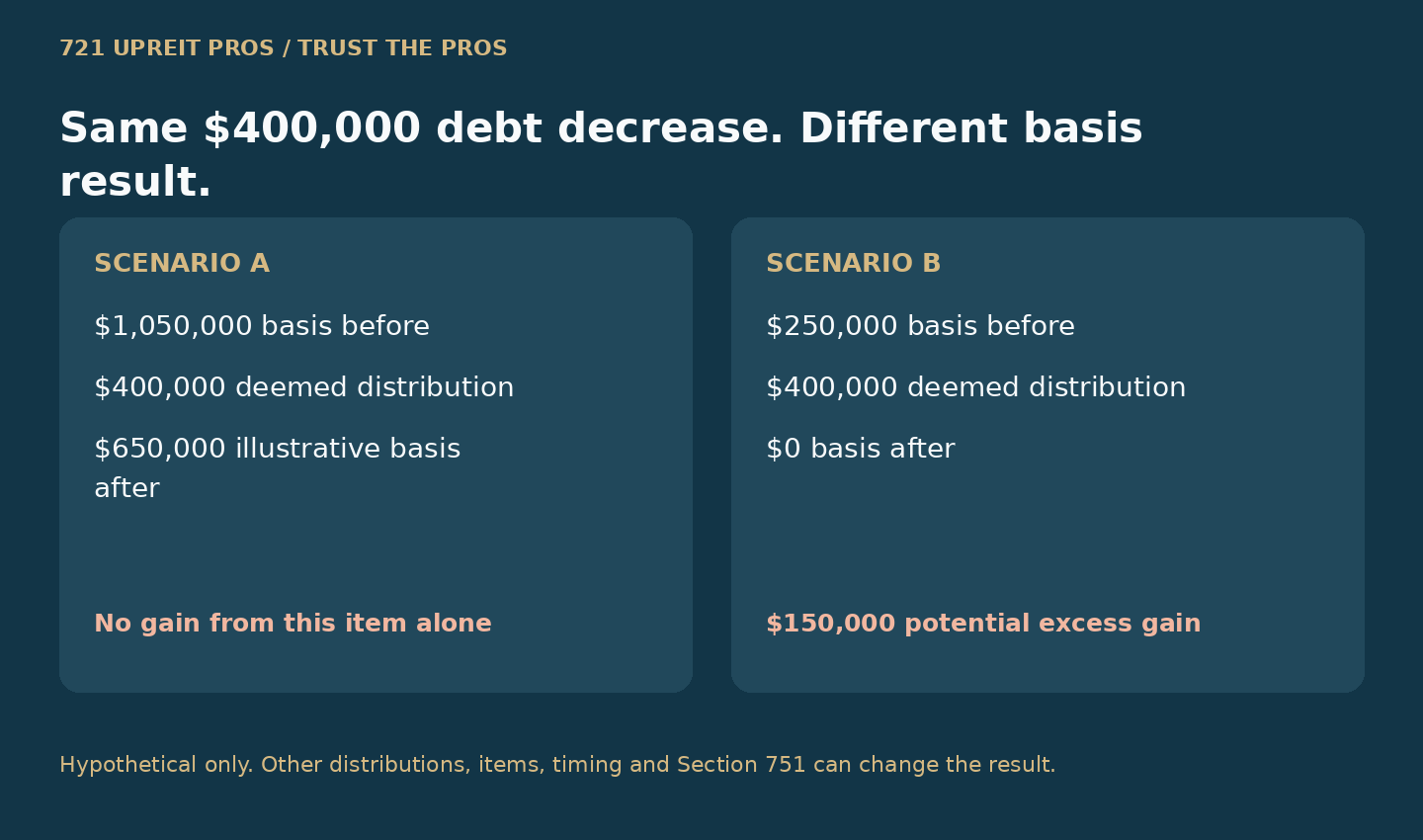
Scenario A leaves $650,000 of illustrative basis after this item, so the $400,000 deemed distribution does not create gain by itself. Scenario B has only $250,000 of basis immediately before the same deemed distribution, producing a $150,000 illustrative excess. Actual basis ordering, other money distributions, current-year adjustments and Section 751 can change both character and amount. This example is not a return position or an offering result.
More units, a higher appraisal or a stable account statement cannot replace this calculation. The earlier OP-unit valuation reconciliation explains the economic path from contribution value to unit count. This worksheet addresses a separate tax-record question after liabilities and basis are considered.
What should you send your CPA?
Send a complete, dated file through the professional's secure channel. Ask which records are still missing and who will maintain the outside-basis schedule going forward.
- Opening basis support: acquisition or exchange records, historical depreciation, prior contributions, distributions, income, loss and prior-year basis schedules.
- Contribution documents: the contribution agreement, closing statement, valuation schedule, assumed liabilities and any side letters.
- Debt records: loan statements and a beginning-to-ending schedule separated into recourse, nonrecourse and qualified nonrecourse financing.
- Allocation support: the operating partnership agreement, applicable allocation method and any Section 704(c) schedules supplied by the partnership.
- Guarantee file: executed guarantees, indemnities, reimbursement rights, amendments, release dates and evidence of the obligor's actual economic exposure.
- Tax reporting: every Schedule K-1, especially Item K1, Item L, Box 19 code D and attached statements.
- Cash and unit activity: distribution notices, redemption or conversion documents, unit-class changes and payment dates.
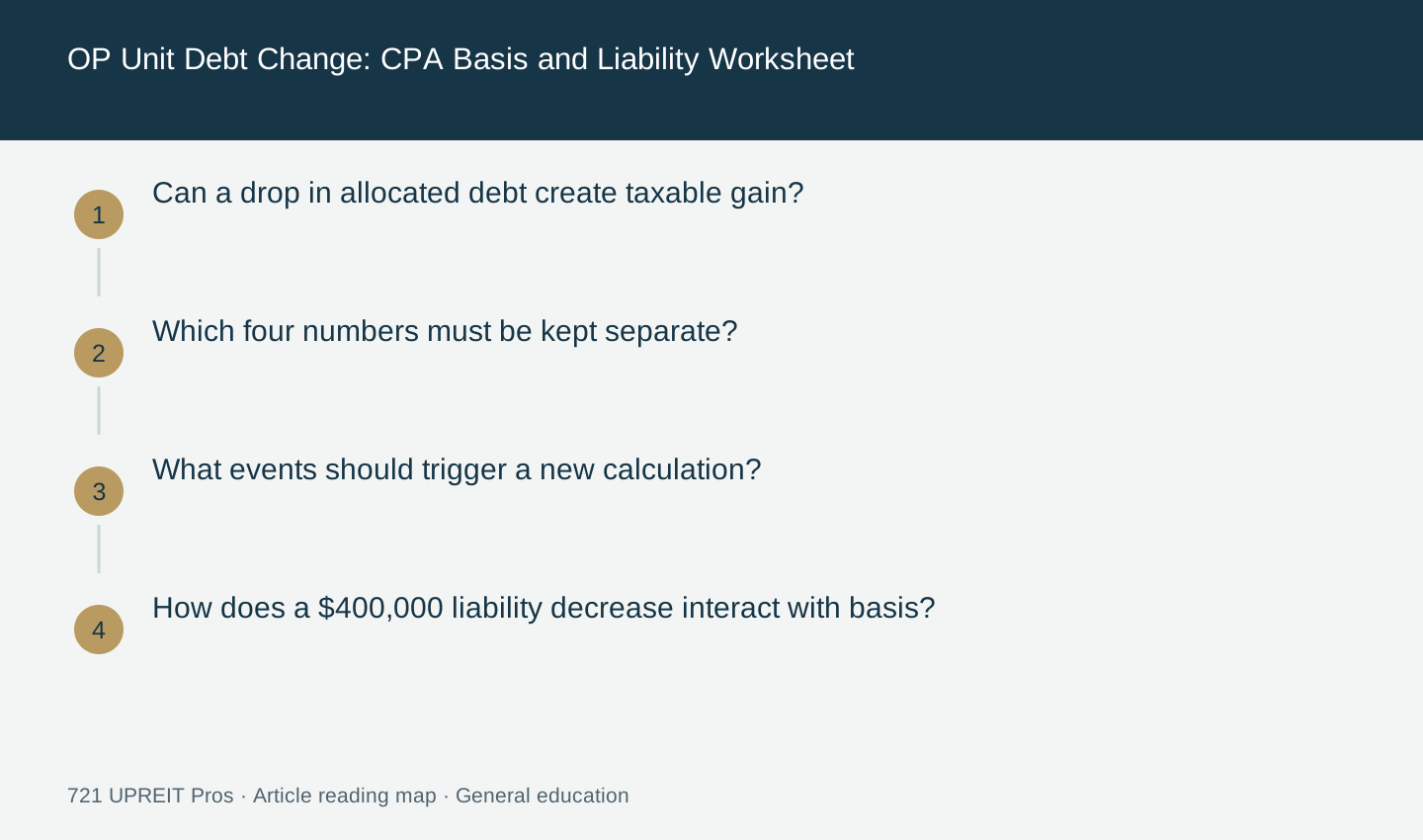
Ask the CPA to show the calculation as a bridge: opening outside basis, additions, reductions other than distributions, cash and deemed distributions, recognized gain if any, and ending outside basis. Separately reconcile beginning and ending liability categories. This format makes it easier to identify whether a difference comes from debt allocation, missing transaction history or a capital-account assumption.
What should you ask about a tax-protection agreement?
A tax-protection agreement may restrict specified actions or provide a negotiated remedy, but it does not freeze every liability allocation or guarantee no tax. Ask which assets, liabilities, partners, actions and time periods are covered. Identify notice procedures, permitted exceptions, calculation methods and the party responsible for any payment.
Do not assume a guarantee was created solely for tax protection or that it will remain effective for basis purposes. Ask counsel and the tax professional about the guarantee's substance, reimbursement rights, term and enforceability. Review the site's broader 721 UPREIT risk and due-diligence guide for liquidity, fees, control and document questions that sit beside the tax calculation.
Download the CPA input worksheet
Download the debt and basis worksheet ↓
The worksheet separates source documents, liability categories, outside-basis adjustments and unresolved professional questions. It does not calculate a return or transmit records to an advisor.
Watch the one-minute basis briefing
Original silent explainer with on-screen text and English captions. Open the transcript only if you want the full text.
Read video transcript
0:00 · A liability decrease can act like money.
Section 752(b) can treat a decrease in a partner's share of liabilities as a distribution of money. That does not automatically mean taxable gain.
0:12 · Start with outside basis.
Outside basis is not the same as property debt or tax-basis capital. The partner is responsible for maintaining this basis record.
0:24 · Reconcile the liability change.
Compare beginning and ending recourse, nonrecourse and qualified nonrecourse financing. Review guarantees and allocation changes.
0:36 · Test the distribution against basis.
Example: a $400,000 deemed distribution against $1.05 million of basis does not create gain by itself. Against $250,000, the illustrative excess is $150,000.
0:48 · Give the CPA a complete file.
Include K-1 items, contribution and debt records, distributions, losses, guarantees and dates. Use the agreement and current tax advice.
What is the next useful conversation?
Sources checked September 17, 2026. Prepared as general education by 721 UPREIT Pros; no independent expert review or individualized tax opinion is represented. Investments may lose value and be illiquid; liability allocations, conversion, liquidity and tax results are not guaranteed.
BEFORE YOUR ADVISOR CONVERSATION
Three questions before you commit
This companion briefing covers the professional's identity, compensation and how restrictions fit your cash needs. Use it alongside this article's specific document checks.
Loading the video connects to YouTube. Watch on YouTube · 721 UPREIT Pros channel · Read the full advisor checklist.
Read video transcript
Before you hire a seven twenty-one UPREIT advisor, ask these three questions.
First: who exactly am I hiring? Get the professional's legal name, firm and registration information. Check the record through Investor dot gov and read the firm's relationship summary where applicable. Ask whether this conversation involves brokerage services, investment advice, or both. A marketing title alone does not answer that question.
Second: who gets paid, and how much? Request a written cost breakdown in dollars. Identify the payer, calculation base, payment timing and ongoing charges. Include product expenses and embedded compensation. No separate advisor invoice does not mean there are no costs.
Third: how does this fit my cash needs? Review the actual agreements. Ask who controls a possible conversion and what happens if it does not occur. Separate permission to request redemption from approval, pricing and payment. Do not assume a fixed cash-out date.
Then agree on responsibilities. Your investment professional, CPA, attorney and qualified intermediary can have different roles. Put continuing service and unresolved questions in writing.
Read the complete advisor checklist using the article link in the description. Seven twenty-one UPREIT Pros. Trust the Pros. Educational only. Investments involve risk and may be illiquid. Tax treatment depends on your circumstances.
Educational only. Investments involve risk and may be illiquid. Footage is illustrative; narration is synthetic.
TALK TO A 721 UPREIT ADVISOR
Ready to discuss your 721 options?
Request a callback to discuss the questions raised by this article, your timing and what to ask before you commit. Share your name, email and phone below to start the conversation.
No investment commitment or financial documents required. A callback request does not book an appointment or establish an advisory relationship.