
721 UPREIT PROS / DISTRIBUTION DECISIONS
721 UPREIT distributions: should you take cash or reinvest?
Choose a 721 UPREIT distribution election only after confirming what you own, what reinvestment would buy and how much cash you need. Reinvestment can add to an investment, but it does not make a payment tax-free, guarantee growth or make the investment easier to sell. Cash and partial-reinvestment choices depend on the actual account and plan.
Prepared by 721 UPREIT Pros · October 15, 2026 · Educational decision worksheet
The practical question is not simply whether you want income or growth. It is whether the next payment should reach your bank account or purchase another interest, under terms you understand. Start with the current account statement and the issuer's current election instructions, then check the first affected statement after any change.

This page covers the election itself. For distribution-rate arithmetic, use the cash-flow and total-return example. For the broader property-to-partnership path, start with the 721 UPREIT investor guide. A potential 1031 exchange into a qualifying DST, a later Section 721 contribution and ownership of REIT shares are separate steps.
TALK TO A 721 UPREIT ADVISOR
Talk to a 721 UPREIT advisor
Request a callback to discuss the questions raised by this article, your timing and what to ask before you commit. Share your name, email and phone below to start the conversation.
No investment commitment or financial documents required. A callback request does not book an appointment or establish an advisory relationship.
First identify the interest and the purchase
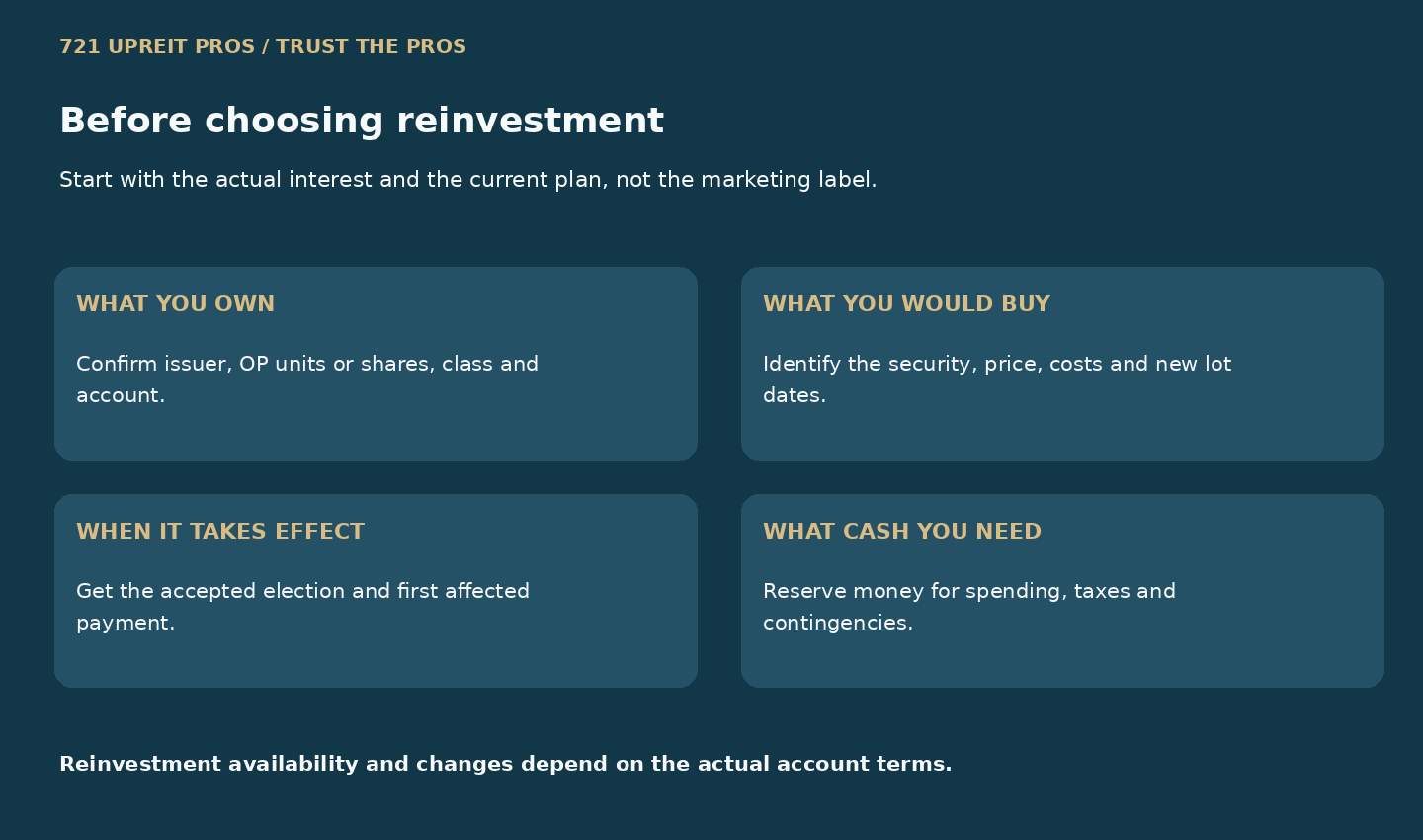
Write the legal issuer, exact class and ownership type at the top of your worksheet. An OP unit represents a partnership interest. A REIT share is corporate stock. Do not apply a shareholder reinvestment form to an OP-unit account merely because both use the same sponsor's branding. Ask the issuer which current documents govern your account and whether an election is available.
Then ask a second question: What security would each reinvested payment acquire? Obtain its issuer, class, purchase-price method, applicable charges and acquisition-date treatment. Do not assume it adds more of the exact units you already hold. Do not confuse the purchase made with a distribution with a redemption or exchange of your original OP units. If anyone proposes converting existing units, review that separate transaction using the OP-unit-to-share conversion checklist.
| Decision | Written evidence to request | Why it matters |
|---|---|---|
| Am I eligible? | Current plan and account-specific eligibility confirmation | A plan advertised for one class or ownership type may not cover yours. |
| What choices exist? | Cash, full reinvestment or any permitted split, including the current default | A hypothetical split is not proof a partial election is offered. |
| What will I acquire? | Legal issuer, security, class, pricing method and charges | The purchased interest needs its own risk, cost and tax review. |
| When does it start? | Deadline, acceptance confirmation and first affected payment period | Submitting an instruction does not prove the next payment will change. |
| How can I stop? | Change procedure, effective-date rules and any plan suspension terms | Stopping future purchases is different from selling past purchases. |
Compare the cash choices before the growth story
Reinvestment may fit money that is not needed for near-term expenses and that the investor is willing and able to keep exposed to the investment's risks. Cash may better serve an upcoming spending need, a tax reserve or a decision to direct new money elsewhere. Neither choice fixes a weak investment or substitutes for reviewing its value, expenses and distribution sources.
Taking a declared distribution in cash is not the same as withdrawing your original capital through a redemption request. Reinvesting does not create a readily accessible savings balance. The SEC's REIT investor overview warns that non-traded REIT shares can be difficult to sell and that distributions may come from sources beyond operating cash. Apply the actual governing terms to OP units and any newly purchased shares; do not presume their liquidity rights are identical.
Before deciding, make three estimates with your professionals: cash needed for ordinary spending, cash reserved for taxes and cash available elsewhere if payments fall or stop. Keep those estimates separate from a distribution projection. A reinvestment setting cannot create a payment the issuer has not declared.
A fictional $2,400 monthly payment test
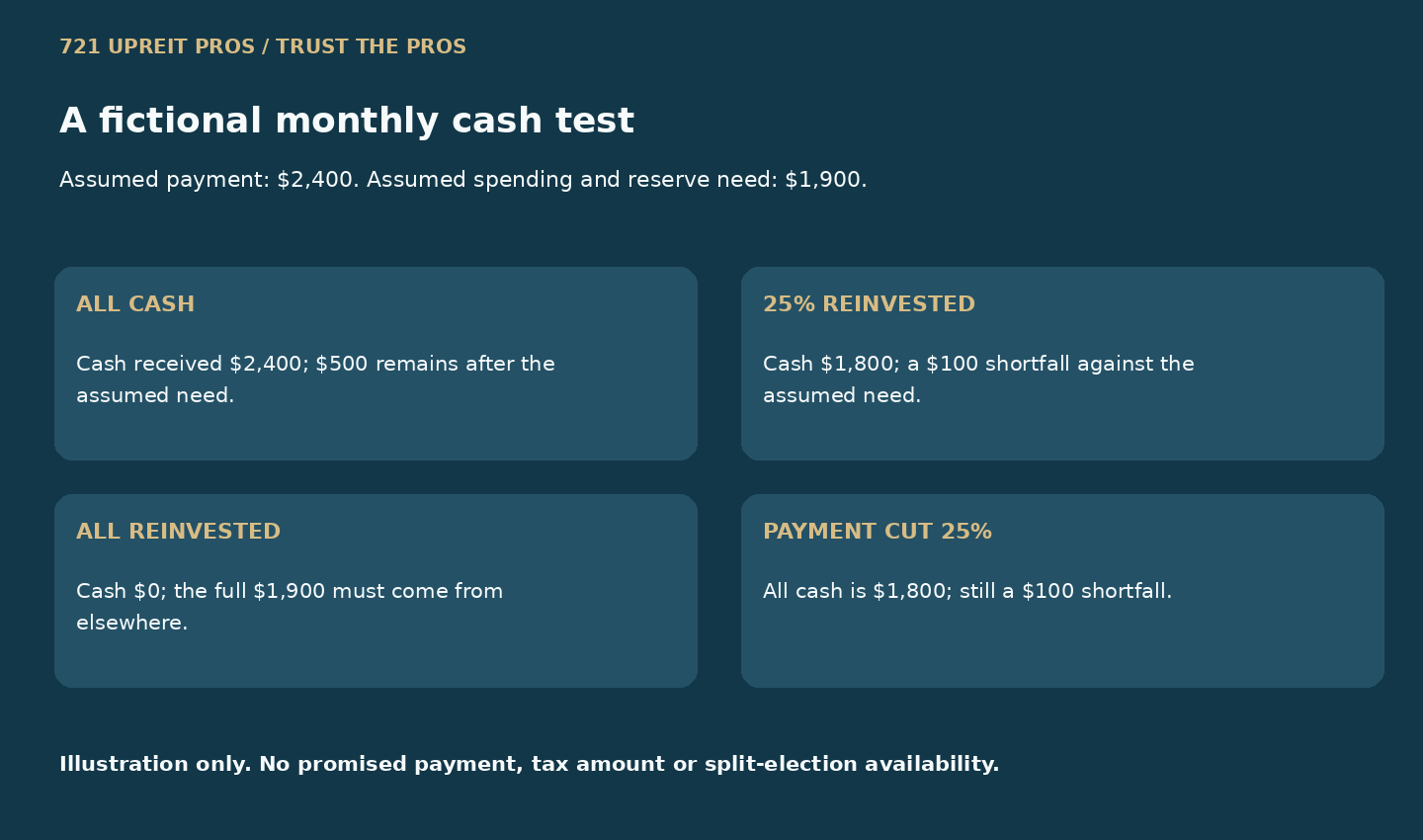
Assume an investor receives a hypothetical $2,400 monthly distribution before any withholding or separate charges. Their budget calls for $1,500 of spending and a $400 tax reserve, a combined $1,900 cash need. The $400 is an invented budgeting input, not a tax calculation or recommended reserve percentage. Assume a 25% reinvestment election is permitted solely to illustrate the comparison.
| Election or scenario | Reinvested | Cash received | Cash surplus or shortfall |
|---|---|---|---|
| All cash | $0 | $2,400 | $500 surplus |
| 25% reinvested | $600 | $1,800 | $100 shortfall |
| All reinvested | $2,400 | $0 | $1,900 shortfall |
| Payment reduced 25%, all cash | $0 | $1,800 | $100 shortfall |
| Payment stops | $0 | $0 | $1,900 shortfall |
The permitted 25% split, if available, would fail this particular cash budget without another funding source. That does not establish that all cash is suitable for every investor. Even the all-cash election fails the reduced-payment stress test. A useful decision file identifies the outside reserve that would cover the gap and how long it could last.
Do not treat the $600 reinvestment as a $600 investment gain. It is money directed into an additional purchase. If, purely for arithmetic, the plan applied the whole $600 at a $12 price with no purchase charges, it would buy 50 interests. A $10 price would buy 60. More interests at a lower price do not establish a better total return. Valuation changes, fees, distributions and the performance of the underlying investment all matter.
Does reinvestment remove the tax bill?
No. Reinvestment by itself is not a tax exemption. The IRS's Publication 550, Dividends Used To Buy More Stock, explains that using dividends to purchase stock at fair market value does not remove the requirement to report those dividends as income. This stock rule should not be substituted for partnership accounting.
For OP units, the IRS partner Schedule K-1 instructions explain that a partner may owe tax on allocated partnership income even when it is not distributed. Your cash election does not determine that allocation. The tax character of the actual distribution and purchase must be reviewed separately.
Ask your tax professional to reconcile the applicable K-1 or 1099 package, distribution details and purchase confirmations. Preserve both the existing interest's records and the new acquisition records. IRS Publication 541 explains that partnership basis changes with contributions, allocations, distributions and other events; an account value is not a replacement for that history. Use the separate taxable-income-without-cash worksheet when planning the reserve. This article does not calculate tax, select a filing position or establish anyone's basis.
Change the election in four steps
- Confirm the existing instruction. Read the account record rather than assuming the setting you chose at subscription still applies. Record the document version and how the issuer verified it.
- Submit the supported change. Use the issuer's verified channel and required authorization. Ask for the deadline and the first payment the change can affect. Avoid sending account credentials or tax documents through a general website inquiry.
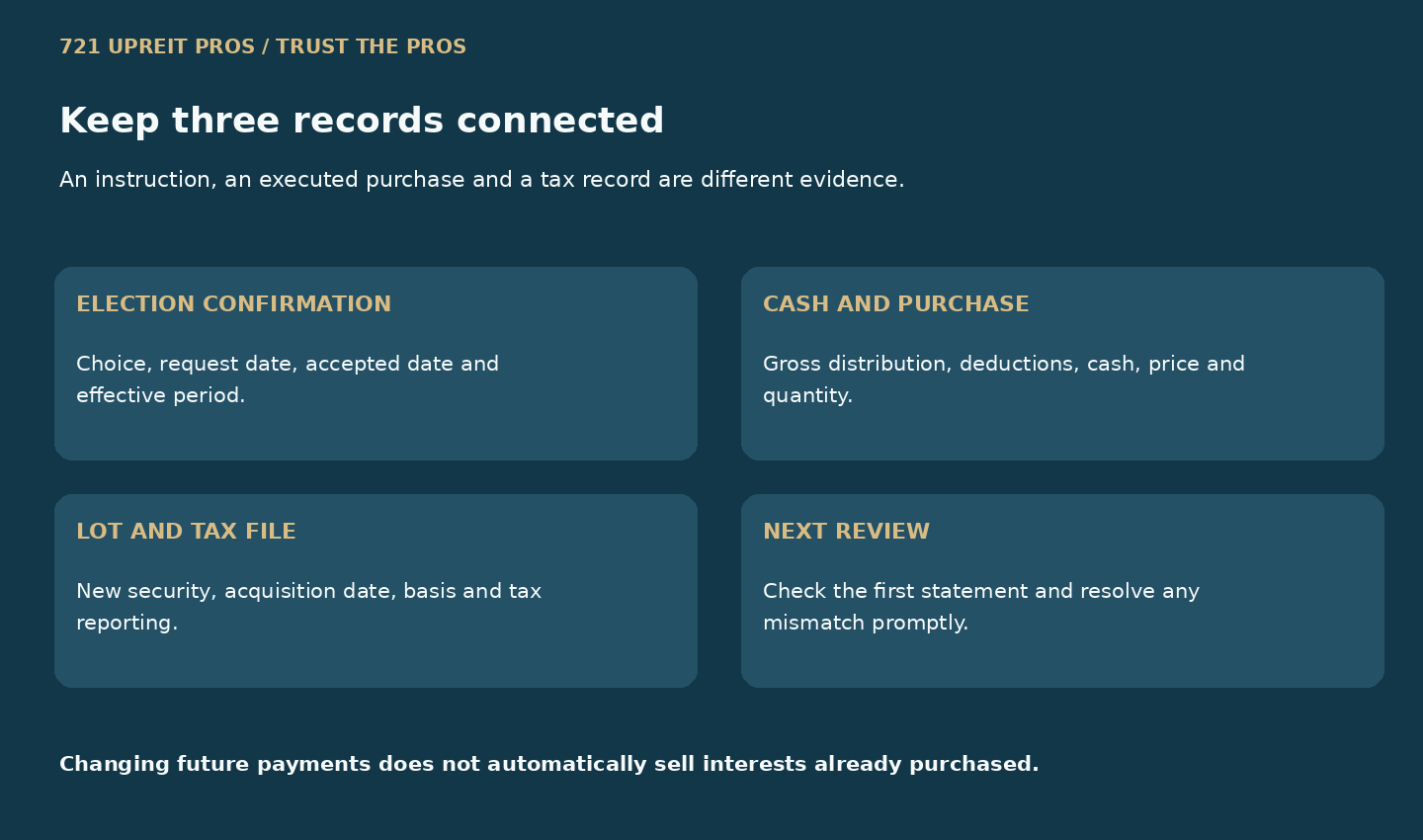
- Keep the acceptance. Save the request, timestamp and written acceptance together. If the response only acknowledges receipt, mark the effective election unresolved. Ask what happens if the request misses the cutoff.
- Check the first affected statement. Reconcile the declared amount, deductions, bank deposit, reinvested amount, purchase price and new quantity. Ask about mismatches promptly rather than assuming the next cycle will correct them.
A switch to cash ordinarily concerns future distributions under the plan's terms. It should not be interpreted as an automatic sale of previously acquired interests. Ask separately which lots you own, what restrictions apply and whether any particular plan treats reinvested lots differently for redemption purposes. There is no universal new lockup period assumed here. The holding-period and lockup calendar helps keep those questions distinct.
If you are also comparing the earlier DST stage with rental ownership, this comparison of DST distributions and rental cash flow provides a separate cash-budget review. Apply the documents for the ownership interest you actually hold.
Questions worth bringing to your advisor
- Does this election apply to my exact OP-unit or share class?
- What would reinvestment buy, and what are the purchase and ongoing costs?
- Can I choose a partial amount, and what happens if I make no election?
- How much spending and tax cash must remain outside this investment?
- Which payment first reflects a change, and how will acceptance be confirmed?
- Which records establish new lots and their tax basis?
- What happens to prior purchases if I stop reinvesting?
- How does this choice change my concentration in one issuer or strategy?
Bring the latest statement and the current plan to a 721 UPREIT advisor conversation. Use the advisor selection and fee questions to understand the person's role. For another view of distribution sources and valuation, see DST Experts' guide to interpreting 721 UPREIT yield. The risk overview remains the broader due-diligence starting point.
Download the election worksheet
Download the cash-or-reinvestment worksheet
Watch the one-minute election briefing
This original silent video includes timed captions. Its complete text is also available below.
Read video transcript
0:00 · 721 UPREIT: cash or reinvestment?
Identify the exact interest you own. Confirm which election the plan permits.
0:12 · Ask what reinvestment buys
Confirm security, price, costs and lot dates. Do not assume OP units and shares are identical.
0:24 · Protect the cash you need
Test household expenses and a tax reserve. Stress-test a reduced or stopped payment.
0:36 · Keep the election receipt
Confirm the first affected payment. Reconcile the cash and purchase statement.
0:48 · Separate reinvestment from tax
Reinvestment does not itself erase taxable income. Ask your advisor and tax professional before changing.
Sources and scope
Primary tax and investor guidance checked October 15, 2026: IRS Publication 550 (2025), Partner's Instructions for Schedule K-1 (Form 1065) (2025), Publication 541 (December 2025) and the SEC's Investor.gov REIT overview, linked in the relevant sections. The election framework, fictional budget and worksheet are original educational tools. No named sponsor's current plan availability, default, pricing, deadline or redemption treatment is asserted. Your current governing documents control those terms.
Educational only, not tax, legal or investment advice. Distributions, investment value, access to principal and tax outcomes are not guaranteed.
BEFORE YOUR ADVISOR CONVERSATION
Three questions before you commit
This companion briefing covers the professional's identity, compensation and how restrictions fit your cash needs. Use it alongside this article's specific document checks.
Loading the video connects to YouTube. Watch on YouTube · 721 UPREIT Pros channel · Read the full advisor checklist.
Read video transcript
Before you hire a seven twenty-one UPREIT advisor, ask these three questions.
First: who exactly am I hiring? Get the professional's legal name, firm and registration information. Check the record through Investor dot gov and read the firm's relationship summary where applicable. Ask whether this conversation involves brokerage services, investment advice, or both. A marketing title alone does not answer that question.
Second: who gets paid, and how much? Request a written cost breakdown in dollars. Identify the payer, calculation base, payment timing and ongoing charges. Include product expenses and embedded compensation. No separate advisor invoice does not mean there are no costs.
Third: how does this fit my cash needs? Review the actual agreements. Ask who controls a possible conversion and what happens if it does not occur. Separate permission to request redemption from approval, pricing and payment. Do not assume a fixed cash-out date.
Then agree on responsibilities. Your investment professional, CPA, attorney and qualified intermediary can have different roles. Put continuing service and unresolved questions in writing.
Read the complete advisor checklist using the article link in the description. Seven twenty-one UPREIT Pros. Trust the Pros. Educational only. Investments involve risk and may be illiquid. Tax treatment depends on your circumstances.
Educational only. Investments involve risk and may be illiquid. Footage is illustrative; narration is synthetic.
TALK TO A 721 UPREIT ADVISOR
Ready to discuss your 721 options?
Request a callback to discuss the questions raised by this article, your timing and what to ask before you commit. Share your name, email and phone below to start the conversation.
No investment commitment or financial documents required. A callback request does not book an appointment or establish an advisory relationship.