
721 UPREIT PROS / DISTRIBUTION DECISIONS
721 UPREIT distributions cut: what should you check first?
If your 721 UPREIT distribution falls, first reconcile the declared amount for your exact unit class and period with eligible units, reinvestment, withholding and the bank deposit. Then request the issuer's explanation, review household cash needs and check contractual options. A smaller deposit alone does not prove why income changed or create an immediate exit.
By 721 UPREIT Pros · October 17, 2026 · Original educational reconciliation
Key takeaways
- A smaller bank deposit is not necessarily a lower declared distribution.
- Reconcile the exact class, period, eligible units, cash routing and settlement.
- Request the governing provision and financial evidence behind a confirmed reduction.
- Check spending, tax reserves and feasible options without assuming a rebound or immediate exit.

The first decision is whether you are looking at a lower declared distribution, a different payment period or an account-level cash change. An operating partnership unit is not a REIT share. Start with the legal issuer and class on your statement, not a payment headline for another security using similar branding.
Keep the previous statement, new statement and change notice together. Record which distribution period each covers and verify the communication through the administrator contact already in your records. This review does not ask you to sell, reinvest or submit new banking instructions. It helps identify which question needs an answer before you act.
TALK TO A 721 UPREIT ADVISOR
Talk to a 721 UPREIT advisor
Request a callback to discuss the questions raised by this article, your timing and what to ask before you commit. Share your name, email and phone below to start the conversation.
No investment commitment or financial documents required. A callback request does not book an appointment or establish an advisory relationship.
Did the distribution fall, or did the bank deposit change?
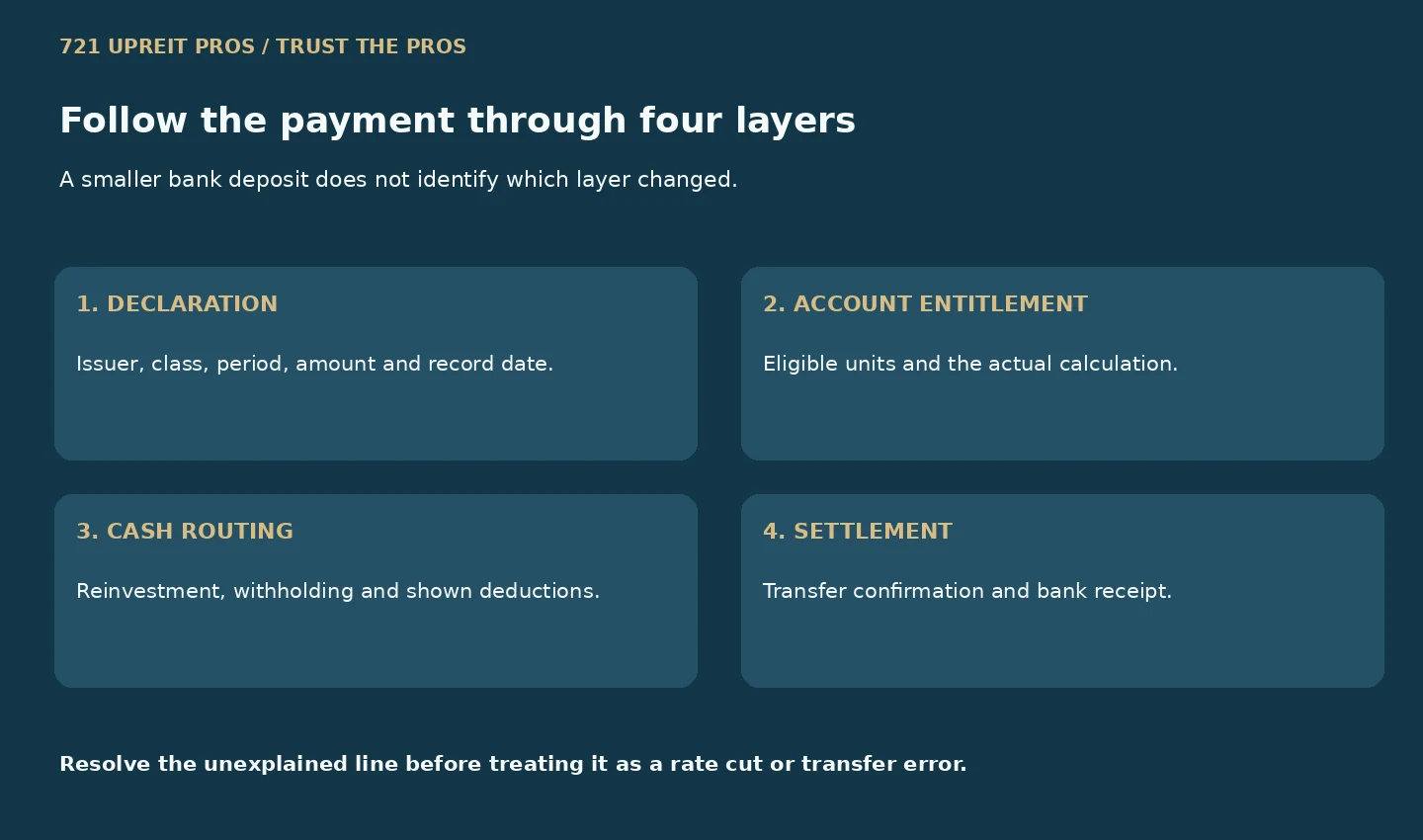
Reconstruct one payment from the declaration through the account statement to the bank. Use the actual calculation method: a per-unit amount, a stated base or another documented formula. Confirm eligible units at the relevant record date. A shorter period, a changed quantity or a reinvestment instruction can affect cash without establishing an issuer-wide rate reduction.
| Layer | Evidence to compare | What it can establish |
|---|---|---|
| Declaration | Exact class, period, amount or formula, record and payment dates | Whether the stated payment for that class changed |
| Account entitlement | Eligible quantity, class-specific adjustments and statement calculation | What the account should receive under those terms |
| Cash routing | Reinvestment purchases, withholding and separately shown deductions | Why the gross amount may differ from cash sent |
| Settlement | Transfer confirmation, bank receipt and any rejected payment | Whether the expected cash actually arrived |
Do not label a missing transfer as an investment loss before checking settlement, or label a lower declaration as a bank error. If the records do not reconcile, ask the administrator for a written calculation and identify the unresolved line. The separate cash-versus-reinvestment guide addresses changing an election; this article addresses investigating an unexpected result.
Can the partnership change the amount or timing?
Read the distribution provision and any class terms or amendments that govern your units. Identify who determines the payment, what discretion exists and what notice is required. Do not assume an advertised annualized percentage is a permanent contractual obligation or that the rules for publicly traded REIT dividends govern your partnership interest.
One dated example shows why the actual agreement matters. Section 5.2 of the Brookfield REIT Operating Partnership agreement dated September 25, 2024 gives the general partner discretion over the cash amount and permits a different distribution frequency. It also describes class-specific differences. This is an illustration of contractual language, not a report that this issuer has cut payments, an assessment of current availability or a universal OP-unit rule. Check later amendments and your own agreement.
What does a fictional payment reconciliation reveal?
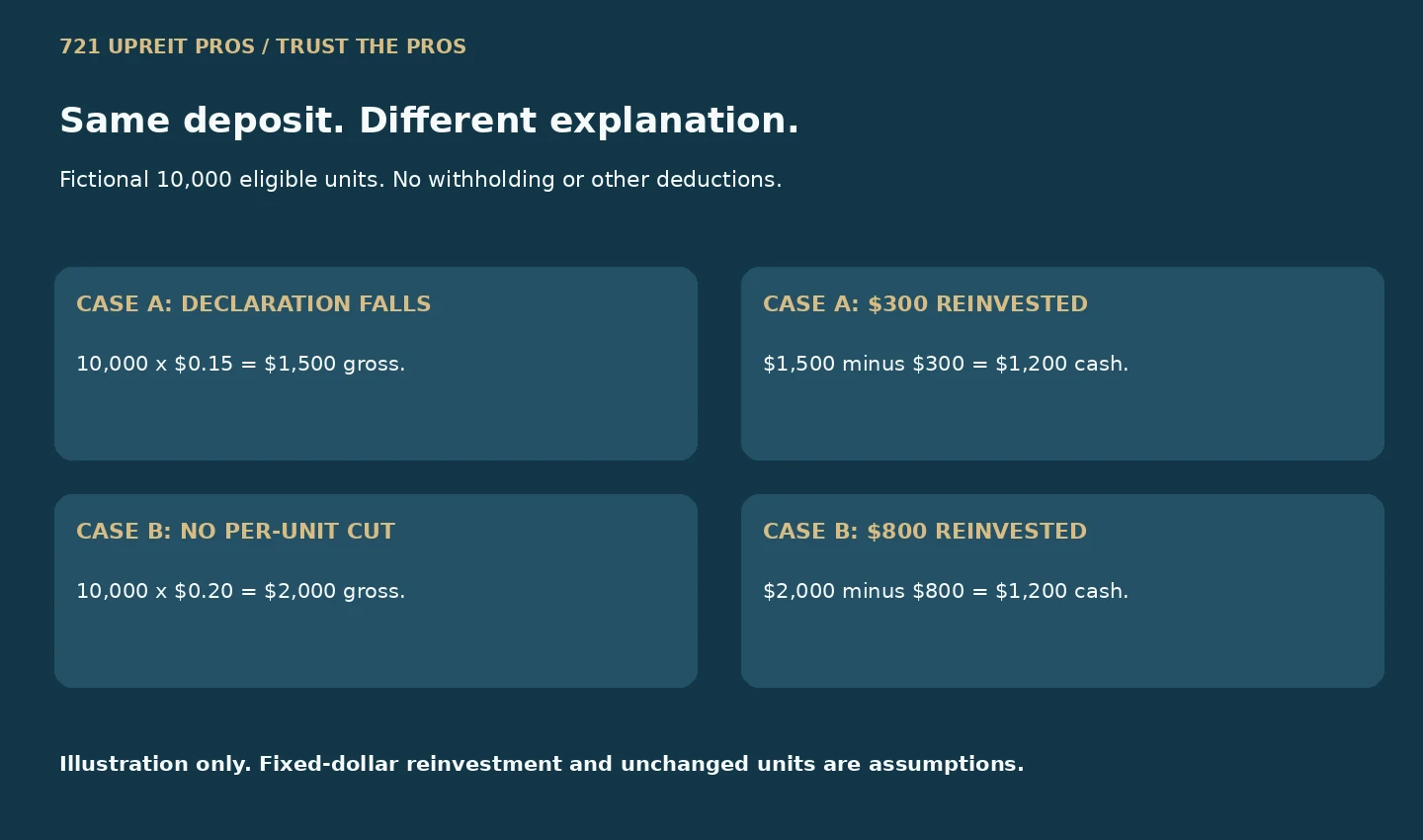
Assume an account has 10,000 eligible units in both periods. Its fictional declared amount changes from $0.20 to $0.15 per unit. Assume the statement shows $300 reinvested in each period, no withholding, no other deductions and completed bank transfers. These are invented inputs, not actual program terms or expected payments.
| Item | Prior period | New period |
|---|---|---|
| Eligible units | 10,000 | 10,000 |
| Declared amount per unit | $0.20 | $0.15 |
| Gross distribution | $2,000 | $1,500 |
| Reinvestment shown | $300 | $300 |
| Bank deposit | $1,700 | $1,200 |
The declared per-unit amount and gross distribution each fell 25%. The bank deposit fell approximately 29.4%, because the assumed reinvestment stayed at $300. Calling this a 29.4% distribution-rate cut would confuse net cash with the declaration. The unchanged eligible quantity is a simplifying assumption; actual reinvestment may change subsequent quantities, and a fixed-dollar election may not be offered.
Now change only one assumption: suppose the declared amount stayed at $0.20 but reinvestment increased to $800. The same $1,200 deposit would result with no per-unit distribution reduction. That second case needs an election inquiry, not the same explanation as the first. Neither case measures investment value, total return or tax due.
Which evidence explains a confirmed reduction?
Request the issuer's dated explanation and the reporting periods it uses. Ask which changes in operating cash, debt service, capital needs, reserves or expenses support the decision, and where those figures appear in the financial reports. These are diagnostic questions, not allegations about any investment. Separate a statement of intent to restore payments from an executed declaration.
The SEC's REIT investor overview explains that non-traded REIT distributions may use offering proceeds or borrowing and that their shares can be difficult to sell. Those shareholder warnings are not a substitute for OP-unit terms. They explain why a payment's source and the availability of an exit deserve separate scrutiny. The distribution-versus-total-return example keeps payment size separate from economic performance.
If the explanation mentions higher charges or ending expense support, request a before-and-after expense reconciliation. Do not subtract a fee again if it is already reflected in the reported amount. Use the fee-waiver expiration review for the separate contract question. Record unsupported explanations as unresolved rather than choosing the most reassuring one.
What should change in your household plan?
Build a near-term calendar of essential spending, tax payments and other available cash. Test the newly declared payment and a period with no payment. Count a pending redemption as uncertain until its settlement is confirmed. For each shortfall, identify a genuinely available funding source and a review date rather than assuming a distribution rebound.
A lower cash payment does not automatically reduce the partner's taxable allocation. The IRS partner Schedule K-1 instructions explain that tax can be due on a share of partnership income even when it is not distributed. Ask your CPA to review updated estimates and the actual tax package before reducing a reserve. See the taxable-income-without-cash worksheet for that distinct calculation.
Discuss holding, future reinvestment and any permitted redemption separately with qualified professionals. A distribution change does not establish a new redemption right or make an exchange or sale tax-free. Start with the 721 UPREIT risk framework and actual governing documents, not a promise that switching securities will replace the lost cash.
What should you request before making a decision?
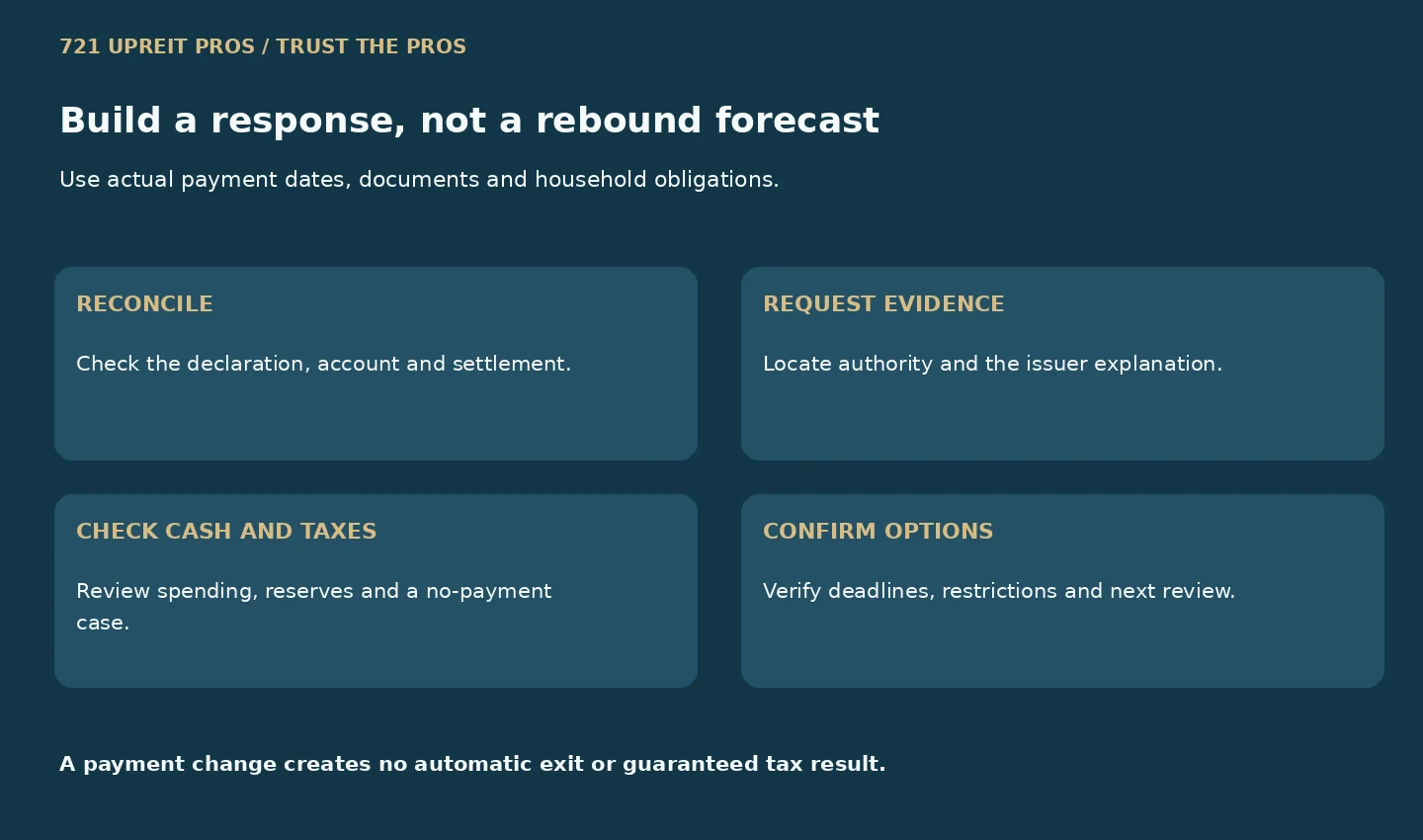
- Reconcile the payment. Match issuer, class, period, eligible units, gross distribution, deductions and settlement.
- Locate the authority. Obtain the governing distribution clause, current amendments and dated change notice.
- Test the explanation. Request the relevant operating and cash-source evidence, with unresolved items listed.
- Rework cash and taxes. Document the next spending dates, reserve needs and a no-payment case with your professionals.
- Verify feasible options. Confirm election deadlines, any redemption restrictions, costs and tax consequences before submitting instructions.
- Set a follow-up. Record who owes an answer and when the next statement or declaration is expected. An acknowledgment is not resolution.
Bring the completed record to a 721 UPREIT advisor conversation. The main 721 UPREIT guide explains the ownership structures. If you still hold a DST rather than OP units, this DST-specific sponsor-notice checklist covers a different stage. For an earlier property-sale comparison, use this review of DST distributions and rental cash flow. A qualifying 1031 exchange, DST ownership and a separate potential Section 721 transaction are not an automatic sequence.
Download and watch the payment review
Download the payment-reconciliation worksheet
This original one-minute silent briefing has timed English captions and a complete transcript below.
Read video transcript
0:00 · 721 UPREIT payment lower?
First distinguish a lower declaration from a smaller bank deposit.
0:12 · Trace four payment layers
Declaration, account entitlement, cash routing and bank settlement.
0:24 · One deposit, two causes
Fictional $1,200 cash may follow a cut or increased reinvestment. Check records.
0:36 · Ask what supports the change
Read your distribution provision. Request dated financial evidence.
0:48 · Protect the decision process
Check cash needs and taxes separately. A change creates no automatic cash exit.
Sources and limits
Primary agreement, IRS instructions and SEC investor guidance linked above were reviewed October 17, 2026. The agreement is expressly a September 25, 2024 example, not a certification of current terms or a claim about an actual payment cut. The matrix, counterexample, checklist and worksheet are original educational tools. This page does not determine your rights, investment value, tax liability or suitable transaction.
Educational only, not tax, legal or investment advice. Distributions, returns, liquidity, principal and tax results are not guaranteed. Do not send account credentials or confidential statements through a general inquiry form.
Frequently asked questions
Does a smaller deposit prove that my 721 UPREIT distribution rate was cut?
No. A different period, eligible quantity, reinvestment, withholding or settlement issue can also change cash received. Reconcile the declaration, statement and bank record before identifying the cause.
Does a distribution reduction mean the investment lost the same percentage in value?
No. Payment size and investment value are different measurements. Review current valuation information and total economic results separately; a payment change alone does not determine either.
Can stopping reinvestment restore the prior payment?
A supported election change may redirect future declared amounts into cash. It cannot create an undeclared payment or guarantee the previous cash amount. Confirm eligibility and the first affected period.
Will my partnership tax bill fall automatically when cash falls?
No. Allocated taxable income and cash distributions are separate. Give the current statements and tax package to your CPA before changing estimated payments or reserves.
Can I redeem my OP units immediately after a cut?
A cut does not itself create an immediate redemption right. The agreement, class terms and current restrictions govern eligibility, settlement, costs and any discretion. Tax consequences need separate review.
Should I wait for the payment to recover?
Do not build a spending plan around an undocumented recovery. Request the issuer's evidence, distinguish an intention from a declaration, test no-payment cash needs and set a dated review with qualified professionals.
TALK TO A 721 UPREIT ADVISOR
Ready to discuss your 721 options?
Request a callback to discuss the questions raised by this article, your timing and what to ask before you commit. Share your name, email and phone below to start the conversation.
No investment commitment or financial documents required. A callback request does not book an appointment or establish an advisory relationship.