
721 UPREIT PROS / CONTRIBUTION CLOSING RECORDS
What documents prove a 721 contribution actually closed?
A signed contribution agreement does not, by itself, prove that property transferred, the transaction became effective, debt was handled as expected or the correct OP units were issued. Build a post-closing evidence file that connects the recorded transfer, effective time, final economics, debt records, unit ledger, governing rights and opening tax workpapers.
Prepared by 721 UPREIT Pros · Published October 7, 2026 · General education

This article owns the post-closing proof question. The direct-property acceptance checklist addresses what must be investigated before closing. The value-to-unit worksheet tests the arithmetic. The DST-to-OP-unit transition-year article organizes two tax reporting periods. Here, the task is narrower: prove what legally and economically happened at closing.
What should you receive after a 721 UPREIT contribution closes?
At minimum, keep final evidence of the asset transferred, the contribution's effective date and time, the closing economics, debt treatment, the exact OP-unit owner, class and count, and the agreement that governs those units. Then connect those records to the contributor's basis, liability and Section 704(c) opening workpapers.
TALK TO A 721 UPREIT ADVISOR
Talk to a 721 UPREIT advisor
Request a callback to discuss the questions raised by this article, your timing and what to ask before you commit. Share your name, email and phone below to start the conversation.
No investment commitment or financial documents required. A callback request does not book an appointment or establish an advisory relationship.
The evidence may not arrive as one document. A recorded deed or assignment can establish a transfer. A closing certificate can establish the contractual effective time. A final adjustment statement can show value, cash, reserves and costs. A partnership ledger, joinder or amended partner schedule can evidence the units. The partnership agreement defines rights. Tax workpapers support the opening records. One item should not be asked to prove every fact.
Closing proof is a chain
A unit statement cannot prove that title was recorded. A recorded deed cannot prove the final unit count. An appraisal cannot prove outside tax basis. A Section 721 label cannot prove nonrecognition for the actual facts.
Use a six-record contribution closing chain
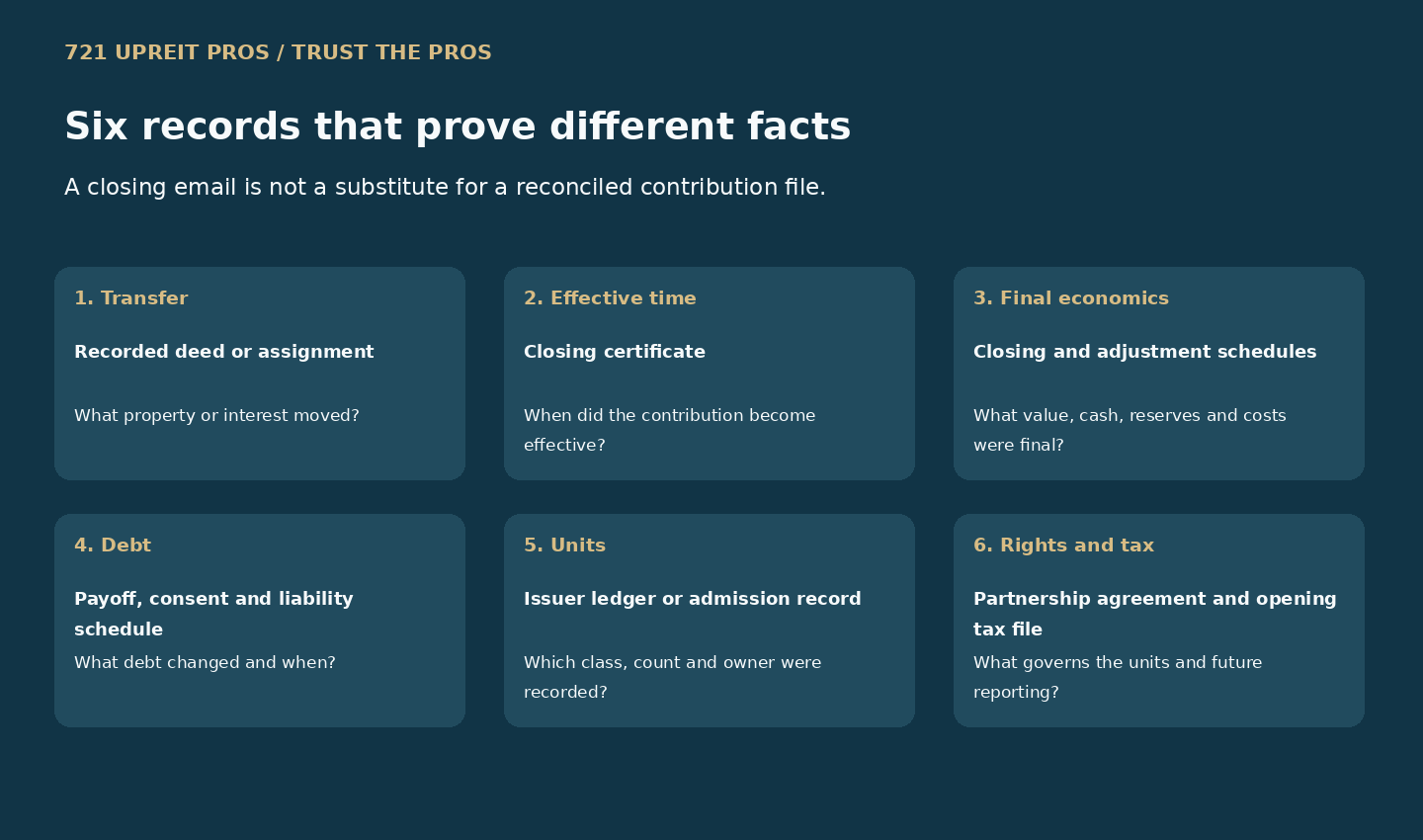
| Record group | Examples | Question to answer | Common gap |
|---|---|---|---|
| Transferred asset | Recorded deed, assignment, interest-transfer instrument, legal description and recording receipt | What property or entity interest moved, from whom and to whom? | File contains only the pre-closing title commitment or an unsigned draft |
| Effective contribution | Executed agreement, closing certificate, satisfaction or waiver schedule and effective-time provision | When did the transaction become legally effective under the documents? | Funding date, recording date and contractual effective time are assumed to be identical |
| Final economics | Final contribution statement, settlement statement, adjustment schedule, reserve and cash schedule | What values and adjustments became final? | Preliminary spreadsheet remains in the file without the signed final version |
| Debt and obligations | Payoff, assumption, lender consent, releases, guarantee status and partnership-liability schedule | What happened to debt and retained obligations? | Economic payoff is confused with the later tax liability allocation |
| OP units | Issuer ledger, partner admission record, joinder, amended partner exhibit, custodian statement or written issuance confirmation | Who received which class and count of units, and on what date? | Estimated unit count is copied from a closing model |
| Rights and tax opening | Partnership agreement, side letters, tax-protection agreement, basis file and Section 704(c) opening schedule | What governs the units and what records begin the partner's tax history? | Contribution value is treated as outside basis without analysis |
A public SEC-filed contribution agreement illustrates why the actual contract matters. One dated agreement required OP-unit issuance at closing and admission of the contributor as a limited partner, with the units evidenced through an amendment to the partnership agreement's partner exhibit. Another public agreement made issuance subject to adjustments shown in a final contribution statement. These filings are examples of transaction-specific documentation, not universal closing requirements or current offerings.
Reconcile the legal, economic and tax files
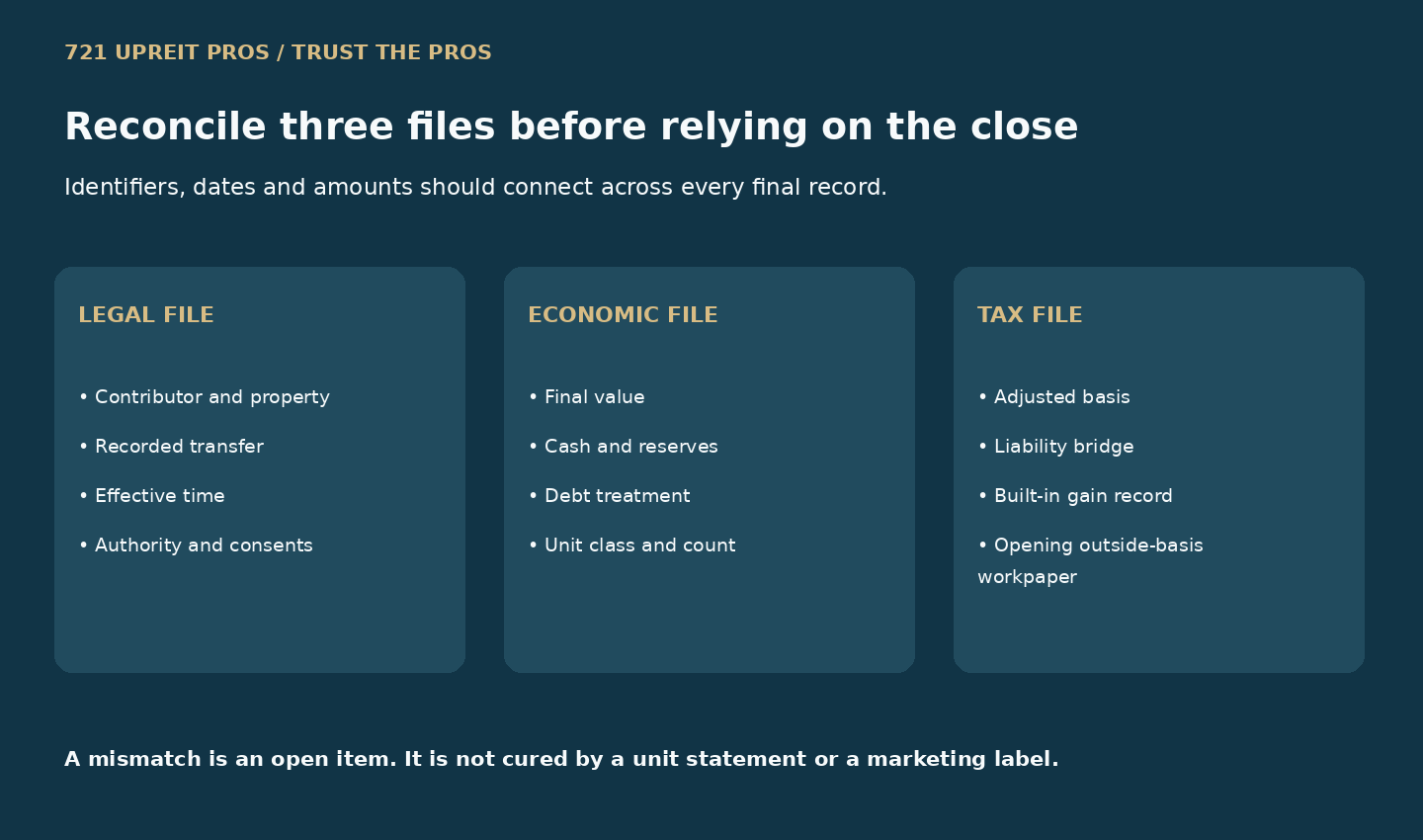
Start with a control sheet that lists the exact legal names of the contributor, operating partnership and property-owning entity. Add the property legal description or contributed-interest identifier, closing date, contractual effective time, valuation date, unit issuance date, unit class and unit count. Then cite the final document and page for each field.
Differences can be legitimate, but they need explanations. A deed might record the morning after contractual closing. A unit ledger might use the next business day as its posting date. A final value can differ from an appraisal because the agreement applies debt, reserve, rent, tax or expense adjustments. The file should show the reason rather than silently forcing one date or amount across all records.
- Lock final versions. Mark drafts, estimates and superseded schedules clearly. Preserve them only when they explain a change.
- Match identities. Confirm that the contributor named in the agreement matches the transfer instrument and unit owner, or document the authorized intermediate steps.
- Match the asset. Tie the legal description or entity interest to the property schedule and valuation perimeter.
- Bridge the economics. Reconcile agreed value through debt, cash, reserves, prorations and other adjustments to the amount assigned to units.
- Bridge the units. Divide or apply the signed formula using the correct class and date, then match the result to the issuer's final ledger.
- Open the tax file. Give the CPA the final closing facts, not only the marketing summary or account statement.
What proves the OP units you actually received?
Use the operating partnership's own ownership evidence and governing agreement. Depending on the structure, units may be uncertificated. The evidence might be an amended partner schedule, unit ledger, joinder, admission agreement, custodian statement or issuer confirmation. Ask which record is authoritative and how a correction would be documented.
Record the exact partnership legal name, unit class, number of units, registered owner, issuance date and any separate capital-account field. Do not shorten a class name or assume common and preferred units have the same economics. Do not use a REIT share ticker as proof of an OP unit. A later redemption or conversion right does not mean the contributor received publicly traded shares at closing.
One SEC-filed agreement described no physical certificate for OP units unless certificates were issued to all limited partners, while the contributor's ownership was reflected on the partnership agreement exhibit. That dated example shows why “Where is my certificate?” may be the wrong question. The better question is “Which final record does this partnership treat as the ownership ledger?”
- Does the final unit count match the signed contribution and adjustment schedules?
- Is the registered owner the same legal person or entity expected to receive the units?
- What unit class appears in both the ledger and governing agreement?
- What transfer, redemption, lockup and conversion provisions apply to that class?
- Did any side letter, tax-protection agreement or registration-rights agreement survive closing?
If money, reimbursements, reserves or other property moved around closing, use the contribution-payment evidence checklist to identify each purpose and open tax question separately.
What belongs in the opening tax record?
IRS Publication 541 explains the general rule that neither the partner nor partnership usually recognizes gain or loss when property is contributed for a partnership interest, while also discussing liabilities, disguised sales and basis. It also explains that the partnership generally takes a carryover basis in contributed property, adjusted for recognized gain, and that built-in gain or loss must be accounted for through partnership allocations.
That general guidance does not calculate the contributor's result. Give the preparer the adjusted basis and depreciation file, final property and interest schedule, final value, every form of consideration, cash movements, closing costs, debt immediately before and after closing, guarantee changes and the final unit records. Publication 551 emphasizes accurate records for items affecting basis. Preserve those items while closing participants can still explain them.
Keep at least four tax records separate:
- Contributed-property basis: the historical adjusted basis and depreciation evidence delivered into the transaction analysis.
- Partnership carryover basis file: the operating partnership's property-level opening record, when available.
- Section 704(c) record: contribution-date fair market value, adjusted basis and built-in gain or loss support.
- Partner outside-basis workpaper: the preparer's opening calculation for the partnership interest, including liability effects and any recognized items.
The Section 704(c) records checklist organizes the future annual handoff. The liability worksheet helps keep debt economics separate from the partner's tax-basis bridge.
Worked example: a close that does not yet reconcile
This is a fictional records example, not a transaction model or tax conclusion. The signed agreement for Example Property LLC states a $4,800,000 agreed value. A final adjustment schedule deducts $1,400,000 of debt and $120,000 of reserves and closing adjustments, leaving $3,280,000 assigned to Class A OP units. At an agreed issue price of $20 per unit, the expected result is 164,000 units.
| Record | Observed fact | Status | Next evidence |
|---|---|---|---|
| Recorded deed | Transfers the property to Example Operating Partnership LP on October 7 | Matched | Keep recording receipt and legal description |
| Closing certificate | Effective at 11:59 p.m. October 6 | Explain date difference | Written counsel or closing-agent explanation |
| Final adjustment schedule | $3,280,000 assigned to units | Matched | Keep signed final version |
| Unit statement | 163,500 Class A units dated October 7 | Open mismatch | Issuer ledger detail and any late adjustment or correction |
| Debt release | Personal guarantee release is absent | Open obligation | Lender or authorized closing confirmation |
The 500-unit shortfall equals $10,000 at the stated issue price, but that arithmetic does not explain the cause. The file needs the authoritative final formula, any adjustment posted after the signed schedule and a corrected ownership record if the ledger is wrong. The contributor should not change tax records or assume a remedy from the discrepancy alone.
What should you ask before treating the closing file as complete?
- Which final instrument proves the exact property or interest transferred?
- Which signed provision or certificate establishes the effective date and time?
- Where is the final value and adjustment schedule, and who approved each change?
- What happened to each loan, payoff, consent, guarantee and other retained obligation?
- Which record is the operating partnership's authoritative unit ledger?
- Do the unit owner, class, count and issuance date match the final agreement and schedules?
- Which partnership-agreement version, side letters and tax-protection provisions govern after closing?
- What closing items remain estimates, holdbacks, reserves, earnouts or post-closing true-ups?
- Which records did the CPA use for opening outside basis, liabilities and Section 704(c)?
- Who owns the correction process for each mismatch, and how will the final resolution be preserved?
DST 1031 Experts provides broader context on 721 exchange tax, basis, debt and exit records. Use it as related education, not proof that a particular contribution closed or qualifies. Bring this evidence file and its unresolved exceptions when you talk to a 721 UPREIT advisor, and route legal and tax determinations to the appropriate professionals.
If the proposed closing stops before the transfer and unit issuance are complete, use the failed-closing unwind checklist to reconcile termination authority, deposits, expenses, title, debt and the partnership unit ledger.
One-minute video: build the closing proof chain
Download the contribution closing evidence checklist
Read video transcript
0:00 · Did the 721 contribution actually close?
Start with final records, not a verbal confirmation. Different documents prove different facts.
0:12 · Prove the transfer and time
Match the recorded deed or assignment to the contributor and property. Keep the signed effective-time certificate.
0:24 · Reconcile the economics
Compare final value, cash, reserves, costs and debt. Preserve every signed adjustment schedule.
0:36 · Prove the OP units
Confirm owner, entity, class, count and issuance date. The partnership agreement controls the rights.
0:48 · Open the tax file
Give the CPA basis, liability and built-in-gain records. Carry unresolved mismatches forward in writing.
General education by 721 UPREIT Pros with AI assistance. No independent professional review is represented. Public agreements are dated examples, not current offerings or universal terms. This page does not determine whether a transaction closed, qualified under Section 721, produced a specific basis, satisfied a title or contract requirement, or created any particular value, income, liquidity, tax result, indexing or ranking.
BEFORE YOUR ADVISOR CONVERSATION
Three questions before you commit
This companion briefing covers the professional's identity, compensation and how restrictions fit your cash needs. Use it alongside this article's specific document checks.
Loading the video connects to YouTube. Watch on YouTube · 721 UPREIT Pros channel · Read the full advisor checklist.
Read video transcript
Before you hire a seven twenty-one UPREIT advisor, ask these three questions.
First: who exactly am I hiring? Get the professional's legal name, firm and registration information. Check the record through Investor dot gov and read the firm's relationship summary where applicable. Ask whether this conversation involves brokerage services, investment advice, or both. A marketing title alone does not answer that question.
Second: who gets paid, and how much? Request a written cost breakdown in dollars. Identify the payer, calculation base, payment timing and ongoing charges. Include product expenses and embedded compensation. No separate advisor invoice does not mean there are no costs.
Third: how does this fit my cash needs? Review the actual agreements. Ask who controls a possible conversion and what happens if it does not occur. Separate permission to request redemption from approval, pricing and payment. Do not assume a fixed cash-out date.
Then agree on responsibilities. Your investment professional, CPA, attorney and qualified intermediary can have different roles. Put continuing service and unresolved questions in writing.
Read the complete advisor checklist using the article link in the description. Seven twenty-one UPREIT Pros. Trust the Pros. Educational only. Investments involve risk and may be illiquid. Tax treatment depends on your circumstances.
Educational only. Investments involve risk and may be illiquid. Footage is illustrative; narration is synthetic.
TALK TO A 721 UPREIT ADVISOR
Ready to discuss your 721 options?
Request a callback to discuss the questions raised by this article, your timing and what to ask before you commit. Share your name, email and phone below to start the conversation.
No investment commitment or financial documents required. A callback request does not book an appointment or establish an advisory relationship.