
721 UPREIT PROS / FAILED-CLOSING RECORDS
A proposed 721 contribution did not close: what should you document?
If a proposed property contribution stops before closing, preserve the signed termination or extension, escrow and deposit disposition, title and lender status, expense allocation, transfer instruments, and the operating partnership's unit ledger. Do not assume that every draft document disappeared, that a deposit must be refunded, or that OP units were issued. The actual agreements and completed acts control.
Prepared by 721 UPREIT Pros · Published October 9, 2026 · General education

This page addresses a direct proposed contribution that does not close. It does not repeat the separate DST-to-721 fallback decision, where an investor may still own a DST interest after a potential sponsor-led conversion does not occur. Start with the 721 investor guide for the broader structure and the transaction sequence for the intended closing steps.
Does a failed closing automatically put everyone back where they started?
No. A termination may end specified future obligations while leaving notice, confidentiality, expense, breach, indemnity, dispute or document-return provisions in place. Money may be returned, retained or allocated under a particular clause. A deed delivered to escrow is different from a recorded deed. A provisional unit calculation is different from an entry in the final partnership ledger.
TALK TO A 721 UPREIT ADVISOR
Talk to a 721 UPREIT advisor
Request a callback to discuss the questions raised by this article, your timing and what to ask before you commit. Share your name, email and phone below to start the conversation.
No investment commitment or financial documents required. A callback request does not book an appointment or establish an advisory relationship.
Create one dated exception file that answers four questions: what was promised, what actually occurred, which document ended or changed the deal, and what remains open. Keep a copy of every version. A clean file is useful even when the business answer is simply that the parties walked away.
Identify the transaction's actual stopping point
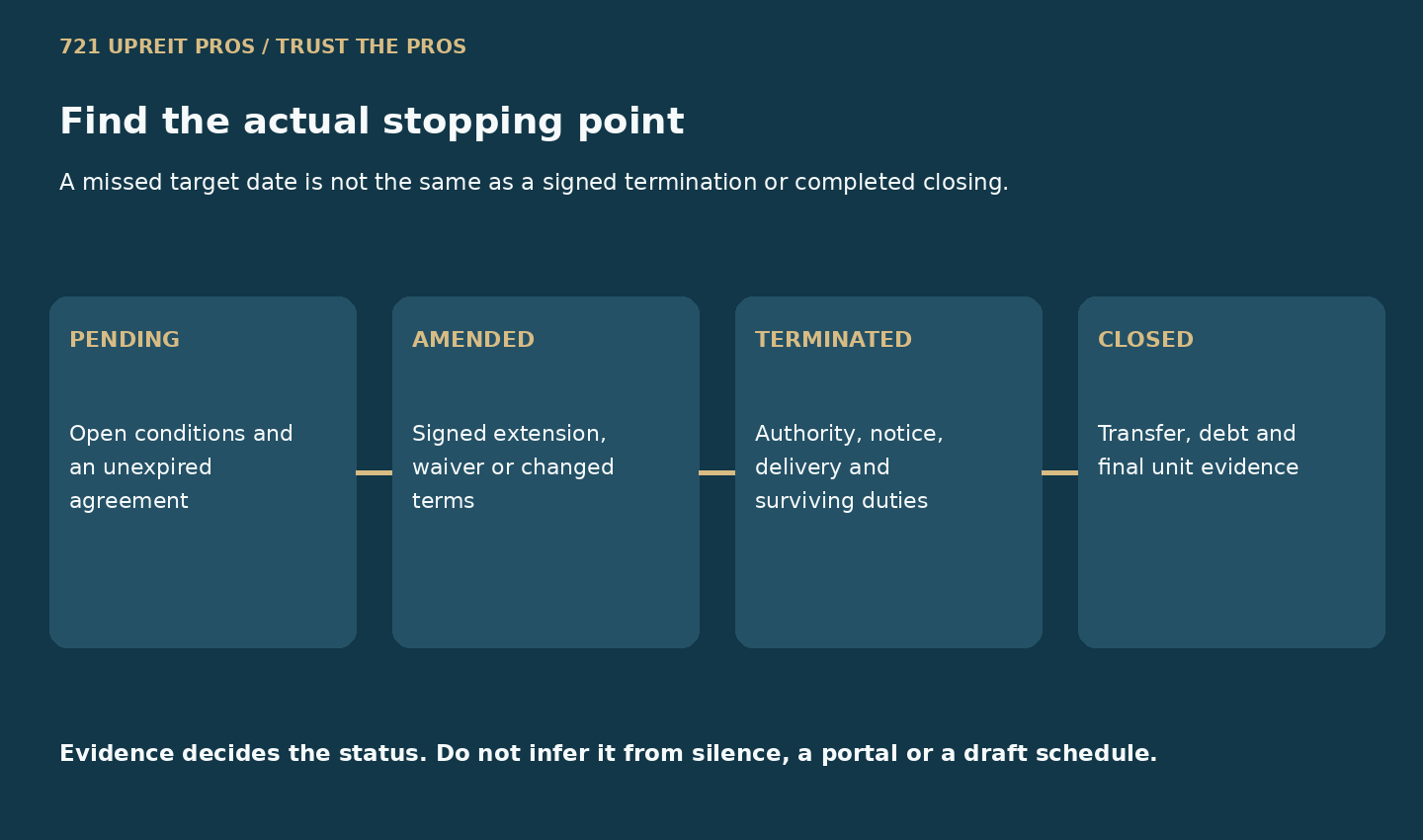
| Status | Evidence to request | Do not assume |
|---|---|---|
| Still pending | Current agreement, unexpired closing date, open-condition list, written status and escrow confirmation | Silence or a missed target date always terminated the agreement |
| Extended or amended | Signed amendment or waiver, revised outside date, changed economics and updated conditions | An email summary replaced the signed deal terms |
| Terminated before closing | Termination right, signed notice, delivery proof, effective time and surviving-obligation schedule | Every obligation, remedy and expense disappeared |
| Closed in whole or part | Recorded transfer, assignment, lender evidence, partnership admission and final unit ledger | A transaction can be unwound merely by relabeling it failed |
Read the defined terms. An “outside date,” due diligence deadline, financing condition and closing condition may have different consequences. Some conditions can be waived, and a failure to send the required notice may change the result. Your attorney should apply the notice, cure, waiver, default and survival provisions to the actual timeline.
An SEC-filed 2024 property contribution agreement illustrates why the exact clause matters. Its due diligence provision allowed the operating partnership to terminate during a stated period and called for the earnest money to be returned. Its title provision offered choices after uncured objections. A different default provision addressed documented expenses and remedies. Those provisions describe that agreement, not a universal 721 rule.
If the transaction is still moving under revised terms, use the separate pre-closing change-control checklist to compare the signed baseline with proposed amendments, consents, waivers, changed economics and open conditions.
Who gets the deposit, and who pays the failed-deal expenses?
Trace each dollar to a contract provision and an actual disbursement. Keep the escrow agreement, wire receipt, escrow ledger, termination notice, joint instruction if required, final disbursement statement and bank confirmation. Do not treat “earnest money,” “expense deposit,” “retainer” and “breakage fee” as interchangeable labels.
The same 2024 SEC-filed agreement specified a $15,000 earnest-money deposit, its application at closing and different outcomes for due diligence termination, title objections, default and specified nonperformance. In contrast, a 2013 Rexford contribution agreement said that if closing did not occur, each party bore its allocable share of costs under identified letter agreements. The useful lesson is not the dollars or percentages. It is that deposit and expense outcomes live in the transaction's own documents.
| Item | Evidence | Open question |
|---|---|---|
| Escrow deposit | Funding proof, escrow receipt, controlling clause and final ledger | Was it returned, retained, split or still disputed? |
| Title and survey | Invoices, engagement terms, payer and title objection history | Who is responsible if closing never occurs? |
| Legal and tax work | Engagement letters, invoices and any reimbursement or cost-sharing letter | Was reimbursement contingent on closing? |
| Lender costs | Application, assumption or payoff work, deposits and cancellation statement | Which fees are refundable and which survive? |
| Property work | Inspection, environmental, engineering and repair commitments | Who owns the reports and who pays outstanding vendors? |
| Breakage or remedy | Default clause, cure notice, expense support and signed resolution | Is there an agreed amount, a capped claim or an unresolved dispute? |
Keep disputed amounts as disputed. Do not net them against another payment merely to make the file balance. Preserve invoices and the professional conclusion about deductibility, capitalization or other tax treatment separately from the cash ledger.
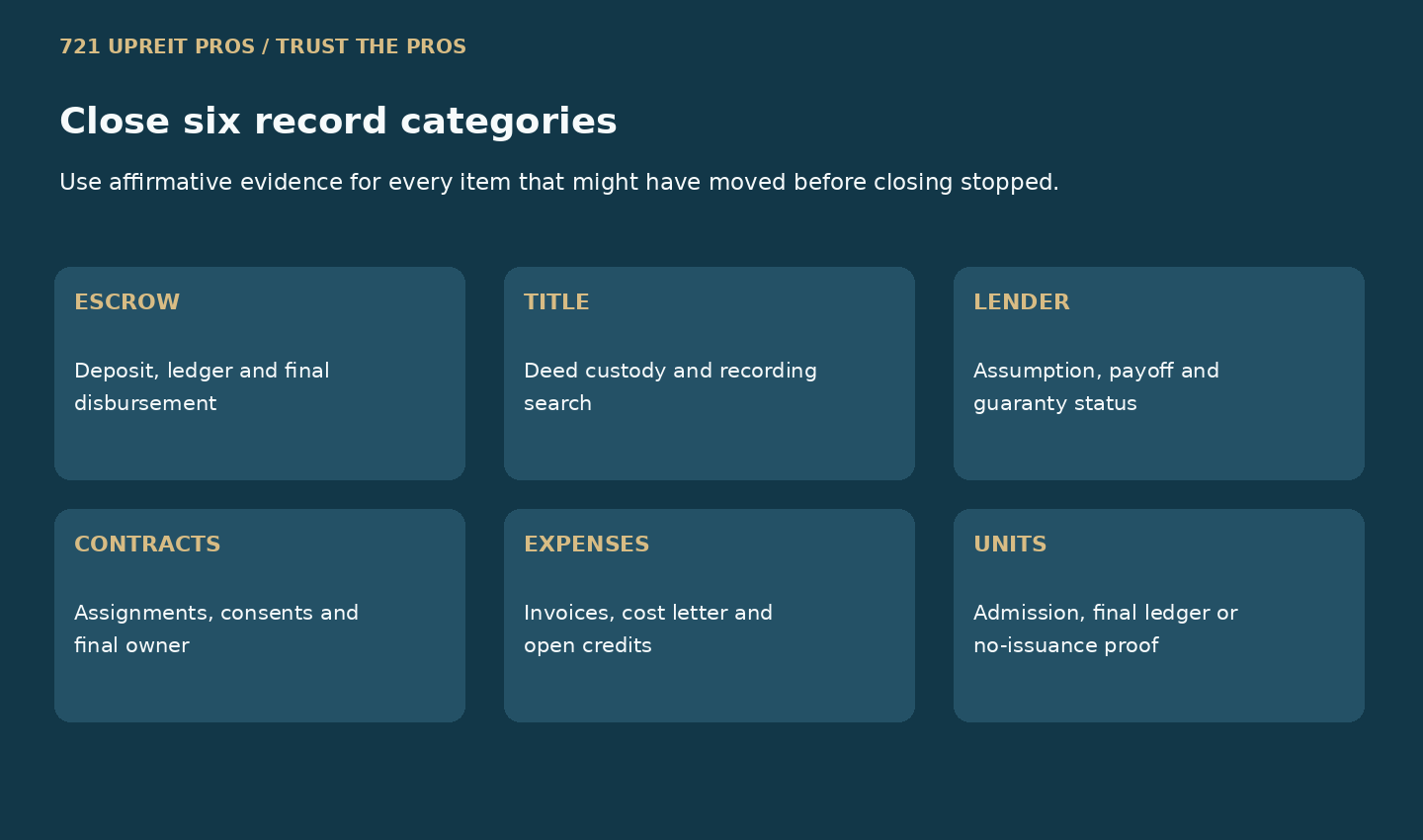
Confirm property, title, contracts and debt did not move, or document what did
A draft deed or assignment may have been signed and deposited into escrow before a closing failed. Ask the title company for the final escrow status and obtain a current recording search. Keep any written instruction that the instrument was destroyed, returned or held. If an instrument was recorded, the matter is no longer just a proposed closing and requires immediate legal review.
Build a property-control list covering deeds, entity interests, leases, security deposits, service contracts, insurance, permits, licenses, books and tenant communications. For each item, record the pre-deal owner, any document placed in escrow, whether consent was obtained, and the final owner or responsible party after termination.
Debt needs its own confirmation. Request the lender's written status for an assumption, payoff, refinancing, guaranty release, reserve transfer and automatic payment instructions. A consent draft is not an assumption. A payoff quote is not proof that a loan was paid. If any lender action did occur, reconcile it with title, bank and tax records rather than calling the entire deal unclosed.
Verify that no OP units or partnership admission remain outstanding
A proposed unit count can appear in a valuation schedule, draft closing statement or portal before legal issuance. Request a dated confirmation from the operating partnership's authorized recordkeeper showing whether the contributor was admitted, whether any units were issued, and whether any provisional entry was cancelled. Preserve the cap table or unit ledger extract that supports the answer.
If units were issued, a later cancellation, repurchase, rescission or transfer is a separate event. It needs its own authority, effective date, consideration, ledger entry and tax analysis. Do not delete the initial issuance from the history. If no units were issued, retain the written no-issuance confirmation with the unused calculation so a later reviewer can understand why a draft count exists.
The contribution closing evidence checklist explains the positive proof of a completed transfer and final unit issuance. Use the two checklists together when different parties disagree about whether closing occurred.
Fictional example: the deed entered escrow, but the title condition failed
This example organizes records and does not interpret a contract. Example Owner LLC signs a proposed contribution agreement. The operating partnership deposits $50,000 with escrow. The owner and partnership together incur $42,000 of legal, tax, title and lender costs. A deed is signed and placed in escrow. A provisional statement shows 160,000 OP units. The lender has not executed an assumption.
A title objection remains uncured. Counsel sends a termination notice under the agreement before the outside date. The title company returns the deed unrecorded and sends the $50,000 deposit back to the operating partnership. The parties' cost letter allocates $12,000 to the owner and $30,000 to the operating partnership. The partnership recordkeeper confirms that the owner was never admitted and the provisional unit entry was cancelled.
| Record | Resolved evidence | Still open |
|---|---|---|
| Agreement status | Signed notice, delivery receipt and cited termination clause | Whether confidentiality and dispute provisions survive |
| Escrow and title | Final ledger, returned deposit, unrecorded deed returned and recording search | Outstanding title-company invoice |
| Expenses | Cost letter and invoices totaling $42,000 | Professional tax treatment and one vendor credit |
| Debt | Lender confirms no assumption, payoff or guaranty release | Application-deposit refund |
| Units | No admission, no final issuance and cancelled provisional entry | Portal screenshot removal is administrative, not proof |
The example reaches an orderly evidence conclusion only because every major record has affirmative support. A real agreement could allocate the deposit or expenses differently, preserve claims, allow a cure, require joint escrow instructions, or show that part of the transaction already occurred.
Build one failed-closing handoff packet
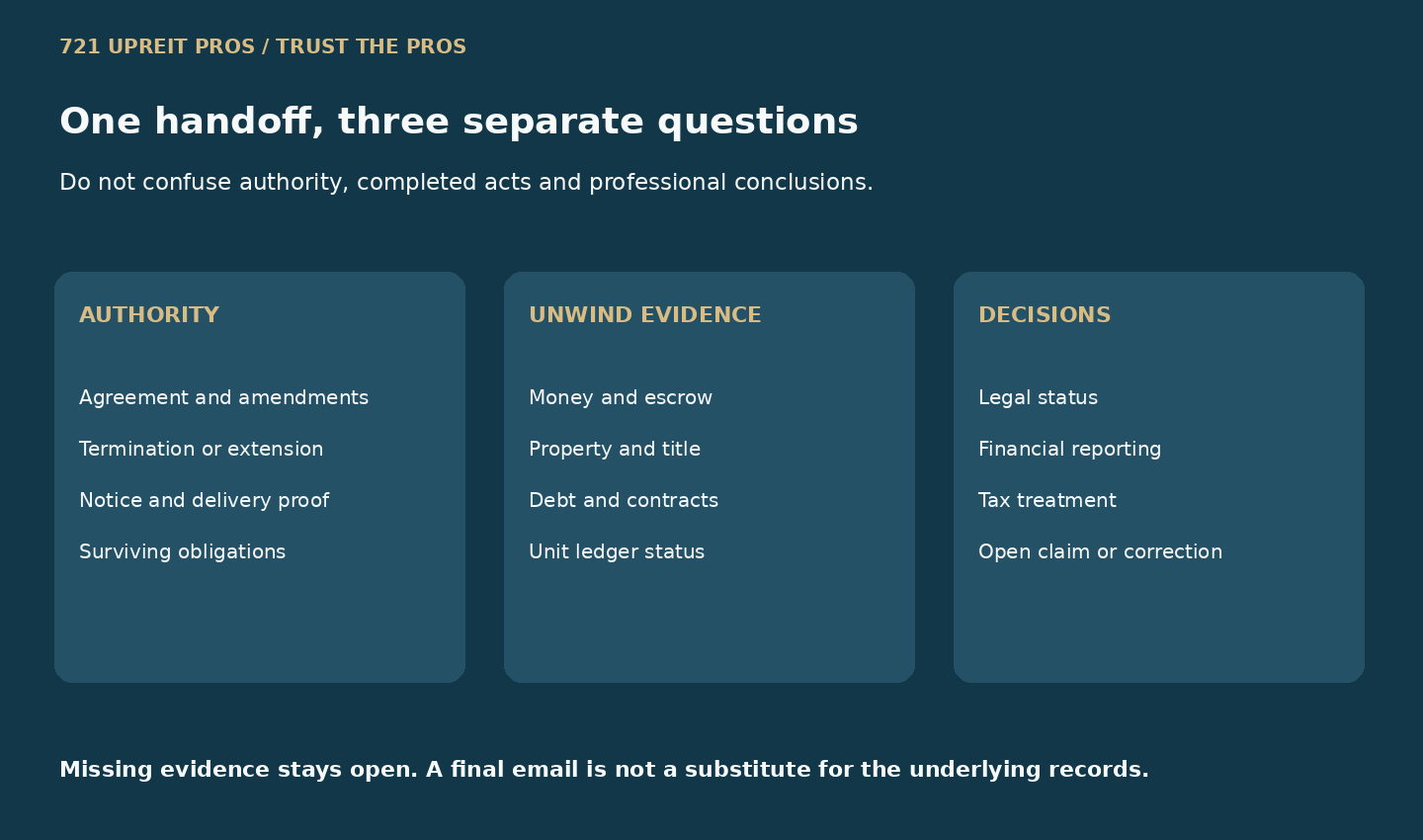
- Controlling documents: Executed contribution agreement, amendments, side letters, waivers and escrow instructions.
- Status authority: Termination, expiry, extension or cure provision plus the signed notice and delivery proof.
- Money: Deposit, escrow ledger, expense invoices, reimbursements, credits and unresolved claims.
- Property: Deed and assignments, recording search, title status, tenant funds, contracts and data custody.
- Debt: Lender consent, assumption, payoff, refinance, guaranties, reserves and final written status.
- Units: Partnership admission, cap table, unit ledger, provisional entries and cancellation or no-issuance confirmation.
- Surviving duties: Confidentiality, document return, indemnity, dispute, notice, access and record-retention provisions.
- Professional decisions: Legal status, financial-statement treatment, tax treatment and any reporting or amendment still required.
Record the source, date, responsible person and current status for every row. Mark missing items as missing. Do not replace the agreement with an advisor summary or delete superseded versions.
For a broader look at closing conditions and direct-property underwriting, review the DST 1031 Experts 721 transaction guide. For help organizing the investment-side questions, talk to a 721 UPREIT advisor. Contract interpretation and tax conclusions belong with the appropriate attorney and tax professional.
Watch the failed-closing records briefing and download the worksheet
The original one-minute captioned video follows the status, money, property, debt and unit record checks. It is a silent visual explainer, not a determination of contract rights.
Read video transcript
0:00 · When a contribution does not close
Identify the actual stopping point. Preserve the agreement, notice and completed acts.
0:12 · Confirm the legal status
Pending, amended, terminated and closed are different. Read notice, cure and survival provisions.
0:24 · Reconcile money and property
Trace the deposit, costs, deed and contracts. Keep disputed items open.
0:36 · Confirm debt and units
Ask the lender and authorized partnership recordkeeper. A draft is not proof of a completed act.
0:48 · Build the professional handoff
Separate authority, unwind evidence and decisions. Actual agreements control each result.
Download the failed-closing unwind worksheet. Use it to reconcile evidence and open questions without assuming a refund, cancellation or tax result.
Primary sources and review limits
Sources checked October 9, 2026. The SEC exhibits below are examples of negotiated agreements, not standard forms or terms for every 721 transaction. This educational checklist has not received a named advisor, CPA or attorney review and is not contract interpretation, a tax determination or an individualized recommendation.
- Medalist Diversified Holdings contribution agreement dated December 14, 2024: escrow deposit, title review, due diligence termination, default remedies, notices and surviving provisions.
- Rexford Industrial contribution agreement dated July 24, 2013: closing deliveries, failed-closing cost allocation, outside date and effect of termination.
- City Office REIT contribution agreement dated April 14, 2014: conditions, transfer documents, lender deliveries, unit consideration and termination provisions.
Property values and investment income can fall. Proposed contributions may not close, deposits and expenses may be at risk, and disputes can delay resolution. No closing, refund, reimbursement, debt release, unit cancellation, tax deferral, liquidity or investment result is guaranteed.
BEFORE YOUR ADVISOR CONVERSATION
Three questions before you commit
This companion briefing covers the professional's identity, compensation and how restrictions fit your cash needs. Use it alongside this article's specific document checks.
Loading the video connects to YouTube. Watch on YouTube · 721 UPREIT Pros channel · Read the full advisor checklist.
Read video transcript
Before you hire a seven twenty-one UPREIT advisor, ask these three questions.
First: who exactly am I hiring? Get the professional's legal name, firm and registration information. Check the record through Investor dot gov and read the firm's relationship summary where applicable. Ask whether this conversation involves brokerage services, investment advice, or both. A marketing title alone does not answer that question.
Second: who gets paid, and how much? Request a written cost breakdown in dollars. Identify the payer, calculation base, payment timing and ongoing charges. Include product expenses and embedded compensation. No separate advisor invoice does not mean there are no costs.
Third: how does this fit my cash needs? Review the actual agreements. Ask who controls a possible conversion and what happens if it does not occur. Separate permission to request redemption from approval, pricing and payment. Do not assume a fixed cash-out date.
Then agree on responsibilities. Your investment professional, CPA, attorney and qualified intermediary can have different roles. Put continuing service and unresolved questions in writing.
Read the complete advisor checklist using the article link in the description. Seven twenty-one UPREIT Pros. Trust the Pros. Educational only. Investments involve risk and may be illiquid. Tax treatment depends on your circumstances.
Educational only. Investments involve risk and may be illiquid. Footage is illustrative; narration is synthetic.
TALK TO A 721 UPREIT ADVISOR
Ready to discuss your 721 options?
Request a callback to discuss the questions raised by this article, your timing and what to ask before you commit. Share your name, email and phone below to start the conversation.
No investment commitment or financial documents required. A callback request does not book an appointment or establish an advisory relationship.