
721 UPREIT PROS / CONTRIBUTION PAYMENT RECORDS
Cash around a 721 contribution: what does each payment represent?
If you receive cash or other property before, at or after a proposed 721 UPREIT contribution, collect the purpose, contractual right, funding source and supporting records for each transfer. A payment called a reimbursement, distribution or closing adjustment is not automatically tax-free. Give the complete event history to your CPA and transaction counsel before relying on the proposed treatment.
Prepared by 721 UPREIT Pros · Published October 8, 2026 · General education

This page answers a contribution-payment question, not a withdrawal question. Start with the 721 investor guide for the ownership structure and the risk overview for the broader decision. The closing proof file establishes what closed; this article records why money or other value moved around that closing.
Can you receive cash and still call the transaction a 721 contribution?
The label does not settle the tax result. A property contribution and related money or other consideration can be analyzed as a sale in whole or in part under the partnership disguised-sale rules. Other transfers require their own distribution, reimbursement or liability analysis. Preserve each event separately instead of treating all cash as one tax-free payout or applying a 1031 “boot” shortcut.
TALK TO A 721 UPREIT ADVISOR
Talk to a 721 UPREIT advisor
Request a callback to discuss the questions raised by this article, your timing and what to ask before you commit. Share your name, email and phone below to start the conversation.
No investment commitment or financial documents required. A callback request does not book an appointment or establish an advisory relationship.
Section 721 generally addresses property contributed for a partnership interest. Section 1031 addresses qualifying real-property exchanges. A DST acquisition and a later contribution are separate stages. OP units are partnership interests, not REIT shares or automatically spendable cash. Review the actual steps in the transaction sequence.
The practical first step is a payment ledger: who transferred what, to whom, when, under which document, from which funding source and for what stated reason. Keep the tax conclusion in a separate field for the professionals responsible for that analysis.
Separate six payment categories before drawing conclusions
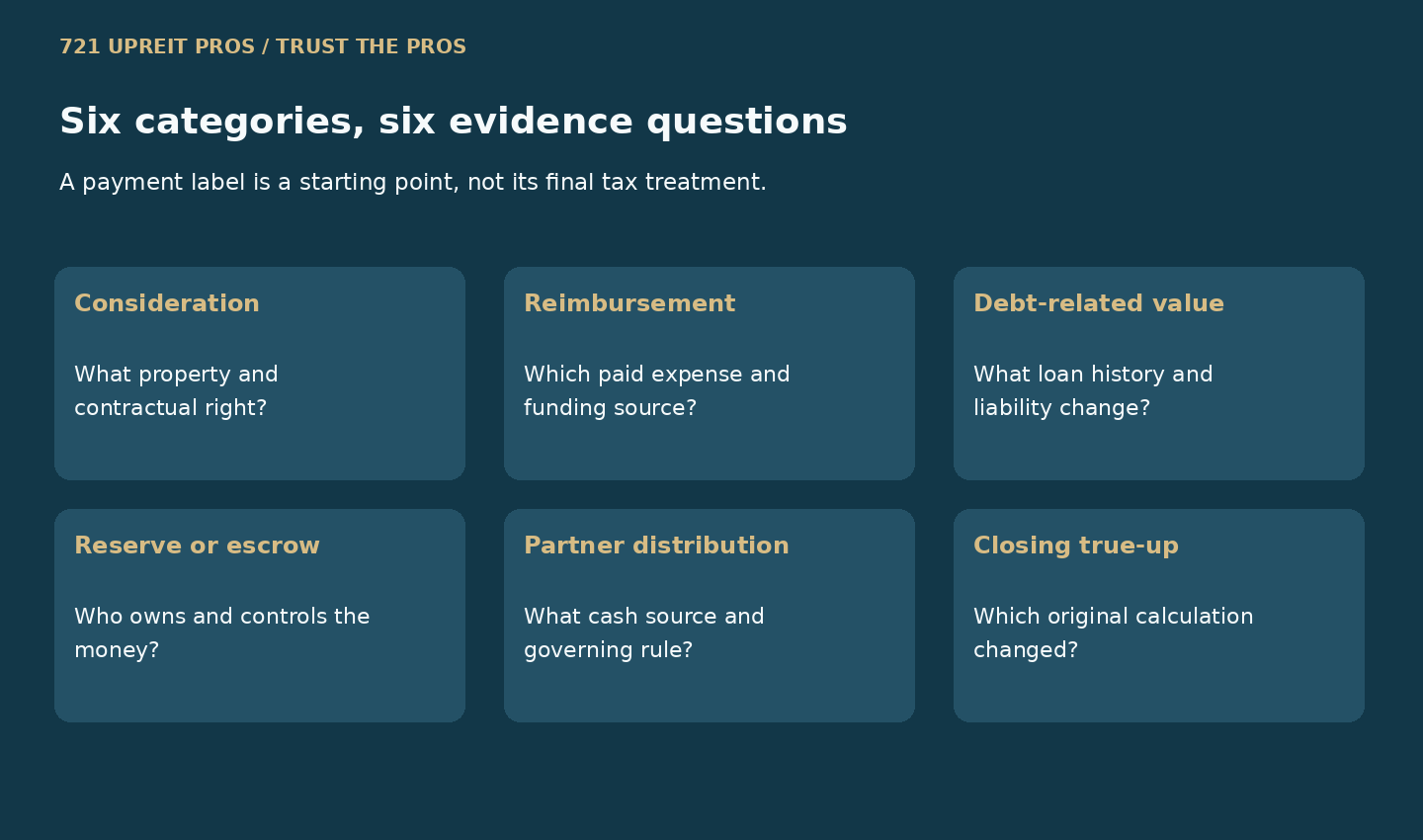
| Stated purpose | Evidence to preserve | Question left for analysis |
|---|---|---|
| Purchase consideration | Purchase and contribution agreements, asset schedule, cash election, settlement statement and payment proof | Is some property being sold rather than contributed, and how are the steps connected? |
| Expense reimbursement | Invoices, work dates, proof of payment, capitalization records, reimbursement clause and funding history | Which expense was actually reimbursed and does an applicable exception cover the facts? |
| Debt-related value | Loan origination, use of proceeds, refinance history, payoff or assumption, guarantees and partner liability schedules | How do disguised-sale and partner-basis rules apply to the actual liability changes? |
| Reserve or escrow | Control agreement, owner of the funds, release conditions, beneficiary, statement and actual release | Was value transferred to the contributor, retained for the property or conditionally held? |
| Partner distribution | Partnership provision, declaration, cash-source records, distribution statement and tax package | Is this operating cash flow, borrowed cash, sale proceeds or another transfer? |
| Post-closing true-up | Original estimate, final adjustment, contractual formula, authorization, payment or unit correction | What original item changed, and which economic and tax records must be updated? |
Do not combine categories merely because one wire pays several amounts. Ask for a line-item bridge from the signed statement to the bank receipt. Conversely, several wires might implement one contractual payment. Preserve both the individual transfers and their connection.
For noncash property, add an exact description, transfer instrument, recipient, transfer date, valuation source and related obligations. “Other property” is not a zero-dollar placeholder just because there is no bank receipt.
Does waiting two years make cash safe?
No automatic tax result follows from a calendar alone. Treasury Regulation 1.707-3 considers the connection between the property and consideration, including whether the payment would occur without the property transfer and whether a later payment depends on partnership operating risks. Transfers within two years, in either order, are generally presumed to be a sale unless the facts clearly establish otherwise. Transfers more than two years apart have the opposite presumption, which the facts can also rebut.
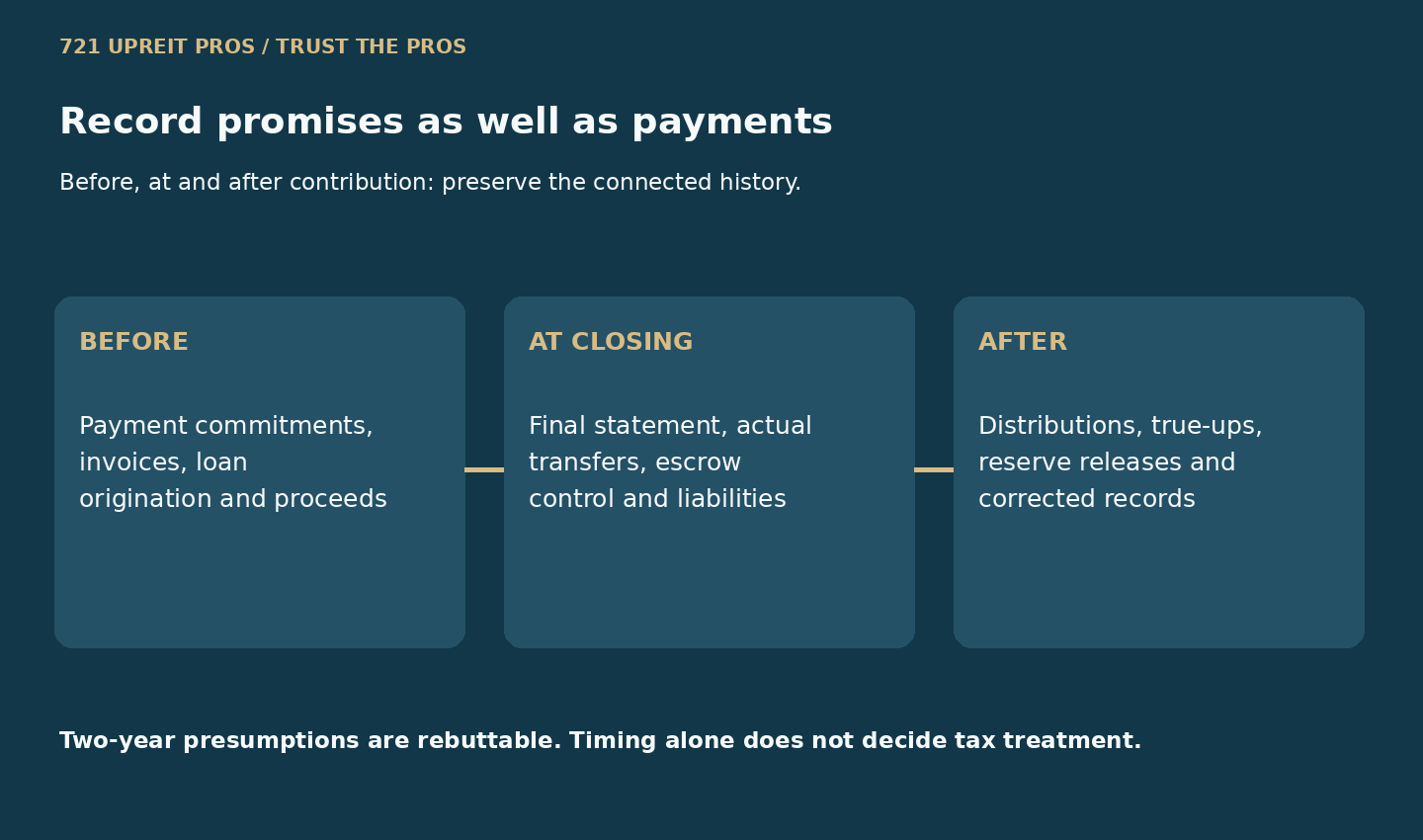
Record when the right to payment was first agreed, not only when cash arrived. Keep side letters, binding commitments, secured payment arrangements and later amendments. Ask the CPA to review disclosure obligations, including Regulation 1.707-3(c)(2), rather than assuming a reimbursement label removes the issue.
This tax timing analysis is separate from a contractual lockup or eligibility date for redemption. Use the holding-period and lockup timeline for those different clocks. Neither a lockup ending nor a two-year anniversary guarantees payment, liquidity or tax deferral.
What should support an expense reimbursement?
Regulation 1.707-4(d) provides a specific exception for certain preformation capital-expenditure reimbursements, with expenditure timing, property-level limits, basis/value tests and debt-funding coordination. It is not a blanket exclusion for all closing expenses. The same regulation separately addresses guaranteed payments, preferred returns and operating cash-flow distributions; the parties' chosen label does not substitute for the conditions.
Build a schedule showing invoice date, service or improvement, property, actual payment date, payer, whether the cost was capitalized or deducted, and whether loan proceeds funded it. Link the requested reimbursement to each underlying invoice. Give the preparer the original adjusted-basis record and contribution-date valuation, not only the reimbursement total.
If the closing statement says “reimbursements $45,000” but the file contains invoices for $30,000, leave the $15,000 difference open. Ask for the missing invoices or a corrected statement. Do not assume the missing amount qualifies, treat it as zero or change the tax record merely to match the bank deposit.
Why can debt matter even without a payment to your bank?
Regulation 1.707-5 has specific rules for assumed liabilities and debt-financed transfers. Qualified and other liabilities are treated differently, and the partner's share, financing history and related cash can matter. A loan's age or a payoff receipt alone does not establish the complete result.
IRS Publication 541 also explains that a decrease in a partner's share of partnership liabilities is treated as a money distribution for basis purposes. Keep that partner-level analysis separate from the economic loan balance and disguised-sale review. No wire to the investor does not necessarily mean no tax-relevant event.
Request loan documents, proceeds tracing, balances immediately before and after closing, refinancing dates, guarantee changes and the opening partner-liability calculation. The debt-change CPA worksheet addresses the basis bridge in more detail. Do not infer a gain amount from this evidence checklist.
Fictional example: one deposit, several unresolved facts
This example organizes evidence; it does not calculate tax. Example Owner LLC contributes property on October 8. A $180,000 deposit arrives that day. The closing statement assigns $120,000 to a cash payment under the agreement, $40,000 to improvements reimbursement and $20,000 to a released reserve. A $12,000 adjustment arrives in November. A mortgage is assumed separately.
| Event | Known evidence | Open item |
|---|---|---|
| $120,000 cash item | Closing statement and October 8 bank receipt | Signed clause, payment right, funding source and connection to transferred property |
| $40,000 reimbursement | Two invoices totaling $28,000 | $12,000 unsupported; expenditure dates, basis records and debt-funding history |
| $20,000 reserve release | Release statement | Who owned and controlled the reserve, release conditions and original source |
| $12,000 November true-up | Bank receipt and email calling it an adjustment | Signed final calculation and the original item being corrected |
| Assumed mortgage | Loan balance and assumption document | Use of proceeds, guarantees and opening partner liability workpaper |
The $192,000 total bank receipts are a cash reconciliation, not a tax conclusion. The loan belongs in the event file even though it was not another deposit. The reimbursement mismatch remains unresolved. The November email cannot establish whether the payment changes contribution economics, purchase consideration or something else.
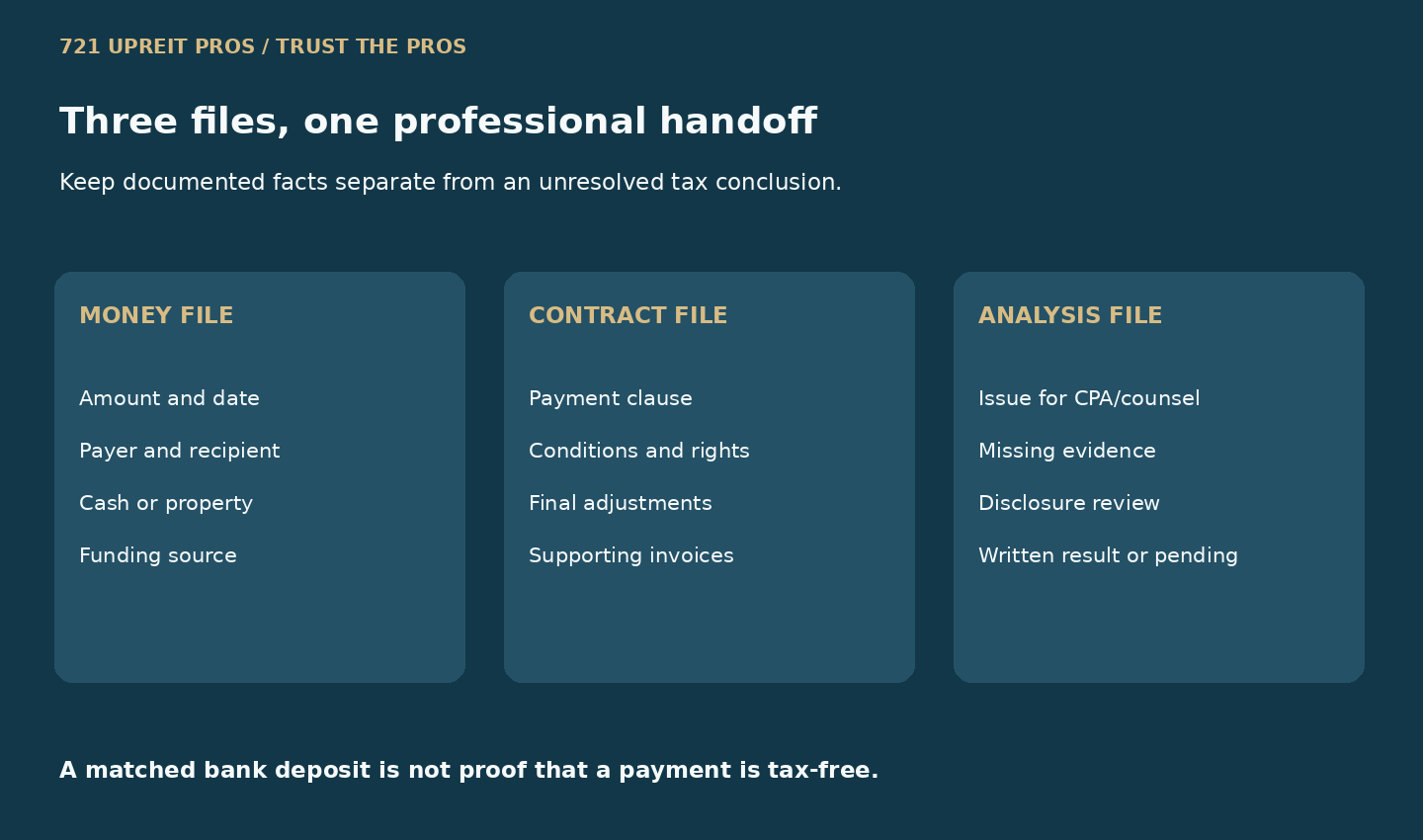
What should the advisor, CPA and counsel receive?
- Final contribution and purchase documents, amendments and side letters.
- Every cash or other-property transfer before and after closing, including recipient and date.
- The contractual purpose and page reference for each item.
- Bank, escrow or transfer evidence matching the signed statement.
- Funding sources, reimbursement invoices, adjusted basis and valuation support.
- Loan, refinance, guarantee and partner-liability records.
- The unresolved-items log, with a responsible contact and requested evidence.
- The written conclusion or pending status for each tax issue, including disclosure review.
Ask who will reconcile the investor's analysis with the partnership's opening records and eventual tax package. If a final payment or allocation changes, retain the old and corrected versions and explain the change. The transition-year record checklist helps when a DST and OP-unit stage occur in the same year.
An investment-side conversation can help identify missing documents and decision points. It does not replace your own tax or legal analysis. Talk to a 721 UPREIT advisor about the questions to resolve before committing; share general planning questions rather than confidential tax records or wire instructions in the contact form.
Watch the payment-evidence briefing and download the worksheet
The original one-minute captioned video follows the event file from payment purpose to professional handoff. It is a silent visual explainer, not an individual tax determination.
Read video transcript
0:00 · Cash around a 721 contribution
Identify every transfer and contractual purpose. A payment label does not settle tax treatment.
0:12 · Separate the payment categories
Consideration, reimbursements, debt and reserves. Keep distributions and true-ups separate.
0:24 · Preserve the complete timeline
Record payment promises, funding and actual dates. Two years is not an automatic safe harbor.
0:36 · Reconcile the evidence
Match each amount to its contract and supporting record. Leave missing invoices and unexplained adjustments open.
0:48 · Hand off facts, then conclusions
Give the complete file to your CPA and counsel. Keep written analysis separate from the cash ledger.
Download the contribution-payment evidence worksheet. Record amounts, dates, documents and open questions without assigning a tax result.
Primary sources and review limits
Sources checked October 8, 2026. eCFR Title 26 displayed currency through October 6, 2026. Publication 541 is revised December 2025. This educational checklist has not received a named advisor, CPA or attorney review and is not a transaction qualification, filing instruction or individualized recommendation.
- IRS Publication 541: contribution, distribution, liability and disguised-sale overview.
- Treasury Regulation 1.707-3: facts, timing presumptions and disclosure conditions.
- Treasury Regulation 1.707-4: specific payment and reimbursement rules.
- Treasury Regulation 1.707-5: liability and financing rules.
Property values and investment income can fall. Units may remain illiquid, and fees, leverage, conflicts and tax complexity can affect the decision. No contribution, tax deferral, reimbursement exception, distribution or cash-out result is guaranteed.
BEFORE YOUR ADVISOR CONVERSATION
Three questions before you commit
This companion briefing covers the professional's identity, compensation and how restrictions fit your cash needs. Use it alongside this article's specific document checks.
Loading the video connects to YouTube. Watch on YouTube · 721 UPREIT Pros channel · Read the full advisor checklist.
Read video transcript
Before you hire a seven twenty-one UPREIT advisor, ask these three questions.
First: who exactly am I hiring? Get the professional's legal name, firm and registration information. Check the record through Investor dot gov and read the firm's relationship summary where applicable. Ask whether this conversation involves brokerage services, investment advice, or both. A marketing title alone does not answer that question.
Second: who gets paid, and how much? Request a written cost breakdown in dollars. Identify the payer, calculation base, payment timing and ongoing charges. Include product expenses and embedded compensation. No separate advisor invoice does not mean there are no costs.
Third: how does this fit my cash needs? Review the actual agreements. Ask who controls a possible conversion and what happens if it does not occur. Separate permission to request redemption from approval, pricing and payment. Do not assume a fixed cash-out date.
Then agree on responsibilities. Your investment professional, CPA, attorney and qualified intermediary can have different roles. Put continuing service and unresolved questions in writing.
Read the complete advisor checklist using the article link in the description. Seven twenty-one UPREIT Pros. Trust the Pros. Educational only. Investments involve risk and may be illiquid. Tax treatment depends on your circumstances.
Educational only. Investments involve risk and may be illiquid. Footage is illustrative; narration is synthetic.
TALK TO A 721 UPREIT ADVISOR
Ready to discuss your 721 options?
Request a callback to discuss the questions raised by this article, your timing and what to ask before you commit. Share your name, email and phone below to start the conversation.
No investment commitment or financial documents required. A callback request does not book an appointment or establish an advisory relationship.