
721 UPREIT PROS / DIRECT CONTRIBUTION READINESS
Direct property to UPREIT: acceptance and readiness checklist
A property owner may be able to contribute real estate directly to an UPREIT operating partnership for OP units under a negotiated transaction. Section 721 can provide a nonrecognition framework for a qualifying contribution, but it does not require a sponsor to accept the property, assume its debt or issue units on the owner's preferred terms.
By 721 UPREIT Pros · September 23, 2026 · Updated October 25, 2026 · Direct-property contribution acceptance checklist

This page answers a narrower question than the complete 721 UPREIT guide. The guide explains the structure and compares a direct contribution with a DST pathway. This article asks what evidence a property owner should assemble before approaching an operating partnership and how to separate statutory tax concepts from commercial acceptance.
When several people share the investment, reconcile the deed owner, federal tax classification, authorized signers and proposed OP-unit holder before negotiating separate outcomes. A member wanting cash and another wanting units does not establish independent elections. Use the co-owner ownership-and-goals matrix to prepare a coordinated meeting with the receiving partnership and your tax and legal professionals.
TALK TO A 721 UPREIT ADVISOR
Talk to a 721 UPREIT advisor
Request a callback to discuss the questions raised by this article, your timing and what to ask before you commit. Share your name, email and phone below to start the conversation.
No investment commitment or financial documents required. A callback request does not book an appointment or establish an advisory relationship.
Can a property owner contribute directly to an UPREIT?
Potentially, if the operating partnership agrees to acquire the property and the parties complete a qualifying contribution for operating partnership units. The agreement must identify the property, contributor, value, debt treatment, unit class, closing conditions and representations. The operating partnership can decline the asset, require changes or stop the transaction if a stated condition is not satisfied.
Internal Revenue Code Section 721 generally provides that gain or loss is not recognized to a partnership or contributing partner when property is contributed to a partnership for a partnership interest. That general rule is not a sponsor acceptance rule, a valuation formula or a promise that every transfer qualifies. Cash, liability shifts, related steps, entity classification and other consideration can change the analysis.
Key takeaway
Ask two separate questions. First, can the proposed contribution fit the applicable tax rules? Second, will this particular operating partnership accept this property on documented terms the owner can live with? A “yes” to one is not a “yes” to the other.
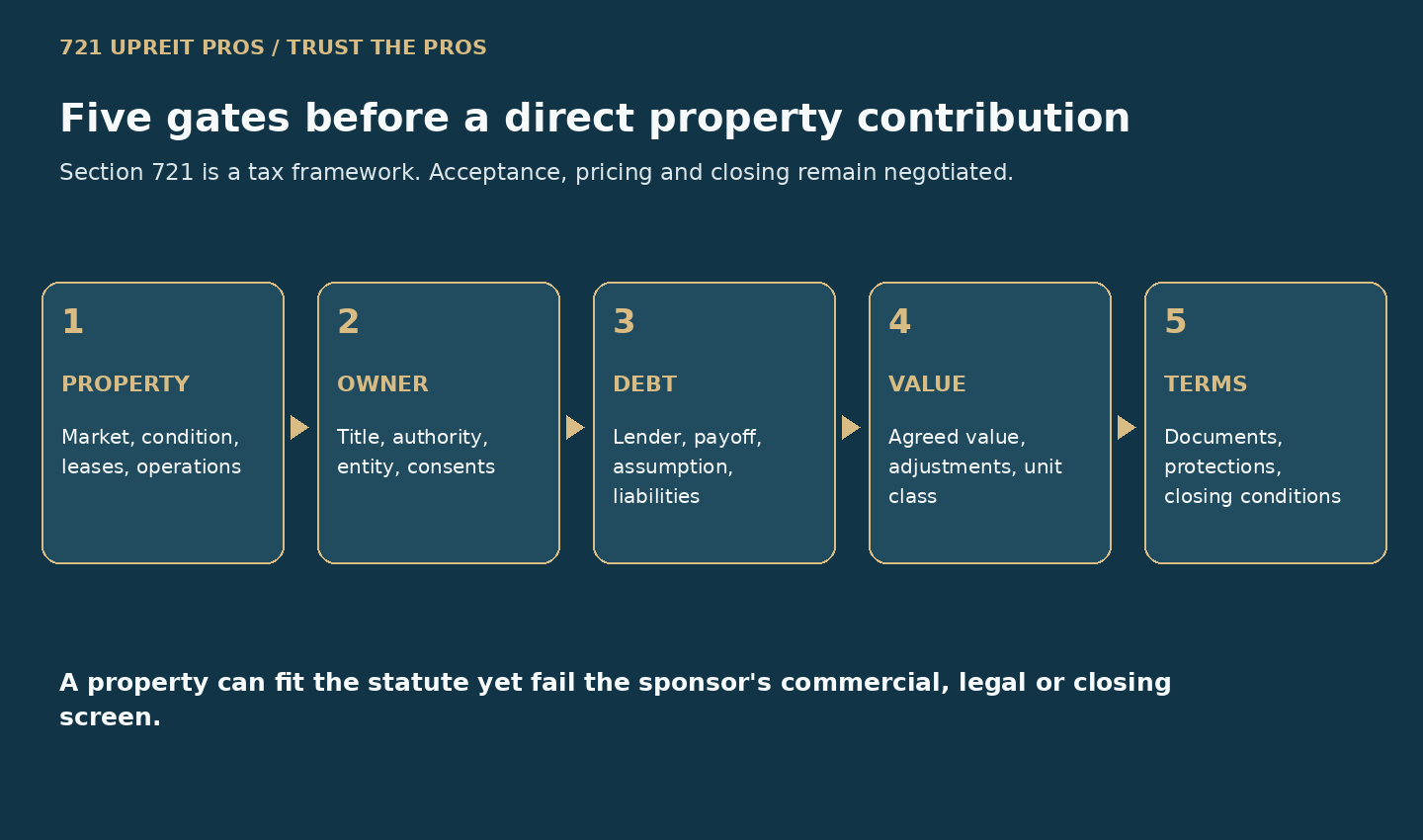
What are the five acceptance gates?
Use a five-gate file rather than one generic “721 exchange” folder. Each gate should have a dated owner, source document and list of unresolved items. A verbal indication of interest is not final acceptance.
| Gate | Evidence to assemble | Decision it supports |
|---|---|---|
| 1. Property fit | Rent roll, leases, operating statements, budget, condition reports, environmental material, zoning, insurance, capital plan and market data | Does the asset fit the operating partnership's property, geography, return and risk criteria? |
| 2. Owner and authority | Deed, title report, entity chart, operating or trust agreement, resolutions, partner or member consents and tax-owner confirmation | Who can transfer the property and who must approve or sign? |
| 3. Debt and liabilities | Loan documents, payoff statement, prepayment or defeasance terms, lender-consent requirements, guarantees and liability schedules | Will debt be paid, assumed, refinanced or otherwise handled, and what economic and tax effects require review? |
| 4. Value and units | Appraisal or valuation material, negotiated adjustments, reserves, unit class, issue price, allocation schedule and capitalization table | What agreed value is assigned to the property and how many of which OP units will be issued? |
| 5. Contract and closing | Contribution agreement, schedules, representations, indemnities, tax protections, closing conditions, termination rights, deed and settlement package | What must be true at closing, which risks survive and what exactly does the contributor receive? |
A dated public transaction shows how specific the negotiated economics can be. Rexford Industrial reported on April 11, 2019 that a seller contributed an industrial property to its operating partnership and received a stated number and class of convertible preferred operating partnership units. The issuer described a negotiated stock-price reference, unit terms and later conversion mechanics. That historical transaction is evidence that direct contributions can occur, not a current offering or a template for another property. See the issuer's dated transaction announcement.
What property information will an UPREIT review?
Expect an acquisition review, not merely a tax questionnaire. An operating partnership acquiring real estate may examine physical condition, tenant concentration, lease expirations, collections, operating history, capital needs, environmental exposure, title, zoning, insurance and the market. The property may be economically sound yet fall outside the sponsor's target property type, geography, scale or portfolio plan.
Start with a clean trailing operating statement and current rent roll. Reconcile material differences between financial statements, tax returns, leases and bank records. Identify deferred maintenance and planned capital work. A proposed value that ignores near-term roof, mechanical, tenant-improvement or leasing costs may not survive diligence.
Separate known facts from forecasts. Occupancy today is evidence. A broker's projected renewal or rent increase is an assumption until supported. Present assumptions with dates and sources so the operating partnership can adjust them rather than discovering an unexplained gap late in the process.
Property file to prepare
- Legal description, current survey, title commitment and recorded exceptions.
- Current rent roll, every material lease and a schedule of concessions, arrears and security deposits.
- At least the requested period of operating statements, budgets and tax returns, reconciled to unusual items.
- Property-condition, environmental, engineering, roof, mechanical and accessibility reports that exist.
- Real estate tax, insurance, utility, service-contract and pending-capital schedules.
- Litigation, notices, code, zoning, casualty, condemnation and tenant-dispute records.
Do not hide a material issue in a general data room. Flag it, identify what is known, state what remains unresolved and assign the next evidence request. Early clarity can prevent a false unit estimate based on a property the operating partnership later reprices or rejects.
Why do ownership and debt need separate reviews?
The deed owner, tax owner, signing authority and borrower may not be the same person or entity. An individual might own membership interests in an LLC that holds title, a trust might be the record owner, or multiple partners might need to approve a transfer. The contributor identified in the tax analysis must align with the legal steps actually taken.
Prepare an entity and authority chart showing the record owner, tax classification, percentage owners, managers, trustees, partners, spouses and other required consent parties. Include restrictions in loan documents, joint-venture agreements, leases, ground leases or purchase options. A contribution agreement cannot cure missing authority by itself.
Debt affects at least three different workstreams. First, the lender may have a contractual right to approve a transfer or may require payoff. Second, the parties must agree who economically bears payoff costs, prepayment premiums, defeasance expense and closing adjustments. Third, the owner's CPA must analyze partnership liability allocations and any decrease in the contributor's share of liabilities under Section 752.
How are contribution value and OP units negotiated?
Start with the agreement's defined value and adjustment schedule, then divide the documented net amount assigned to units by the applicable issue price. Do not assume tax basis, appraisal value, debt balance, agreed value, net contribution value and OP-unit value are interchangeable.
A November 3, 2025 BREIT operating partnership agreement filed with the SEC provides one dated example of transaction-specific definitions. It defines “Agreed Value” by reference to the fair market value of a noncash contribution as agreed by the partner and general partner, and it describes multiple unit classes. The terms illustrate why a contributor needs the actual agreement and class schedule. They are not a universal formula. See the SEC-filed operating partnership agreement.
Ask who sets the valuation date, who may revise it, which appraisal standard is used and how diligence discoveries flow into adjustments. Then identify the unit class, issue price or formula, economic rights, distribution terms, transfer limits, redemption rights and any conversion features. A larger unit count at a lower issue price does not by itself create more value.
| Field | What it answers | Common mistake |
|---|---|---|
| Property valuation | What value evidence supports the real estate? | Treating a preliminary broker opinion as the final agreed value |
| Agreed contribution value | What value do the signed documents assign for the transaction? | Assuming it must equal appraisal value or tax basis |
| Debt and adjustments | What amounts reduce or change the value assigned to units? | Subtracting debt twice or omitting a reserve, credit or closing cost |
| Unit issue price | What denominator determines the stated unit count? | Using a later NAV or REIT share price without contractual support |
| Outside tax basis | What tax record is maintained for the partnership interest? | Equating contribution value or unit value with tax basis |
Does Section 721 guarantee no tax at closing?
No. Section 721 states a general nonrecognition rule for qualifying property contributions to a partnership for a partnership interest, but transaction facts can require additional analysis. The contributor should have a tax professional examine the actual legal steps, consideration, liabilities, entity classification and related agreements before signing or transferring the property.
Internal Revenue Code Section 721 supplies the general contribution rule. Section 752 addresses changes in a partner's share of partnership liabilities, including circumstances treated as contributions or distributions of money. IRS Publication 541 summarizes partnership formation, basis and liabilities. Those sources do not approve a particular UPREIT contribution or calculate a result from marketing material.
Ask the CPA to model the closing facts, including debt immediately before and after the transaction, cash or other property received, transaction expenses, built-in gain, contributed-property records and any tax-protection agreement. Ask counsel to identify representations and covenants that protect the operating partnership and the contributor. A tax-protection agreement may cover only specified assets, partners, events and time periods.
DST Experts' 721 transaction overview can help readers distinguish the broad contribution concept from a sale. Its discussion of 721 tax and exit questions provides follow-up questions about basis, debt and later taxable events. Use those pages as educational context, then rely on the current documents and your own professionals for the actual property.
What does a direct-contribution reconciliation look like?
Assume a hypothetical apartment property has a negotiated value of $6,000,000. It has $2,000,000 of existing debt that the parties agree will be handled at closing. The signed adjustment schedule also deducts $200,000 for reserves and closing adjustments. In this simplified illustration, the amount assigned to OP units is $3,800,000.
If the applicable issue price is $25 per unit, $3,800,000 divided by $25 equals 152,000 OP units. That arithmetic is a control check, not a valuation opinion or tax conclusion. The actual transaction might treat debt, reserves, costs or other consideration differently. The applicable unit price might be tied to a different date, class, formula or approval.
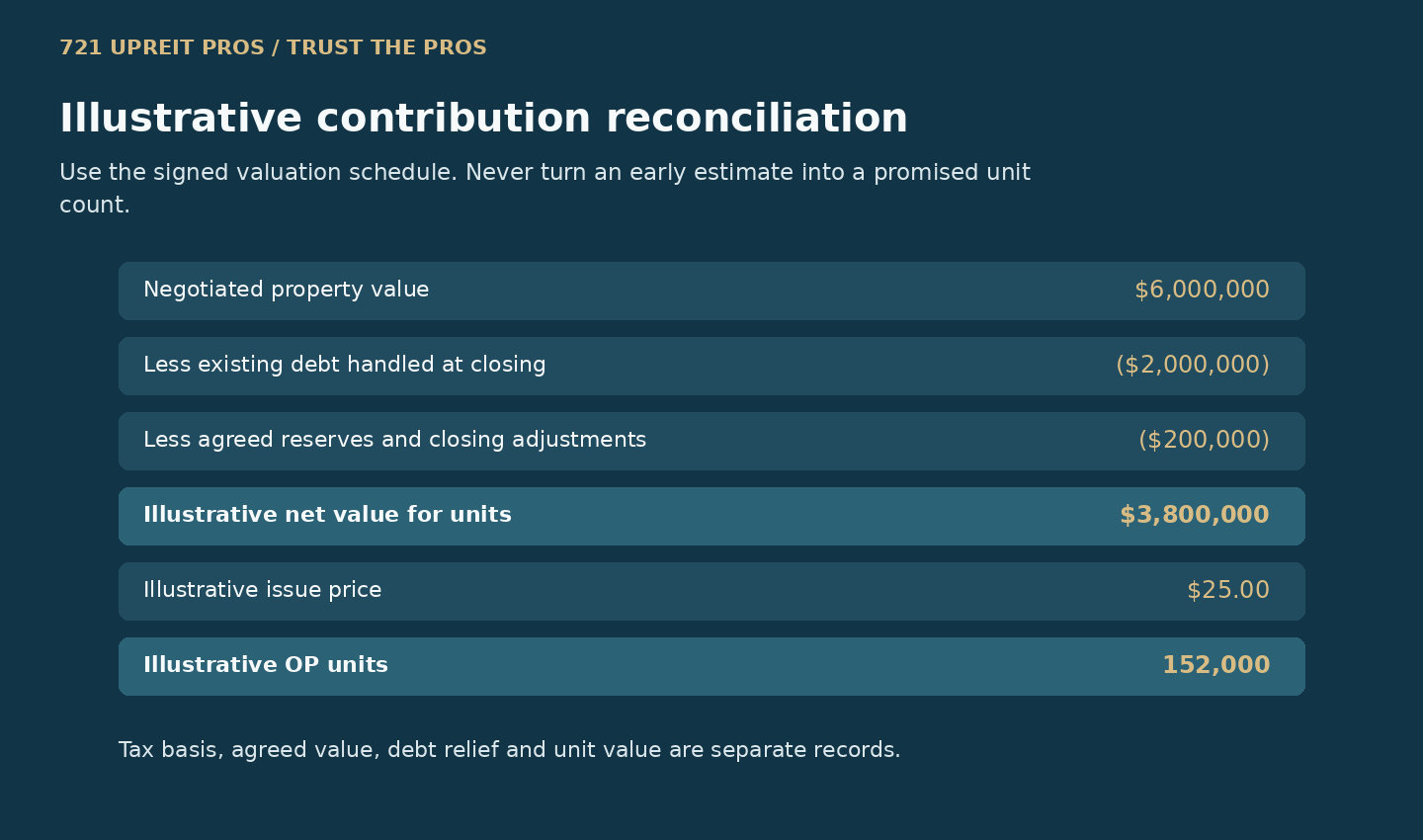
The contributor should be able to reconcile the final deed and settlement statement to the contribution agreement, adjustment schedule and unit statement. If the property value, debt amount or adjustments changed between approval and closing, preserve both versions and the written reason. Then keep the CPA's basis and liability workpapers separately. A unit statement showing 152,000 units would not establish an outside tax basis of $3,800,000.
After the transaction closes, use the 721 contribution closing evidence checklist to match the recorded transfer, effective time, final adjustments, debt records, OP-unit ledger and opening tax file. That post-closing proof task is separate from the pre-closing acceptance review on this page.
What should be complete before the owner relies on the transaction?
- Property evidence: Current operations, leases, condition, environmental, zoning, insurance, title and capital needs are documented.
- Authority: The record owner, tax owner and authorized signers are identified, with every required consent.
- Debt plan: The lender's requirements, payoff or assumption path, costs, guarantees and liability analysis are written.
- Agreed value: The valuation date, method, adjustments, reserves and approval rights are in the signed schedule.
- OP units: The class, issue price or formula, count, economic rights, transfer limits and redemption terms are confirmed.
- Tax file: The CPA has the legal steps, debt schedule, basis records and all consideration, and has documented unresolved items.
- Contract protections: Representations, indemnities, survival periods, tax protections, closing conditions and termination rights are understood.
- Closing proof: The executed agreement, deed, settlement statement, debt evidence and final unit confirmation reconcile.
- Fallback: The owner knows what happens if the operating partnership rejects the asset, changes the economics or a condition fails.
Use the 721 UPREIT transaction sequence to place a direct contribution beside the separate DST pathway. For value arithmetic, use the OP-unit valuation reconciliation example. For liability records, use the OP-unit debt and CPA worksheet.
One-minute briefing and downloadable worksheet
Download the contribution-readiness checklist
Read video transcript
0:00 · Can you contribute property directly?
Potentially, but Section 721 does not force an operating partnership to accept it. Start with the actual property and owner.
0:12 · Gate one: property fit
Document market, leases, condition, operations and capital needs. A tax concept is not an acquisition approval.
0:24 · Gate two: owner and debt
Confirm title, authority, entity, lender consent, payoff or assumption. Debt can change both closing economics and tax analysis.
0:36 · Gate three: value and units
Reconcile agreed value, debt and adjustments before dividing by the documented issue price. An estimate is not a promise.
0:48 · Gate four: signed terms
Read closing conditions, representations, tax protections and exit rights. Keep the final deed, agreement, unit statement and tax workpapers together.
Sources checked September 23, 2026. General education by 721 UPREIT Pros with AI assistance. No independent expert review is represented. Public transactions and agreements are dated examples, not current offerings or universal terms. The numbers are hypothetical. Acceptance, closing, Section 721 treatment, unit value, distributions, liquidity and tax results are not guaranteed. Consult your own legal, tax and investment professionals.
BEFORE YOUR ADVISOR CONVERSATION
Three questions before you commit
This companion briefing covers the professional's identity, compensation and how restrictions fit your cash needs. Use it alongside this article's specific document checks.
Loading the video connects to YouTube. Watch on YouTube · 721 UPREIT Pros channel · Read the full advisor checklist.
Read video transcript
Before you hire a seven twenty-one UPREIT advisor, ask these three questions.
First: who exactly am I hiring? Get the professional's legal name, firm and registration information. Check the record through Investor dot gov and read the firm's relationship summary where applicable. Ask whether this conversation involves brokerage services, investment advice, or both. A marketing title alone does not answer that question.
Second: who gets paid, and how much? Request a written cost breakdown in dollars. Identify the payer, calculation base, payment timing and ongoing charges. Include product expenses and embedded compensation. No separate advisor invoice does not mean there are no costs.
Third: how does this fit my cash needs? Review the actual agreements. Ask who controls a possible conversion and what happens if it does not occur. Separate permission to request redemption from approval, pricing and payment. Do not assume a fixed cash-out date.
Then agree on responsibilities. Your investment professional, CPA, attorney and qualified intermediary can have different roles. Put continuing service and unresolved questions in writing.
Read the complete advisor checklist using the article link in the description. Seven twenty-one UPREIT Pros. Trust the Pros. Educational only. Investments involve risk and may be illiquid. Tax treatment depends on your circumstances.
Educational only. Investments involve risk and may be illiquid. Footage is illustrative; narration is synthetic.
TALK TO A 721 UPREIT ADVISOR
Ready to discuss your 721 options?
Request a callback to discuss the questions raised by this article, your timing and what to ask before you commit. Share your name, email and phone below to start the conversation.
No investment commitment or financial documents required. A callback request does not book an appointment or establish an advisory relationship.