
721 UPREIT PROS / TRANSITION-YEAR TAX RECORDS
DST to OP units in one tax year: two-package record checklist
Keep two tax packages and one cutover log. The first package covers the period when you held the DST interest. The second covers the period after you became an operating-partnership unit holder. The cutover log connects the contribution closing, debt and value records, unit issuance and the first partnership Schedule K-1 without assuming that every sponsor uses the same forms or reporting periods.
By 721 UPREIT Pros · September 27, 2026 · Original two-package cutover checklist

This guide answers a narrow operational question: what records should an investor preserve when a DST interest and OP units appear in the same tax year? It supports the 721 UPREIT process guide. It does not determine whether a proposed contribution qualifies for nonrecognition, how an issuer should allocate income, or what a particular return must report.
What records do you need in a DST-to-OP-unit transition year?
Preserve the complete DST-period package, the complete OP-unit-period package and the documents that establish the cutover between them. Do not merge the files into one unlabeled folder, and do not discard the earlier DST records after the OP units are issued. Your preparer may need to reconcile different entities, tax identifiers, reporting forms, activity periods, liabilities and basis inputs.
TALK TO A 721 UPREIT ADVISOR
Talk to a 721 UPREIT advisor
Request a callback to discuss the questions raised by this article, your timing and what to ask before you commit. Share your name, email and phone below to start the conversation.
No investment commitment or financial documents required. A callback request does not book an appointment or establish an advisory relationship.
Revenue Ruling 2004-86 describes a particular Delaware statutory trust that the IRS treated as an investment trust and, under its stated facts, treated each beneficial owner as owning a direct interest in the real property for Section 1031 purposes. That ruling does not establish that every vehicle called a DST has the same classification or tax package. The actual trust structure and documents control. See IRS Revenue Ruling 2004-86.
After a property contribution, an OP-unit holder may receive partnership reporting. The IRS explains that a partnership generally passes its income, deductions, gains, losses and credits through to partners, and Schedule K-1 reports a partner's share. The partner instructions also warn that contributed property with built-in gain or loss can affect allocations and reporting. See the 2025 Partner's Instructions for Schedule K-1 and Publication 541. Use the instructions for the actual tax year.
Do not force both periods into one form assumption
A DST package may include operating statements, grantor-style reporting, information returns or other sponsor materials. An OP-unit package may include a partnership K-1 and attached statements. Collect what was actually issued and let the preparer classify it. “DST” does not always mean one form, and “721” does not replace the underlying records.
Build two packages, then add a bridge folder
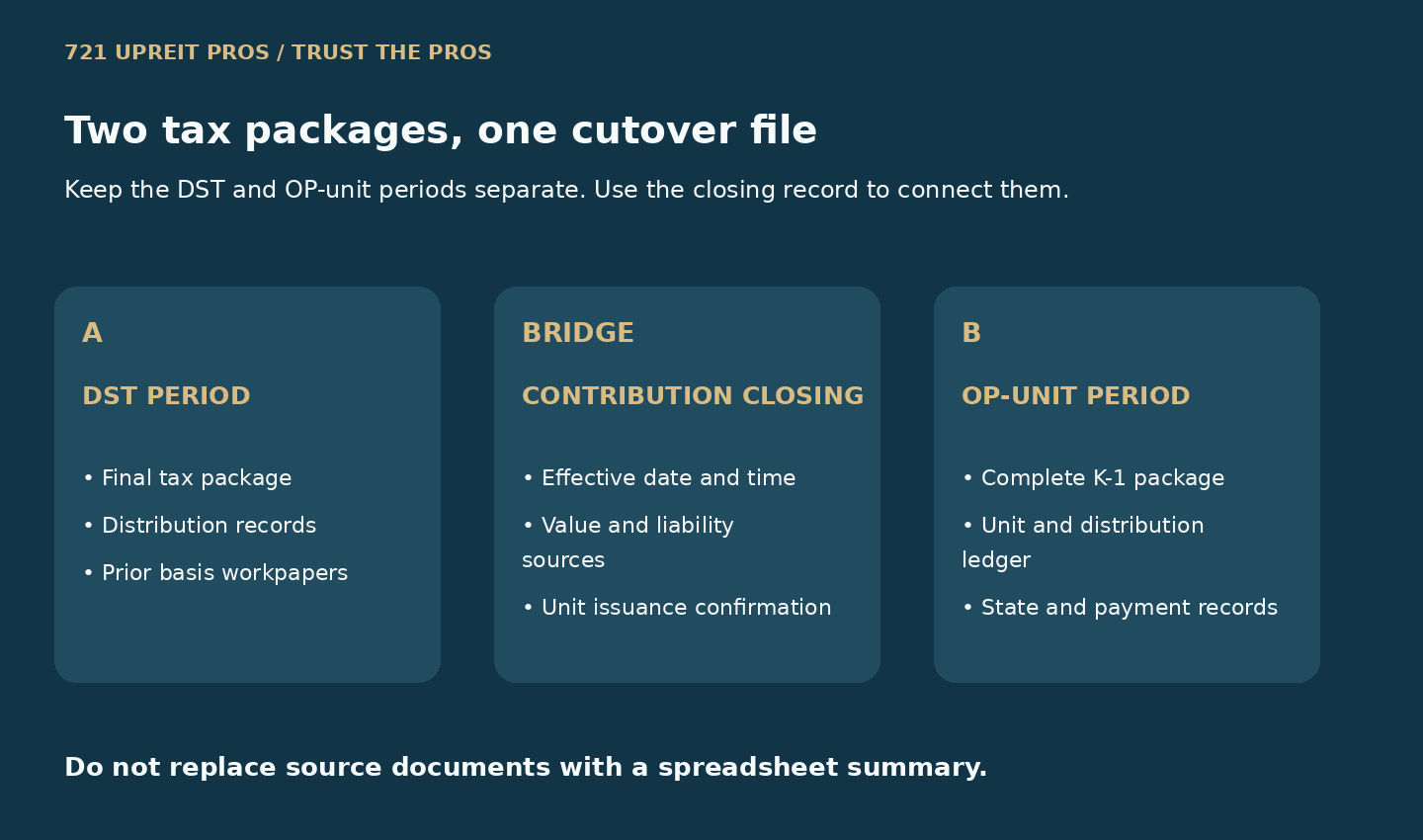
| Package | Records to preserve | Question it helps answer |
|---|---|---|
| A. DST period | Final sponsor tax package, every attached statement, distribution ledger, ownership record, debt statement if supplied, prior depreciation or basis workpapers, and corrected versions | What entity or property interest was reported before the cutover, for which dates, and under which identifier? |
| Bridge. Contribution closing | Executed contribution agreement, effective-time provision, closing statement, valuation schedule, liability schedule, unit issuance confirmation, legal entity names and tax-ID suffixes | What document defines the change, when did it become effective, and which numbers must be carried into later workpapers? |
| B. OP-unit period | First complete K-1 package, attached statements, distribution history, unit ledger, state schedules, payment or withholding evidence, and any corrected package | What did the operating partnership report after the cutover, for which period, and what remains unresolved? |
Keep the packages in separate folders with a common index. A useful file name begins with the year, entity and period, such as 2026_ExampleDST_final-tax-package.pdf or 2026_ExampleOPLP_K1_original.pdf. Do not rename source forms so aggressively that the issuer's original label disappears.
For the earlier DST-form distinction, use DST Experts' guide to DST tax forms and K-1 questions. For a broader transaction sequence, review its 721 exchange transaction overview. Those resources provide context, not the tax conclusion for a specific deal.
Package A: close the DST period without deleting history
- Save the final version of every annual or partial-year sponsor tax statement and attachment.
- Record the exact ownership name, taxpayer identification number suffix and reporting entity shown on each document.
- Preserve cash-distribution statements separately from income or loss allocations. Cash received is not a substitute for taxable-income reporting.
- Retain prior-year depreciation, suspended-loss, basis and state workpapers supplied by the preparer.
- Keep correction notices and both the superseded and replacement packages.
Publication 551 says taxpayers must keep accurate records of items that affect basis. The transition is a reason to strengthen that record, not to start over with only the OP-unit count. See IRS Publication 551.
Bridge folder: preserve the legal and numerical handoff
The bridge folder should make it possible to answer four questions without guessing: what was contributed, when the contribution became effective, which liabilities and adjustments were recognized in the closing records, and what OP units were issued. Include drafts only when they explain a change, but clearly mark the signed final documents.
The unit ledger and contribution closing statement serve different purposes. A unit ledger may show the number and effective date of units. A closing statement may show property value, debt, reserves, prorations and transaction adjustments. Neither should silently replace the other. If the values do not reconcile, add an open item and use the OP-unit valuation reconciliation example as an organizing model.
Package B: keep the first K-1 and every attachment together
The first partnership package is more than page one of Schedule K-1. Preserve all attached statements, state schedules, capital and liability information, corrected versions and issuer correspondence. The IRS partner instructions include a worksheet for adjusting the basis of a partnership interest, but personal outside basis generally requires partner-level records beyond a single capital-account number.
If the partnership package spans several jurisdictions, use the separate OP-unit multistate K-1 preparer handoff. If debt allocations changed, use the debt and outside-basis worksheet. Keep those analyses connected through the same entity name and tax year, not mixed into one calculation.
Create a dated cutover log before tax documents arrive
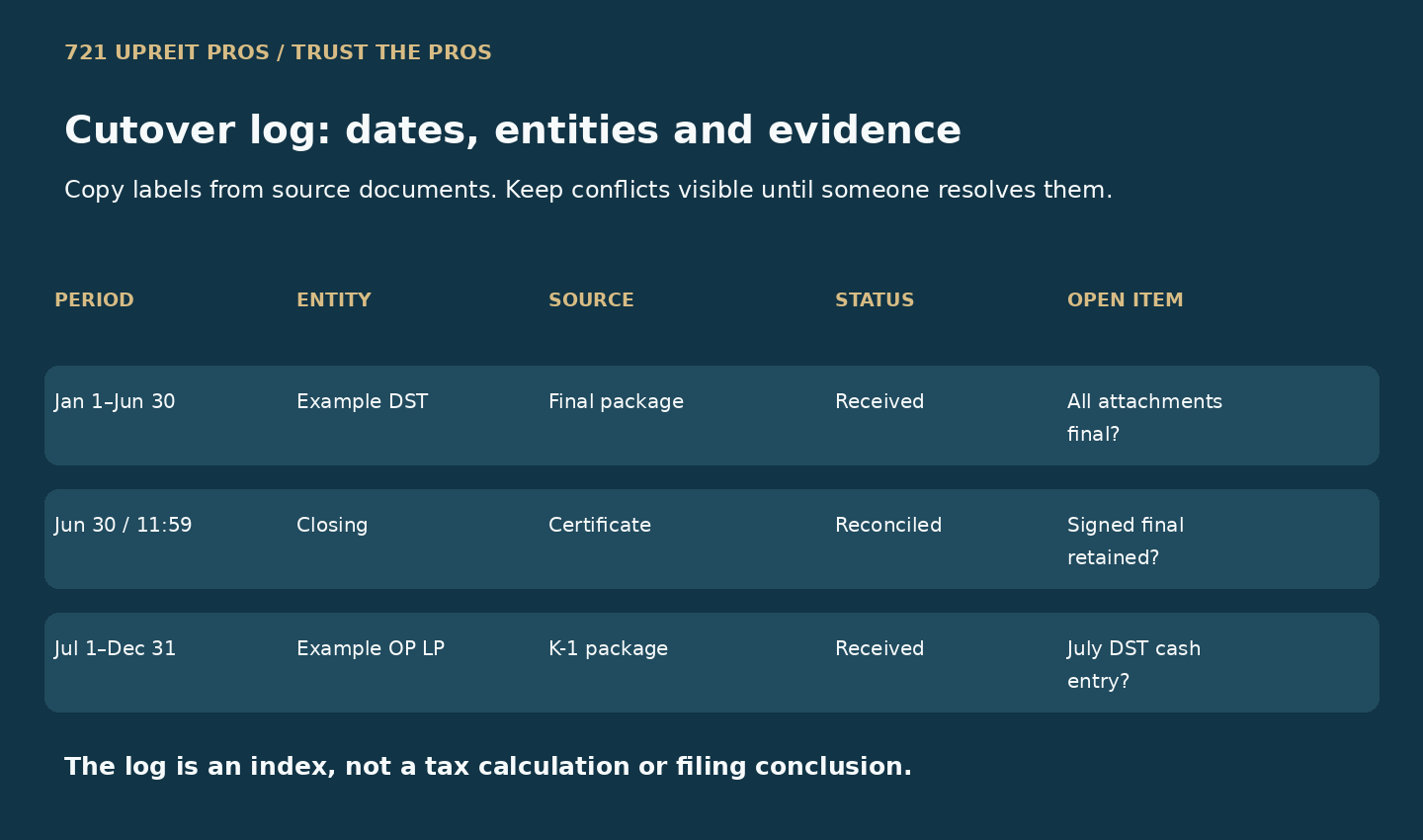
The cutover log is an evidence index, not a tax calculation. Build it after closing while the documents are easy to locate. Update it when the first OP-unit K-1 arrives or when an issuer sends a correction.
| Field | Record | Do not assume |
|---|---|---|
| DST reporting period | Start and end dates shown in the actual tax package | That the period ends on the signature date |
| Contribution effective time | Exact date and time from the signed agreement or closing certificate | That funding, signing and tax effectiveness are identical |
| OP-unit effective date | Date from the unit ledger or issuer confirmation | That it matches the first cash-distribution date |
| Entity identifiers | Legal names and last four EIN digits from each package | That similar sponsor names are the same taxpayer |
| Liability and value sources | Document name, page and amount, without reclassification | That book value, tax basis and contribution value are interchangeable |
| First K-1 period | Tax-year dates and partner-information dates shown on the package | That a calendar-year investor always receives a simple half-year allocation |
| Status | Expected, received, reconciled, corrected or unresolved | That a missing record means no item exists |
Download the two-package cutover checklist
Worked example: one year, two packages, one date conflict
This example is invented and does not determine tax treatment. Assume an investor owns an interest in Example DST at the start of 2026. The contribution agreement is signed June 30. A closing certificate says the contribution becomes effective at 11:59 p.m. that day. The OP unit ledger shows 45,000 units effective July 1. The final DST package later labels its activity “January 1 through June 30,” and the first Example OP LP K-1 labels its partner period “July 1 through December 31.”
Those records appear aligned, but the investor should still give the preparer the source documents rather than typing “half year” into a summary. The preparer needs the actual activity and allocation statements. If the DST package instead includes July activity, or the K-1 identifies a different admission date, the discrepancy belongs in the unresolved column.
| Record | Source label | Status | Follow-up |
|---|---|---|---|
| DST package | Activity January 1 to June 30 | Received | Confirm it is final and includes every attachment |
| Closing certificate | Effective June 30 at 11:59 p.m. | Reconciled | Retain signed final copy |
| Unit ledger | 45,000 units effective July 1 | Reconciled | Match entity and account name |
| First K-1 | Partner period July 1 to December 31 | Received | Keep statements and test against closing records |
| July DST activity | One sponsor cash statement references July | Unresolved | Ask whether it is a payment date, accrual, correction or post-closing distribution |
The $900,000 of net contributed value and 45,000-unit example from a separate valuation worksheet may help explain unit issuance, but it does not establish tax basis, income allocations or the correct period. This article deliberately keeps the cutover problem separate from the valuation problem.
Common transition-year mistakes
- Keeping only the first K-1: this loses the DST-period support and the bridge documents.
- Using cash dates as tax-period dates: payment timing may not establish when an item was earned, allocated or reportable.
- Treating capital account as outside basis: a partner's personal basis can require separate records and adjustments.
- Assuming Section 721 solves every issue: Publication 541 describes the general nonrecognition rule for a property contribution, but liabilities, built-in gain, disguised-sale rules, partner-specific facts and transaction documents can matter.
- Deleting superseded packages: retain corrected and prior versions with a clear status and received date.
- Sending sensitive files through ordinary email: use the preparer's approved secure delivery method.
Questions for the issuer, preparer and advisor
Ask the issuer or administrator
- Which document states the contribution effective date and time?
- Will the DST-period reporting be final, partial-year or corrected later?
- Which entity will issue the first partnership K-1, and what partner admission date should appear?
- Where are the final valuation, liability and unit issuance schedules?
- Who handles a mismatch between the DST closing records and the K-1 package?
Ask the tax preparer
- Which DST-period and OP-unit-period documents are still missing?
- Which basis, depreciation, passive-loss and state workpapers should carry forward?
- Does the contribution create a reporting issue that needs more than the ordinary K-1 package?
- How should conflicting effective dates or post-closing payments be documented?
- Should a corrected form, extension or protective estimate be expected?
If partnership income may exceed accessible distributions, pair this file with the K-1 cash-tax reserve worksheet. That worksheet organizes a funding question. It does not replace the transition-year entity and period reconciliation.
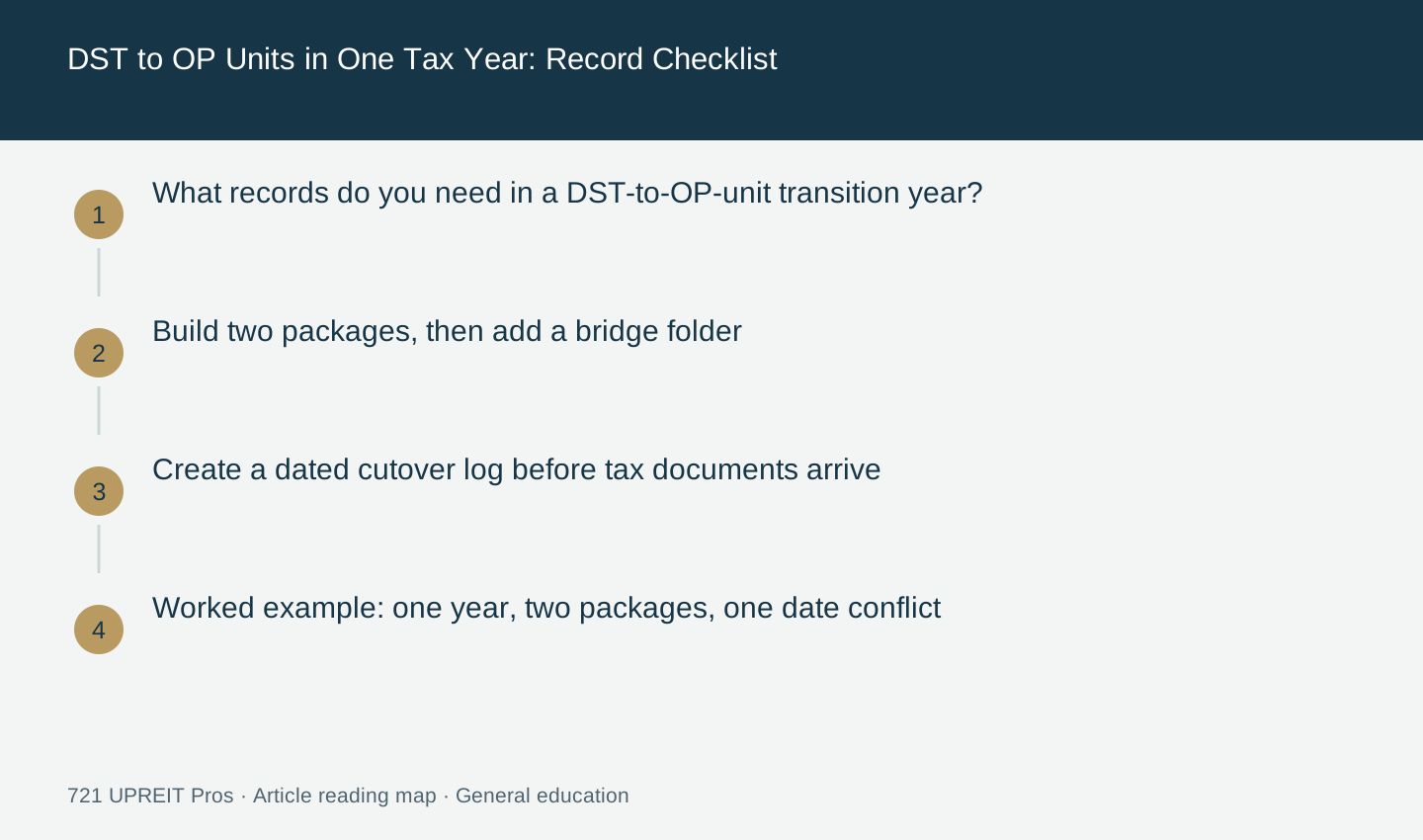
Use the records to prepare a better advisor conversation
Watch: organize the transition-year cutover
A one-minute silent explainer with English captions. The complete transcript is available below.
Read video transcript
0:00 · Start with two packages
Package A covers the DST period. Package B covers the OP-unit period.
0:12 · Add the bridge folder
Keep the signed contribution agreement, closing statement, liability schedule and unit confirmation. Do not substitute the unit ledger for the closing record.
0:24 · Record the cutover
Copy effective dates, entity names and tax-ID suffixes exactly. Cash dates may not be tax-period dates.
0:36 · Keep conflicts visible
A July cash entry or different admission date becomes an open item. Do not silently rewrite a source document.
0:48 · Send the complete file
Give the preparer both packages, the bridge and the cutover log. Refresh the file when corrected documents arrive.
Sources and scope
Primary references checked September 27, 2026: IRS Revenue Ruling 2004-86, IRS Publication 541, Partnerships, 2025 Partner's Instructions for Schedule K-1 (Form 1065), and IRS Publication 551, Basis of Assets. Use current instructions and the actual governing and tax documents.
General education by 721 UPREIT Pros with AI assistance. No independent professional review is represented. The example is hypothetical and does not determine Section 721 treatment, basis, allocations, filing duties, tax due, investment suitability, liquidity or returns.
BEFORE YOUR ADVISOR CONVERSATION
Three questions before you commit
This companion briefing covers the professional's identity, compensation and how restrictions fit your cash needs. Use it alongside this article's specific document checks.
Loading the video connects to YouTube. Watch on YouTube · 721 UPREIT Pros channel · Read the full advisor checklist.
Read video transcript
Before you hire a seven twenty-one UPREIT advisor, ask these three questions.
First: who exactly am I hiring? Get the professional's legal name, firm and registration information. Check the record through Investor dot gov and read the firm's relationship summary where applicable. Ask whether this conversation involves brokerage services, investment advice, or both. A marketing title alone does not answer that question.
Second: who gets paid, and how much? Request a written cost breakdown in dollars. Identify the payer, calculation base, payment timing and ongoing charges. Include product expenses and embedded compensation. No separate advisor invoice does not mean there are no costs.
Third: how does this fit my cash needs? Review the actual agreements. Ask who controls a possible conversion and what happens if it does not occur. Separate permission to request redemption from approval, pricing and payment. Do not assume a fixed cash-out date.
Then agree on responsibilities. Your investment professional, CPA, attorney and qualified intermediary can have different roles. Put continuing service and unresolved questions in writing.
Read the complete advisor checklist using the article link in the description. Seven twenty-one UPREIT Pros. Trust the Pros. Educational only. Investments involve risk and may be illiquid. Tax treatment depends on your circumstances.
Educational only. Investments involve risk and may be illiquid. Footage is illustrative; narration is synthetic.
TALK TO A 721 UPREIT ADVISOR
Ready to discuss your 721 options?
Request a callback to discuss the questions raised by this article, your timing and what to ask before you commit. Share your name, email and phone below to start the conversation.
No investment commitment or financial documents required. A callback request does not book an appointment or establish an advisory relationship.