
721 UPREIT PROS / LANDLORD EXIT DECISIONS
How do I stop being a landlord and defer capital gains taxes?
Separate the management problem from the tax transaction. Hiring a manager can reduce daily work without a disposition. A taxable sale ends ownership but may recognize gain. A qualifying Section 1031 exchange or Section 721 contribution may defer recognition under different rules, but neither automatically removes every ownership risk, guarantees passive income or produces cash on demand.
Prepared by 721 UPREIT Pros · Published October 6, 2026 · General education

This article owns one decision gap: how to compare relief from landlord work with the legal path that may recognize or defer gain. The existing cash-needs and control worksheet helps define household constraints. The 721 UPREIT guide explains the broader structure. Here, the first task is to identify what the owner wants to stop, then test each transaction path separately.
Can you stop managing property without immediately paying tax on a sale?
Potentially, but “stop being a landlord” is not one tax strategy. Keeping the property and hiring a manager can reduce operations without a sale. A properly structured Section 1031 exchange can defer recognition when qualifying business or investment real property is exchanged for qualifying replacement real property. A qualifying Section 721 contribution can generally defer recognition when property is contributed to a partnership for a partnership interest. Each path changes control, liquidity, records and risk in a different way.
TALK TO A 721 UPREIT ADVISOR
Talk to a 721 UPREIT advisor
Request a callback to discuss the questions raised by this article, your timing and what to ask before you commit. Share your name, email and phone below to start the conversation.
No investment commitment or financial documents required. A callback request does not book an appointment or establish an advisory relationship.
The IRS explains that Section 1031 now applies only to exchanges of real property held for business or investment. The replacement asset must be real property under the applicable rules. Buying REIT shares after a sale is not a direct Section 1031 exchange into real property. Section 721 is a separate partnership-contribution rule, not a way to turn sale proceeds into tax-deferred REIT shares.
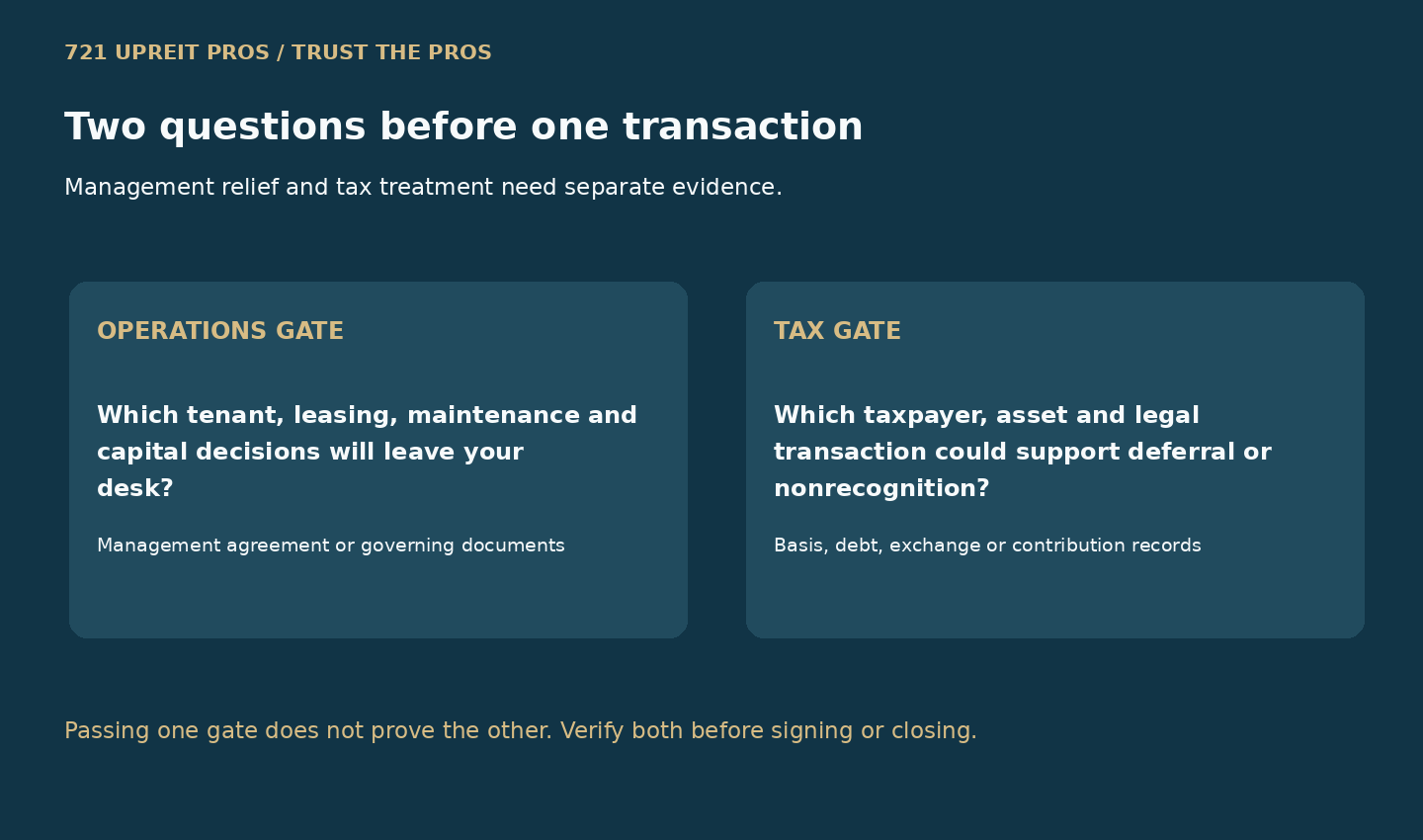
Two separate gates
Operations gate: Which tenant, maintenance, leasing, financing and property decisions will no longer be yours? Tax gate: What asset, taxpayer and legal transaction could support nonrecognition or deferral? A path can pass one gate and fail the other.
Map management relief and the tax path on separate axes
A property manager may take calls and supervise vendors while the owner retains the deed, financing exposure, capital decisions and sale timing. A DST interest may remove direct control over day-to-day operations but introduce sponsor control, transfer limits and property-level concentration. OP units may replace property ownership with a partnership interest after a qualifying contribution, but the operating partnership must accept the transaction and its documents control distributions, transfers and exit rights.
Do not rank a path only by how passive it sounds. Ask what remains on the owner's side of the line. Guarantees, loan covenants, tax filings, capital calls, document review, concentration and illiquidity may remain even when another party handles the building.
What are the main paths away from daily landlord work?
| Path | Management result | Tax question | Evidence to verify |
|---|---|---|---|
| Keep the property and hire a manager | Delegates selected operating tasks, while the owner keeps the property and higher-level decisions | No sale or exchange solely from hiring a manager, but ordinary income, deductions and later disposition rules continue | Management agreement, budget authority, leasing limits, reserve rules, termination rights and current tax records |
| Taxable sale | Ends direct ownership and daily management after closing, subject to retained obligations | Gain, depreciation-related items, selling costs, debt and state rules must be calculated from the actual records | Adjusted basis file, depreciation schedules, debt payoff, closing statement, improvements and transaction costs |
| 1031 exchange into directly owned replacement property | Changes the property, not necessarily the owner's role; management can still be outsourced | Potential deferral only if the taxpayer, relinquished and replacement real property, use, timing and exchange structure qualify | Qualified-intermediary agreement, identification, title, closing records, basis and debt analysis |
| 1031 exchange into a qualifying DST interest | May remove direct property operations while the trust and sponsor control the identified real estate | Depends on the actual trust facts and Section 1031 requirements; a DST label alone is insufficient | Trust and offering documents, Revenue Ruling 2004-86 fact comparison, property economics, debt, fees, transfer and sale terms |
| Direct Section 721 contribution for OP units | Replaces direct property ownership with a partnership interest if the operating partnership accepts and closes the contribution | Section 721 provides a general nonrecognition rule for qualifying property contributions, but liabilities, cash, related steps and other facts need review | Contribution agreement, valuation, debt treatment, unit class, partnership agreement, tax-protection terms and closing proof |
A sixth possibility is a two-stage path: a qualifying 1031 exchange into a DST followed by a later possible Section 721 contribution. The stages must not be collapsed. The DST must be evaluated at acquisition, and the later contribution depends on the governing documents, operating-partnership acceptance and transaction facts. Conversion is not automatic merely because marketing material mentions a 721 path.
Use the ownership-stage guide to identify when Section 1031 stops being the relevant unit-level path. Use the direct-contribution checklist if an operating partnership is considering the property.
Build one decision file before choosing the structure
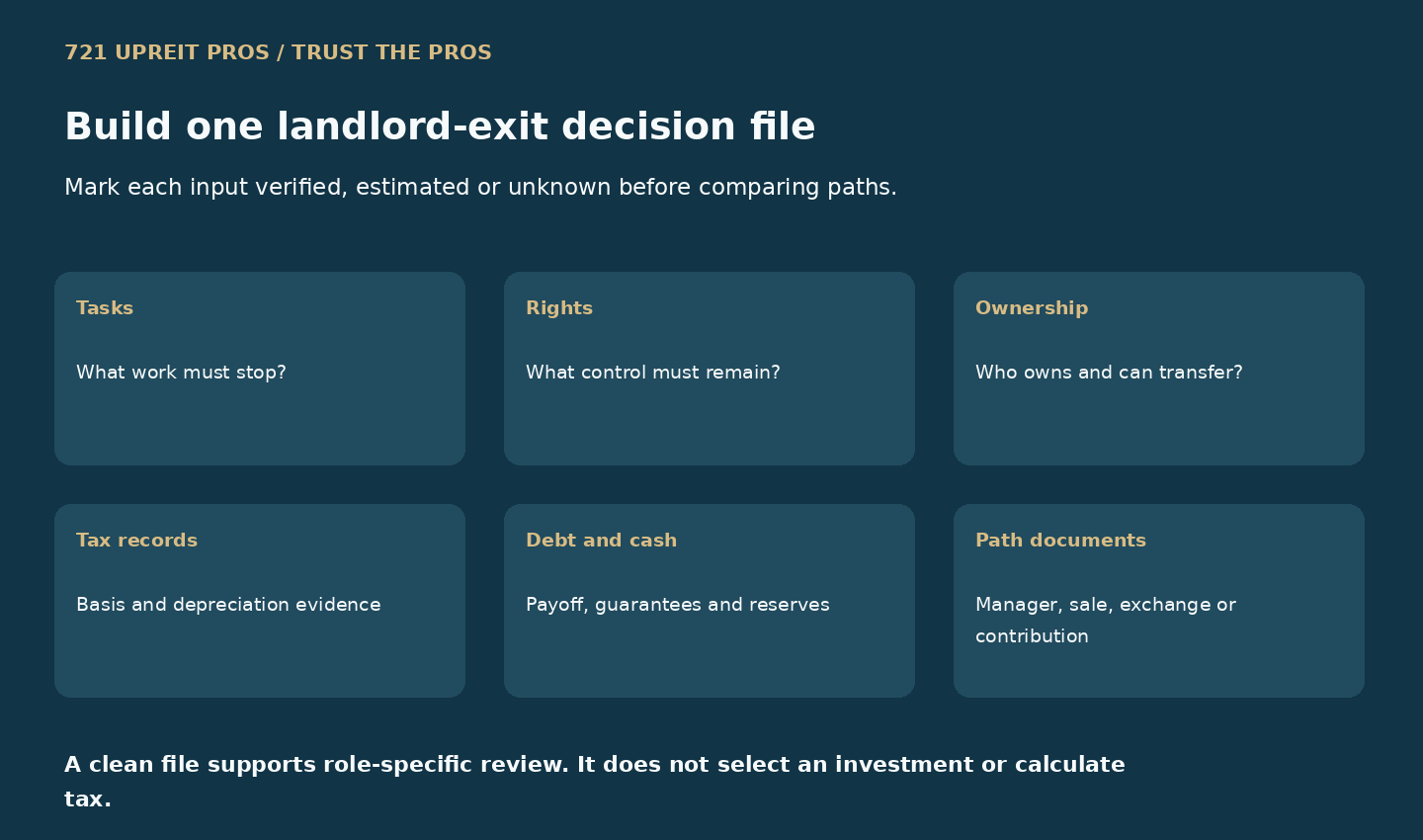
- Tasks to stop: list tenant calls, leasing, collections, vendors, maintenance, capital projects, bookkeeping and after-hours responsibility separately.
- Rights to keep: identify decisions the owner still wants to make, including sale timing, borrowing, major improvements and asset selection.
- Ownership and authority: confirm the deed owner, tax owner, borrower, entity approvals, co-owners and required consents.
- Tax records: gather acquisition and improvement basis, depreciation schedules, prior exchanges, suspended losses, state history and the intended disposition date.
- Debt and cash needs: record loan payoff, guarantees, replacement or liability questions, closing costs and accessible reserves outside the proposed investment.
- Path documents: collect the manager contract, sale agreement, qualified-intermediary file, DST package or Section 721 contribution documents that actually apply.
IRS Publication 544 for 2025 explains that dispositions of depreciable property can involve rules beyond a simple long-term capital-gain label. The basis and depreciation file should reach the CPA before a path is selected, not after the closing statement arrives. No headline estimate can replace the property-level calculation.
Download the landlord-exit decision checklist
Worked example: the same property, three different decisions
This is a fictional decision example, not a tax calculation or recommendation. Avery owns a 12-unit rental property with a current estimated value of $3,200,000, loan payoff of $700,000 and preliminary adjusted-basis records totaling $1,100,000. The $2,100,000 difference between estimated value and preliminary basis is not the tax due. Selling costs, depreciation-related rules, liabilities, ownership, state law and other facts still need to be reconciled.
Avery's immediate problem is 15 to 20 hours a month of leasing, vendor and tenant work. Avery also wants $250,000 of accessible cash within twelve months for a separate family goal. Those facts create two different constraints.
| Path | Question it may solve | Open issue that prevents an automatic answer |
|---|---|---|
| Manager | Could reduce the monthly operating workload while Avery retains the property | Does not itself provide $250,000 or change the later disposition tax analysis |
| Taxable sale | Could end ownership and produce net cash after closing | The CPA must calculate recognized gain and other tax items; net proceeds are not the sale price |
| 1031 replacement | May defer recognition if the exchange qualifies and could use a more passive replacement structure | Accessible cash taken from the exchange can create recognized gain, and the replacement may remain illiquid |
| Direct 721 contribution | Could exchange the property for OP units if a partnership accepts the asset and the contribution qualifies | Unit terms may not meet the twelve-month cash need; property acceptance, debt and cash consideration are unresolved |
The example shows why “defer the tax” cannot be the only goal. A structure that restricts principal may conflict with a dated cash need. A taxable sale may solve liquidity while producing a tax bill. A manager may solve workload while preserving ownership risk. Avery should bring the same verified property file to the CPA, attorney, qualified intermediary and investment professional, but ask each one role-specific questions.
What should you ask before signing or closing?
- Which landlord tasks do I want to stop, and which ownership decisions am I still willing to make?
- Who owns the property for legal and federal tax purposes today?
- What is the reconciled adjusted basis, including depreciation allowed or allowable and capital improvements?
- What cash do I need outside the transaction, and what tax effect could receiving that cash create?
- If Section 1031 is proposed, which qualifying real property will be transferred and received, and when must the intermediary be engaged?
- If a DST is proposed, do its actual powers and facts support the intended treatment, and what responsibilities and risks replace direct management?
- If Section 721 is proposed, which partnership will receive the property, what consideration will be issued, and how will debt be handled?
- Which fees, conflicts, guarantees, transfer limits and liquidity restrictions survive after daily landlord work ends?
- What is the fallback if the replacement property, DST closing or partnership contribution does not occur?
DST 1031 Experts offers a broader explanation of why a 1031 exchange cannot ordinarily go directly into REIT shares. Treat it as related education, not evidence that a particular DST, contribution or tax outcome qualifies. Then talk to a 721 UPREIT advisor with the decision file and your current documents.
One-minute video: solve the workload and tax questions separately
Read video transcript
0:00 · Want to stop being a landlord?
Define the work you want to stop. Then test the tax path separately.
0:12 · Management relief is one gate
A manager can take calls while you keep ownership risk. A passive interest can shift control and add restrictions.
0:24 · Tax treatment is another gate
A taxable sale, 1031 exchange and Section 721 contribution are different transactions. A label does not prove qualification.
0:36 · Protect the dated cash need
Separate accessible reserves from exchange or contributed capital. Do not assume a distribution or redemption will fund a deadline.
0:48 · Compare current evidence
Bring basis, debt, ownership and transaction documents. Resolve open items before signing or closing.
General education by 721 UPREIT Pros with AI assistance. No independent professional review is represented. This page does not calculate gain, depreciation-related tax, state tax, exchange eligibility, contribution treatment, proceeds, income, liquidity, acceptance, conversion, indexing or ranking.
BEFORE YOUR ADVISOR CONVERSATION
Three questions before you commit
This companion briefing covers the professional's identity, compensation and how restrictions fit your cash needs. Use it alongside this article's specific document checks.
Loading the video connects to YouTube. Watch on YouTube · 721 UPREIT Pros channel · Read the full advisor checklist.
Read video transcript
Before you hire a seven twenty-one UPREIT advisor, ask these three questions.
First: who exactly am I hiring? Get the professional's legal name, firm and registration information. Check the record through Investor dot gov and read the firm's relationship summary where applicable. Ask whether this conversation involves brokerage services, investment advice, or both. A marketing title alone does not answer that question.
Second: who gets paid, and how much? Request a written cost breakdown in dollars. Identify the payer, calculation base, payment timing and ongoing charges. Include product expenses and embedded compensation. No separate advisor invoice does not mean there are no costs.
Third: how does this fit my cash needs? Review the actual agreements. Ask who controls a possible conversion and what happens if it does not occur. Separate permission to request redemption from approval, pricing and payment. Do not assume a fixed cash-out date.
Then agree on responsibilities. Your investment professional, CPA, attorney and qualified intermediary can have different roles. Put continuing service and unresolved questions in writing.
Read the complete advisor checklist using the article link in the description. Seven twenty-one UPREIT Pros. Trust the Pros. Educational only. Investments involve risk and may be illiquid. Tax treatment depends on your circumstances.
Educational only. Investments involve risk and may be illiquid. Footage is illustrative; narration is synthetic.
TALK TO A 721 UPREIT ADVISOR
Ready to discuss your 721 options?
Request a callback to discuss the questions raised by this article, your timing and what to ask before you commit. Share your name, email and phone below to start the conversation.
No investment commitment or financial documents required. A callback request does not book an appointment or establish an advisory relationship.