
721 UPREIT PROS / DIVERSIFICATION REVIEW
721 UPREIT Diversification: What Exposure Remains?
A 721 UPREIT contribution may replace direct exposure to one property with an interest in a broader operating partnership. It does not automatically diversify your whole financial life. Compare the actual portfolio, overlapping holdings, debt and liquidity, then separately review tax exposure connected to your contributed property before deciding.
By 721 UPREIT Pros · Published October 19, 2026 · Original hypothetical exposure worksheet
Key takeaways
- Separate partnership diversification, household overlap and contributor-specific tax exposure.
- Label each percentage's date and calculation base before comparing holdings.
- A smaller original-property weight can coexist with substantial real-estate concentration.
- Broader holdings do not guarantee liquidity, tax deferral or protection from loss.
The useful question is not simply how many buildings appear in a brochure. Ask what changed in your exposure after the proposed transaction, what stayed concentrated and which facts remain unknown. This article provides a look-through comparison, not a recommended allocation or a ranking of available programs. Start with the 721 UPREIT guide for the structure.
Before listing or closing a property sale, coordinate the intended path with your broker, qualified intermediary where applicable, CPA and attorney. A qualifying 1031 exchange into a DST and a separate later Section 721 contribution are not one automatic transaction. Direct property contributions require their own acceptance and tax review; see how the ownership stages differ.
TALK TO A 721 UPREIT ADVISOR
Talk to a 721 UPREIT advisor
Request a callback to discuss the questions raised by this article, your timing and what to ask before you commit. Share your name, email and phone below to start the conversation.
No investment commitment or financial documents required. A callback request does not book an appointment or establish an advisory relationship.

What does diversification mean in this decision?
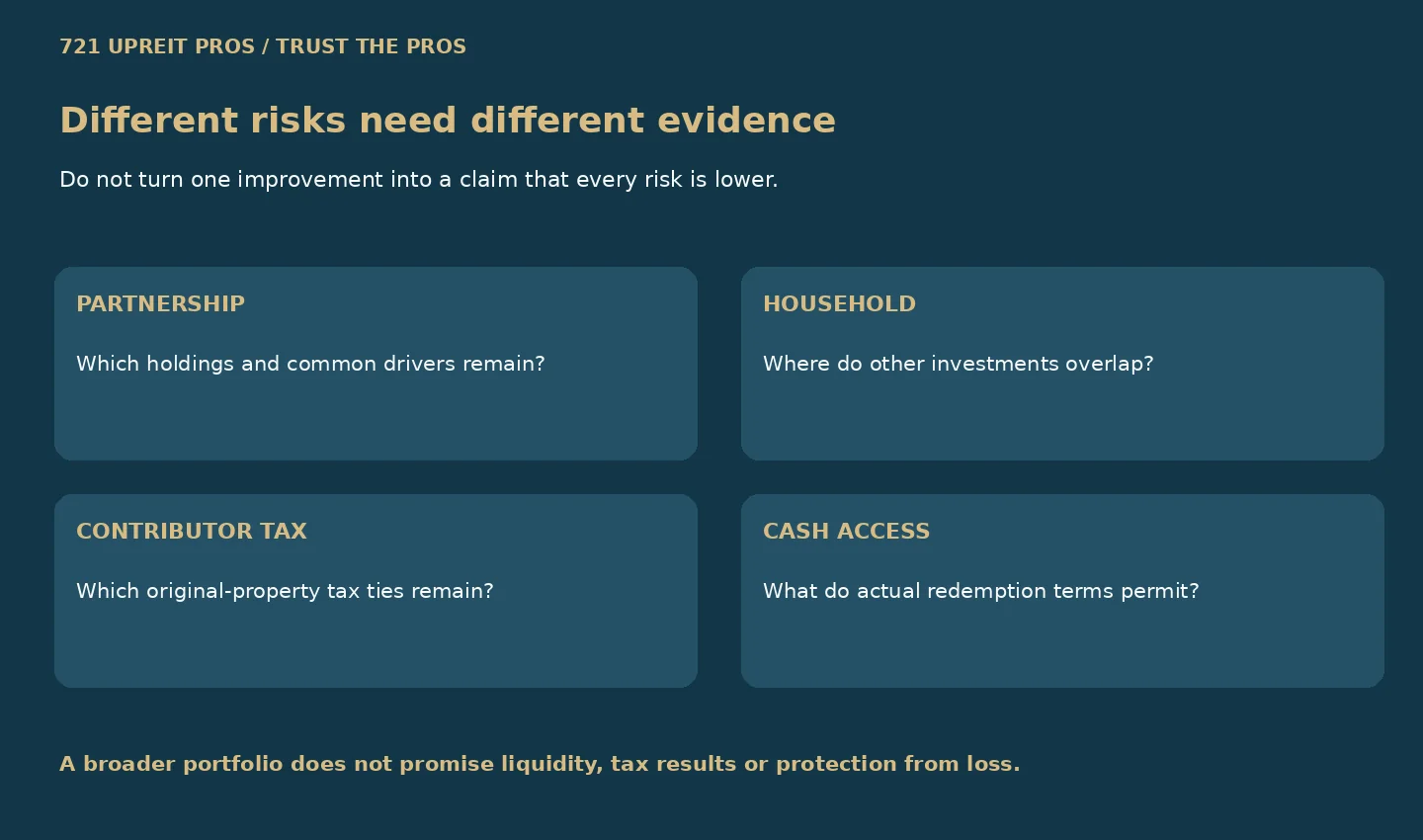
Use three separate tests: exposure within the operating partnership, exposure across your household's investments, and contributor-specific tax obligations. A favorable answer to one does not settle the others. For example, a portfolio can contain many properties while remaining heavily weighted toward apartments, one region or one financing environment.
FINRA's concentration-risk guidance explains that related investments can create overlapping exposure and that concentration can exist in an asset class, market segment or illiquid holdings. Apply that principle by examining underlying assets rather than counting account statements. This is a review method, not a claim that any particular percentage is safe.
| Review layer | Evidence to request | What it cannot establish |
|---|---|---|
| Partnership portfolio | Dated holdings, property types, markets, tenants, debt and valuation basis | Your household is diversified merely because the partnership owns many assets |
| Household overlap | Other rentals, DSTs, REIT funds, securities and accessible cash | Separate accounts have independent economic risks |
| Contributor tax exposure | Contribution records, built-in gain information and actual tax-protection provisions | A small portfolio property weight erases your original tax history |
Which portfolio percentage are you actually comparing?
Write the denominator next to every percentage. A property's share of gross asset value, equity value, rental revenue or net operating income answers a different question. A portfolio that reports 20% of rent from a sector is not necessarily reporting 20% of investor equity in that sector. Do not multiply unlike measurements as though they were interchangeable.
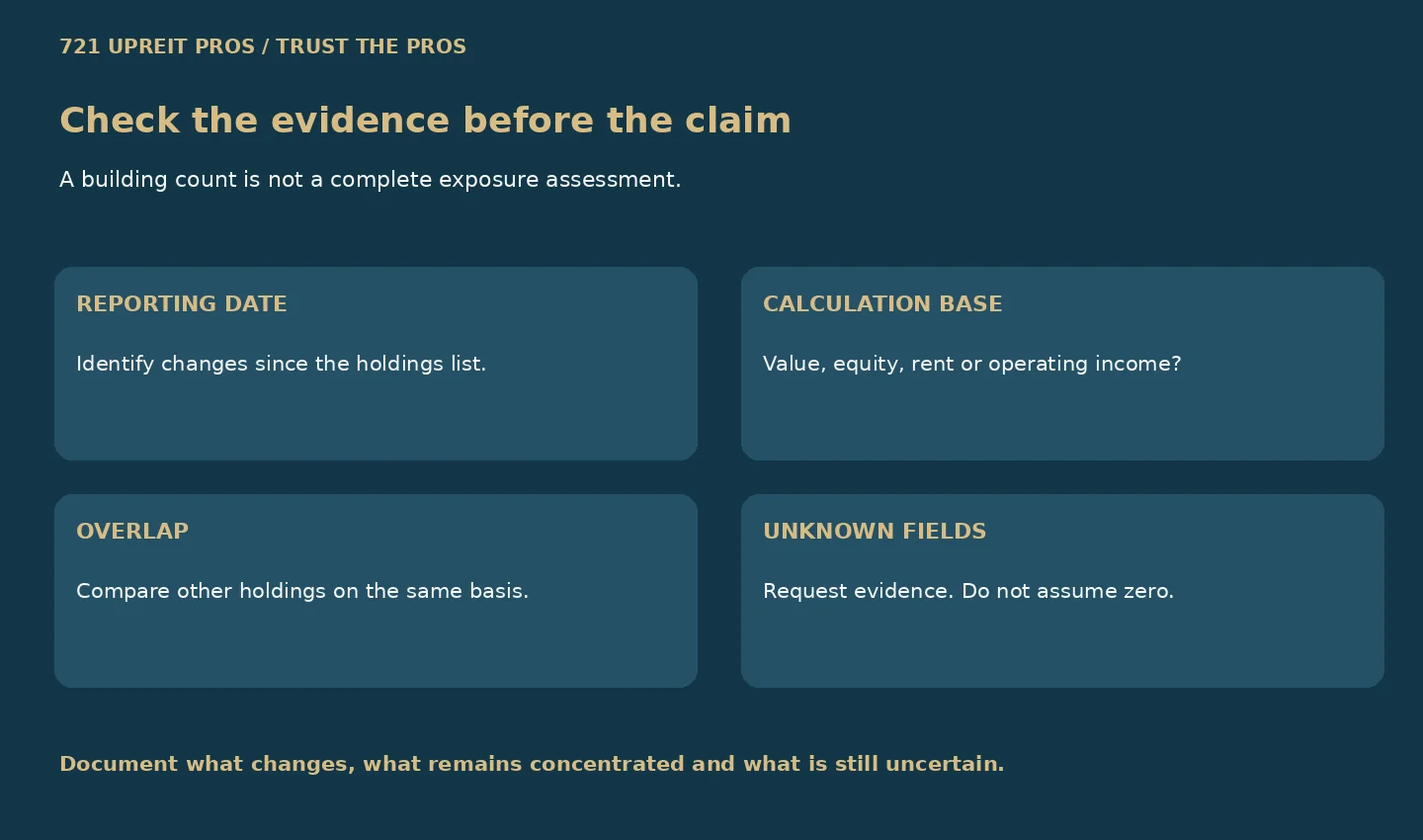
Also record the reporting date, treatment of joint ventures, ownership percentage and whether cash or loans are included. A current-looking presentation may use an older property schedule. Ask for material acquisitions, sales or financing changes since that schedule. Where the information is unavailable, leave the field unknown rather than assigning zero exposure.
The original worksheet below uses deliberately simplified equity-attribution weights. It is suitable for explaining the arithmetic only because those assumptions are explicit. A real portfolio may need more detailed reconciliation of leverage, preferred interests, asset valuations and ownership rights. Ask the investment professional which calculations the supplied reports actually support.
Can single-property exposure fall while real estate stays concentrated?
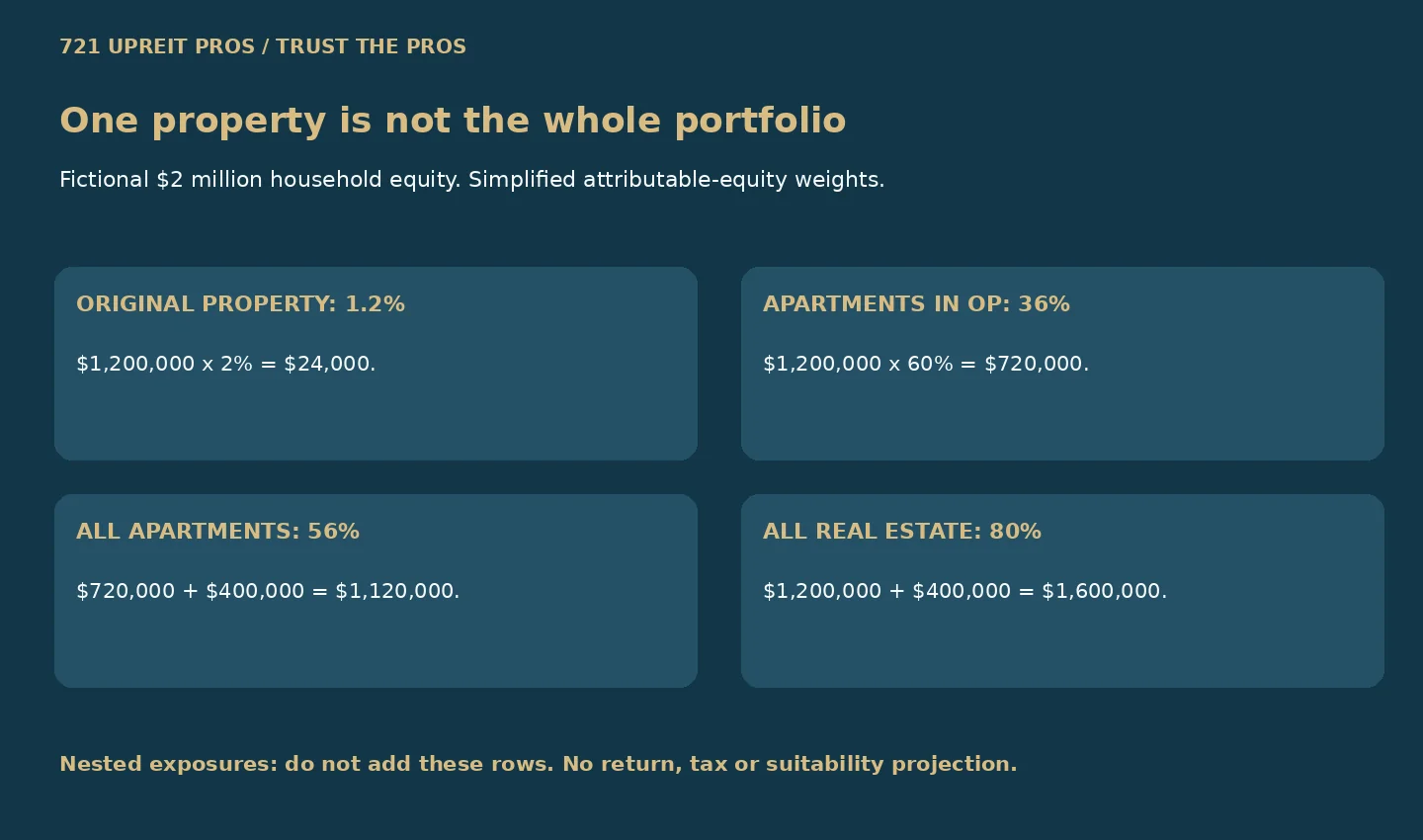
Yes. Consider a fictional household with $2 million of modeled investment equity: $1.2 million in one apartment property, $400,000 in another apartment investment and $400,000 in cash and non-real-estate investments. Exclude the personal residence and assume no other holdings. These amounts are not a client case, recommendation or forecast.
Assume the first property is accepted in exchange for an OP interest worth $1.2 million, with no immediate value change. For this simplified exercise, the partnership's attributable equity is 60% apartments and 40% other real estate, and the original property accounts for 2% of that attributable equity. Ignore transaction costs, taxes and valuation changes to isolate concentration arithmetic.
| Exposure after contribution | Illustrative calculation | Household weight |
|---|---|---|
| Original property through the OP interest | $1,200,000 × 2% = $24,000 | 1.2% |
| Apartments through the OP interest | $1,200,000 × 60% = $720,000 | 36% |
| Total apartments, including the separate holding | $720,000 + $400,000 = $1,120,000 | 56% |
| Total real estate | $1,200,000 + $400,000 = $1,600,000 | 80% |
The modeled original-property weight falls from 60% to 1.2%. Apartment exposure falls from 80% to 56%. But total real-estate exposure remains 80%, and 60% of the household's modeled investment equity is now represented by one partnership interest. Those are different observations, not a contradiction. The example does not measure volatility, loss probability, tax liability or suitability.
Do not add the table rows together: the original property is already inside apartments, and apartments are already inside real estate. These are nested views of the same capital. If a real report supplies gross-property weights rather than attributable-equity weights, this multiplication is not a verified household allocation calculation.
What can remain concentrated besides property type?
Build a short list of shared drivers: geography, tenant industry, major tenant groups, loan maturities, variable-rate exposure, insurance pressures and management dependence. Request the underlying evidence for the drivers material to your proposed investment. A varied collection of buildings can still depend on the same local employer or refinancing conditions.
Review other holdings alongside the proposed OP interest. For an earlier DST stage, the related DST tenant-concentration review helps frame tenant and lease questions. It is a separate ownership-stage resource, not evidence that a future UPREIT will inherit the same portfolio or that a transition is guaranteed.
Keep the review proportionate. You do not need an invented precision score when disclosures are incomplete. A useful finding can be: two holdings depend on the same market, but comparable exposure data is missing. State the decision consequence and request clarification before assuming the overlap is immaterial.
Does a smaller property weight eliminate built-in gain?
No. Portfolio diversification and tax allocation are separate. IRS Publication 541 explains that partnership allocations must account for differences between contributed property's value and adjusted basis. A later sale of that property can allocate built-in gain to its contributor. A small economic portfolio weight is not evidence that this tax connection disappeared.
Preserve the contribution-date records and ask your CPA how the applicable allocation method affects you. Use the existing Section 704(c) record checklist for that detailed handoff. Any tax-protection agreement must be read for covered events, exceptions, duration and remedies. This article does not calculate tax or certify protection.
Does broader exposure mean better access to cash?
No. Asset breadth is not a redemption promise. The SEC's REIT overview distinguishes publicly traded and non-traded REITs and warns about non-traded liquidity. Present OP-unit rights require their own agreement review; they cannot be inferred from a later REIT-share description.
Compare your actual cash deadlines with outside reserves, not the number of portfolio buildings. The cash-needs and control worksheet already provides that planning exercise. Consider retirement accounts and other investments in the household review without treating retirement-account assets as exchange proceeds or assuming an account transfer is appropriate.
What should you verify before accepting the diversification claim?
- Identify the exact operating partnership, interest and ownership stage.
- Obtain a dated holdings schedule and label every percentage's calculation base.
- Record material sector, market, tenant, debt and management overlap.
- Compare the proposed interest with your other investments without double counting.
- Review contributor-specific tax exposure and cash-access terms separately.
- Document unresolved facts and discuss their effect on your decision before signing.
The result should be a short evidence-based conversation: which exposure changes, which remains, what is uncertain and whether the resulting constraints fit your goals. Review the broader 721 UPREIT risk framework, then talk to a 721 UPREIT advisor. Use the seller checklist if you are still preparing a sale. Do not send account numbers or tax documents through a general inquiry form.
Watch the one-minute exposure review
This original silent video includes English captions and a complete transcript. The example is hypothetical, not an available portfolio.
Read video transcript
0:00 · 721 UPREIT diversification
Ask what exposure changes and what remains concentrated.
0:12 · Separate the review layers
Portfolio, household and tax risks need different evidence.
0:24 · Use a matched calculation base
Fictional household: 56% apartments, 80% real estate after contribution.
0:36 · Look beyond the building count
Check dates, weights and overlap. Keep unknown information visible.
0:48 · Review the decision with your team
Diversification does not promise liquidity, returns or tax results.
Download the exposure-review worksheet
Sources and review limits
Primary sources checked October 19, 2026: FINRA concentration-risk guidance, SEC Investor.gov REIT overview and IRS Publication 541, revised December 2025. No specific offering availability, portfolio composition, return or named expert review is represented. Diversification cannot guarantee profit or prevent loss. Educational only, not tax, legal or investment advice.
Frequently asked questions
Does a 721 UPREIT automatically diversify my investments?
No. Review the actual partnership portfolio and its overlap with your other assets. More buildings can broaden one exposure without reducing concentration in real estate, a sector, a market or one manager.
Is the number of properties enough to compare two portfolios?
No. Ask for comparable dated weights and the basis used to calculate them. Property counts do not describe size, income contribution, leverage or common economic drivers.
Can I multiply my OP value by any reported sector percentage?
No. Confirm that the reported weighting supports an attributable-equity calculation. A rental-revenue or gross-asset percentage is not automatically your equity weight. Keep unsupported estimates separate from verified figures.
Why should I include my other rentals and retirement investments?
They can change the household's combined exposure. Review underlying holdings and accessible reserves while keeping account tax rules separate. This does not mean retirement assets are exchange proceeds or that a rollover is appropriate.
Does diversification remove the tax connection to my original property?
Do not assume that. Contributor-specific basis and built-in gain records remain relevant. Ask your CPA about the applicable allocation rules and counsel about any actual tax-protection terms.
What if the issuer cannot provide comparable exposure data?
Record the limitation, ask which information is available and identify what decision depends on the missing data. Do not fill the gap with a zero, a brochure property count or a claim of guaranteed diversification.
TALK TO A 721 UPREIT ADVISOR
Ready to discuss your 721 options?
Request a callback to discuss the questions raised by this article, your timing and what to ask before you commit. Share your name, email and phone below to start the conversation.
No investment commitment or financial documents required. A callback request does not book an appointment or establish an advisory relationship.