
721 UPREIT PROS / ANNUAL BASIS RECORDS
K-1 capital account versus OP-unit outside basis: annual reconciliation
Do not copy the Schedule K-1 Item L capital account into an outside-basis schedule. Start with the prior year's partner-level outside basis, roll forward supported increases and decreases, reconcile liability changes separately, and give unresolved differences to the tax preparer.
By 721 UPREIT Pros · September 29, 2026 · Original annual evidence rollforward and reconciliation example

This guide answers one narrow question: how should an OP-unit holder organize an annual reconciliation between the K-1 capital account and partner-level outside basis? It supports the 721 UPREIT risk and due-diligence guide. It does not replace the preparer's basis calculation or determine a loss limitation, distribution, liability allocation, redemption or sale result.
Is the K-1 capital account the same as outside basis?
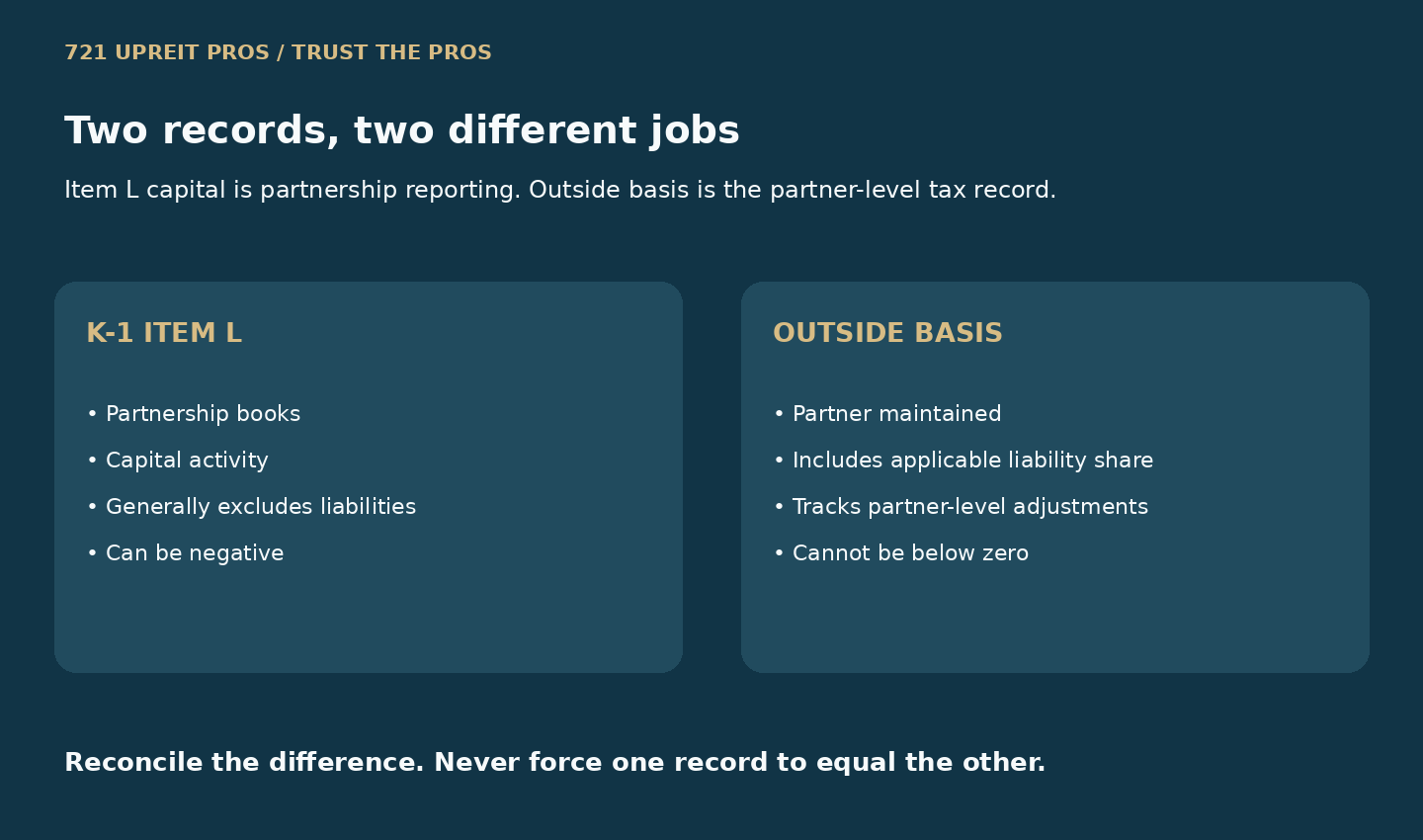
No. Schedule K-1 Item L reports a partner's capital-account analysis from the partnership's books and records. Adjusted outside basis is the partner-level tax basis in the partnership interest. The partner is responsible for maintaining the information needed to determine outside basis, and Item L cannot be used by itself to calculate it.
TALK TO A 721 UPREIT ADVISOR
Talk to a 721 UPREIT advisor
Request a callback to discuss the questions raised by this article, your timing and what to ask before you commit. Share your name, email and phone below to start the conversation.
No investment commitment or financial documents required. A callback request does not book an appointment or establish an advisory relationship.
The 2025 Partner's Instructions for Schedule K-1 (Form 1065), checked September 29, 2026, state that Item L information is based on the partnership's books and records and cannot be used to figure the partner's adjusted basis. The instructions provide a separate Worksheet for Adjusting the Basis of a Partner's Interest in the Partnership and say an annual outside-basis record can require partner-level information.
IRS Publication 541 similarly explains that adjusted basis is determined without considering an amount shown in the partnership's books as capital, equity or a similar account. It identifies contributions, income, distributions, losses, nondeductible expenses and applicable liability changes among the items that can affect outside basis.
Use Item L as evidence, not as the answer
A difference is not automatically an error. The useful task is to explain the difference with source documents, identify what remains unresolved and preserve the preparer's approved ending outside-basis schedule for the next year.
What does each record tell you?
| Record | What it can show | What it does not establish alone |
|---|---|---|
| K-1 Item L capital account | Beginning capital, capital contributed, current-year net income or loss, withdrawals and distributions, and ending capital under the reported method | The investor's complete adjusted outside basis or every partner-level adjustment |
| K-1 Item K1 liabilities | Beginning and ending shares of recourse, nonrecourse and qualified nonrecourse financing, subject to the form instructions | The full reason for an allocation or the investor's final basis result |
| K-1 boxes and statements | Allocated income, gain, loss, deduction, distribution and other reported items | Whether the item is currently deductible, taxable or limited for this investor |
| Partner outside-basis schedule | The annual bridge from the accepted opening basis through supported partner-level increases and decreases | A substitute for the return, partnership agreement, liability analysis or preparer judgment |
The K-1 instructions note that tax-basis capital generally excludes liabilities, while a partner's outside basis may include an applicable share of partnership liabilities. Capital can be negative, while outside basis cannot be reduced below zero. Other partner-level facts can also create differences, so do not use a shortcut that simply adds one or two K-1 fields and labels the result final.
If the annual difference is driven by a changed debt allocation, use the separate OP-unit debt-change and outside-basis organizer. That page addresses a Section 752 liability event. This page owns the broader year-over-year evidence rollforward.
If the interest was acquired after an owner's death, first use the post-death OP-unit basis record checklist to establish the initial outside-basis source, income cutoff, election status and any transferee-specific Section 743(b) file. Then use this annual worksheet for later rollforwards.
How do you build the annual outside-basis rollforward?
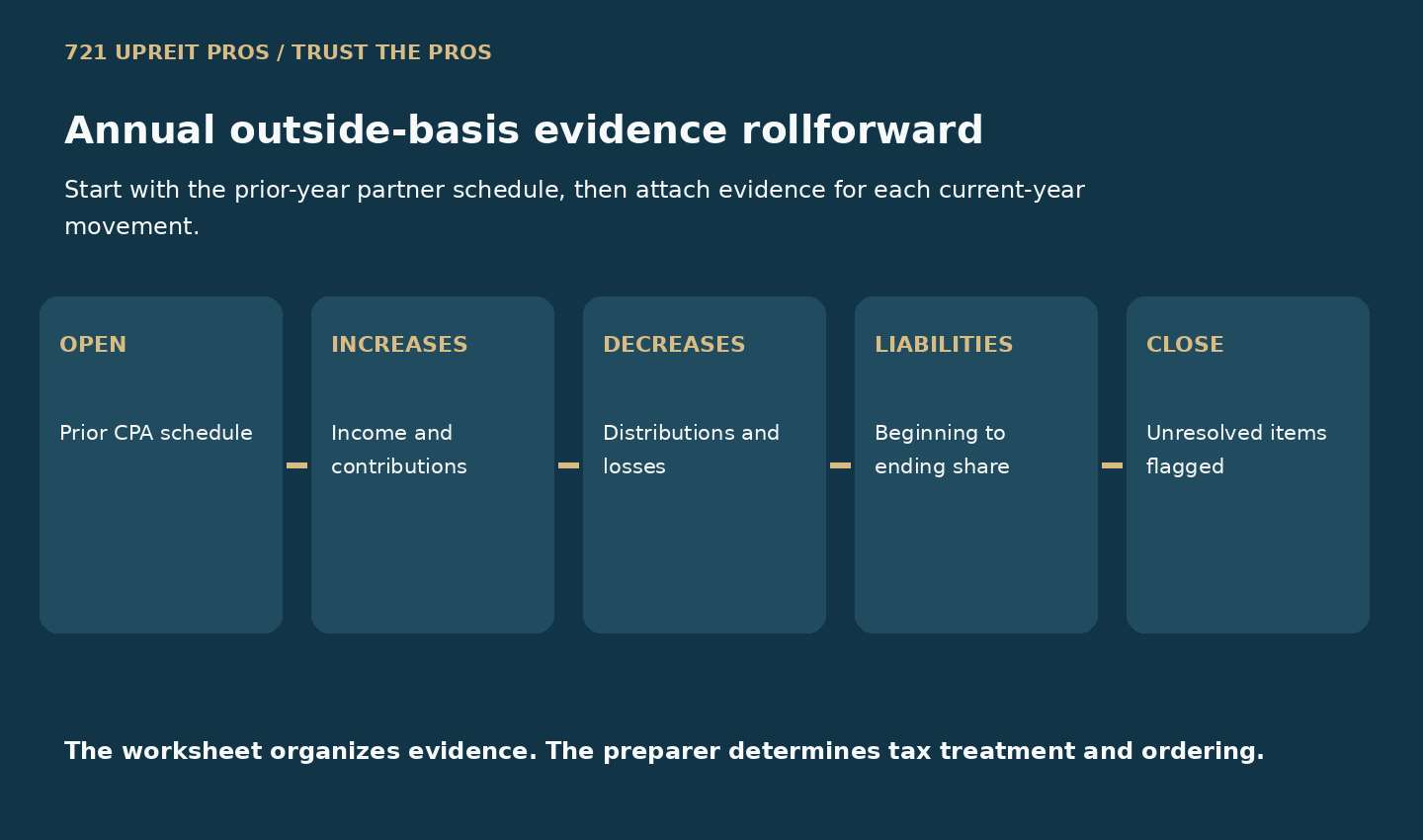
- Anchor the opening number. Use the prior year's ending outside-basis schedule accepted by the preparer. If none exists, mark the opening basis as unresolved rather than copying beginning capital.
- Inventory current-year increases. Organize contributions, taxable and tax-exempt income, applicable increases in liability share and other supported partner-level adjustments.
- Inventory current-year decreases. Organize distributions, losses, nondeductible noncapital expenses, applicable decreases in liability share and other supported reductions. Ordering and limitations can matter.
- Reconcile the liability bridge. Compare beginning and ending liability categories with the full supporting statement and any transaction notice. Do not substitute property-level debt, a loan balance or account value for the partner's allocated share.
- Close the year with exceptions visible. List missing documents, unverified amounts, suspended items and any event requiring basis at a particular date. Ask the preparer to approve or revise the ending schedule.
The IRS basis worksheet warns that some transactions or distributions require basis at the point in time of the event rather than a simple year-end sequence. A redemption, sale, liquidating distribution or liability change can therefore require a dated calculation. The annual worksheet should flag those events, not flatten them into a year-end total.
| Folder | Include | Control question |
|---|---|---|
| Opening basis | Prior-year outside-basis schedule, prior K-1 package and preparer note | Who approved the opening number and when? |
| Current K-1 | K-1, every statement, Item K1 and Item L detail, state schedules and later corrections | Is this the complete final package for the legal entity? |
| Transactions | Contribution, distribution, redemption, transfer and closing records | Does an event require basis on a date other than year-end? |
| Liabilities | Beginning and ending shares, categories, allocation notices and relevant agreements | Can the change be traced without using property debt as a shortcut? |
| Partner history | Purchase, inheritance, transfer, prior suspended items and partner-specific adjustments if applicable | Which facts may not appear in Item L? |
Download the annual basis reconciliation
Worked example: explain a $150,000 difference
This example is hypothetical, simplified and not a tax-return position. Assume an investor's preparer-approved opening outside basis is $720,000 and beginning Item L capital is $600,000. During the year, the K-1 package reports $38,000 of taxable income, $4,000 of tax-exempt income, $50,000 of cash distributions and $12,000 of nondeductible noncapital expenses. The investor's applicable partnership-liability share increases by $30,000.
| Movement | Item L capital | Outside-basis organizer | Evidence |
|---|---|---|---|
| Opening record | $600,000 | $720,000 | Prior-year K-1 and preparer-approved basis schedule |
| Taxable and tax-exempt income | +$42,000 | +$42,000 | K-1 boxes and attached statements |
| Cash distributions | -$50,000 | -$50,000 | Box 19 detail and cash record |
| Nondeductible noncapital expenses | -$12,000 | -$12,000 | K-1 statement and preparer classification |
| Increase in applicable liability share | Not included in tax-basis capital | +$30,000 | Item K1 and liability allocation support |
| Preliminary ending records | $580,000 | $730,000 | Subject to ordering, limitations and unresolved items |
The $150,000 ending difference has an evidence bridge in this simplified example: the $120,000 opening difference plus the $30,000 current-year liability increase. That does not prove $730,000 is the correct tax basis. The preparer still reviews the actual K-1 statements, liability rules, transaction dates, prior adjustments and any limitations before accepting the ending schedule.
The example also shows why a market value, account statement or REIT share price does not belong in the arithmetic merely to make the records match. Outside basis is a tax record, not an estimate of what the units are worth.
What if the capital account and outside-basis schedule still do not reconcile?
Do not insert an unexplained plug. Build a difference log and classify each item as supported, pending, not applicable or assigned for review. Preserve the source used and the person responsible for resolving it.
- Missing opening history: locate the prior contribution, acquisition, inheritance or transfer records and prior returns.
- Liability mismatch: compare each K-1 category and the partnership's supporting statement, then use the dedicated debt-change worksheet if the allocation changed materially.
- Corrected tax package: retain both versions and use the K-1 version-control log before revising the annual schedule.
- Unclear distribution: distinguish cash, deemed money, property and marketable-securities reporting. Do not infer treatment from the bank deposit alone.
- Loss limitation: the IRS explains that partnership losses are generally allowed only to the extent of outside basis under Section 704(d), with excess amounts carried forward subject to the rules. Outside basis is only one potential limitation.
- Partner-level adjustment: ask whether an acquisition, Section 743(b) adjustment, suspended item or other investor-specific fact belongs in the schedule. Do not assume it applies.
For a first K-1 after a DST-to-OP-unit transition, preserve the separate two-package transition-year record checklist. It establishes the cutover file. This annual page then carries the partner-level record forward in later years.
Questions for the partnership and tax preparer
Ask the partnership or administrator
- Is this the complete K-1 package, including all statements and liability detail?
- Which capital-account method is shown in Item L for this tax year?
- What explains each beginning-to-ending change in the partner's liability categories?
- Was any package corrected, superseded or followed by another statement?
- Is partner-specific information available for an acquisition, transfer or other adjustment?
Ask the tax preparer
- What ending outside basis from last year should be used as this year's opening amount?
- Which current-year items increase or decrease outside basis, and in what order?
- Does any event require basis on a transaction date rather than only at year-end?
- How should liability changes, suspended losses and partner-level adjustments be documented?
- Which unresolved difference should remain open rather than be forced into the schedule?
Prepare the investment-side questions separately
For follow-up education, compare this investor-level organizer with DST 1031 Experts' explanation of 721 UPREIT tax deferral, basis and trade-offs. Their guide on DST tax packages versus partnership K-1s helps keep the pre-contribution and post-contribution forms distinct.
One-minute video: reconcile capital and outside basis
A one-minute silent explainer with English captions. The complete transcript is available below.
Read video transcript
0:00 · Do not copy Item L
The K-1 capital account and outside basis serve different jobs. Keep both records in the annual file.
0:12 · Begin with last year's close
Use the ending outside basis accepted by the preparer. Do not reconstruct the opening number from memory.
0:24 · Attach every movement
Record income, contributions, distributions, losses and expenses. Connect each amount to its source statement.
0:36 · Reconcile liabilities separately
Compare beginning and ending liability categories. Do not treat property debt as the same record.
0:48 · Close with open items
Flag missing statements and unresolved differences. Let the preparer approve the ending basis schedule.
Dividing OP units in a divorce adds a separate transfer-date handoff. The divorce-related basis and holding-period record guide explains why settlement value must not replace the tax-history file.
Sources and scope
Primary references checked September 29, 2026: 2025 Partner's Instructions for Schedule K-1 (Form 1065), including the partner basis worksheet and Item L instructions; Publication 541, Partnerships, revised December 2025; and the IRS Section 704(d) outside-basis limitation FAQs. Use instructions for the actual tax year and the investor's complete records.
General education by 721 UPREIT Pros with AI assistance. No independent professional review is represented. The example is hypothetical and does not determine outside basis, capital account, liability allocation, loss deductibility, distribution treatment, gain, Section 721 treatment, investment suitability, liquidity or returns.
BEFORE YOUR ADVISOR CONVERSATION
Three questions before you commit
This companion briefing covers the professional's identity, compensation and how restrictions fit your cash needs. Use it alongside this article's specific document checks.
Loading the video connects to YouTube. Watch on YouTube · 721 UPREIT Pros channel · Read the full advisor checklist.
Read video transcript
Before you hire a seven twenty-one UPREIT advisor, ask these three questions.
First: who exactly am I hiring? Get the professional's legal name, firm and registration information. Check the record through Investor dot gov and read the firm's relationship summary where applicable. Ask whether this conversation involves brokerage services, investment advice, or both. A marketing title alone does not answer that question.
Second: who gets paid, and how much? Request a written cost breakdown in dollars. Identify the payer, calculation base, payment timing and ongoing charges. Include product expenses and embedded compensation. No separate advisor invoice does not mean there are no costs.
Third: how does this fit my cash needs? Review the actual agreements. Ask who controls a possible conversion and what happens if it does not occur. Separate permission to request redemption from approval, pricing and payment. Do not assume a fixed cash-out date.
Then agree on responsibilities. Your investment professional, CPA, attorney and qualified intermediary can have different roles. Put continuing service and unresolved questions in writing.
Read the complete advisor checklist using the article link in the description. Seven twenty-one UPREIT Pros. Trust the Pros. Educational only. Investments involve risk and may be illiquid. Tax treatment depends on your circumstances.
Educational only. Investments involve risk and may be illiquid. Footage is illustrative; narration is synthetic.
TALK TO A 721 UPREIT ADVISOR
Ready to discuss your 721 options?
Request a callback to discuss the questions raised by this article, your timing and what to ask before you commit. Share your name, email and phone below to start the conversation.
No investment commitment or financial documents required. A callback request does not book an appointment or establish an advisory relationship.