
721 UPREIT PROS / K-1 VERSION CONTROL
An OP-unit K-1 arrives late or corrected: preparer decision log
Archive every version, compare the complete packages, record the return's current status and give the differences to your tax preparer. Do not overwrite the K-1 that supported an earlier estimate or filed return. A late or changed package does not, by itself, tell an investor whether to extend, file, amend, supersede, use Form 8082 or take no further action.
By 721 UPREIT Pros · September 28, 2026 · Original K-1 version-control and preparer decision log

This guide answers a narrow operational question: how should an OP-unit holder organize a late or corrected Schedule K-1 package before a preparer decides what happens next? It supports the 721 UPREIT process guide. It does not choose a filing procedure or determine the tax effect of any changed item.
What should you do when an OP-unit K-1 is late or corrected?
Save the complete original and replacement packages as separate records, compare every changed box and attachment, preserve the exact return or estimate that used the earlier version, and send a dated change log to the preparer through the preparer's secure delivery method. The preparer then matches the change to the actual return status, current instructions, materiality and any state or partner-level consequences.
TALK TO A 721 UPREIT ADVISOR
Talk to a 721 UPREIT advisor
Request a callback to discuss the questions raised by this article, your timing and what to ask before you commit. Share your name, email and phone below to start the conversation.
No investment commitment or financial documents required. A callback request does not book an appointment or establish an advisory relationship.
The IRS explains that a partnership uses Schedule K-1 to report a partner's share of income, deductions, credits and other items. A partner should keep the K-1 for the partner's records, and may owe tax on allocated partnership income whether or not cash was distributed. See the 2025 Partner's Instructions for Schedule K-1 (Form 1065). Use the instructions for the actual tax year when preparing a return.
If an investor believes a K-1 contains an error, the IRS partner instructions say to notify the partnership, ask for a corrected K-1, avoid changing the items on the investor's copy and confirm that the partnership sends the correction to the IRS. The partnership-side 2025 Instructions for Form 1065 say that when information supplied to a partner is incorrect, the partnership files an amended Schedule K-1 with the amended Form 1065, gives the partner a copy and checks the “Amended K-1” box. A sponsor or portal may use the word “corrected,” but the actual form label and notice should be preserved exactly.
The filing decision is not in the email subject line
“Corrected K-1,” “tax package update” and “revised statement” do not describe the same change in every situation. The changed document, partnership procedure, return status and tax-year instructions matter. Record the evidence first. Let the preparer determine the action.
Build one evidence trail without overwriting files
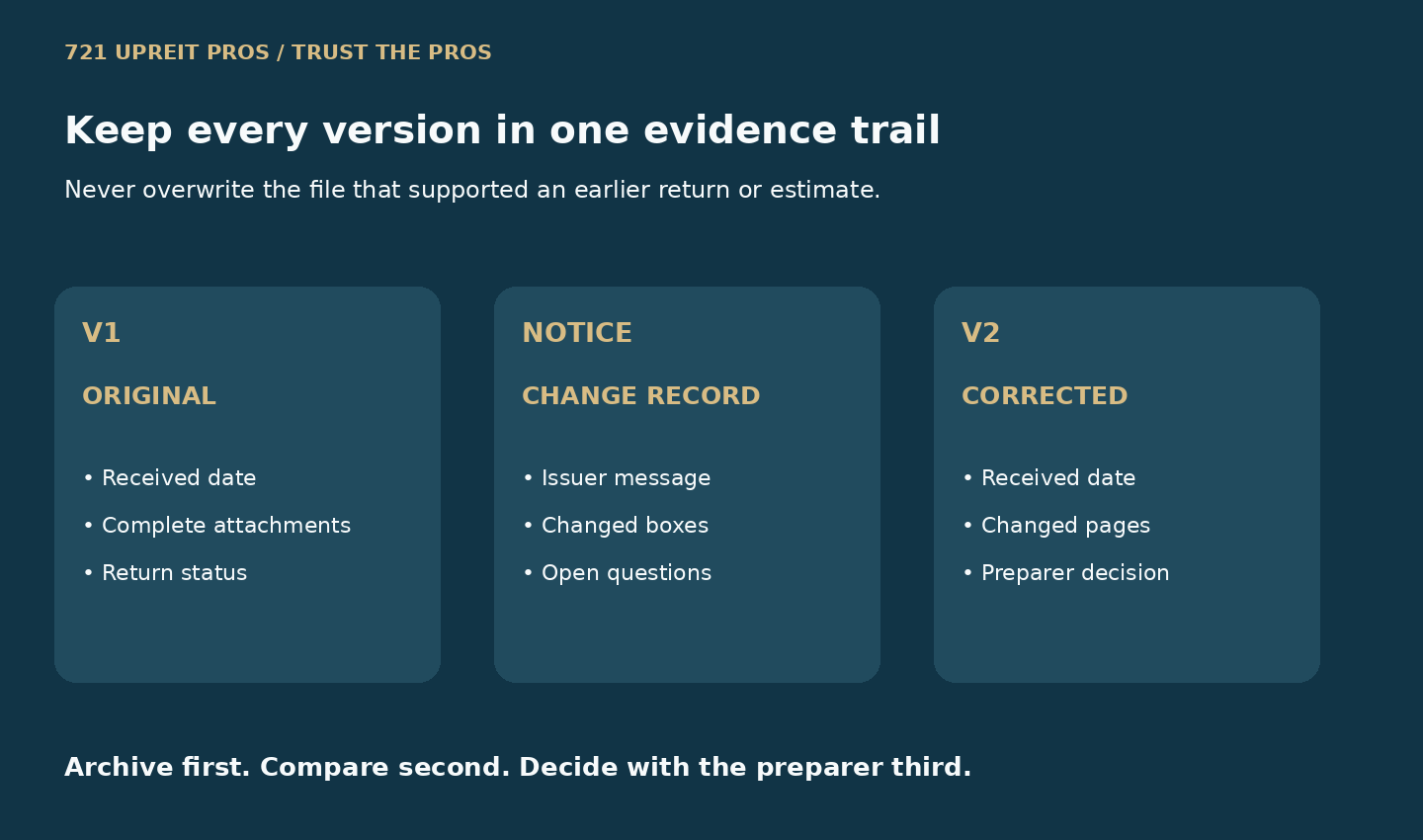
Create a tax-year folder for the legal partnership name. Inside it, keep the issuer's original filename and add a neutral status prefix or index file. A useful pattern is 2025_ExampleOPLP_K1_V1_original_received-2026-03-12.pdf and 2025_ExampleOPLP_K1_V2_amended_received-2026-09-28.pdf. Do not replace the first file with the second.
| Field | Record | Why it matters |
|---|---|---|
| Entity identity | Legal name and last four EIN digits exactly as shown | Similar sponsor names can refer to different reporting entities. |
| Tax year and partner period | Dates printed on the K-1 and attached statements | A replacement can change a period, admission date or allocation. |
| Version label | Original, amended, corrected, superseded or issuer's exact description | Do not translate an issuer label into a tax conclusion. |
| Received evidence | Portal timestamp, secure-message date or delivery record | The date received can be relevant to the preparer's timeline and workpapers. |
| Package contents | K-1, every statement, state schedule, K-3 notice, basis or liability detail and cover notice | A changed attachment can matter even when the first page looks unchanged. |
| Prior use | Estimate, extension workpaper, unfiled draft, original filed return or later filing | The next step depends on what was already prepared or filed. |
If the package includes several jurisdictions, connect the version trail to the OP-unit multistate K-1 preparer handoff. If it is the first K-1 after a DST contribution, also preserve the DST-to-OP-unit transition-year cutover file. These pages solve different problems: jurisdiction records, entity-period cutover and version control.
Compare the complete packages, not only box 1
Make a difference log with one row per changed item. Copy the source label, original value, replacement value and attachment name. Do not decide that a difference is immaterial because the federal total appears unchanged. A state allocation, liability line, footnote, activity code, credit statement or partner-information field can affect another part of the preparer's work.
| Review area | What to compare | Question to record |
|---|---|---|
| Partner and entity data | Name, address, taxpayer ID suffix, entity type and partner type | Does a mismatch reflect an account error or a real ownership change? |
| Dates and percentages | Beginning and ending ownership percentages, partner admission or disposition information and tax period | Did the issuer change the allocation window or only correct an identifier? |
| Income and deductions | Every numbered box, code and supporting statement | Which return lines or limitation workpapers used the original amount? |
| Capital and liabilities | Capital-account entries, partner share of liabilities and related explanations | Does the change affect a partner-level outside-basis schedule? |
| States and payments | State-source schedules, composite-return notices, withholding and estimated-payment evidence | Did a state amount change even if the federal K-1 did not? |
| International information | K-2/K-3 notice, request process and later-supplied schedules | Is the document late because information was supplied separately? |
Do not treat Schedule K-1's capital account as a complete outside-basis calculation. The IRS instructions describe partner-level limitations and responsibilities that can require information beyond the K-1. If liabilities changed, keep the comparison beside the OP-unit debt-change and outside-basis organizer.
Match the evidence to the return's current status
The decision log should state what has happened, not what someone assumes happened. Confirm the status with the preparer and retain a copy of any filed return, extension acknowledgment, payment confirmation or later filing that the preparer identifies as relevant.
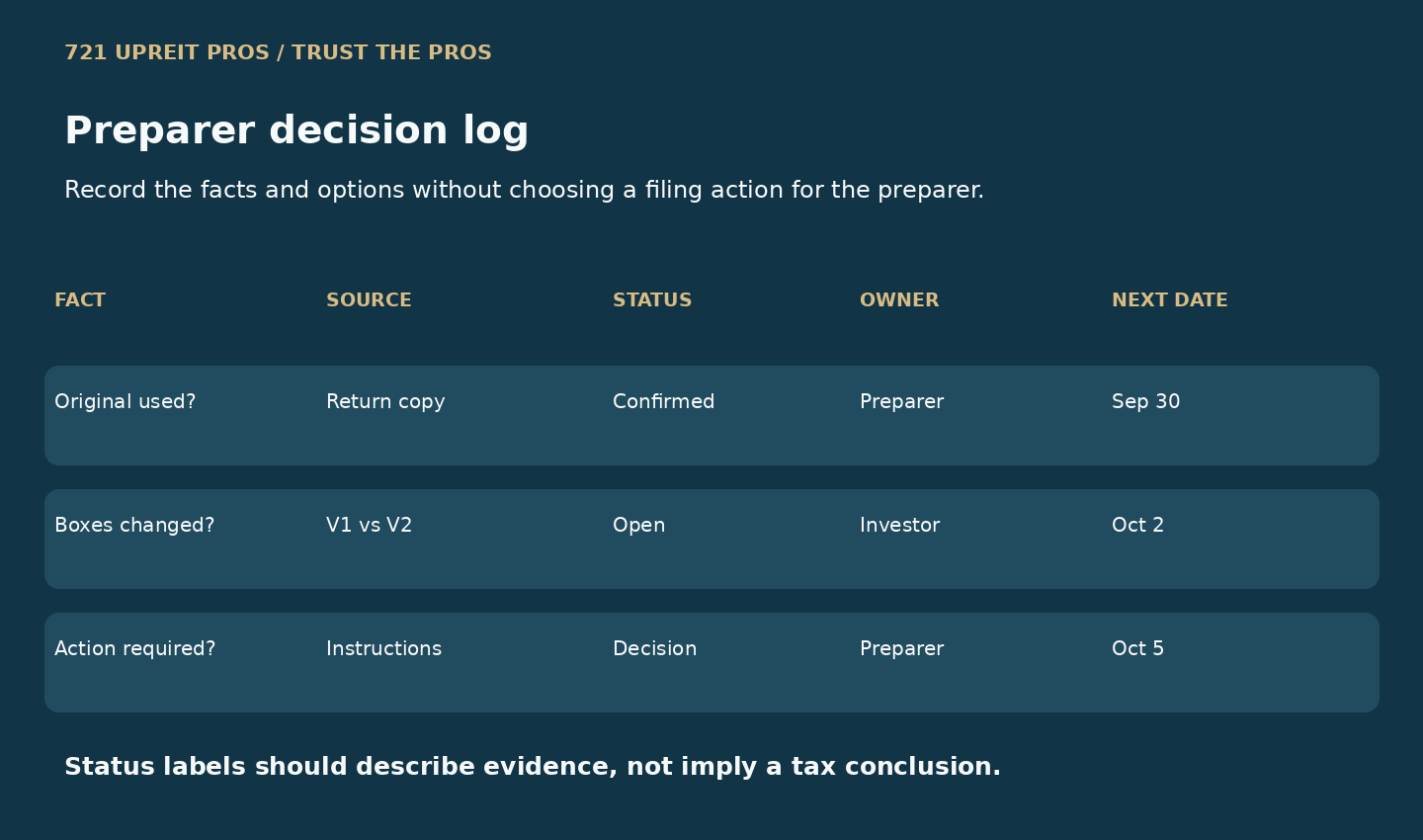
| Observed status | Records to hand over | Decision for the preparer |
|---|---|---|
| K-1 expected, return not filed | Issuer timing notice, prior estimates, payment records and all received statements | How should the preparer proceed under the current filing and payment rules? |
| Extension filed, return not filed | Extension acknowledgment, extension workpapers, payments and replacement package | Does the new information change the draft return, estimate or remaining work? |
| Original return filed | Exact filed return, e-file acceptance, original K-1 package and replacement package | What current procedure applies to the actual changes and taxpayer facts? |
| Prior later filing already made | Every filed version and acceptance record in chronological order | Which filing is operative and what, if anything, remains open? |
| No K-1 by the applicable due date or inconsistent treatment | Missing-form correspondence, estimates, partnership return information if known and the planned treatment | Do the current Form 8082 rules or another disclosure procedure apply? |
| BBA adjustment or AAR notice | Full partnership notice, reviewed year, adjustment year, statements and deadlines | Is this an administrative-adjustment process rather than an ordinary amended K-1? |
The Instructions for Form 8082 say the form can notify the IRS when a partner's treatment differs from the partnership's treatment, and also address situations where a partner did not receive a Schedule K-1 by the return due date including extensions. That does not mean every late K-1 automatically requires Form 8082. The instructions, the partnership's BBA status and the investor's actual filing facts must be reviewed.
A BBA partnership's administrative adjustment request can have procedures that differ from an ordinary amended return. The IRS maintains separate guidance on administrative adjustment requests for BBA partnerships. Preserve the exact notice and let the preparer identify which process applies.
Download the K-1 version and decision log
Worked example: a corrected K-1 after the return was filed
This example is invented and does not select a filing procedure. Assume an OP-unit holder receives a 2025 Schedule K-1 package on March 12, 2026. The preparer uses the package to file the investor's return on April 8. On September 28, the partnership portal posts an amended K-1 and a cover notice. Box 2 changes from $18,400 of net rental real estate income to $21,100. An attached state schedule changes one state's amount from $6,000 to $7,250. The liability statement also changes.
The investor should not delete the March package or edit its PDF. The investor archives both complete packages, saves the September notice, preserves the exact filed return and records three separate changes: federal income, state allocation and liability information. The investor then sends the file through the preparer's secure portal.
| Record | Original | Replacement | Status | Preparer question |
|---|---|---|---|---|
| Box 2 | $18,400 | $21,100 | Changed | Which filed-return and limitation workpapers used the earlier amount? |
| State schedule | $6,000 | $7,250 | Changed | Does the change affect a state filing, credit, withholding or payment? |
| Liability statement | Version 1 amount | Version 2 amount | Changed | Does the outside-basis schedule require revision? |
| Federal return | Filed April 8 | No decision recorded | Preserved | What current procedure applies after reviewing all changes? |
The $2,700 box difference is not itself the tax due. The investor's return, limitations, other income, state rules, payments and preparer's analysis affect the result. The checklist keeps those facts visible without turning an arithmetic difference into an unsupported conclusion.
Common mistakes when a K-1 changes
- Overwriting the first package: this destroys the record of what supported an estimate or filing.
- Comparing only page one: attached statements and state schedules may contain the meaningful change.
- Editing the investor's copy: the IRS instructions say to request a correction from the partnership rather than changing items on the copy.
- Assuming a correction always means an amended return: return status, partnership procedure, current instructions and the actual difference matter.
- Assuming no cash means no tax effect: partnership income and cash distributions are different records. Use the separate K-1 cash-tax reserve worksheet for that funding question.
- Emailing sensitive forms casually: tax packages can contain identifying data. Use the preparer's approved secure method.
Questions to ask the partnership and preparer
Ask the partnership or administrator
- Is this the complete replacement package, including every attachment and state schedule?
- Which boxes, codes, statements or periods changed, and why?
- Is the partnership calling the package amended, corrected, superseded or part of another procedure?
- Was the replacement supplied to the IRS, and what form label identifies it?
- Should another K-1, K-3, state schedule or notice still be expected?
Ask the tax preparer
- What return or estimate status should be recorded before evaluating the new package?
- Which federal, state, basis, passive-loss, credit or payment workpapers used the original values?
- Do the current instructions require a filing, disclosure, payment or documentation step?
- Is this an ordinary amended K-1, a missing-form issue, an inconsistent-treatment issue or a BBA adjustment process?
- What deadline, responsible person and confirmation should close each open item?
Prepare a better 721 UPREIT planning conversation
For investment-side questions about a contemplated or completed property transition, Talk to a 721 UPREIT advisor. For background on the difference between DST supplemental packages and partnership reporting, see DST Experts' K-1 and DST tax-package guide and its tax-preparer document checklist. Those pages do not determine what to do with a particular corrected OP-unit K-1.
Watch: organize a late or corrected K-1
A one-minute silent explainer with English captions. The complete transcript is available below.
Read video transcript
0:00 · Archive before comparing
Save the original K-1 package and every attachment. Record when and how each version arrived.
0:12 · Confirm what changed
Compare boxes, codes, statements and state schedules. Do not rely only on an email summary.
0:24 · Match the return status
Was the return not filed, filed, extended or already changed? Preserve the exact filed copy.
0:36 · Log the preparer decision
Record the option considered, source used and responsible person. Do not choose a filing action from a checklist alone.
0:48 · Close the evidence trail
Keep both versions, the comparison and the final instruction. Use a secure delivery method for tax documents.
Sources and scope
Primary references checked September 28, 2026: 2025 Partner's Instructions for Schedule K-1 (Form 1065), 2025 Instructions for Form 1065, Instructions for Form 8082, revised October 2025, Publication 541, Partnerships, and IRS guidance for BBA partnership administrative adjustment requests. Use instructions for the actual tax year and the exact partnership notice.
General education by 721 UPREIT Pros with AI assistance. No independent professional review is represented. The example is hypothetical and does not determine a filing procedure, tax due, Section 721 treatment, basis, allocations, investment suitability, liquidity or returns.
BEFORE YOUR ADVISOR CONVERSATION
Three questions before you commit
This companion briefing covers the professional's identity, compensation and how restrictions fit your cash needs. Use it alongside this article's specific document checks.
Loading the video connects to YouTube. Watch on YouTube · 721 UPREIT Pros channel · Read the full advisor checklist.
Read video transcript
Before you hire a seven twenty-one UPREIT advisor, ask these three questions.
First: who exactly am I hiring? Get the professional's legal name, firm and registration information. Check the record through Investor dot gov and read the firm's relationship summary where applicable. Ask whether this conversation involves brokerage services, investment advice, or both. A marketing title alone does not answer that question.
Second: who gets paid, and how much? Request a written cost breakdown in dollars. Identify the payer, calculation base, payment timing and ongoing charges. Include product expenses and embedded compensation. No separate advisor invoice does not mean there are no costs.
Third: how does this fit my cash needs? Review the actual agreements. Ask who controls a possible conversion and what happens if it does not occur. Separate permission to request redemption from approval, pricing and payment. Do not assume a fixed cash-out date.
Then agree on responsibilities. Your investment professional, CPA, attorney and qualified intermediary can have different roles. Put continuing service and unresolved questions in writing.
Read the complete advisor checklist using the article link in the description. Seven twenty-one UPREIT Pros. Trust the Pros. Educational only. Investments involve risk and may be illiquid. Tax treatment depends on your circumstances.
Educational only. Investments involve risk and may be illiquid. Footage is illustrative; narration is synthetic.
TALK TO A 721 UPREIT ADVISOR
Ready to discuss your 721 options?
Request a callback to discuss the questions raised by this article, your timing and what to ask before you commit. Share your name, email and phone below to start the conversation.
No investment commitment or financial documents required. A callback request does not book an appointment or establish an advisory relationship.