
721 UPREIT PROS / OWNERSHIP CHANGE
What happens to OP units in a divorce?
A divorce settlement can allocate an interest between spouses, but you should not assume that it completes the operating partnership's transfer process, admits a new partner or makes the units liquid. Keep the settlement, issuer recognition, payment instructions and tax-record handoff on separate tracks.
Prepared by 721 UPREIT Pros · Published October 14, 2026 · General education

This guide is for an investor who already owns operating partnership units and needs to organize a proposed divorce-related division. It does not decide whether an interest is marital or separate property, interpret a court order, value the interest or approve a transfer. Those questions require the actual documents and qualified professionals.
Start with the 721 UPREIT ownership guide if you need to distinguish OP units from REIT shares and DST interests. A settlement involving an existing partnership interest is a different event from the original property contribution. Do not assume that a reference to Section 721 answers the later divorce-transfer tax question.
TALK TO A 721 UPREIT ADVISOR
Talk to a 721 UPREIT advisor
Request a callback to discuss the questions raised by this article, your timing and what to ask before you commit. Share your name, email and phone below to start the conversation.
No investment commitment or financial documents required. A callback request does not book an appointment or establish an advisory relationship.
Can OP units be transferred to a former spouse?
A transfer may be possible, but the answer depends on the actual ownership, court and settlement documents, governing partnership agreement, applicable law and issuer requirements. Obtain the issuer's current written process before treating a proposed division as completed. Ask separately whether the recipient will be recognized as an assignee, admitted as a substitute limited partner, or placed in another status defined by the agreement.
There are at least four questions to resolve: what the settlement requires, what the partnership recognizes, how distributions and notices will be administered, and what tax records follow the interest. A completed step in one track does not prove completion in the others. A court-directed allocation should be reviewed with counsel alongside the issuer's requirements; this article does not decide their legal interaction.
Ask this before signing a transfer packet
“What exact interest moves, to whom, on which effective date, under which approval or exception, and what written evidence will confirm the recipient's rights?” Save the answer and the document version it relies on.
Keep four tracks in the same handoff file
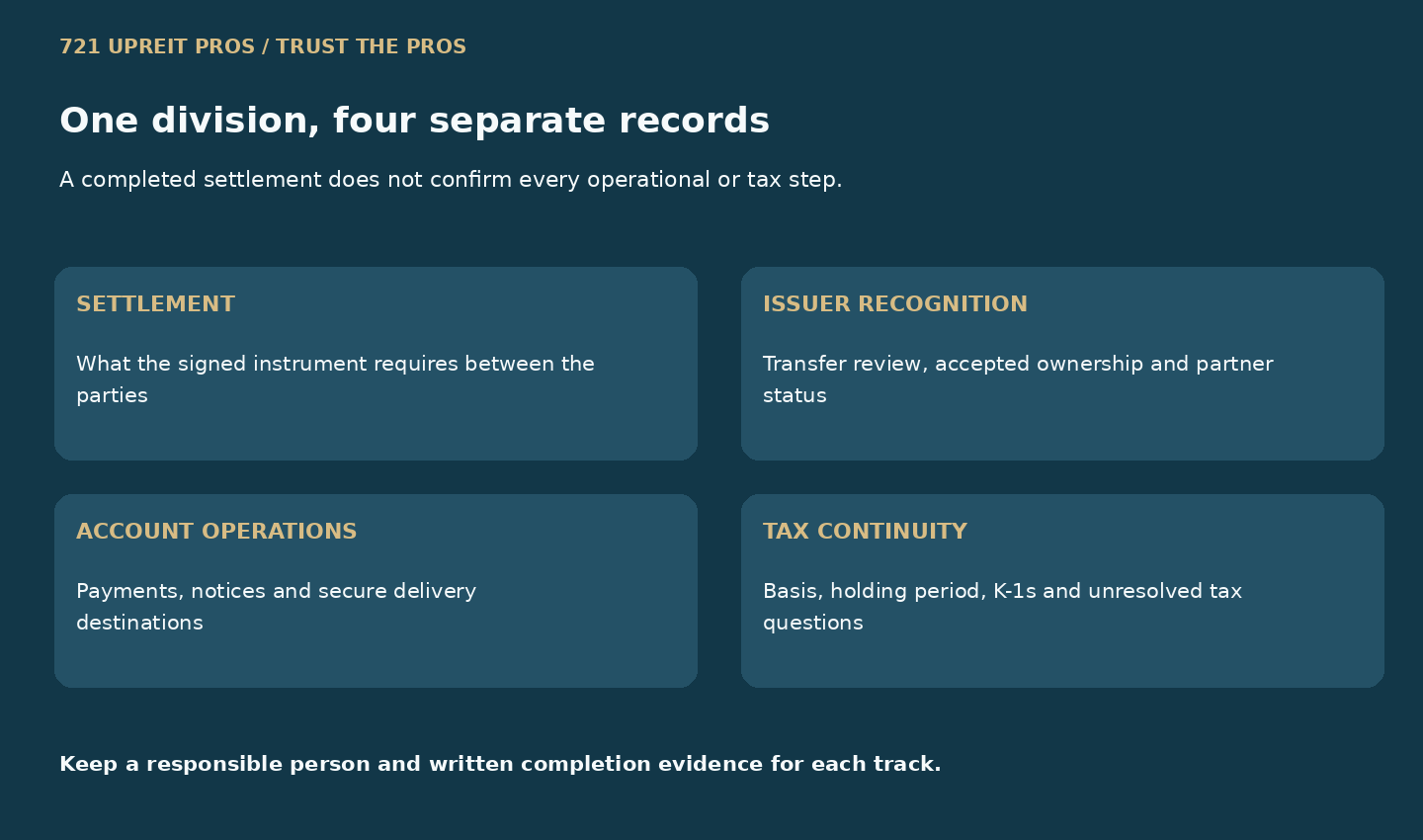
| Track | Evidence to collect | Question owner | Completion evidence |
|---|---|---|---|
| Settlement allocation | Signed agreement, relevant order, amendments and precise interest description | Each party's family-law counsel | Document-specific advice on obligations, effective dates and unresolved conditions |
| Issuer recognition | Current partnership agreement, transfer policy, consent and admission package | Issuer or transfer agent, with counsel | Written accepted status and updated ownership record |
| Account operations | Distribution, communication and tax-delivery instructions | Issuer operations and authorized account holders | Confirmed destination, cutover date and notice access |
| Tax continuity | Basis and holding-period records, K-1 packages, liabilities and loss schedules | Qualified tax professionals and partnership tax team | Documented reporting approach, missing-item list and secure record receipt |
Identify the registered holder before deciding what paperwork to request. If an LLC or trust owns the OP units, a change in that entity's ownership or beneficial interests is not necessarily a direct transfer of the registered OP-unit account. Give counsel both levels of governing documents. Do not substitute an individual's name for an entity on a form without confirming the intended legal transaction.
Which partnership provisions and forms should you request?
Ask for the current agreement and amendments, the precise unit class, any account-specific restrictions or side agreements, and the issuer's current transfer and substitution instructions. The file should answer:
- Does the requested action involve units, economic rights, ownership of an entity holding units, or some combination?
- Is consent required, or is a documented exception available for this exact recipient and transaction? Do not infer that a family-transfer exception includes every spouse or former spouse.
- What notices, identity records, signatures, certifications, opinions or other documents are required, and who bears processing costs?
- Does assignment alone confer the rights sought, or is separate partner admission required?
- Which date governs the issuer's account record, distribution processing and reporting, and what confirms it?
- Are any pending redemption requests, lockups, pledges or tax-protection provisions affected?
A dated example shows why these questions are separate. Article 9 of the Brookfield REIT Operating Partnership agreement dated September 25, 2024 addresses transfer restrictions, exceptions, requested documents, substitute-partner admission and notice of assignment in distinct provisions. Section 9.3 conditions substitute-partner admission on consent and specified steps. Section 9.4 addresses recognition after notice. This is one historical agreement, not evidence of current offering availability or a universal rule. Obtain the agreement actually governing your interest, including later amendments.
For the broader investment risks, use the 721 UPREIT risk and due-diligence page. If a settlement contemplates cash, review the separate redemption request and payment checklist. A proposed property division does not itself create a guaranteed buyer, cash payment or redemption date.
Does a divorce transfer reset OP-unit tax basis?
Do not replace tax basis with the settlement's stated value. Under the general spousal-transfer rules described in IRS Publication 504, a qualifying transfer between spouses or to a former spouse incident to divorce generally does not recognize gain or loss, and the recipient generally takes the transferor's adjusted basis. Exceptions and special situations matter, including nonresident-alien recipients and certain trust transfers. Your tax professional must establish which rule applies to the actual transaction.
Publication 504 explains that a transfer is incident to divorce if it occurs within one year after the marriage ends or is related to the end of the marriage. It also describes the divorce-instrument and six-year framework for related transfers, with a rebuttable presumption outside that framework. Preserve the agreement, date of divorce, transfer documents and evidence of delays. These are tax-review inputs, not a new issuer deadline or automatic permission to transfer.
The IRS also requires sufficient records to establish adjusted basis and holding period when property is transferred under these rules. For an OP-unit interest, ask the tax professional to assemble the partner-level outside-basis history, acquisition and contribution records, prior K-1s, distributions, allocated liabilities and relevant adjustment schedules. IRS Publication 541 explains that partnership outside basis is determined independently of the amount shown as capital or equity in the partnership books. A K-1 capital-account figure alone is not the complete handoff.
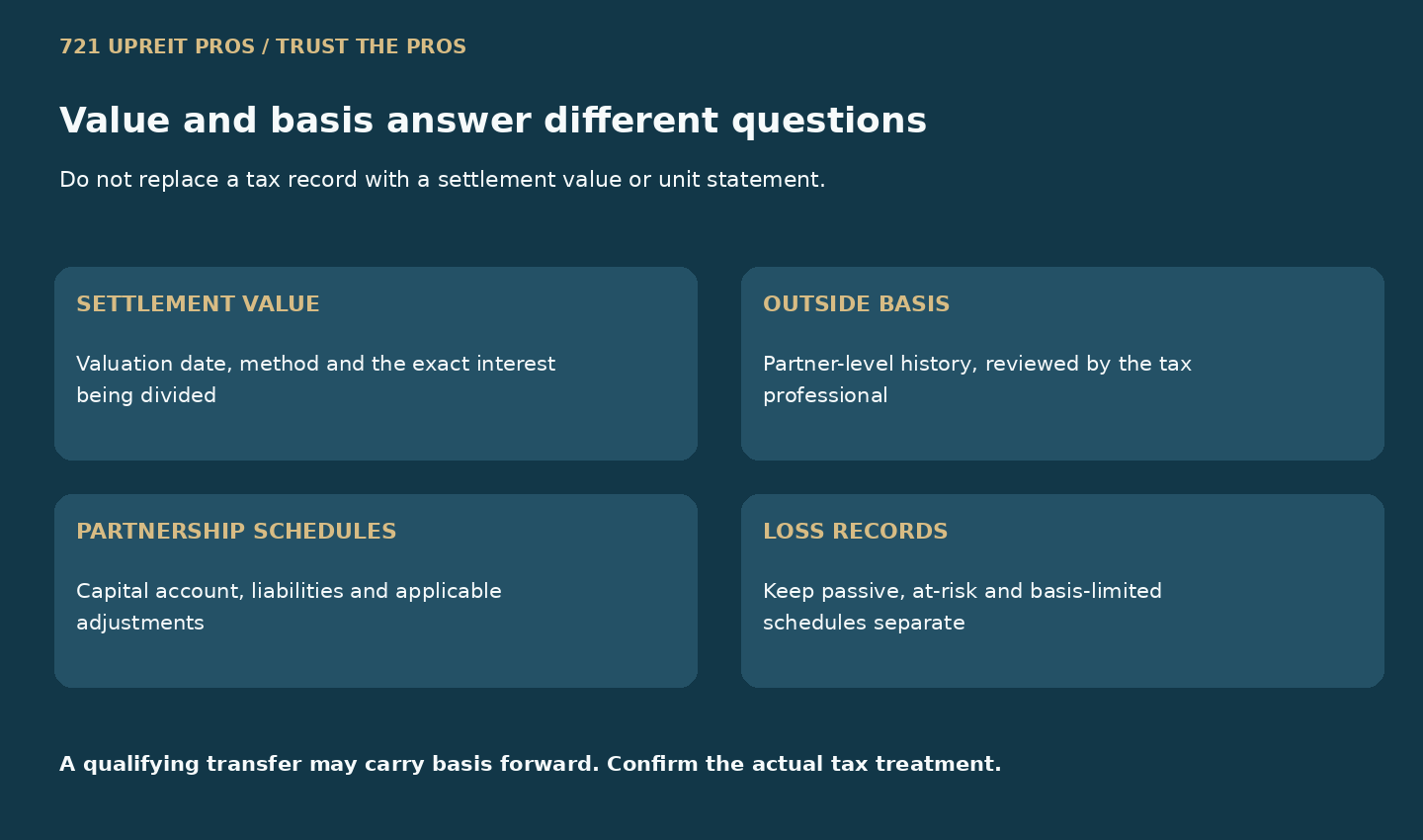
Also preserve suspended passive-loss, at-risk and basis-limited loss schedules separately. Do not assume every unused loss becomes immediately deductible or follows the interest in the same way. Publication 504's passive-activity example describes a basis adjustment rather than a current deduction for accumulated unused passive losses associated with the transferred interest. Have the preparer identify the applicable category and treatment before completing the recipient's opening records.
If units are sold or redeemed to fund a cash settlement, give the tax team that transaction separately. The treatment of a qualifying spouse-to-spouse transfer does not establish the treatment of a sale to a third party or a partnership redemption. The outside-basis reconciliation guide helps organize inputs; it does not calculate a divorce transaction.
Reconcile the dates before changing distributions or K-1 delivery
Use one dated register, with a separate row for each event. Record the date stated in the settlement, signature dates, requested transfer date, issuer receipt, acceptance or missing-item notice, admission date if applicable, distribution cutover and tax team's reporting conclusion. Keep the source for each date. Ask the professionals to resolve differences rather than silently replacing one date with another.
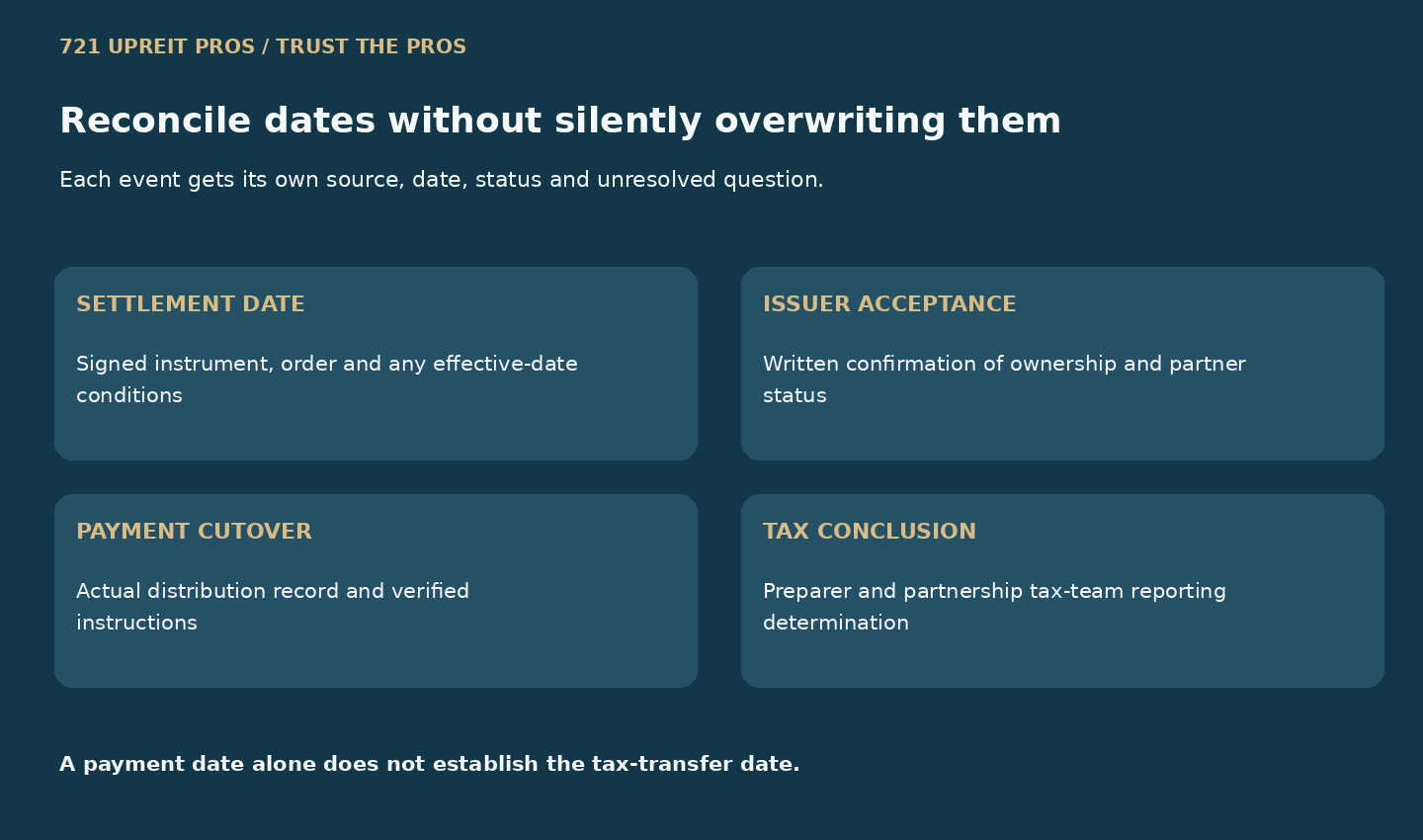
Ask the partnership tax team who will receive each K-1 and supplemental package, how the transfer will be reflected, and what information or forms they need. Do not divide annual income by the number of months or redirect a bank payment and assume the tax reporting follows. Preserve any interim payment instructions and the actual payment history for reconciliation with counsel and the preparers.
Use verified issuer channels for address, portal and bank changes. Share sensitive tax and court records only through the approved secure process. Our general inquiry form is for contact details and planning questions, not full tax returns, Social Security numbers, bank instructions or confidential divorce records.
Fictional example: the agreement and issuer record show different dates
Assume a fictional settlement signed June 15 assigns 40% of an owner's 10,000 identical OP units to a former spouse. The proposed transfer packet therefore identifies 4,000 units. The issuer acknowledges the packet June 28 but asks for an additional document. Written acceptance arrives July 12. A June distribution has already reached the original account.
| Observed fact | Open question | Next evidence |
|---|---|---|
| 4,000 proposed units | Does the settlement require a unit transfer, an economic allocation or another arrangement? | Counsel's confirmed implementation instructions and exact class/account description |
| June 15 settlement date | What effective date and conditions apply between the parties? | Complete executed agreement and relevant order |
| July 12 issuer acceptance | What ownership and partner status did the issuer recognize, and from when? | Written acceptance, admission record if applicable and updated unit statement |
| June cash went to the original account | How should the payment and related reporting be handled? | Payment record, settlement terms and tax-team conclusion |
The 4,000-unit arithmetic is not a valuation, approval or tax allocation. No settlement value is used as a substitute for basis. The record keeper leaves the legal, operational and tax questions open until the responsible professional provides an answer, then retains the dated answer with the supporting document.
Build an eight-part handoff packet
- Interest identity: exact partnership, registered holder, unit class, count and any ownership through an entity or trust.
- Settlement evidence: complete signed instrument, relevant order and amendments, stored securely with counsel's implementation notes.
- Governing documents: current agreement, transfer restrictions, relevant side agreements and issuer instructions.
- Transfer status: submitted records, outstanding items, approvals, rejection or acceptance and any substitute-partner admission.
- Date register: source-backed dates and an assigned owner for every unresolved difference.
- Payment and communication: securely verified distribution destinations, notice access and tax-package delivery.
- Tax continuity: basis and holding period, full K-1 history, liabilities, loss schedules and preparer-specific requests.
- Closing reconciliation: updated statements, remaining unit counts, retained copies and confirmation that both professionals received the necessary records.
For investment-side document questions, request a conversation with a 721 UPREIT advisor. Family-law classification, order interpretation and transfer validity belong with qualified counsel. Tax treatment belongs with qualified tax professionals, and account recognition must be confirmed with the actual issuer. For adjacent structure education, the DST 1031 Experts guide to the DST and OP-unit stages provides broader context.
Watch the one-minute briefing and use the worksheet
This original silent visual briefing summarizes the four tracks, separate tax records and date register. English captions and the complete transcript are provided.
Read video transcript
0:00 · OP units in a divorce: start with four tracks
Separate the settlement from issuer recognition. Keep operations and tax records connected.
0:12 · Confirm what the issuer recognizes
Ask about assignment and partner admission. Save written status for the exact interest.
0:24 · Settlement value is not tax basis
Preserve basis and holding-period records. Ask the tax professional which rules apply.
0:36 · Keep a source-backed date register
Settlement, acceptance and payment dates may differ. Resolve reporting with the tax team.
0:48 · Close the file with evidence
Reconcile units, payments and secure record delivery. Do not assume approval, liquidity or a tax result.
Download the divorce-related OP-unit handoff worksheet. Keep completed records private and share them through your professionals' secure channels.
Primary sources and review limits
Sources checked October 14, 2026. This educational workflow has not received a named attorney, CPA, advisor or issuer review. State law, facts and current governing documents matter.
- IRS Publication 504 (2025), Divorced or Separated Individuals, Property Settlements and Table 5: qualifying spousal transfers, exceptions, dates, basis and holding-period record delivery.
- IRS Publication 541, revised December 2025: partnership interests, outside basis, capital accounts, liabilities and dispositions.
- IRS, Filing taxes after divorce or separation: general property-transfer and filing context.
- Brookfield REIT Operating Partnership agreement dated September 25, 2024, Article 9: a dated example of separate transfer, admission and recognition provisions, subject to later amendments.
OP units can lose value and may be illiquid. A divorce-related plan does not guarantee transfer approval, partner admission, redemption, cash availability or a tax result. Educational only, not tax, legal or investment advice.
BEFORE YOUR ADVISOR CONVERSATION
Three questions before you commit
This companion briefing covers the professional's identity, compensation and how restrictions fit your cash needs. Use it alongside this article's specific document checks.
Loading the video connects to YouTube. Watch on YouTube · 721 UPREIT Pros channel · Read the full advisor checklist.
Read video transcript
Before you hire a seven twenty-one UPREIT advisor, ask these three questions.
First: who exactly am I hiring? Get the professional's legal name, firm and registration information. Check the record through Investor dot gov and read the firm's relationship summary where applicable. Ask whether this conversation involves brokerage services, investment advice, or both. A marketing title alone does not answer that question.
Second: who gets paid, and how much? Request a written cost breakdown in dollars. Identify the payer, calculation base, payment timing and ongoing charges. Include product expenses and embedded compensation. No separate advisor invoice does not mean there are no costs.
Third: how does this fit my cash needs? Review the actual agreements. Ask who controls a possible conversion and what happens if it does not occur. Separate permission to request redemption from approval, pricing and payment. Do not assume a fixed cash-out date.
Then agree on responsibilities. Your investment professional, CPA, attorney and qualified intermediary can have different roles. Put continuing service and unresolved questions in writing.
Read the complete advisor checklist using the article link in the description. Seven twenty-one UPREIT Pros. Trust the Pros. Educational only. Investments involve risk and may be illiquid. Tax treatment depends on your circumstances.
Educational only. Investments involve risk and may be illiquid. Footage is illustrative; narration is synthetic.
TALK TO A 721 UPREIT ADVISOR
Ready to discuss your 721 options?
Request a callback to discuss the questions raised by this article, your timing and what to ask before you commit. Share your name, email and phone below to start the conversation.
No investment commitment or financial documents required. A callback request does not book an appointment or establish an advisory relationship.