
721 UPREIT PROS / POST-DEATH BASIS RECORDS
What happens to OP-unit basis when an owner dies?
An inherited OP-unit partnership interest can receive a new outside-basis determination under the rules for property acquired from a decedent, but that does not automatically reset the partnership's basis in its real estate. Preserve the date-of-death valuation, final and successor K-1 records, possible income in respect of a decedent, Section 754 election status and any transferee-specific Section 743(b) adjustment.
Prepared by 721 UPREIT Pros · Published October 12, 2026 · General education

This guide owns one narrow post-death question: which tax and partnership records are needed to establish the recipient's interest-level basis and determine whether a partnership adjustment applies? It does not decide who may act for an estate, whether an issuer recognizes a transfer, who becomes a substituted partner, or whether OP units can be redeemed.
Use the separate OP-unit estate access checklist for authority, issuer recognition and account access after death. For a living owner who may no longer be able to manage the interest, use the OP-unit incapacity continuity plan. Use the capital-account and outside-basis reconciliation for the annual rollforward. This page connects those files to the death-date tax record handoff without treating every number as a universal step-up.
TALK TO A 721 UPREIT ADVISOR
Talk to a 721 UPREIT advisor
Request a callback to discuss the questions raised by this article, your timing and what to ask before you commit. Share your name, email and phone below to start the conversation.
No investment commitment or financial documents required. A callback request does not book an appointment or establish an advisory relationship.
Do inherited OP units always receive a basis step-up?
No. Start with the actual partnership interest that passed from the decedent, the applicable valuation rule and any statutory exceptions. Then keep that outside-basis conclusion separate from the partnership's basis in its assets and from any transferee-specific Section 743(b) adjustment.
Internal Revenue Code Section 1014 generally starts the basis of property acquired from a decedent at fair market value on the date of death, subject to alternate valuation, special-use valuation, consistent-basis rules and other exceptions. Section 1014(c) excludes a right to receive income in respect of a decedent. The interest's ownership history and the estate's actual reporting therefore matter.
IRS Publication 559 for 2025 returns explains that inherited-property basis is usually tied to date-of-death fair market value, but it also describes exceptions and consistent-basis reporting. A portal value, distribution statement or capital-account number is not automatically the required fair market value or tax basis.
Replace “step-up” with five questions
What interest passed? Which valuation date and rule apply? Is any item income in respect of a decedent? What is the recipient's outside basis? Does a valid Section 754 election or mandatory Section 743 rule produce a transferee-specific partnership adjustment?
Which three basis layers must stay separate?
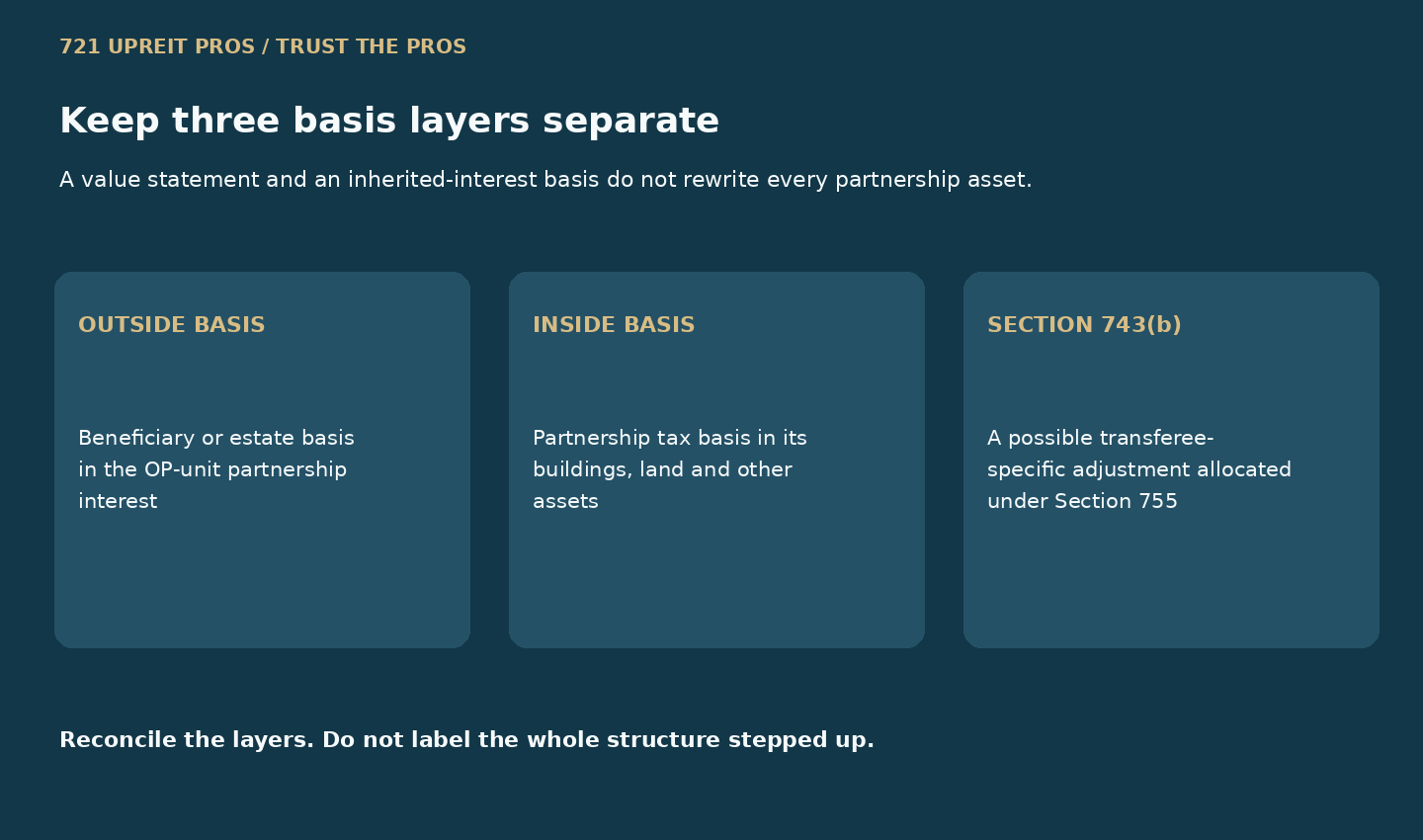
| Layer | What it measures | Records to preserve |
|---|---|---|
| Recipient's outside basis | The estate's or beneficiary's adjusted tax basis in the OP-unit partnership interest | Ownership documents, valuation support, estate reporting, acquisition date, liabilities and the professional basis workpaper |
| Partnership inside basis | The partnership's adjusted basis in land, buildings and other assets | Partnership tax-basis balance sheet, property schedules, liabilities and contributed-property layers |
| Section 743(b) adjustment | A potential increase or decrease to partnership property basis with respect to the transferee partner only | Section 754 election status, transferee basis, transferee share of partnership basis, Section 743(b) computation, Section 755 allocation and annual adjustment schedules |
IRS Publication 541, revised December 2025, says a partner's adjusted basis is not the same as a capital or equity account. It also says a partnership's asset basis is generally not affected by a transfer of a partnership interest, including a transfer caused by a partner's death, unless an adjustment rule applies.
What belongs in the post-death record chain?
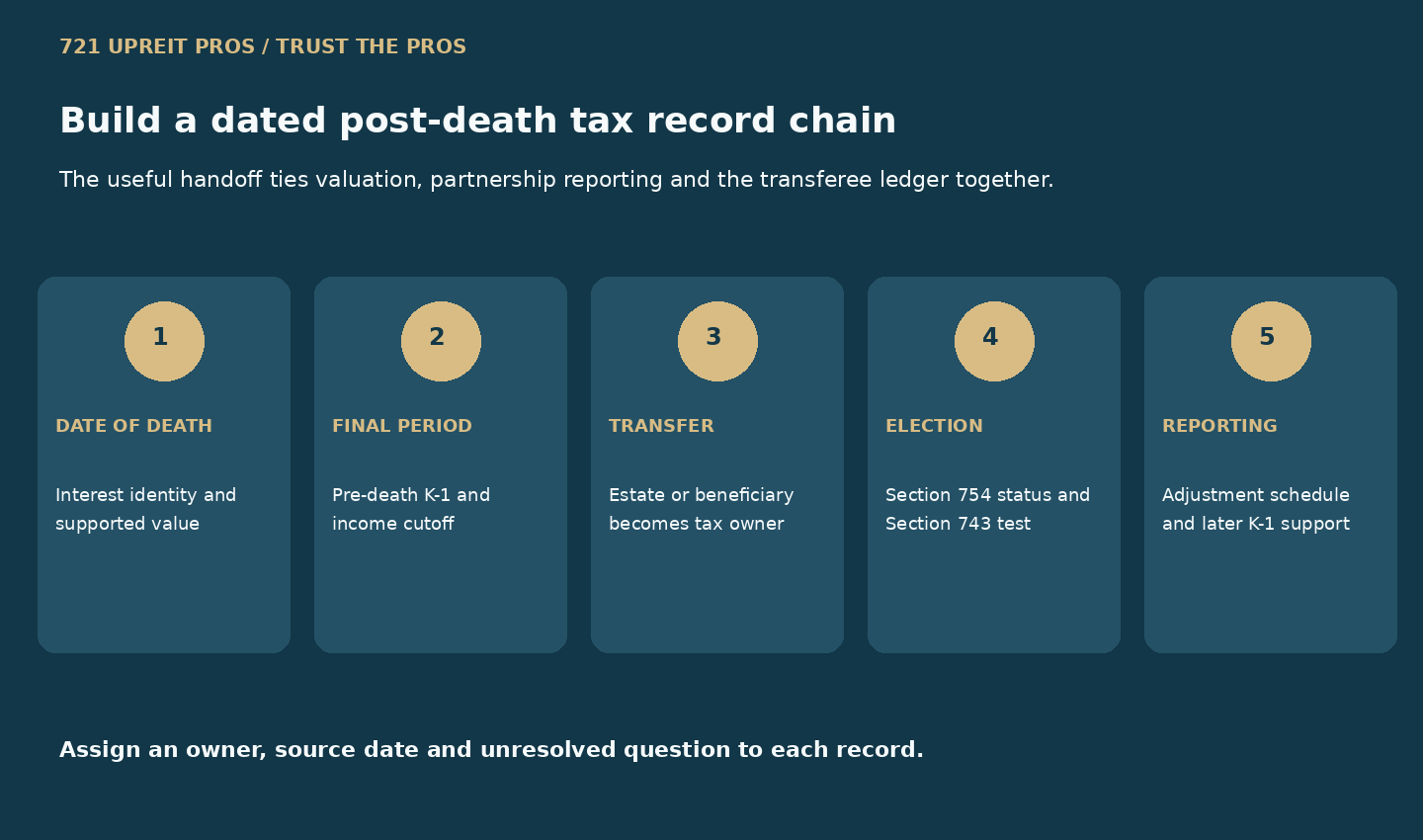
- Identify the interest at the date of death. Confirm the legal partnership name, class and number of OP units, registration, restrictions, liability allocation and governing agreement in effect.
- Preserve the valuation file. Keep the appraisal or other support, valuation date, estate-tax schedules when applicable, discounts or restrictions considered, and the final value reported to the beneficiary when a consistent-basis statement applies.
- Close the decedent's tax period. Preserve the final pre-death Schedule K-1, prior outside-basis rollforward, liability workpaper, unresolved distributions and the partnership's method for allocating items across the transfer date.
- Document the successor tax owner. Record whether the estate, trust or beneficiary holds the interest during each period. Match taxpayer identification numbers, K-1 recipients and transfer dates to the issuer's records.
- Obtain the adjustment file. Ask the partnership tax team whether a Section 754 election was in effect or made for the transfer year, whether a mandatory Section 743 adjustment rule was tested, and how any adjustment was computed, allocated and reported.
The estate-access file and the tax-ownership file can move at different speeds. A beneficiary can be named in estate documents while the estate still receives a partnership K-1, or an administrator can recognize a transfer before the tax team finishes a Section 743(b) schedule. Reconcile the dates rather than assuming one event completed every step.
Why must income in respect of a decedent be flagged separately?
Section 1014 does not apply to a right to receive income in respect of a decedent under Section 691. Publication 559 describes this category as income the decedent would have received had death not occurred but that was not properly included on the final return. It gives partnership examples, including remaining liquidation payments that can be income in respect of a decedent when received by the estate or successor.
Do not mark every post-death partnership payment as income in respect of a decedent. Instead, create an issue list for the estate's CPA:
- Partnership items allocated to the decedent's final tax period.
- Guaranteed payments, accrued rights, receivables or liquidation payments that may cross the death date.
- Cash distributions that may be balance-sheet movements rather than income.
- Amounts earned after death by the estate or successor.
- Any income-in-respect-of-a-decedent deduction or estate-tax interaction the preparer must evaluate.
A payment date alone does not establish its tax character. Match the partnership agreement, closing-of-the-books or proration method, K-1 periods and supporting statements.
When can Section 743(b) create a partnership-basis adjustment?
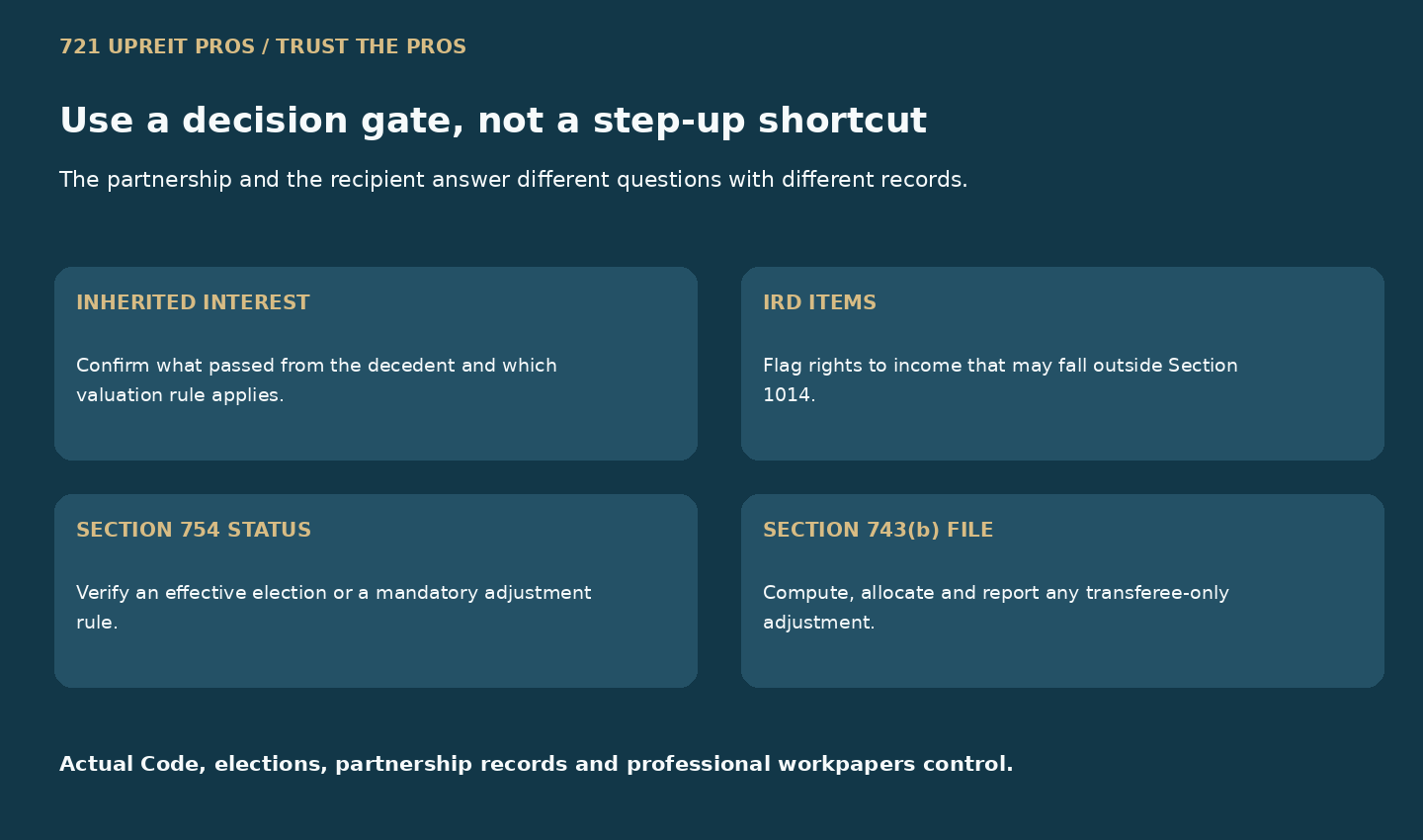
Section 743 says partnership property basis generally is not adjusted after a sale, exchange or partner death unless a Section 754 election is in effect or the partnership has a substantial built-in loss immediately after the transfer. When the rule applies, the adjustment is the difference between the transferee's basis in the partnership interest and the transferee's share of the partnership's adjusted basis in its property. The adjustment applies with respect to that transferee partner.
Treasury Regulation Section 1.743-1, current through October 8, 2026 when checked, provides the computation framework. Treasury Regulation Section 1.754-1 says a Section 754 election generally applies to both Sections 734(b) and 743(b), to transfers and distributions during the election year and to later years unless revoked under the rules. A beneficiary cannot create an election by labeling a worksheet “754.” The partnership makes and maintains the election.
Ask for written evidence of:
- The partnership return year and election statement, or confirmation of a previously effective election.
- The mandatory-adjustment analysis if no election is in effect.
- The recipient's outside-basis input, including liability treatment.
- The recipient's share of partnership adjusted basis under the regulation.
- The Section 743(b) increase or decrease and Section 755 asset allocation.
- Annual depreciation, amortization, gain or loss effects reflected for the transferee.
Fictional example: reconcile the layers without promising a result
This example is a record exercise, not a valuation or return position. Assume an estate file says a decedent held 80,000 OP units. A qualified professional uses the governing facts and a date-of-death valuation to conclude, solely for this hypothetical, that the recipient's initial outside basis is $920,000 after considering the applicable rules and liabilities.
The partnership tax team calculates the recipient's share of adjusted basis in partnership property at $670,000. It confirms that a valid Section 754 election applies for the transfer year. Before allocation under Section 755, the simplified difference is a potential $250,000 positive Section 743(b) adjustment for that transferee. The partnership also flags an $18,000 pre-death payment right for separate income-in-respect-of-a-decedent analysis.
| Record | Example status | Still needs support |
|---|---|---|
| Interest identity | 80,000 OP units | Legal owner, class, restrictions and transfer date |
| Recipient outside basis | Assumed professional conclusion of $920,000 | Valuation method, estate reporting, exceptions and liability treatment |
| Share of partnership basis | Partnership team calculates $670,000 | Previously taxed capital, liabilities and property-level records |
| Potential Section 743(b) | Simplified $250,000 positive difference | Validity of election, final computation and Section 755 allocation |
| Possible IRD item | $18,000 payment right is flagged | Whether it is IRD, who reports it and any related deduction |
The $920,000 figure is not a partnership-wide asset basis. The $250,000 difference is not cash, account value or a guaranteed deduction. The $18,000 item is not automatically taxable to a beneficiary merely because it was paid after death. The useful output is a reconciled file with documented conclusions and unresolved issues.
What should the estate or beneficiary request?
- The final unit statement and governing partnership agreement in effect at death.
- The date-of-death valuation report and the precise interest valued.
- Form 706 schedules, Schedule A of Form 8971 or other basis statements when applicable.
- The decedent's final outside-basis rollforward and prior Schedules K-1.
- The final pre-death, estate-period and beneficiary-period K-1 packages and amendments.
- Liability allocation and Section 752 workpapers across the transfer date.
- The partnership's Section 754 election status and any mandatory Section 743 analysis.
- The Section 743(b) computation, Section 755 allocation and annual transferee schedule.
- A list of candidate income-in-respect-of-a-decedent items and the preparer's conclusions.
- A dated open-items log that identifies the owner and secure location for each record.
For investment-side questions, talk to a 721 UPREIT advisor. Valuation, estate administration, partnership election and return conclusions belong with the estate's counsel, valuation professional, partnership tax team and the recipient's qualified tax professional.
For separate background on the broader 721 structure, see the independent DST 1031 Experts 721 exchange guide. It does not determine the post-death tax records for a specific OP-unit interest.
Watch the record-chain briefing and download the checklist
The original one-minute captioned video explains the three basis layers, dated record chain, income cutoff and partnership adjustment gate. It is a silent visual explainer, not tax or estate advice.
Read video transcript
0:00 · Death does not create one universal basis reset
Identify the inherited OP-unit interest. Keep the valuation support and exceptions.
0:12 · Separate three basis layers
Outside basis belongs to the interest. Inside basis belongs to partnership assets.
0:24 · Build a dated record chain
Tie the death date to final and later K-1 periods. Record ownership and election status.
0:36 · Test the adjustment rules
Verify Section 754 status. Flag any mandatory Section 743 rule.
0:48 · Give the preparer a reconciled packet
Include value, basis, liabilities and IRD questions. Do not calculate from a portal value.
Download the post-death OP-unit basis checklist. Use it to organize valuation, outside-basis, K-1, IRD, election and adjustment records.
Primary sources and review limits
Sources checked October 12, 2026. Use the law, regulations, forms and instructions that apply to the actual death date, transfer year and partnership. This educational record guide has not received a named advisor, CPA, attorney or valuation review.
- Internal Revenue Code Section 1014: general inherited-property basis rules, alternate and special valuation references, exceptions and income-in-respect-of-a-decedent exclusion.
- Internal Revenue Code Section 691: income in respect of a decedent.
- IRS Publication 559 for 2025 returns: inherited-property basis, partnership income, income in respect of a decedent and estate reporting.
- Instructions for Form 8971 and Schedule A, August 2025: consistent-basis reporting for covered property and recipients.
- IRS Publication 541, revised December 2025: outside basis, partnership liabilities, capital-account distinction and partnership asset-basis adjustments.
- Internal Revenue Code Section 743 and Section 754: transfer adjustment and election framework.
- Treasury Regulation Section 1.743-1 and Section 1.754-1, eCFR current through October 8, 2026 when checked: computation, transferee-specific adjustment and election mechanics.
Property values, OP-unit values and investment income can fall. Ownership, valuation, tax basis, income allocation, elections, adjustments, transfer recognition, liquidity and tax outcomes depend on the actual facts and governing documents. No basis increase, deduction, deferral, liquidity or investment result is guaranteed.
BEFORE YOUR ADVISOR CONVERSATION
Three questions before you commit
This companion briefing covers the professional's identity, compensation and how restrictions fit your cash needs. Use it alongside this article's specific document checks.
Loading the video connects to YouTube. Watch on YouTube · 721 UPREIT Pros channel · Read the full advisor checklist.
Read video transcript
Before you hire a seven twenty-one UPREIT advisor, ask these three questions.
First: who exactly am I hiring? Get the professional's legal name, firm and registration information. Check the record through Investor dot gov and read the firm's relationship summary where applicable. Ask whether this conversation involves brokerage services, investment advice, or both. A marketing title alone does not answer that question.
Second: who gets paid, and how much? Request a written cost breakdown in dollars. Identify the payer, calculation base, payment timing and ongoing charges. Include product expenses and embedded compensation. No separate advisor invoice does not mean there are no costs.
Third: how does this fit my cash needs? Review the actual agreements. Ask who controls a possible conversion and what happens if it does not occur. Separate permission to request redemption from approval, pricing and payment. Do not assume a fixed cash-out date.
Then agree on responsibilities. Your investment professional, CPA, attorney and qualified intermediary can have different roles. Put continuing service and unresolved questions in writing.
Read the complete advisor checklist using the article link in the description. Seven twenty-one UPREIT Pros. Trust the Pros. Educational only. Investments involve risk and may be illiquid. Tax treatment depends on your circumstances.
Educational only. Investments involve risk and may be illiquid. Footage is illustrative; narration is synthetic.
TALK TO A 721 UPREIT ADVISOR
Ready to discuss your 721 options?
Request a callback to discuss the questions raised by this article, your timing and what to ask before you commit. Share your name, email and phone below to start the conversation.
No investment commitment or financial documents required. A callback request does not book an appointment or establish an advisory relationship.