
OFFERING VERIFICATION
Is a 721 UPREIT legitimate? Verify the offering before you send money

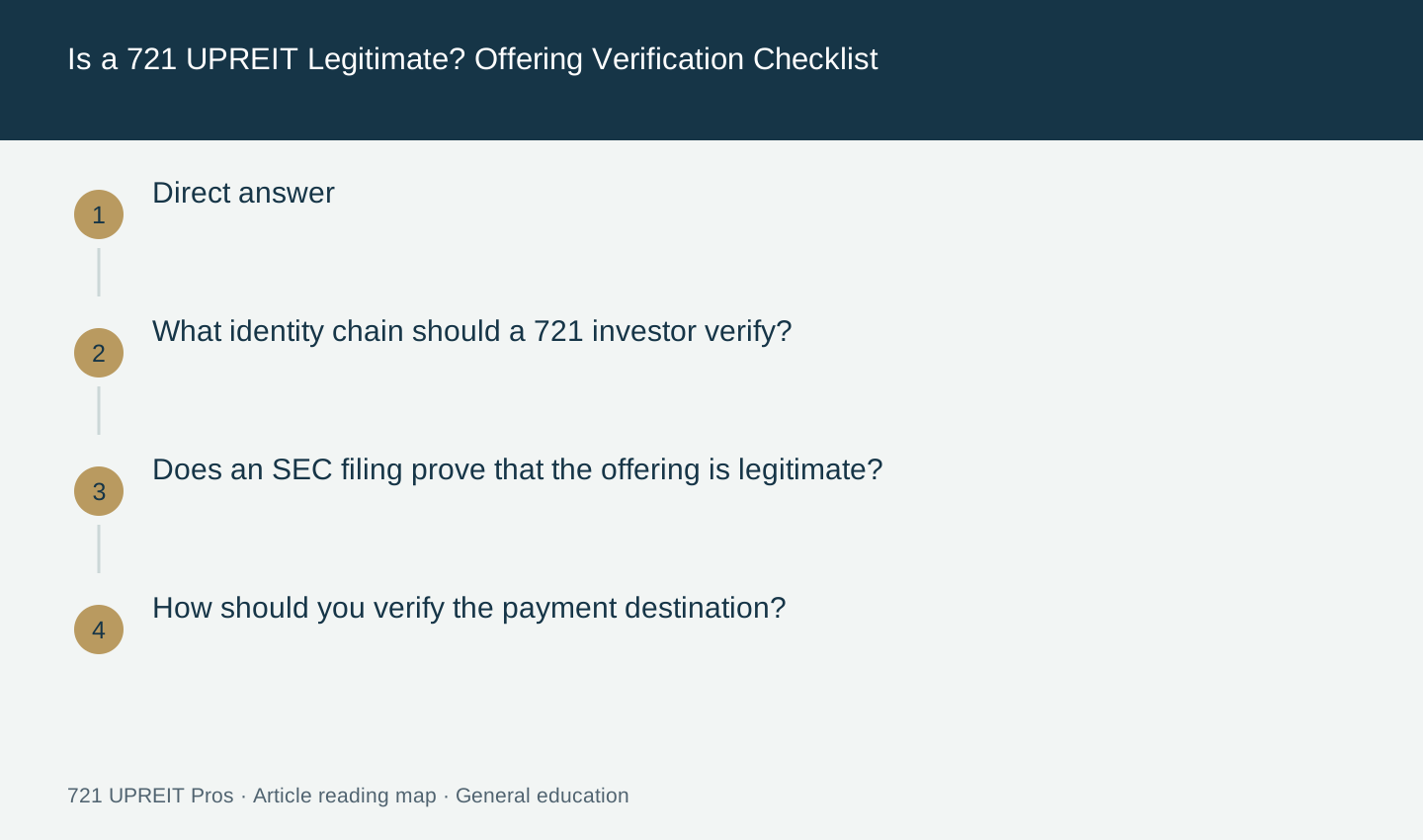
Direct answer
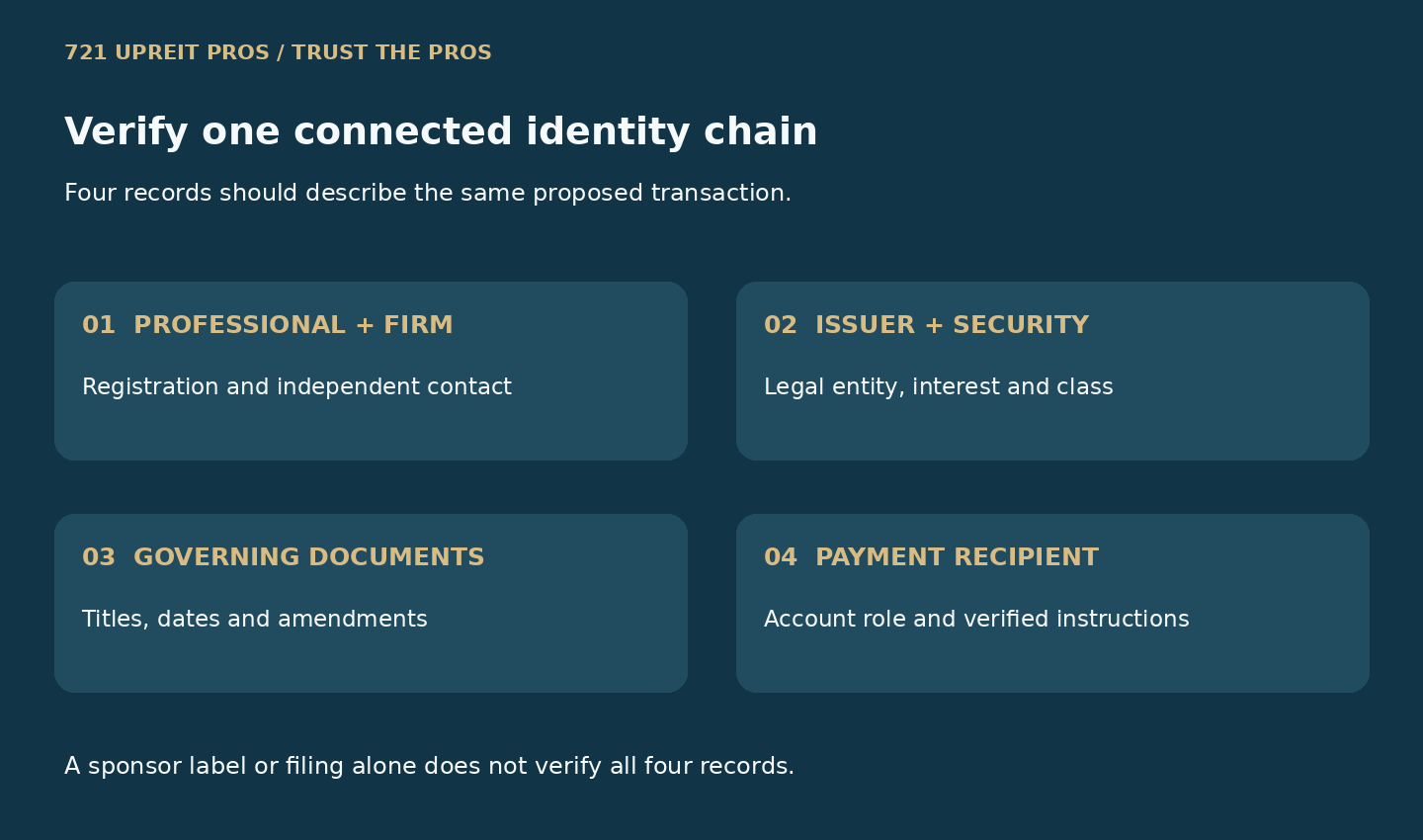
Section 721 is a real part of the federal tax code, but the words “721 UPREIT” do not establish that a specific proposal is genuine, properly offered or appropriate for an investor. Before sending money or signing a contribution agreement, match four records: the professional and firm, the exact issuer and security, the current governing documents, and the named payment recipient. Any mismatch stays unresolved until an independently verified source explains it in writing.
This guide answers a narrow investor question: how can you check the identity of a proposed 721 UPREIT transaction before relying on its documents or payment instructions? It supports the 721 risk and due-diligence framework. It does not certify an offering, determine suitability, provide a tax opinion or conclude that a mismatch is fraud.
TALK TO A 721 UPREIT ADVISOR
Talk to a 721 UPREIT advisor
Request a callback to discuss the questions raised by this article, your timing and what to ask before you commit. Share your name, email and phone below to start the conversation.
No investment commitment or financial documents required. A callback request does not book an appointment or establish an advisory relationship.
The IRS explains that a contribution of property to a partnership in exchange for a partnership interest usually does not cause the partner or partnership to recognize gain at that contribution. The same IRS publication also describes exceptions and other rules. That tax framework does not verify the people, entities, economics or payment destination in an individual proposal.
What identity chain should a 721 investor verify?
Build one dated line from the person discussing the investment to the account receiving funds. Record legal names, not only logos, program labels or email display names.
| Record | Evidence to retain | Question it should answer |
|---|---|---|
| 1. Professional and firm | Full name, firm, role, registration record where applicable, independently obtained contact information and relationship summary | Who is communicating with me, through which firm, and in what capacity? |
| 2. Issuer and security | Exact legal issuer, entity type, state of formation, interest or unit class, subscription or contribution party, and tax-ID suffix when safely available | What would I own at this stage, and which entity issues it? |
| 3. Governing documents | Document title, effective date, version, supplements, amendments, signature pages and controlling section references | Which current agreements establish the rights, risks, costs and possible later transaction? |
| 4. Payment destination | Named recipient, receiving institution, account title or custodian, written funding procedure, verification call record and change history | Does the recipient fit the legal transaction described by the controlling documents? |
How do you verify the professional and firm?
Investor.gov directs investors to check a financial professional's background, registration and disciplinary history through the Investment Adviser Public Disclosure database or FINRA BrokerCheck. A record in one of those systems is an identity and background check, not approval of the proposed investment.
Impersonation changes the problem. An SEC investor alert recommends independently contacting the professional through a telephone number or website listed in the firm's Form CRS. Do not use the number, link or reply address contained only in the message you are trying to verify. Compare the name, firm, office, registration and communication channel, and save the date of the check.
How do you identify the actual issuer and interest?
Write the transaction as separate stages. A property owner might sign with a particular operating partnership for a specified class of OP units. A DST pathway may begin with a separate trust interest and only contemplate a later contribution. A REIT share can be a different security at another stage. Do not merge those entities into the sponsor's marketing name.
Use the program-document comparison matrix to record the initial issuer, operating partnership, unit or share class and controlling agreement. DST Experts' offering-document and supplement checklist provides a separate way to track a DST file and any later transaction without assuming conversion.
Does an SEC filing prove that the offering is legitimate?
No. A filing can help confirm a legal name, identifier, disclosed offering path or document date, but it does not replace the governing package or an investor's diligence. The SEC describes Form D as a notice of an exempt Regulation D offering filed on EDGAR. Its private-placement bulletin states that a Form D filing does not mean SEC approval or registration.
Also avoid the opposite shortcut. A missing Form D search result does not, by itself, prove fraud. The transaction may use a different exemption or registration path, the searched name may be wrong, or the filing deadline may not yet have occurred. The SEC says companies generally file Form D within 15 days after the first sale. Ask the responsible firm to identify the offering path and supporting record. Treat an unexplained mismatch as an open issue, not as a conclusion invented from a search result.
For each document, record the complete title, date, issuer and relevant class. Request every referenced supplement or amendment. A polished brochure, property image or sponsor deck can be useful context, but it does not create a contractual right or identify the account that should receive funds.
How should you verify the payment destination?
Do not treat emailed wire instructions as self-verifying. Investor.gov identifies payments to an individual, a different company than the expected investment, a suspicious address or a purpose unrelated to the investment as warning signs. Its 2026 phishing alert recommends contacting the financial firm through a verified telephone number when an email or text requests financial information or appears to come from the firm.
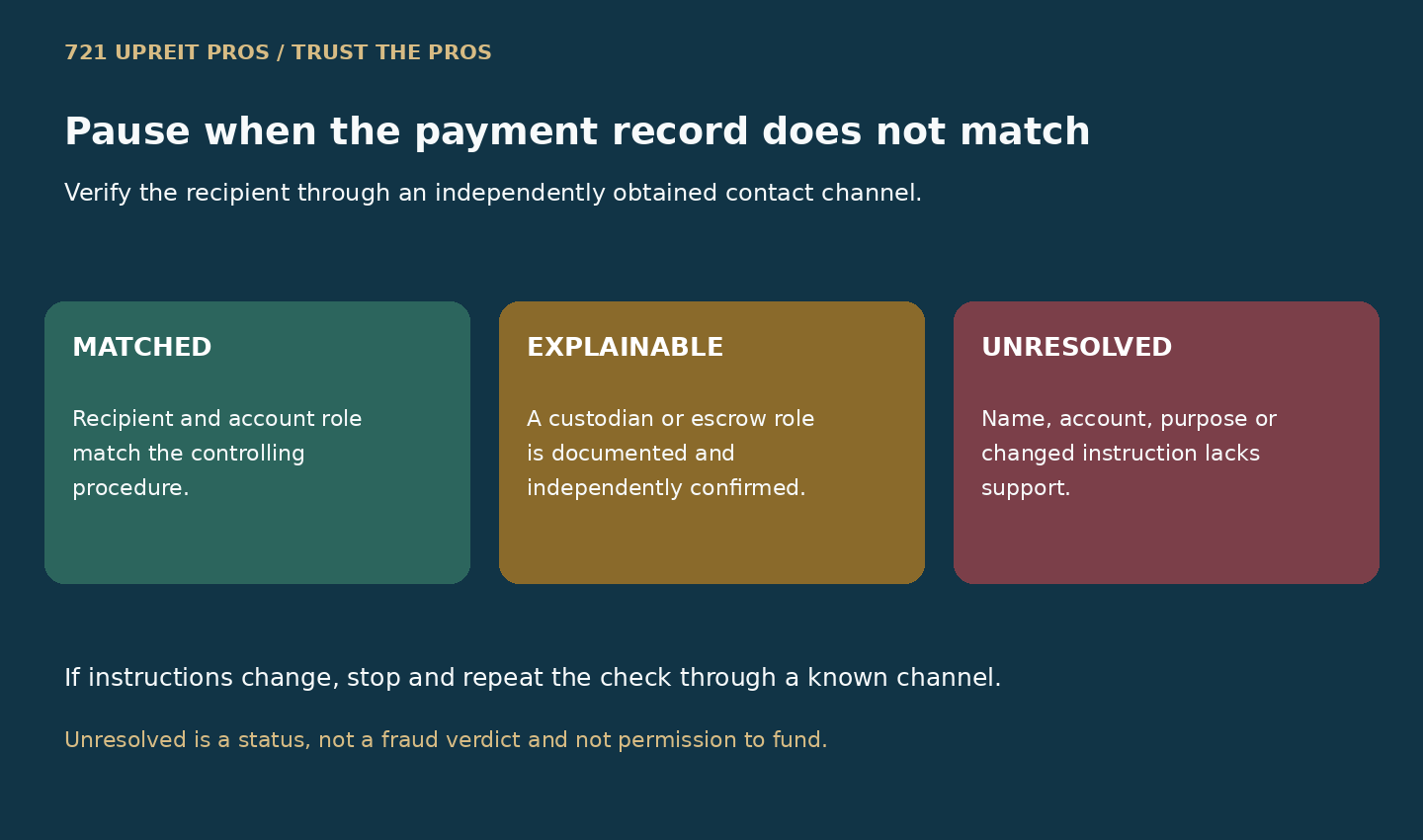
Before authorizing funds, compare the recipient name with the subscription, contribution or escrow procedure. Ask why the recipient is the issuer, custodian, escrow agent, qualified intermediary, closing agent or another party. Obtain the explanation from an independently verified contact. If instructions change, stop and repeat the verification through a known channel. Preserve both versions and the written explanation. Never place account numbers, wire instructions, tax returns or identity documents in an ordinary contact form.
| Observed issue | Why it matters | Useful next step |
|---|---|---|
| The marketing name differs from the subscription issuer | A brand can cover multiple legal entities | Map the brand, issuer, partnership and security class in writing |
| The proposed class is not identified | Fees, conversion rights and restrictions may be class-specific | Request the executed class election and applicable schedule |
| The document references a supplement you do not have | The package may be incomplete or outdated | Obtain the referenced supplement and update the version log |
| EDGAR shows a similar entity name | A similar filing can concern a different security or date | Match the CIK, exact issuer, filing type, class and document date |
| The professional's email domain or telephone number changed | Impersonation can use real names and copied branding | Reconnect through Form CRS, BrokerCheck or the firm's independently located website |
| The payment recipient is an individual | Investor.gov identifies personal recipients as a warning sign | Pause and verify the proper institutional recipient through a known channel |
| The recipient is a different company | It may be a valid custodian or escrow role, or an unexplained mismatch | Request the governing document and written role explanation before funding |
| Instructions change near closing | Urgency can discourage independent verification | Stop, compare versions and call a previously verified contact |
Worked example: a recognizable program name but an unresolved recipient
This example is fictional. It does not describe an actual sponsor, offering or fraud.
An owner receives a folder labeled “Harbor Coast 721 Program.” The subscription agreement identifies Harbor Station DST 26, Delaware Statutory Trust as the initial issuer. A separate summary says a later contribution may be considered by HC Operating Partnership, L.P. for Class A OP Units, subject to approvals and new documents. The names are different, but the folder contains an entity chart that connects the sponsor, trust and operating partnership.
The day before funding, an email instructs the owner to send money to Harbor Advisory Services LLC. That name does not appear in the subscription, escrow provision or entity chart. The owner should not decide that the entire program is fraudulent, and should not assume the new recipient is correct. The decision-ready response is to pause, call a previously verified firm number, obtain the controlling funding provision, identify the recipient's role and confirm the instructions through the agreed secure process.
Suppose the firm explains that Harbor Advisory Services is a servicing affiliate but the subscription requires payment to a titled escrow account. The correct result is not to “average” the two answers. It is to use the procedure in the controlling documents, as confirmed by authorized parties, and preserve that confirmation. If the inconsistency cannot be resolved, do not fund it merely to meet a sales or exchange deadline.
What should be complete before money or property moves?
- Professional verified: the person's name, firm, role, registration record where applicable and independent contact channel are saved.
- First interest identified: the exact legal issuer, entity type, interest and class match the subscription or contribution document.
- Later stages separated: any DST, operating partnership and REIT interests are recorded as distinct entities and events.
- Current package assembled: all referenced supplements, amendments, exhibits, signature pages and applicable class schedules are present.
- Public records matched carefully: EDGAR or other regulator records match the exact entity and filing, with their limitations noted.
- Recipient explained: the payment recipient and account role are consistent with the controlling procedure.
- Changes reverified: any changed email, domain, account, recipient or timing instruction was checked through an independently obtained channel.
- Open issues logged: every mismatch has an owner, requested evidence and follow-up date. Unresolved does not become verified because a deadline is near.
Use the advisor-selection checklist to assign responsibility for the verification work. Your attorney can review legal entities, authority and agreements. Your tax professional can evaluate the tax facts and assumptions. A qualified intermediary addresses the separate exchange process when a 1031 transaction is involved. None of those roles turns an offering label into a guarantee.
Watch the offering-verification walkthrough
This original one-minute video moves from the professional and issuer to the documents and payment recipient. It uses contemporary property and document imagery, original diagrams, English captions and a complete transcript. It contains no client, actual offering or payment information and has no narration.
Read video transcript
0:00 · A real tax rule does not verify a proposal
Section 721 is part of federal tax law. Confirm the specific people, entities, documents and recipient.
0:12 · Start with the professional and firm
Use Investor.gov, IAPD or BrokerCheck where applicable. Reconnect through independently verified contact information.
0:24 · Name the issuer, interest and class
Separate a DST, operating partnership and later REIT security. Match every public record to the exact legal entity and date.
0:36 · Treat filings as evidence, not approval
Form D is a notice of an exempt offering. Request the current governing package and every amendment.
0:48 · Verify the payment destination
Match the recipient to the controlling procedure. Pause changed or unexplained instructions and call a known number.
Download the offering-identity checklist
Save a clean copy for each proposal. Never record full account numbers, Social Security numbers or confidential tax records in the worksheet.
BEFORE YOUR ADVISOR CONVERSATION
Three questions before you commit
This companion briefing covers the professional's identity, compensation and how restrictions fit your cash needs. Use it alongside this article's specific document checks.
Loading the video connects to YouTube. Watch on YouTube · 721 UPREIT Pros channel · Read the full advisor checklist.
Read video transcript
Before you hire a seven twenty-one UPREIT advisor, ask these three questions.
First: who exactly am I hiring? Get the professional's legal name, firm and registration information. Check the record through Investor dot gov and read the firm's relationship summary where applicable. Ask whether this conversation involves brokerage services, investment advice, or both. A marketing title alone does not answer that question.
Second: who gets paid, and how much? Request a written cost breakdown in dollars. Identify the payer, calculation base, payment timing and ongoing charges. Include product expenses and embedded compensation. No separate advisor invoice does not mean there are no costs.
Third: how does this fit my cash needs? Review the actual agreements. Ask who controls a possible conversion and what happens if it does not occur. Separate permission to request redemption from approval, pricing and payment. Do not assume a fixed cash-out date.
Then agree on responsibilities. Your investment professional, CPA, attorney and qualified intermediary can have different roles. Put continuing service and unresolved questions in writing.
Read the complete advisor checklist using the article link in the description. Seven twenty-one UPREIT Pros. Trust the Pros. Educational only. Investments involve risk and may be illiquid. Tax treatment depends on your circumstances.
Educational only. Investments involve risk and may be illiquid. Footage is illustrative; narration is synthetic.
TALK TO A 721 UPREIT ADVISOR
Ready to discuss your 721 options?
Request a callback to discuss the questions raised by this article, your timing and what to ask before you commit. Share your name, email and phone below to start the conversation.
No investment commitment or financial documents required. A callback request does not book an appointment or establish an advisory relationship.