
721 UPREIT PROS / HOLDING PERIODS AND LIQUIDITY
721 UPREIT holding period: which lockup ends when?
There is no single 721 UPREIT holding period that tells every investor when cash becomes available. Separate the DST business plan, OP-unit lockup, redemption notice and settlement process, securities transfer restrictions, and any tax-protection term. Each can start on a different date and end with a different right.
By 721 UPREIT Pros · September 24, 2026 · Five-clock planning worksheet

A statement such as “two-year hold” is incomplete until you know what is being held, what starts the clock and what you may do afterward. This guide helps you build that calendar before committing money or relying on a future withdrawal. Start with the 721 UPREIT investor guide for the broader structure, then use this worksheet alongside the risk and due-diligence framework.
Does Section 721 require a two-year lockup?
Section 721 does not state a universal two-year investor lockup or promise a cash-out date. It generally addresses nonrecognition when property is contributed to a partnership for a partnership interest, subject to exceptions and other tax rules. The contribution agreement, partnership agreement and applicable securities rules must be examined separately to determine what restrictions apply.
TALK TO A 721 UPREIT ADVISOR
Talk to a 721 UPREIT advisor
Request a callback to discuss the questions raised by this article, your timing and what to ask before you commit. Share your name, email and phone below to start the conversation.
No investment commitment or financial documents required. A callback request does not book an appointment or establish an advisory relationship.
An UPREIT uses an operating partnership beneath a real estate investment trust. A contributor may receive operating partnership units, commonly called OP units. Those units are partnership interests. A later transaction involving REIT shares or cash is a separate event. The end of an initial restriction does not, by itself, complete that event.
The question that changes the conversation
“On this date, do I gain the right to request a transaction, receive a security, sell that security, or receive cleared cash?” Ask for the document and section supporting the answer.
What are the five holding-period clocks to verify?
Build a separate row for each applicable clock, including its start event, end condition, decision maker and evidence. The five rows below are a planning framework, not five mandatory rules imposed on every investment. Mark a row not applicable only after checking the actual structure.
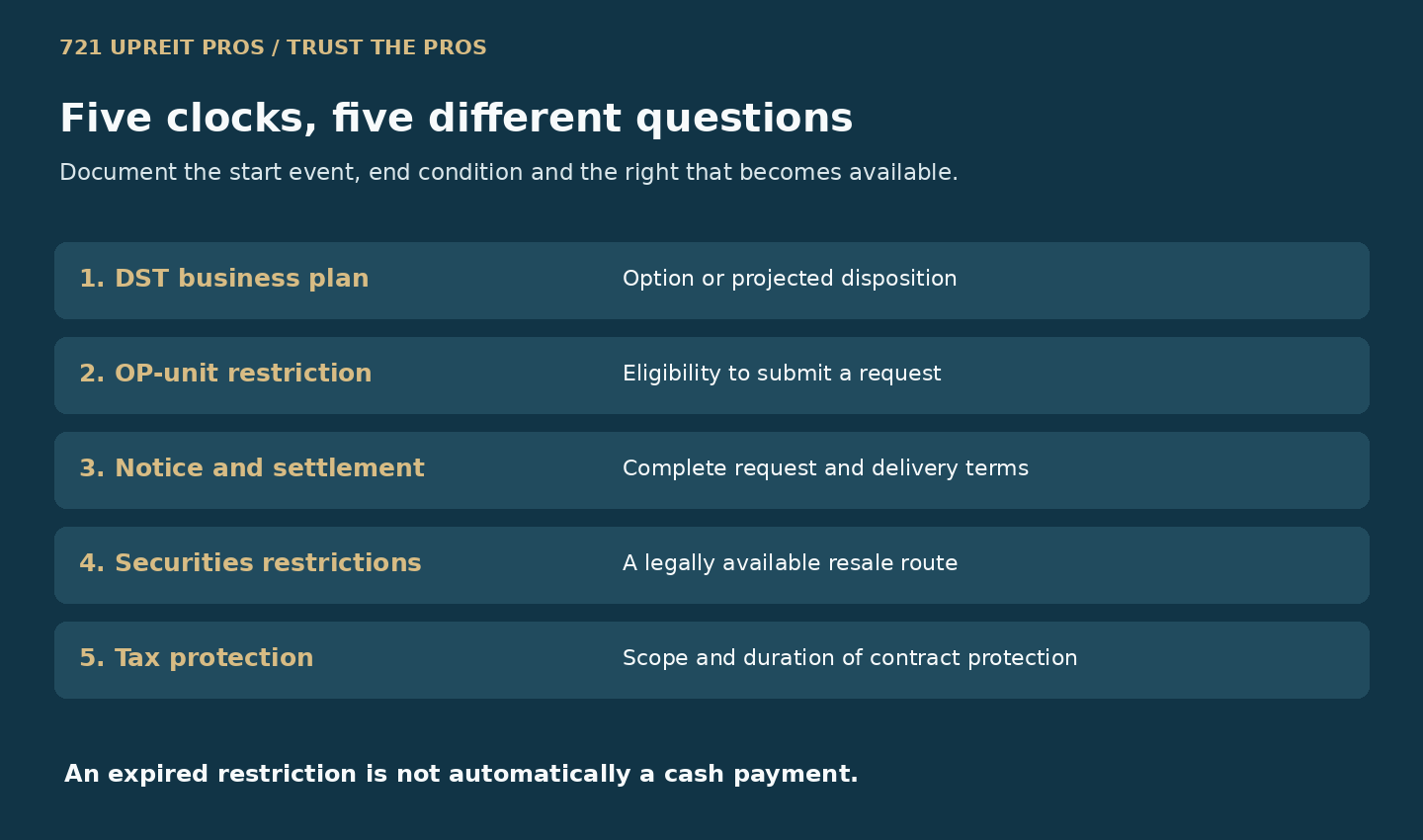
| Clock | Start event to identify | What its end may mean | Evidence to request |
|---|---|---|---|
| 1. DST business plan or conversion option | Subscription closing, property acquisition or another defined date | A proposed sale window or an option becomes exercisable, depending on the documents | Offering memorandum, trust agreement and purchase/contribution option |
| 2. OP-unit contractual restriction | Unit issuance, contribution closing or a negotiated date | The holder may become eligible to submit a redemption or transfer request | Partnership agreement, unit schedule, contribution agreement and side letter |
| 3. Notice, processing and settlement | Receipt of a complete valid notice or another defined trigger | A transaction may settle subject to conditions, election rights and delay provisions | Notice form, acceptance record, current procedures and settlement provisions |
| 4. Securities resale and transfer restrictions | Acquisition and other legally relevant events | A particular transfer or resale route may become available if its other conditions are satisfied | Security legend, registration/exemption analysis and transfer-agent requirements |
| 5. Tax-protection agreement term | The effective date specified in the agreement | Specified contractual protections may end, narrow or change | Signed protection agreement, amendments, covered-property schedule and termination clauses |
Use the full names of the legal entities and unit classes on the calendar. “My REIT account” is too broad when the file includes a DST interest, an OP interest and a possible later share position. If there are multiple subscriptions or contributions, use separate rows for each lot unless the governing documents explicitly combine them.
Why does the DST holding period need its own row?
The DST investment period and the OP-unit period describe different ownership stages. A proposed DST-to-721 pathway does not make the initial DST closing date the start date for every later restriction. Nor does the end of an expected DST holding period prove a contribution will occur.
Ask who can exercise the conversion option, whether exercise is mandatory or discretionary, what conditions remain, and what happens if no conversion occurs. Record “earliest option exercise” separately from “projected exercise” and “completed contribution.” Our conversion decision-rights checklist identifies the party controlling those decisions. If the anticipated transaction does not occur, use the DST-to-721 fallback planning guide.
Can the OP-unit lockup end before you can receive cash?
Yes. Contractual eligibility to make a request and settlement of that request are separate milestones. A dated public example shows why reading just one sentence can be misleading.
The NexPoint Diversified Real Estate Trust Operating Partnership agreement amended April 17, 2025 describes common-unit redemption rights in Section 8.6. It includes a one-year outstanding-unit condition, subject to stated provisions and general-partner discretion to allow earlier exercise. It also refers to dates expressly agreed with a limited partner. The issuer may elect to purchase tendered units using cash or REIT shares. The defined redemption date generally uses the tenth business day after notice receipt, with a stated exception. Other conditions apply.
This is an example of how clauses interact, not a current offering recommendation or a term that applies to your units. Read the dated agreement, including Section 8.6 and its defined terms. Then find the corresponding provisions in your own file. The practical exercise is to trace every cross-reference before putting a cash date on a household budget.
The redemption request checklist covers the request process in more detail. This article's distinct purpose is deciding which start dates and end conditions belong on your calendar before that request is made.
Why do some 721 discussions mention two years?
Two years can refer to a program's proposed DST phase, a negotiated restriction, or a tax analysis involving a different set of events. Those uses should not be collapsed into a universal promise.
Treasury Regulation 1.707-3 contains rebuttable presumptions concerning transfers of property to a partnership and money or other consideration back to the partner. Transfers within two years are generally presumed to be a sale unless the facts clearly establish otherwise. Transfers more than two years apart are generally presumed not to be a sale unless the facts clearly establish a sale. Related rules and exceptions matter. This is not an automatic tax clearance or a rule that creates a redemption right.
Ask tax counsel which events the disguised-sale rules measure in your transaction. Do not assume time spent owning a DST starts a partnership-transfer clock. Separately, have your CPA maintain any tax holding-period record needed for reporting. A tax holding period and a contractual lockup answer different questions.
What changes if redemption delivers REIT shares?
A share position must be evaluated under its own resale, ownership and market conditions. The SEC's Rule 144 overview explains that restricted-security sales can require a holding period and other conditions. Meeting a time condition alone does not remove every restriction or create a buyer. The applicable path depends on the facts, including the issuer and holder.
Use the SEC explanation of restricted and control securities as a starting point for securities counsel. Ask what transfer-agent steps or legend removal may be required. Publicly traded shares, non-traded shares and private securities should not be assigned the same liquidity assumption. Review the received security using our OP-unit-to-REIT-share contract and tax checklist.
For another educational view of the exit decision, read DST Experts' discussion of 721 UPREIT exit planning. Keep the actual issuer's terms in front of you when comparing alternatives.
Worked example: how does a one-year restriction become a longer planning horizon?
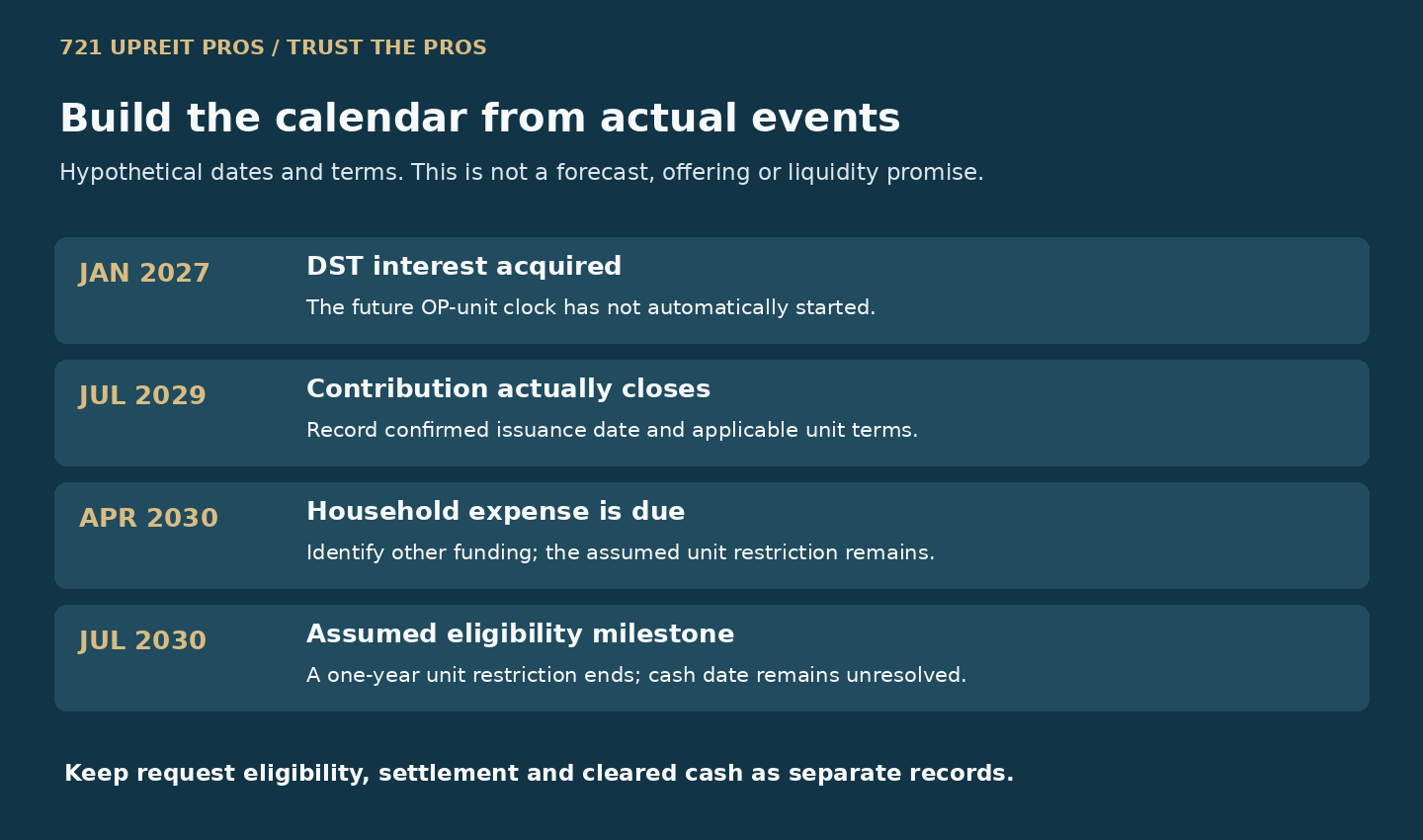
Start from dated events, not the date you first invested elsewhere. The following fictional example illustrates calendar preparation. Its terms are invented for education and are not taken from the NexPoint agreement or an available investment.
| Event | Assumed date or term | Planning conclusion |
|---|---|---|
| DST interest acquired | January 15, 2027 | Record the initial ownership date. Do not start a future OP-unit clock automatically. |
| Contemplated contribution actually closes | July 15, 2029 | Obtain the unit issuance confirmation. The transaction was not assumed complete in January 2029. |
| Assumed unit restriction | One year after issuance | July 15, 2030 is an eligibility milestone under this example, subject to the full terms. |
| Household expense comes due | April 2030 | The expense precedes even the assumed eligibility milestone. Identify another funding source. |
| Request and settlement | Not yet confirmed | Leave the cash date unresolved. Check notice rules, settlement form and all applicable conditions. |
The owner has waited three and a half years from the initial DST purchase to the illustrated OP-unit eligibility date. That is arithmetic, not a forecast. A later contribution, different contractual start date or longer restriction would change the calendar. An earlier waiver should be recorded only when granted in a form that actually applies to the holder.
Now add a hypothetical $90,000 expense due in April 2030 and $55,000 of other cash reserved specifically for it. The funding gap is $35,000. Do not fill that gap with an unconfirmed future redemption or projected distributions. Instead, flag it for a liquidity-planning conversation before committing additional capital. This simple exercise identifies a timing mismatch without pretending to forecast the value or saleability of the investment.
What documents turn a projected date into a reliable record?
Every calendar entry should point to a dated source and say what remains conditional. Use the following review process with your advisor and legal or tax professionals.
- Identify the interest. Record the exact issuer, holder, class, lot and quantity. Match them to the closing documents.
- Copy the trigger. Is it acquisition, issuance, admission, contribution, delivery of notice or acceptance of notice?
- Find every exception. Follow cross-references to side letters, transfer limits, minimum quantities, waiver provisions and amendments.
- Name the right that begins. Use precise language such as “may submit notice,” not “can cash out,” unless the complete documents support that result.
- Assign the next decision. Record who confirms completeness, chooses settlement form, reviews tax consequences and processes delivery.
- Match your needs. List expenses due before the uncertain settlement date and identify resources independent of the investment.
- Refresh after an event. Recheck when a contribution closes, units are transferred, terms change or a request is submitted. Keep prior versions.
Does an expired tax-protection period make an exit tax-free?
No. The contractual protection term and tax treatment of a particular transaction must be reviewed separately. A protection agreement's expiration is not itself a tax exemption or liquidity event. Check the covered events and parties using the tax-protection coverage checklist. IRS Publication 541 discusses partnership contributions, distributions and dispositions; your CPA needs the transaction facts and basis records to assess the actual result.
What should stay blank on the worksheet?
Leave an unconfirmed date marked “unresolved,” with an owner and next action. A blank supported by a clear question is more useful than a precise date copied from an introductory presentation. Record a range as a projection only when its assumptions and source are clear.
Watch the one-minute briefing and build your calendar
The captioned briefing explains how to separate ownership stages, eligibility and actual cash availability.
Download the five-clock calendar worksheet
Read video transcript
0:00 · Which holding period are you measuring?
There is no universal 721 UPREIT cash-out date. Name the interest, start event and governing document.
0:12 · Separate DST time from OP-unit time
A projected conversion is not a completed contribution. Confirm the actual unit issuance date before starting its clock.
0:24 · Eligibility is one milestone
The end of a lockup may allow a request. Notice, issuer elections and settlement conditions still need review.
0:36 · Check the other restrictions
Securities resale conditions and tax-protection terms answer different questions. A two-year reference is not automatic tax clearance.
0:48 · Match dates to your cash needs
List expenses due before confirmed liquidity. Use the five-clock worksheet; leave unknown dates unresolved.
Prepare for an advisor conversation
Bring the timeline, current agreements and the dates when you need cash. Ask which dates are contractual, projected or unresolved, and which party controls each step. Talk to a 721 UPREIT advisor about matching those restrictions to your planning horizon.
Sources and review scope
- Internal Revenue Code Section 721, partnership contribution rule and exceptions.
- Internal Revenue Code Section 1031, qualifying real property and exchange requirements.
- Treasury Regulation 1.707-3, disguised-sale facts, circumstances and timing presumptions.
- NexPoint operating partnership agreement amended April 17, 2025, dated contract example only.
- SEC Rule 144 overview, restricted and control securities.
- IRS Publication 541, revised December 2025, partnership tax framework.
Sources checked September 24, 2026. General education, not tax, legal or investment advice or an offer. Examples are hypothetical. Current agreements, applicable law and individual facts control. No conversion, settlement, liquidity, tax result or return is guaranteed.
BEFORE YOUR ADVISOR CONVERSATION
Three questions before you commit
This companion briefing covers the professional's identity, compensation and how restrictions fit your cash needs. Use it alongside this article's specific document checks.
Loading the video connects to YouTube. Watch on YouTube · 721 UPREIT Pros channel · Read the full advisor checklist.
Read video transcript
Before you hire a seven twenty-one UPREIT advisor, ask these three questions.
First: who exactly am I hiring? Get the professional's legal name, firm and registration information. Check the record through Investor dot gov and read the firm's relationship summary where applicable. Ask whether this conversation involves brokerage services, investment advice, or both. A marketing title alone does not answer that question.
Second: who gets paid, and how much? Request a written cost breakdown in dollars. Identify the payer, calculation base, payment timing and ongoing charges. Include product expenses and embedded compensation. No separate advisor invoice does not mean there are no costs.
Third: how does this fit my cash needs? Review the actual agreements. Ask who controls a possible conversion and what happens if it does not occur. Separate permission to request redemption from approval, pricing and payment. Do not assume a fixed cash-out date.
Then agree on responsibilities. Your investment professional, CPA, attorney and qualified intermediary can have different roles. Put continuing service and unresolved questions in writing.
Read the complete advisor checklist using the article link in the description. Seven twenty-one UPREIT Pros. Trust the Pros. Educational only. Investments involve risk and may be illiquid. Tax treatment depends on your circumstances.
Educational only. Investments involve risk and may be illiquid. Footage is illustrative; narration is synthetic.
TALK TO A 721 UPREIT ADVISOR
Ready to discuss your 721 options?
Request a callback to discuss the questions raised by this article, your timing and what to ask before you commit. Share your name, email and phone below to start the conversation.
No investment commitment or financial documents required. A callback request does not book an appointment or establish an advisory relationship.