
721 UPREIT PROS / CLASS COMPARISON
721 UPREIT Unit Classes: Compare Rights and Total Costs
Compare 721 UPREIT unit classes by the rights and costs in the actual agreements, not by a letter or an advertised distribution. Confirm which class you can receive, its expenses, voting and redemption provisions, and any later class change. A lower headline charge does not establish better liquidity, tax treatment or overall suitability.
By 721 UPREIT Pros · October 18, 2026 · Original class-comparison worksheet
Key takeaways
- Confirm the exact issuer, interest and full class designation before comparing alternatives.
- Compare class charges with separate account charges using their actual calculation bases.
- Read voting, redemption and class-change provisions instead of inferring rights from a label.
- A class label does not establish liquidity, a tax result or suitability for your cash needs.

You may receive two proposals involving the same real estate portfolio but different classes of operating partnership interests. That is a different decision from choosing between two sponsors. Before comparing costs, ask whether both alternatives are actually available for your transaction, through your proposed account, on the relevant date.
This guide addresses that class-level decision. The provider document-comparison guide owns the broader sponsor comparison, while the full-life fee ledger covers all transaction stages. Here, build one matched rights-and-cost sheet before accepting a class assignment or assuming you can change it later.
TALK TO A 721 UPREIT ADVISOR
Talk to a 721 UPREIT advisor
Request a callback to discuss the questions raised by this article, your timing and what to ask before you commit. Share your name, email and phone below to start the conversation.
No investment commitment or financial documents required. A callback request does not book an appointment or establish an advisory relationship.
Which interest and class would you actually own?
Write the full issuer name, security type and class designation at the top of each column. Do not shorten a designation if it contains a suffix. Keep the current DST interest, proposed OP units and possible eventual REIT shares on separate rows. Ask who confirms the assignment and where it appears in the signed documents and issuer records.
For a seller, this review belongs in pre-closing coordination, not in a last-minute search for a familiar class label. Section 1031, a qualifying DST replacement interest and a separate Section 721 contribution are different steps. None of them establishes that every DST will convert or that a particular class will be offered. Use the 721 UPREIT guide to check the larger ownership sequence with your professionals.
A useful dated example is Brookfield REIT Operating Partnership L.P.'s September 25, 2024 agreement. Section 4.2 identifies multiple unit classes; section 5.2 permits class-related distribution differences, including expense allocations. Section 13.12 distinguishes partnership-unit ownership from shareholder rights. These provisions illustrate why a class label needs its own evidence. They are not confirmation of today's terms or your eligibility. Read the SEC-filed agreement.
What should the class-comparison sheet contain?
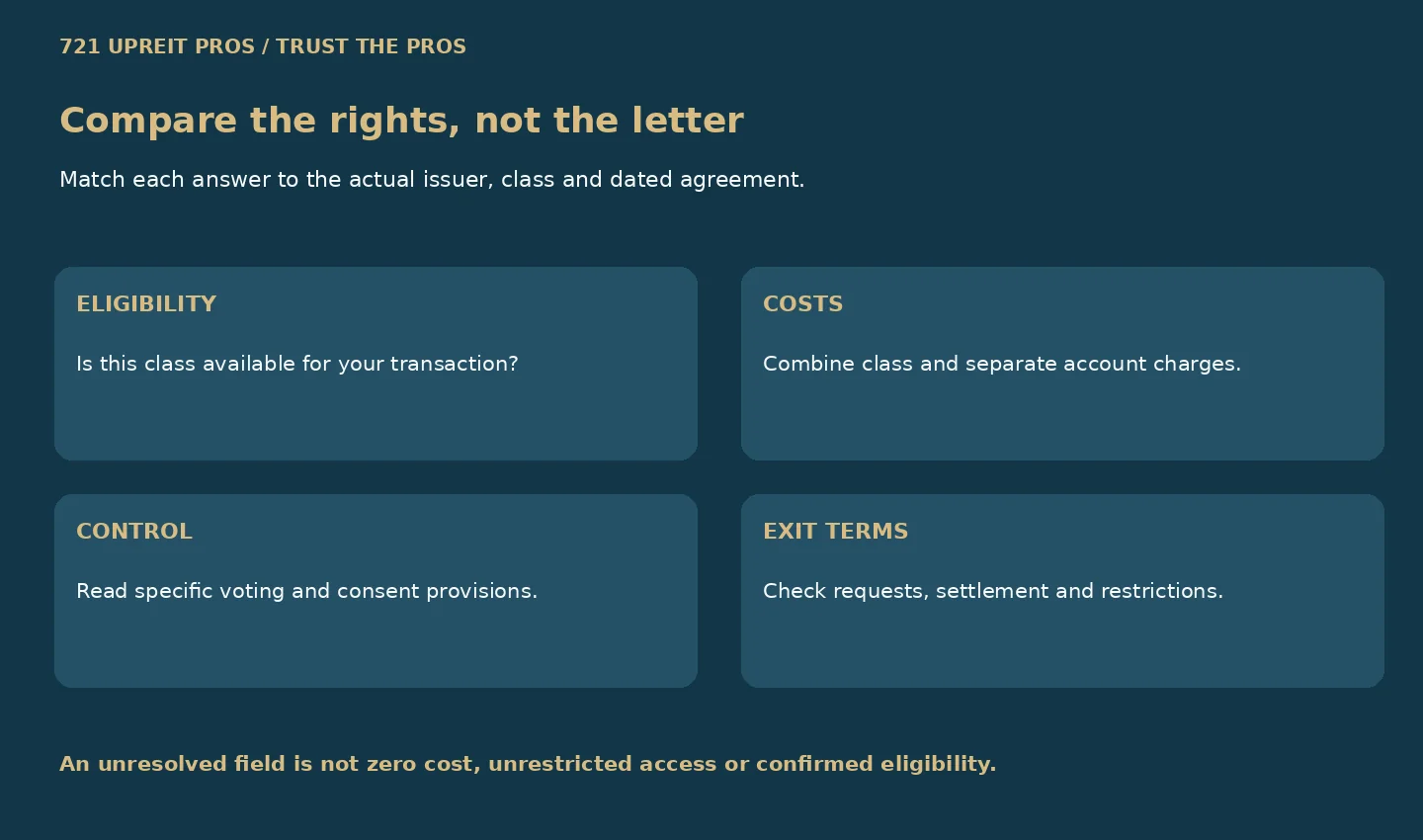
Use the same questions for both alternatives. For each answer, record the controlling document, effective date, section and written explanation. Mark missing information unresolved rather than treating a blank as zero cost or unrestricted access. Separate what the document says from an advisor's estimate and from an assumption you introduced.
| Decision | Evidence to request | What to resolve |
|---|---|---|
| Availability | Contribution or subscription terms and class eligibility | Can this investor receive this class in this transaction? |
| Economics | Class expense schedule and separate account agreement | Which costs differ, who pays, and what calculation base applies? |
| Control | Voting, consent and amendment provisions | Which decisions require your consent, if any? |
| Access to value | OP redemption and transfer provisions | What can be requested, when, and how might it settle? |
| Later class changes | Conversion triggers and valuation formula | Who initiates the change, and which rights and quantities change? |
| Personal fit | Household cash plan and professional tax review | Does either verified alternative fit the investor's constraints? |
How can a lower class charge still produce higher total costs?
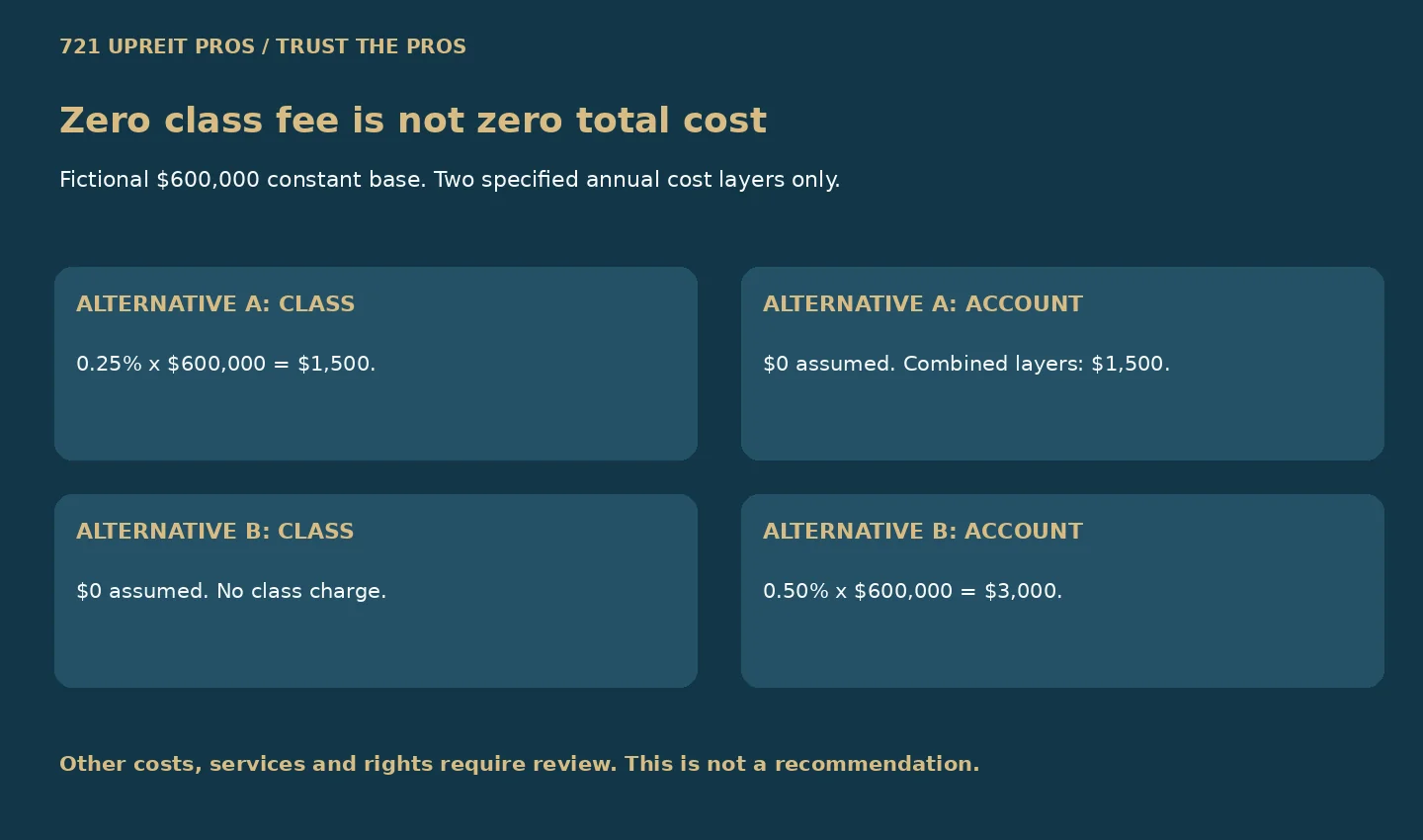
Compare class charges and account charges together, but do not count the same amount twice. A proposal described as having no servicing fee may have a separate advisory-account fee. Ask which services that fee covers, what assets form its base, whether any offset applies and whether the arrangement is required for access to the class.
The following example is entirely hypothetical. It does not describe any sponsor, available class or recommended account. Assume a constant $600,000 comparison base, no returns, no price changes and identical underlying expenses. Alternative A has a 0.25% annual class charge and no additional account charge. Alternative B has no class charge but a 0.50% annual account charge. Assume neither has an initial charge or offset.
| Layer | Alternative A | Alternative B |
|---|---|---|
| Class charge | $600,000 × 0.25% = $1,500 | $0 |
| Separate account charge | $0 | $600,000 × 0.50% = $3,000 |
| Combined illustrated layers | $1,500 | $3,000 |
B's zero class charge does not make the combined illustrated cost lower. But this calculation cannot establish that A is preferable: services, eligibility, other fees and contractual rights remain outside the example. Replace every assumption with the real proposal. If the account fee uses a different base, model that base instead of forcing both percentages onto $600,000.
Also distinguish a continuing class feature from temporary support. A waiver might expire or involve repayment conditions; see the fee-waiver and expense-support review. For the earlier DST ownership stage, the separate DST fee and expense guide helps identify charges that should not be mistaken for later OP-unit expenses.
Do voting rights or redemption terms follow the class letter?
Do not infer control from words such as institutional, preferred or advisory. Ask for the specific action you care about: approving an amendment, replacing management, transferring an interest or requesting redemption. Then identify the relevant holder, threshold, exceptions and decision-maker. A consent right over one change does not establish control over property operations.
Likewise, a possible later REIT-share class does not tell you when present OP units can become cash. Record the earliest request eligibility, any notice requirements, settlement choices, restrictions, expenses and current administrator instructions. Use the request-to-payment checklist for that operational review. Do not budget a retirement withdrawal from a class name or a brochure's repurchase description.
What if the class can change later?
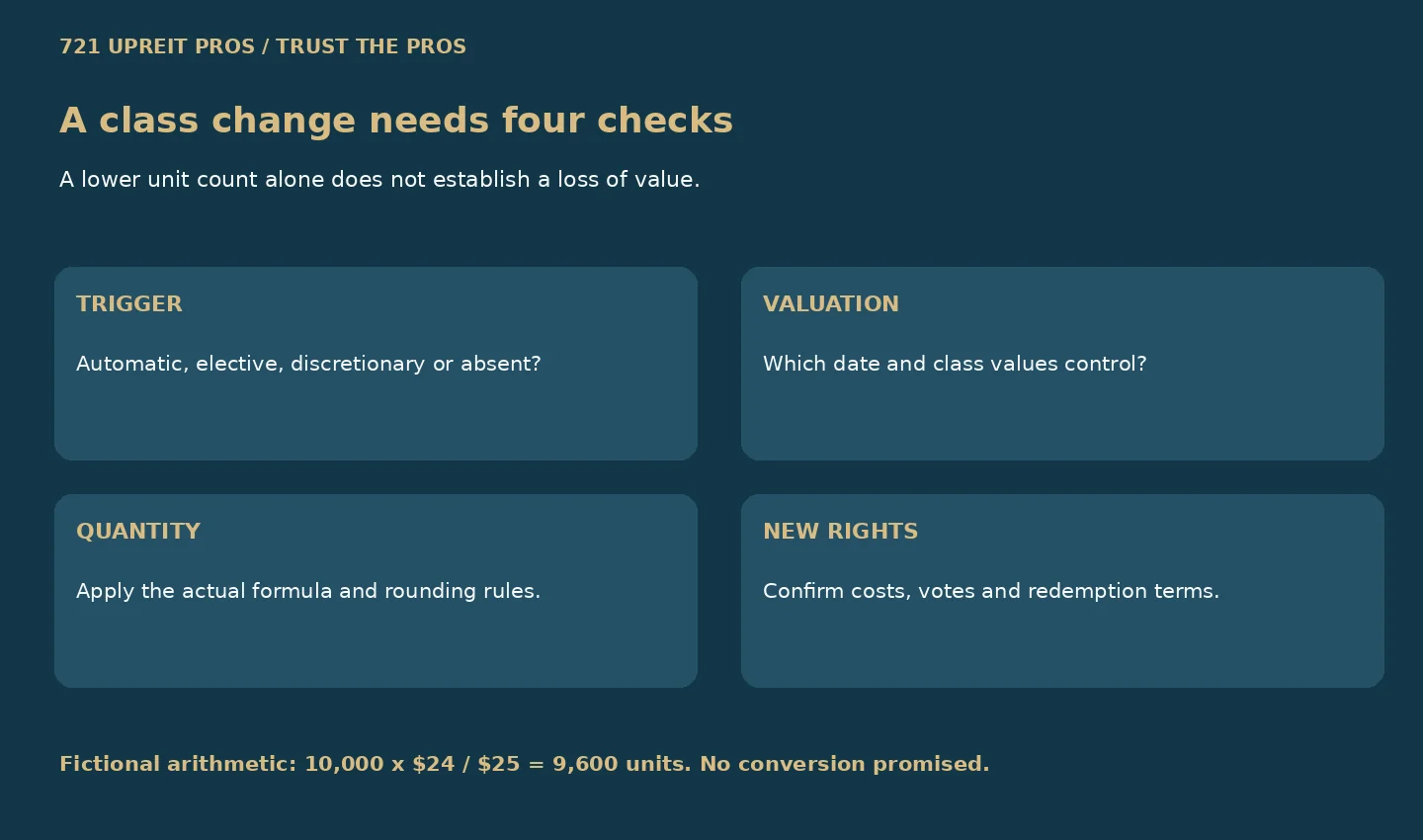
Ask whether a change is automatic under specified conditions, elective, discretionary or unavailable. Obtain the trigger, responsible party, effective date, new expense treatment and calculation of replacement units. Do not assume an available option must be exercised or that an account transfer leaves class economics unchanged.
The dated Brookfield agreement provides a specific illustration: section 4.3(c) describes certain DST-related unit-class changes linked to compensation caps, and its defined conversion rate uses class NAV per unit. This is evidence that both conditions and unit arithmetic deserve review, not a universal promise of conversion. Request the current controlling provisions for your own interest before relying on that example.
As a separate fictional arithmetic exercise, suppose 10,000 old units are valued at $24 each and the applicable new-unit value is $25. A purely value-equivalent calculation gives $240,000 ÷ $25 = 9,600 new units. The lower count alone would not mean a $10,000 loss. Actual formulas, valuation dates, fees and rounding must come from the agreement; this example establishes no right to change classes.
Does choosing a class determine Section 721 tax treatment?
No class label certifies a tax result. IRS Publication 541 explains the general nonrecognition treatment of property contributed for a partnership interest and important exceptions, including disguised-sale issues. Your professionals need the actual transaction, basis, liabilities and any other consideration, not simply the class designation.
Keep an internal OP-unit class change separate from a redemption or exchange for REIT shares. Ask your CPA to assess the particular event before treating it as tax-free. For the ownership distinction, DST Experts' explanation of DST and REIT interests is background, not a substitute for your partnership documents. Investment losses, uncertain distributions and restricted liquidity remain relevant regardless of tax treatment.
What should you confirm before accepting the class?
- Obtain written confirmation of the exact issuer, interest and class available to you.
- Match current agreements, amendments and individual terms to that proposal.
- Price all relevant layers using the same stated period and appropriate calculation bases.
- Compare specific voting, transfer and redemption provisions without assuming equivalence.
- Document any future class-change trigger and the resulting quantity, costs and rights.
- Review cash needs, reserves and tax questions with the appropriate professionals before committing.
Keep unresolved fields visible. A complete matrix may still show that neither alternative fits a near-term cash need or desired level of control. Use the 721 UPREIT risk framework for the broader decision, then talk to a 721 UPREIT advisor with the actual documents. Do not send account numbers or sensitive tax records through a general inquiry form.
Watch the one-minute class comparison
This original silent visual briefing has English captions and a complete transcript. It illustrates a review process, not an available investment.
Read video transcript
0:00 · 721 UPREIT unit classes
Compare the actual rights and costs, not a class letter or headline rate.
0:12 · Start with eligibility
Confirm issuer, security and class. Match the current governing documents.
0:24 · Combine relevant cost layers
A zero class charge may coexist with a separate account charge.
0:36 · Check later class changes
Verify the trigger and value formula. Unit count alone is not investment value.
0:48 · Review fit before committing
Check control, cash needs and taxes. No class guarantees liquidity or returns.
Download the unit-class comparison worksheet
Bring the completed comparison and unanswered questions to your advisor, CPA and attorney. Educational only, not tax, legal or investment advice.
Frequently asked questions
Is Class I always the best 721 UPREIT class?
No universal class ranking applies. Confirm whether the class is available to you and compare its actual rights, all relevant charges and any required account arrangement. A letter is not an assessment of suitability.
Does a zero servicing fee mean there are no investment costs?
No. Other investment-level and account-level charges may remain. Ask which costs are included, separate, contingent or waived and compare the same time period without double counting.
Can I choose any OP-unit class in a DST-to-721 transaction?
Do not assume a choice exists. The actual transaction and class eligibility provisions determine what can be issued. Obtain written confirmation rather than relying on a public REIT share-class menu.
Will fewer units after a class change necessarily mean a loss?
Not necessarily. Compare the applicable per-unit values, quantity, fees and rounding. A value-equivalent conversion can produce fewer units when the replacement class has a higher per-unit value.
Does an OP class have the same rights as a similarly named REIT share class?
Do not assume equivalence. They are different interests. Read the OP agreement for current partnership rights and the applicable share documents for any later share ownership.
What should I bring to a class-comparison consultation?
Bring current proposed class terms, all relevant agreements and amendments, the separate account fee schedule, written eligibility confirmation and your cash needs. Flag unresolved fields and let your tax professional review the actual transaction.
TALK TO A 721 UPREIT ADVISOR
Ready to discuss your 721 options?
Request a callback to discuss the questions raised by this article, your timing and what to ask before you commit. Share your name, email and phone below to start the conversation.
No investment commitment or financial documents required. A callback request does not book an appointment or establish an advisory relationship.