
721 UPREIT PROS / RETIREMENT CASH TIMING
721 UPREIT Retirement Income: Can Quarterly Distributions Cover Monthly Bills?
Quarterly 721 UPREIT distributions can help fund monthly retirement bills only if the actual program declares and pays them, and the household keeps enough accessible cash between payment dates. A quoted annual rate does not set a monthly deposit date. Build a bill calendar from current declarations, test a delayed or reduced payment, and keep a separate reserve.
Prepared by 721 UPREIT Pros · Published November 22, 2026 · General education
Key takeaways
- A quoted annual rate does not establish the dates cash will reach a retirement account.
- Verify the current program declaration, period, record date and payment date for the exact interest.
- Compare actual monthly bills with accessible cash and stress a reduced or delayed payment.
- Payment frequency does not establish distribution sustainability or liquidity.
The decision here is payment timing, separate from the distribution-rate arithmetic and the DST versus 721 retirement-income comparison. An investor might accept a quarterly cadence and still need monthly cash for housing, health care and taxes. Start with the actual offering and operating partnership documents, not a program category.
Does “quarterly” mean a guaranteed deposit every three months?
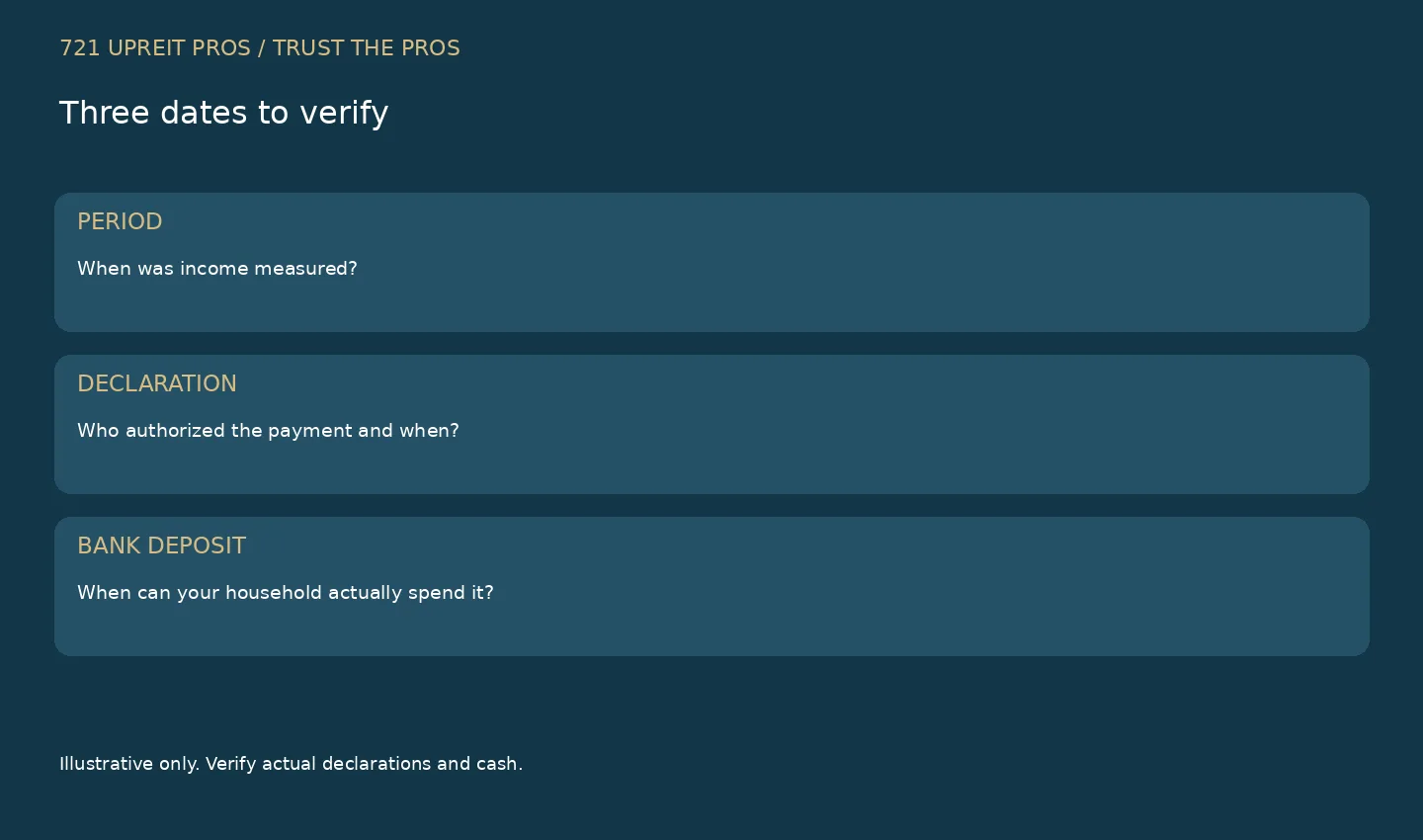
No. Identify the exact interest, governing agreement, distribution policy, declaration authority, record date and payment date. Some programs use monthly payments; some use quarterly periods; some change a policy or pay nothing in a period. A projected or historical schedule is not a contractual promise. Ask whether the cited date is an expected record date, declaration date or the day funds should reach your bank.
TALK TO A 721 UPREIT ADVISOR
Talk to a 721 UPREIT advisor
Request a callback to discuss the questions raised by this article, your timing and what to ask before you commit. Share your name, email and phone below to start the conversation.
No investment commitment or financial documents required. A callback request does not book an appointment or establish an advisory relationship.
A 2026 Urban Edge Properties Form 10-Q reports quarterly dividends for the first three quarters of 2026 and states that future timing and amount remain within its board's discretion. A separate 2026 ExchangeRight Income Fund Form 10-Q describes a monthly distribution policy and specific record and payment timing. These dated filings demonstrate that schedules differ. They do not establish terms for a candidate 721 contribution or guarantee continuation.
Read the partnership-level information for the interest you would actually receive. A REIT-share dividend policy is not automatically the same as an operating partnership distribution term. If the path begins with a 1031 exchange into a DST, keep the DST's current distribution calendar separate from any later proposed Section 721 transaction. The DST-to-721 handoff guide addresses the separate transition period.
How do you turn a quarterly payment into a monthly budget?
Put fixed monthly expenses and every expected cash source in a dated calendar. Mark the distribution as conditional until declared. Record a range for settlement timing, and use only cash already accessible to bridge bills that come due first. Separate this bridge account from a tax reserve, an emergency reserve and money set aside for property or household capital expenses.
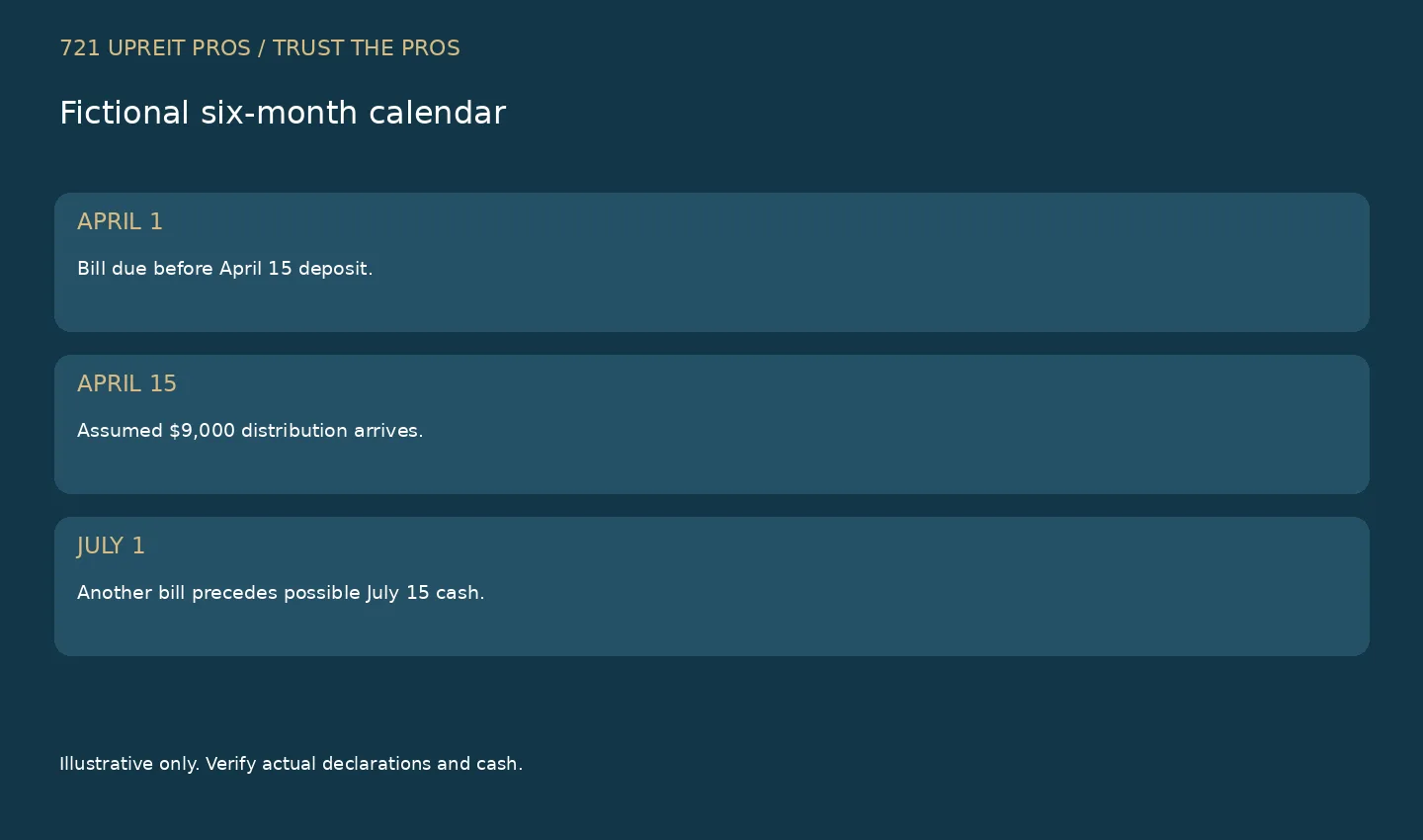
Consider a fictional retiree with $6,000 of essential spending on the first of each month. Assume, for illustration only, a $9,000 distribution is deposited on April 15 for a prior period and again on July 15, with no other cash inflow in this example. The $9,000 payment averages $3,000 per month, but it does not pay the April 1 bill on time. Even if every planned deposit arrived, two quarterly payments would total $18,000 against $36,000 of six-month essential spending.
In this example, a separate reliable cash source or accessible savings must cover at least the $18,000 six-month shortfall and the intra-quarter timing gap. This does not prescribe a reserve amount for a real household. Social Security, pensions, wages, taxes, insurance premiums and other assets may change the calculation. Use actual dates and after-tax cash, not a rounded annualized distribution rate.
| Date | Essential bill | Illustrative deposit | Question |
|---|---|---|---|
| April 1 | $6,000 | $0 | What accessible cash covers the bill? |
| April 15 | $0 | $9,000 | Was the payment declared and actually received? |
| May and June 1 | $12,000 total | $0 | Which other cash source fills the gap? |
| July 1 | $6,000 | $0 | Can the bill be paid before a possible July deposit? |
| July 15 | $0 | $9,000 | What if the deposit is later or smaller? |
| August and September 1 | $12,000 total | $0 | How much reserve remains? |
The exercise exposes two different problems: annual income may be too small for spending, and even sufficient annual income could arrive after a bill is due. Do not solve either problem by assuming that an illiquid interest can be sold or redeemed immediately. The liquidity comparison explains why asset access needs its own evidence.
What if one payment arrives late or is reduced?
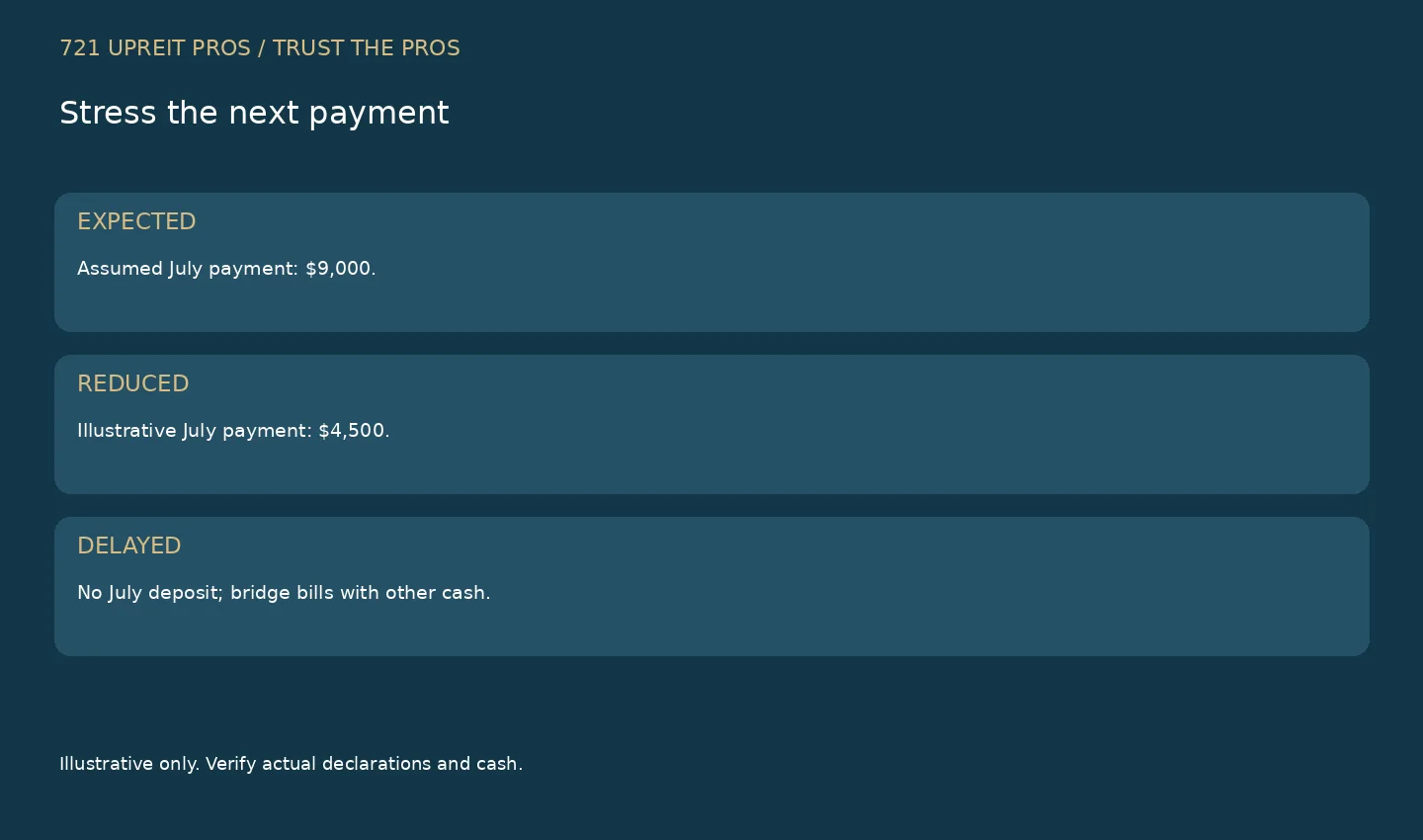
Run a second calendar with the next expected payment delayed by one full period. Then run another with a smaller payment. Keep the assumptions explicit: which bills are fixed, which other income is dependable, what cash is already accessible, and which expense could actually be deferred. A delayed distribution does not automatically become an unpaid debt that the issuer must make up later. Consult the signed terms.
For the fictional household, suppose the July $9,000 payment does not arrive by July 15. The April payment is still only $9,000, while six months of essentials remain $36,000. Without other sources, the cash needed from savings is $27,000 across the period. If July instead pays $4,500, the needed outside cash is $22,500. These figures exclude taxes and investment value changes and are deliberately simplified.
Compare the stress result with the household's accessible reserve and other income. A monthly or quarterly payment history cannot eliminate the chance of a future cut. If an actual payment is unexpectedly lower, use the distribution-reduction reconciliation to check declaration, eligibility, routing and settlement before deciding why it changed.
Does payment frequency tell you whether income is sustainable?
No. Frequency is a calendar fact; sustainability is an economic question. Ask for current financial statements and the period's distribution-source disclosure. Compare property cash flow, debt service, capital needs and reserves. The SEC's non-traded REIT investor bulletin warns that some distributions may be funded with offering proceeds or borrowing rather than property operations. That warning does not prove a particular program uses those sources.
Do not treat a payment as tax-free because the property contribution may have deferred gain. The contribution, ongoing allocations and cash payments require separate analysis. Ask your CPA to estimate after-tax spendable cash and to preserve a reserve for tax obligations. Do not subtract the same fee twice when comparing net payments; use the fee ledger to identify where charges appear.
What should you verify before relying on a distribution?
- Identify the exact issuer, operating partnership and interest you would own.
- Obtain the current agreement, offering documents, supplements and distribution policy.
- Record declaration authority, period, record date, expected payment date and any conditions.
- Separate gross declared amount from net bank deposit, withholding, reinvestment and fees.
- Review recent statements and sources of distributions without assuming historical payments will recur.
- Build an actual monthly bill calendar and stress a skipped or reduced period.
- Keep accessible reserves and ask your CPA about after-tax cash and reporting.
A seller should coordinate broker, qualified intermediary, CPA, attorney and investment professional before closing. A direct Section 721 contribution differs from a 1031 exchange into real property or a qualifying DST, and a later DST-to-721 step is separate and conditional. Use the 721 UPREIT guide for the paths. For related education see DST Experts' 721 overview and the DST and 721 property-sale comparison. For a household-specific discussion, Talk to a 721 UPREIT advisor.
Watch the payment-calendar example
This original one-minute captioned video separates the distribution period, declaration and bank deposit from monthly bill dates.
Read video transcript
0:00 · Calendar, not yield
A rate does not set a bank deposit date.
0:12 · Know three dates
Period, declaration and cash settlement differ.
0:24 · Bills still arrive
The April 1 bill precedes an April 15 deposit.
0:36 · Stress the payment
Model a smaller or delayed quarter.
0:48 · Before relying on cash
Verify policy, declaration and accessible reserve.
Sources checked November 22, 2026: Urban Edge Properties and ExchangeRight Income Fund September 2026 Form 10-Q filings and SEC Investor.gov non-traded REIT bulletin. The filings are dated examples of different schedules, not terms of a candidate investment. General education only; no named expert review or guaranteed payment, tax result, liquidity or retirement outcome.
Frequently asked questions
Are all 721 UPREIT distributions quarterly?
No. Schedules vary by program and may change. Review the current documents and declarations for the exact interest.
Does an annualized rate mean twelve equal monthly deposits?
No. It describes a calculation, not a monthly payment promise.
Can I spend a payment before the declaration date?
That would rely on an unconfirmed future payment. Bridge earlier bills with other accessible cash.
Will a skipped distribution be made up later?
Do not assume so. Review the governing terms and subsequent declarations.
Is a REIT share dividend schedule the same as a partnership distribution?
Not necessarily. Identify the actual interest and its controlling terms.
Does a quarterly distribution prove the income is sustainable?
No. Compare the source of payments with current operating cash flow, borrowings, capital needs and reserves.
TALK TO A 721 UPREIT ADVISOR
Ready to discuss your 721 options?
Request a callback to discuss the questions raised by this article, your timing and what to ask before you commit. Share your name, email and phone below to start the conversation.
No investment commitment or financial documents required. A callback request does not book an appointment or establish an advisory relationship.