
721 UPREIT PROS / DST TRANSITION CASH FLOW
DST-to-721 UPREIT: Do Distributions Continue During the Handoff?
Do not assume DST distributions continue unchanged when a separate 721 UPREIT transaction is proposed. Before closing, the DST agreement governs its payments; after an effective contribution, a different issuer and agreement may control. Ask for the last DST record period, any final adjustment, the first post-closing payment period and the dates cash will actually be sent.
Prepared by 721 UPREIT Pros · Published November 19, 2026 · General education
Key takeaways
- Do not assume a DST payment rate or cadence continues through a separate 721 transaction.
- Track the economic period, eligibility date and payment date for each expected check.
- A 2023 filed example restricts extra pre-closing DST distributions but does not promise any investor a fixed payment.
- Reconcile the last DST statement and first new-issuer declaration before relying on cash.
The cash-flow question is narrower than whether a DST or UPREIT better fits retirement income. It is also different from the response to a lower ongoing payment. Here the investor needs to know who owes or may declare each payment around a specific proposed transaction, including a payment that covers days before closing but is sent afterward.
Which dates decide who pays the investor?
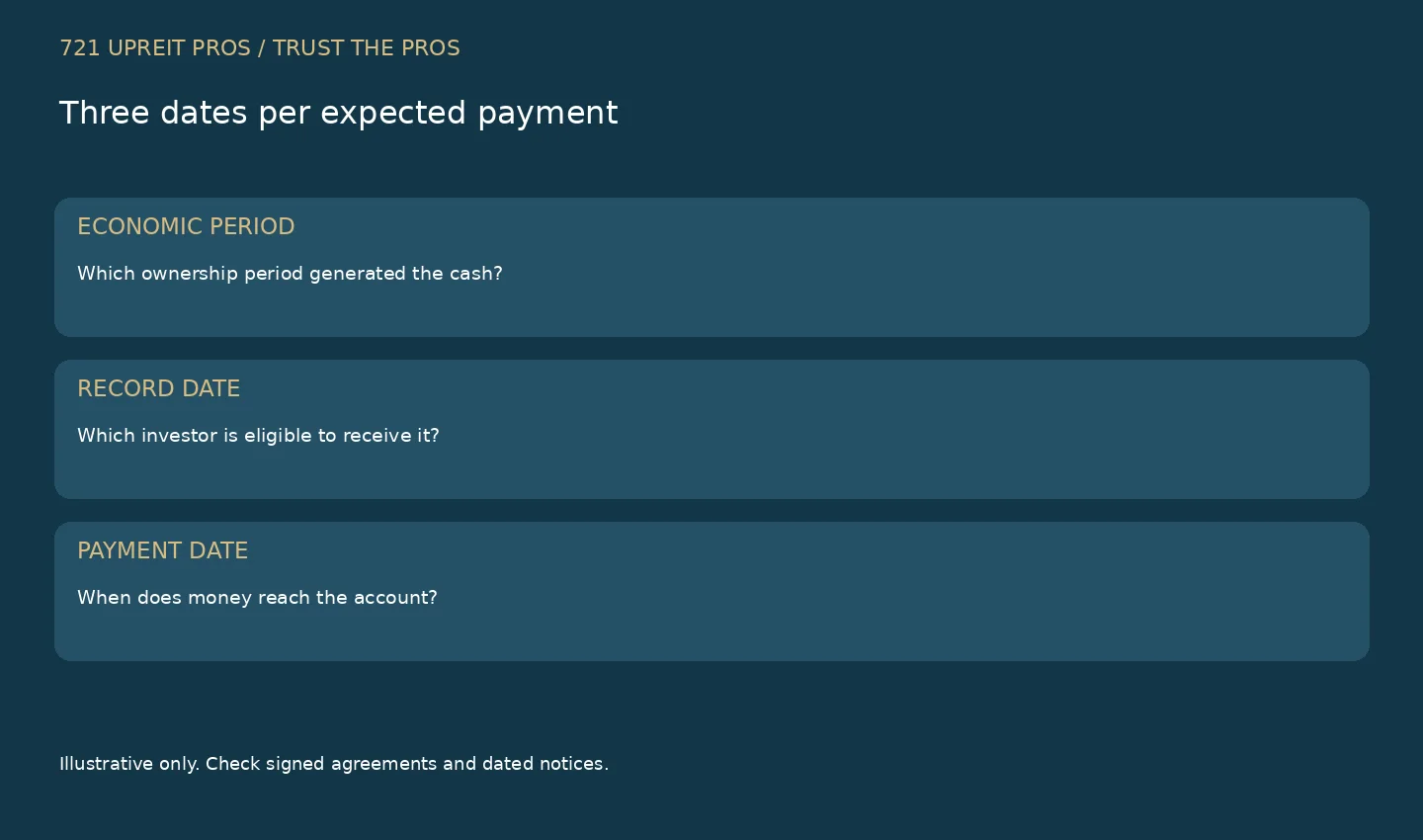
Build a three-date bridge: the economic period that generates cash, the record or eligibility date used to identify the payee, and the payment date when money reaches the account. These dates can fall in different months. A check arriving after closing may relate to an earlier DST period; a projected new payment may relate to a later partnership period. Do not label both checks “monthly 721 income” or double count them in a budget.
TALK TO A 721 UPREIT ADVISOR
Talk to a 721 UPREIT advisor
Request a callback to discuss the questions raised by this article, your timing and what to ask before you commit. Share your name, email and phone below to start the conversation.
No investment commitment or financial documents required. A callback request does not book an appointment or establish an advisory relationship.
Ask the sponsor to mark the legal effective time, the final DST accounting period, and any proration or holdback on one calendar. For each expected payment, request the authority, calculation basis, recipient, paying entity and whether it is declared, accrued, estimated or merely discussed. An advisor should distinguish a signed obligation from an illustrative distribution rate. The amount could change because of reserves, property operations, transaction costs, timing or governing terms.
What governs payments before a DST-to-721 closing?
Start with the DST's current trust agreement, offering terms, distribution notices and actual account history. IRS Revenue Ruling 2004-86 describes a particular DST in which the trustee distributes available cash, after reserves, quarterly. That is a ruling on a specified fact pattern, not a universal quarterly payment promise. A real DST may have different property economics, reserves and distribution practice.
A 2023 SEC-filed DST merger agreement offers a concrete transaction example. Its pre-closing covenant says the DST generally operates in the ordinary course, and it restricts additional distributions except those required by the DST agreement or in the ordinary course under governing documents. It also makes closing subject to conditions. These provisions show why an investor should read both the existing DST agreement and any proposed transaction agreement. They do not say that every pending deal preserves a specified dollar payment.
Ask what happens if the proposed effective date moves. Does the DST continue collecting rent and paying property expenses under its existing arrangement? Who may alter reserves or make an extraordinary distribution? Are there lender or transaction restrictions? Record the answers from the actual documents. A slide showing an expected closing month is not an amendment to the DST's payment obligations.
What changes after the separate 721 transaction closes?
First confirm that closing actually occurred and identify what each investor owns afterward. A qualifying 1031 acquisition of a DST interest and a later Section 721 contribution are separate events. The IRS ruling supports possible 1031 treatment for a DST fitting its facts and other exchange rules; it does not approve a later contribution, determine an investor's payment rights or guarantee any distribution. The executed contribution documents, partnership agreement and post-closing notices govern the new stage.
Ask whether a new issuer has declared a payment, what period it covers, how ownership is recognized, whether a minimum period or record date applies, and whether it is paid in cash or handled another way. Do not carry forward the DST's old distribution rate as though it were a contractual rate for the new investment. Even if an advisor quotes the same annualized number, the cash source, reserves, tax reporting and decision authority may differ.
The 2023 filing describes a merger consideration and investor elections. Its mechanics are specific to that transaction. It should be used to identify questions, not imported into a current proposal as the offer terms. In particular, do not assume a choice between cash and partnership interests exists in every deal. A cash election, if available, can carry a different tax result and must be analyzed with the investor's CPA. The decision-rights guide explains why investor authority is another separate question.
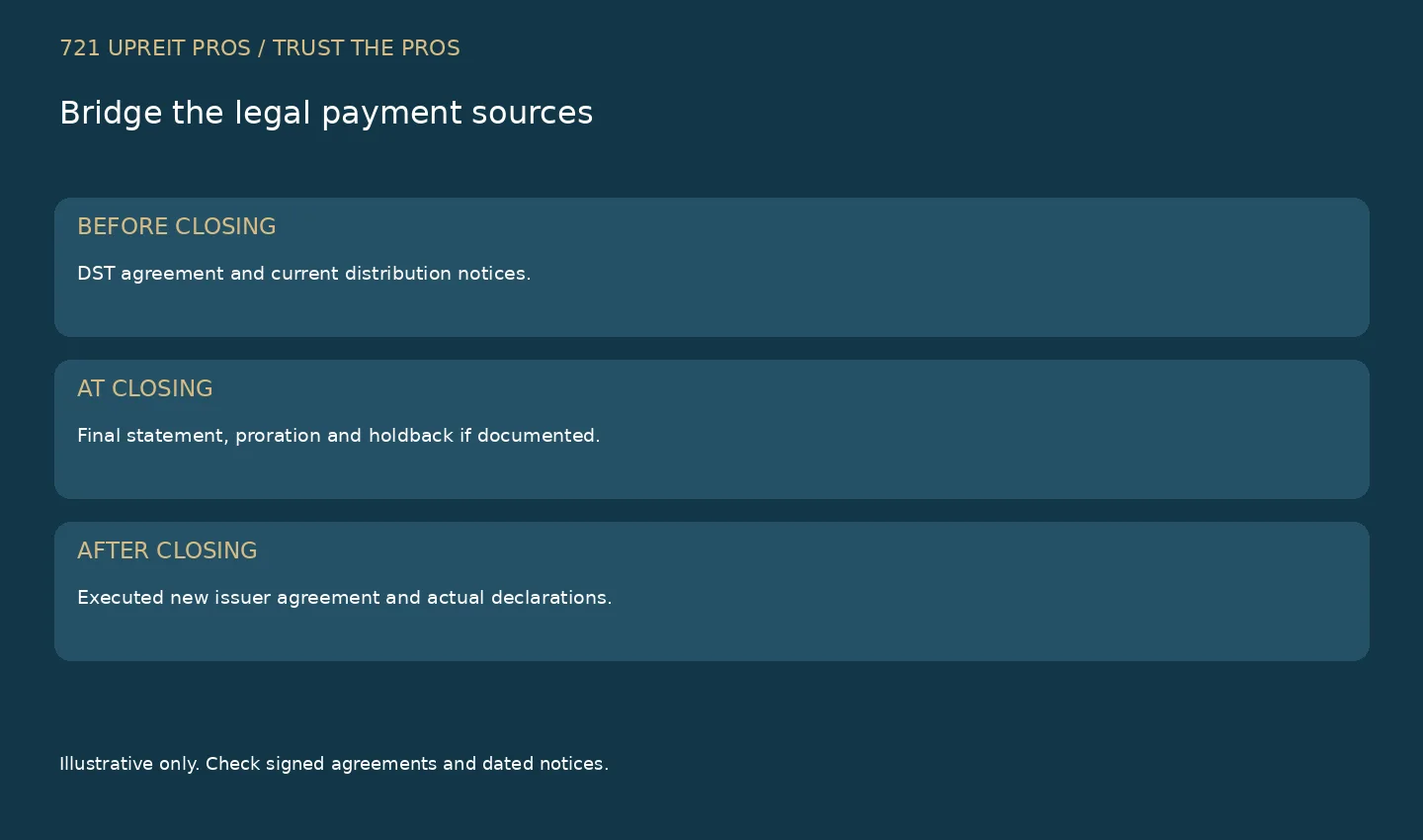
| Line to verify | DST period | Closing adjustment | Post-closing period |
|---|---|---|---|
| Paying entity | Trustee or applicable DST payor | Party named in settlement records | New issuer under executed documents |
| Authority | Trust agreement and notices | Transaction agreement and final statement | Partnership agreement and declarations |
| Amount | Available cash after applicable reserves | Proration, holdback or true-up if documented | Not assumed from old DST rate |
| Date to record | Last covered period and payment date | Effective time and reconciliation date | First eligible period and actual pay date |
How can a missing month appear in a household budget?
Consider a fictional investor who receives a $2,000 DST payment for each normal monthly period, but is told a proposed contribution may close June 20. The last routine DST payment reaches the account in early June for May. The investor tentatively places another $2,000 in July and a new-issuer $2,000 in August on a retirement worksheet. Those entries are unsupported until the periods, record dates, reserves and declarations are confirmed. This illustration does not imply that the real DST pays monthly or that either issuer owes $2,000.
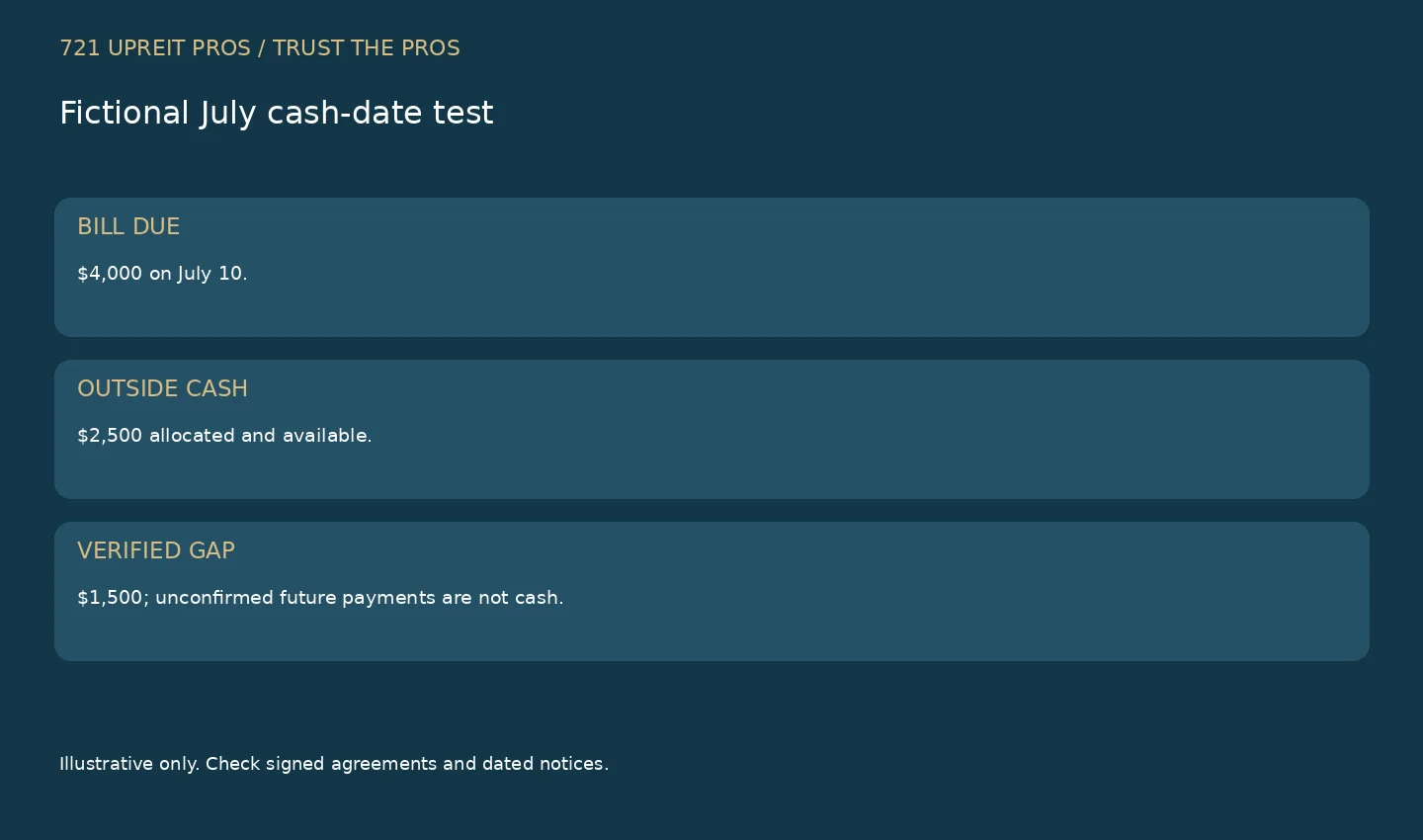
Suppose the household has a $4,000 bill due July 10 and only $2,500 of outside cash allocated to that bill. The verified gap is $1,500. A possible final DST adjustment might be paid after July 10; a new-issuer payment might not be declared for July at all. Neither is available cash for the due date without documentation. The investor should solve the $1,500 funding gap before relying on a transaction that can change date or fail to close.
If the contribution is postponed, return to the DST documents and the current operating status. If it closes, reconcile the final DST statement and new ownership confirmation without assuming a seamless payment cadence. The fallback plan is useful if the contemplated transaction does not happen. Do not treat a delay as proof that existing ownership vanished, and do not treat a projected payment as a guaranteed bridge.
What should you request before relying on continuity?
- Current DST agreement, latest distribution notice and the period covered by each recent payment.
- Proposed transaction agreement and amendments, including pre-closing operations, distribution limits and closing conditions.
- A written schedule showing the proposed effective time and the last DST period, record date and payment date.
- Any final DST proration, reserve release, holdback or true-up and the party responsible for sending it.
- Executed post-closing documents, ownership confirmation, first eligible period and actual payment policy.
- A separate tax-preparer handoff explaining which entity reports each period and whether a cash election or other consideration changes the tax analysis.
- A household cash plan that works if closing or the first new payment is delayed.
Use the seven-document DST-to-721 checklist to gather the complete transaction file and the process timeline to keep the stages distinct. The 721 UPREIT guide provides the broader tax and ownership context. For related explanations, see DST Experts' 721 overview and this DST versus 721 property-sale route comparison. To review an actual payment calendar, Talk to a 721 UPREIT advisor.
Watch the distribution handoff map
This original one-minute video separates the DST payment period, closing adjustment and first new-issuer period.
Read video transcript
0:00 · Do payments continue?
Do not assume the old cadence carries through.
0:12 · Before closing
The DST agreement controls its payment period.
0:24 · At closing
Reconcile any final adjustment or holdback.
0:36 · After closing
Check the new issuer and first eligible period.
0:48 · Test the due date
Keep expected payments outside verified cash.
Primary sources checked November 19, 2026: IRS Revenue Ruling 2004-86 and a 2023 SEC-filed transaction agreement. The filing is a historical example, not a current offer. General education only; no named expert review, seamless payment, contribution, liquidity or tax result is represented.
Frequently asked questions
Does a proposed 721 transaction stop DST payments immediately?
Not necessarily. Check the existing DST agreement and any signed pre-closing covenants. A proposal alone is not proof of closing or of a changed payment obligation.
Can a DST check arrive after a 721 closing?
Possibly. Its payment date may be later than the period that generated the cash. Confirm the final record period, payee and any closing adjustment.
Will the new investment pay at the old DST rate?
Do not assume so. The new issuer, governing agreement, reserves and declarations may differ. Obtain current written terms.
Does IRS Revenue Ruling 2004-86 guarantee quarterly DST distributions?
No. The ruling describes a specific DST fact pattern with quarterly payments of available cash after reserves. It does not set every DST investor’s payment schedule.
What if the proposed closing is delayed?
Confirm current DST operations and payment notices, then update the cash calendar. Do not insert a new-issuer payment before an actual closing.
Can cash elected at the 721 closing replace a missing distribution?
Only if that specific transaction offers and completes such an election. A cash election can have a different tax result; review the signed documents and CPA analysis.
TALK TO A 721 UPREIT ADVISOR
Ready to discuss your 721 options?
Request a callback to discuss the questions raised by this article, your timing and what to ask before you commit. Share your name, email and phone below to start the conversation.
No investment commitment or financial documents required. A callback request does not book an appointment or establish an advisory relationship.