
721 UPREIT PROS / LIQUIDITY DECISIONS
721 UPREIT Liquidity: What Does “Liquid” Actually Mean?
“Liquid” should mean a reliable path to cash at a knowable time and price. A DST interest, a proposed 721 contribution, non-traded REIT shares and exchange-traded REIT shares have different exit mechanisms. Before choosing a route, identify what you will own at each stage, who must approve an exit, what price applies and when cash could actually arrive.
Prepared by 721 UPREIT Pros · Published November 18, 2026 · General education
Key takeaways
- A liquidity claim needs the actual asset, exit gatekeeper, price basis and cash date.
- DST interests, partnership interests, non-traded REIT shares and listed REIT shares have different mechanisms.
- An issuer repurchase plan may be limited or suspended; a listed share can be sold only at the available market price.
- Do not count a hoped-for later contribution or conversion as cash available for a dated bill.

This article answers one narrower question than our household cash-needs worksheet or holding-period calendar: when an advisor says a 721 UPREIT route is “liquid,” which legal asset and exit step do they mean? A possible future REIT share is not the same thing as a share already held in a brokerage account.
Which four questions turn “liquid” into a usable claim?
First ask what can be sold or requested today. Then ask who is obligated to buy or redeem it, whether the amount can be limited, and what price will be used. Finally ask when the proceeds become available after all restrictions, approvals and settlement steps. A quoted distribution rate answers none of these questions. The SEC defines liquidity as the ability to buy or sell readily in a secondary market without a large price impact; a contractual request process is a different mechanism.
TALK TO A 721 UPREIT ADVISOR
Talk to a 721 UPREIT advisor
Request a callback to discuss the questions raised by this article, your timing and what to ask before you commit. Share your name, email and phone below to start the conversation.
No investment commitment or financial documents required. A callback request does not book an appointment or establish an advisory relationship.
Use the same four-column record for every proposal: asset, gatekeeper, price and cash date. Label each answer “documented,” “conditional” or “unknown.” If the exit depends on a later contribution, share settlement or listing, do not put its hoped-for date in the documented column. This simple discipline prevents a marketing phrase from turning into a household spending assumption.

How do DST, UPREIT and REIT paths differ?
A qualifying DST interest may be acquired as replacement property in a Section 1031 exchange when the facts satisfy IRS Revenue Ruling 2004-86 and the other exchange requirements. That tax classification says nothing by itself about finding a buyer for an investor's beneficial interest. Read the DST trust agreement, offering materials, transfer limits and sale plan. A property sale or refinancing may generate proceeds, but neither is a personal demand deposit.
A Section 721 contribution is a separate partnership transaction. If a property or qualifying interest is later accepted by an operating partnership, the investor must analyze the interest actually received and the governing documents. Acceptance, valuation, timing and any later route to REIT shares are not promised by the earlier DST purchase. The DST-to-721 document checklist helps distinguish a sponsor's aspiration from an executed right.
A publicly traded REIT share is listed on a securities exchange and normally can be sold through a brokerage account at the prevailing market price. The SEC's publicly traded REIT bulletin describes the real-time price and relative ease of trading. That does not protect the seller from price declines, bid-ask spreads, market halts or tax consequences. Buying listed shares directly with sale proceeds is a different transaction from a qualifying 1031 replacement or a Section 721 contribution.
A public non-traded REIT can file with the SEC without listing its shares. Its repurchase program may offer limited access, but caps, funding limits, discounts, eligibility requirements and discretion can affect fulfillment. The SEC's non-traded REIT bulletin explains that such programs may be restricted or stopped. A published net asset value is not the same as a guaranteed bid for every requested share.
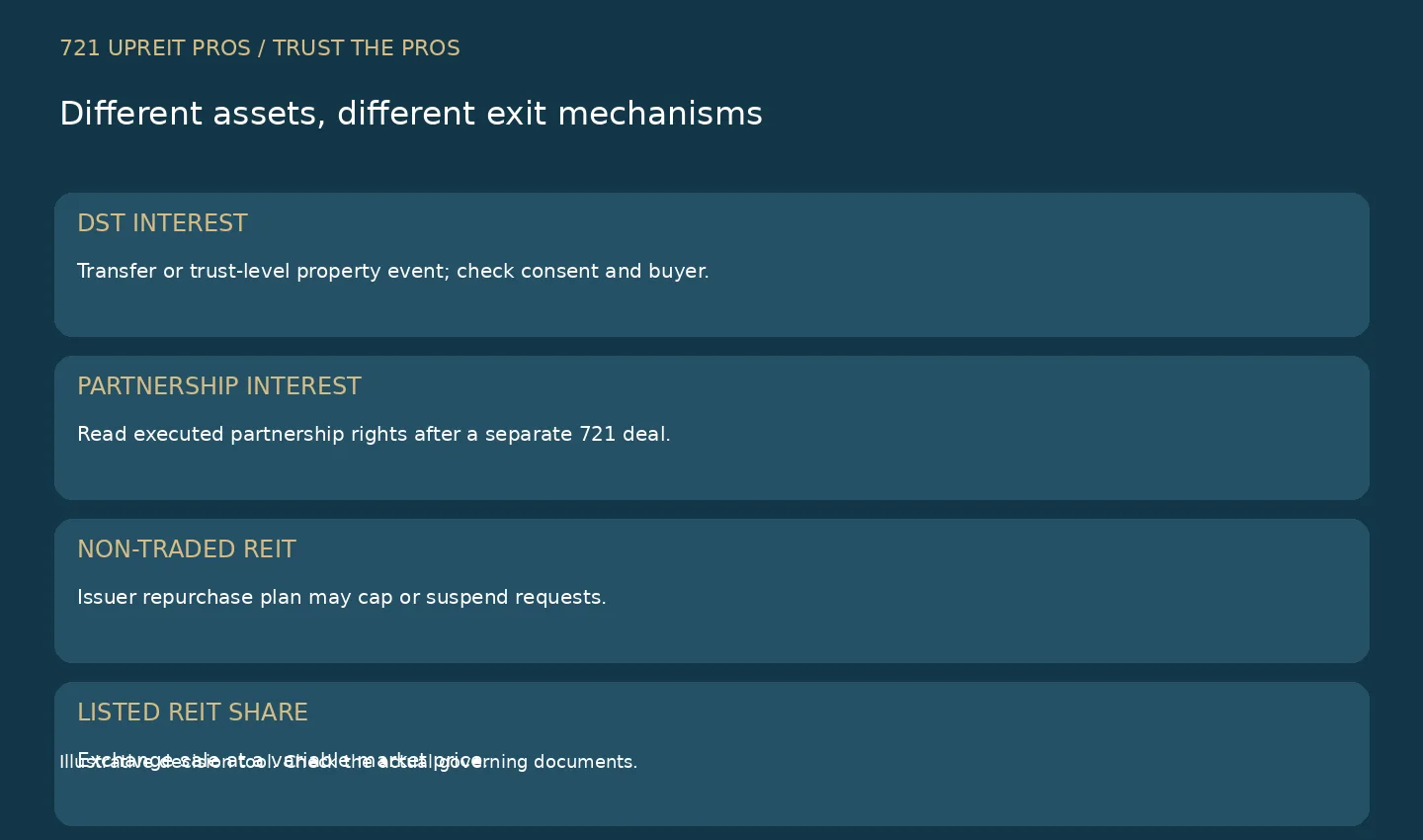
| Current asset | Potential exit route | Critical uncertainty | Price evidence |
|---|---|---|---|
| DST beneficial interest | Permitted transfer or trust-level property event | Buyer, consent and timing | Actual offer or sale proceeds, not assumed par |
| Partnership interest after a separate 721 | Rights in executed partnership agreement | Restrictions and settlement form | Contract formula and current documents |
| Non-traded REIT share | Issuer repurchase plan or other permitted sale | Cap, suspension and funding | Applicable plan price, possible discount |
| Exchange-traded REIT share | Exchange sale through broker | Market price and execution | Live bid and actual fill |
This grid compares legal mechanisms, not expected returns or tax outcomes. A DST may have a projected hold, but that projection does not create a personal exit right. A non-traded REIT may process some requests, but past fulfillment is not a promise for the next window. A listed security is more marketable, yet the amount received can be much lower than the amount invested. Our risk guide covers the broader due-diligence context.
How should a seller test a near-term cash deadline?
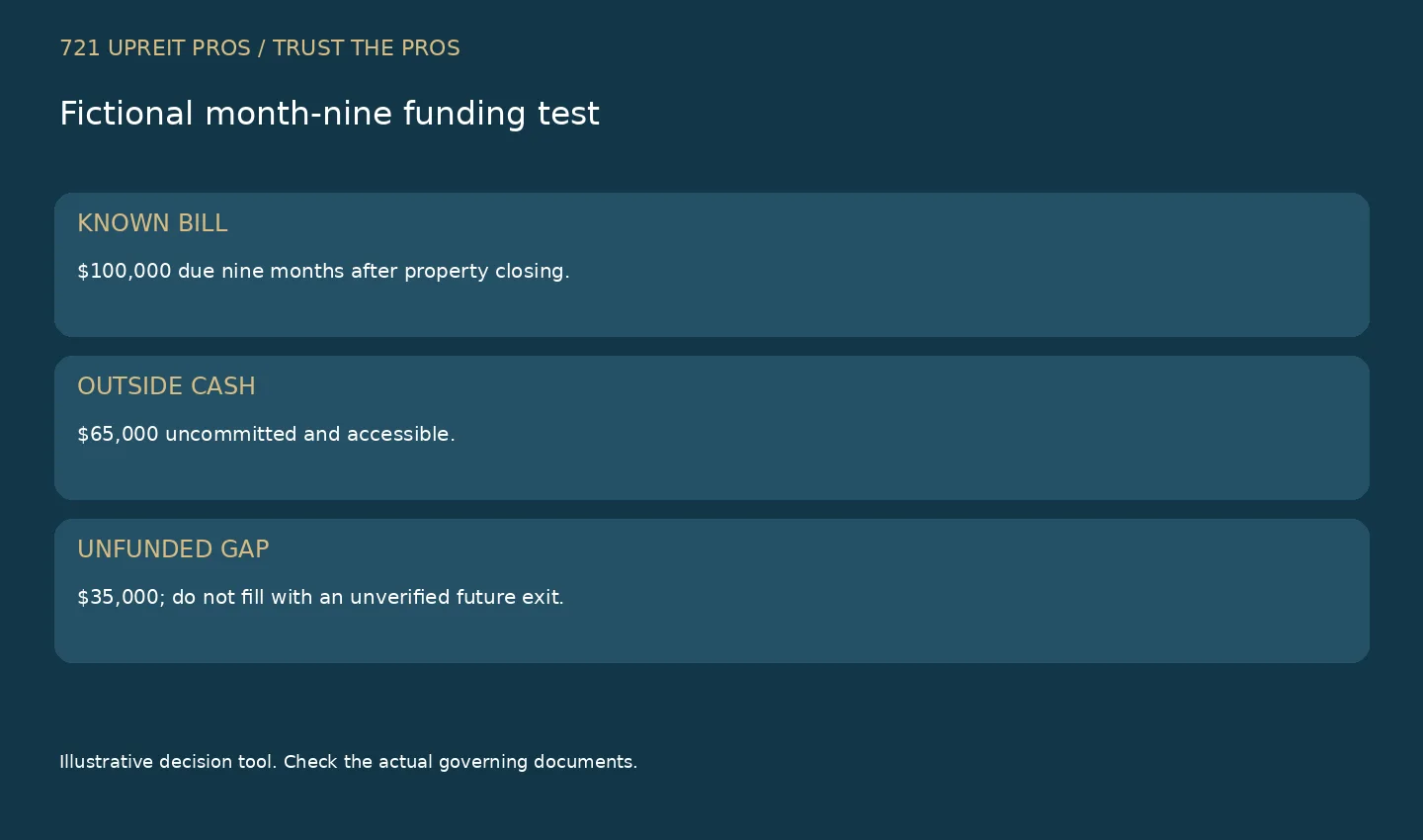
Assume a fictional seller needs $100,000 for a known expense nine months after a property closing. One proposal involves a qualifying 1031 exchange into a DST with a possible later 721 transaction. Another involves a direct 721 property contribution, contingent on partnership acceptance. A third is a taxable sale followed by a listed REIT purchase. This is a decision illustration, not a recommended allocation or a tax calculation.
The seller has $65,000 of uncommitted outside cash. The arithmetic gap is $35,000. Neither the DST's projected distributions nor a potential future partnership transaction is documented cash for the month-nine bill. Selling listed REIT shares could raise cash only if the seller actually owns them then and accepts the market price and tax consequences. Even the taxable sale proceeds must be reconciled after debt, costs and taxes; gross sale price is not a bank balance.
Instead of guessing a redemption date, request a dated funding plan for the $35,000 gap. It might involve retaining cash outside an investment, changing the proposed investment amount, or revisiting the deadline. A qualified intermediary and tax adviser must review any cash taken from a proposed 1031 exchange. A direct 721 proposal needs its own tax and closing review. The key test is whether the expense can be covered without assuming a sponsor action that has not been contractually established.
What evidence should an advisor produce before you act?
- Write the exact asset and legal owner at each planned stage, with dates that are executed versus projected.
- Collect the DST trust agreement, transfer rules and business plan if a DST is proposed.
- For a separate 721 proposal, request the actual contribution and partnership documents, not only a slide describing a possible future transaction.
- For non-traded REIT shares, read the current prospectus and share-repurchase plan. Check recent request, fulfillment, deferral and suspension history in issuer filings.
- For listed REIT shares, identify the exact share class and ticker. Check whether shares will actually be delivered, any resale restrictions and the brokerage settlement process.
- Have the tax adviser model the sale, 1031 exchange, contribution or share sale as separate events. Do not assume that a liquid security can be acquired tax free.
- Put near-term cash needs and outside reserves on the same calendar as each conditional exit, leaving unknown dates blank.
The SEC's non-traded REIT disclosure guidance specifically discusses repurchase-program restrictions and request history. Use those filings as evidence, but verify the latest document for the exact issuer and share class. Ask an advisor to annotate each claim with its source and date rather than saying merely that an investment is “liquid.”
For the broader route comparison, see the 721 UPREIT guide, the process timeline and the DST versus UPREIT income comparison. DST Experts' DST-to-721 overview adds background, and this property-sale path comparison frames the earlier choice. For a documented side-by-side recommendation, Talk to a 721 UPREIT advisor.
Watch the liquidity decision map
This original one-minute video applies the four liquidity tests to each ownership path.
Read video transcript
0:00 · What does liquid mean?
Know the asset, gatekeeper, price and cash date.
0:12 · DST route
A property plan is not a personal cash demand.
0:24 · Non-traded REIT
Repurchase limits and suspensions can matter.
0:36 · Listed REIT
Shares trade, but market prices can fall.
0:48 · Test the cash deadline
Keep an unknown exit outside available reserves.
Primary sources checked November 18, 2026: IRS Revenue Ruling 2004-86, SEC publicly traded REIT bulletin, SEC non-traded REIT bulletin and SEC staff disclosure guidance. General education only. No named expert review, conversion, liquidity, return or tax result is represented.
Frequently asked questions
Does a DST interest have a public market?
Do not assume one. Review the trust agreement, transfer restrictions, available buyers and the property-level sale plan. The IRS tax classification does not create a sale market.
Does a proposed later 721 contribution make my DST liquid now?
No. A later contribution is a separate transaction requiring acceptance and governing documents. Do not book a future exit as current cash.
Are all REIT shares exchange-traded?
No. Public non-traded REITs may file with the SEC but do not list on a stock exchange. Their issuer repurchase plans can be limited.
Can a non-traded REIT suspend repurchases?
Yes, depending on its current plan. SEC guidance describes caps, funding limits and discretion to amend, suspend or terminate programs.
Does a listed REIT guarantee my original investment back?
No. It generally offers a market sale route, but the price can move and a sale can incur costs and tax consequences.
Does a distribution prove principal can be withdrawn?
No. Periodic distributions and return of invested principal are different cash flows with different authorities and conditions.
TALK TO A 721 UPREIT ADVISOR
Ready to discuss your 721 options?
Request a callback to discuss the questions raised by this article, your timing and what to ask before you commit. Share your name, email and phone below to start the conversation.
No investment commitment or financial documents required. A callback request does not book an appointment or establish an advisory relationship.