
721 UPREIT PROS / LIQUIDITY RECORDS
Convert OP units to REIT shares: contract and tax checklist
Converting or redeeming operating partnership units for REIT shares changes the security you own, the documents that control it and the records your tax professional needs. It does not automatically create cash. Verify the settlement form, exchange ratio, share class, restrictions, tax treatment and later-sale records as separate events.
By 721 UPREIT Pros · September 22, 2026 · OP-unit-to-REIT-share conversion checklist

This article answers a narrower question than the UPREIT redemption request checklist. That guide covers whether and when a request may be accepted, priced and paid. This page begins after the documents allow a share settlement or exchange. It focuses on the ownership handoff from OP units to REIT shares and on the separate later decision to sell, tender or retain those shares.
What changes when OP units become REIT shares?
Your partnership interest is surrendered or transferred under the governing agreement, and you receive a stated class and number of REIT shares if the transaction is completed. The partnership agreement no longer describes every right attached to the received position. The REIT charter, bylaws, prospectus, share-class terms, securities restrictions and any share repurchase plan may now matter.
TALK TO A 721 UPREIT ADVISOR
Talk to a 721 UPREIT advisor
Request a callback to discuss the questions raised by this article, your timing and what to ask before you commit. Share your name, email and phone below to start the conversation.
No investment commitment or financial documents required. A callback request does not book an appointment or establish an advisory relationship.
The label on the form is not enough. In some agreements, a limited partner submits a redemption request, but the general partner or REIT decides whether settlement will be cash, REIT shares, a combination or nothing. In other arrangements, a separate exchange or conversion provision controls. Read the actual provision and the confirmation for your transaction.
Key takeaway
REIT shares are not cash, a stock-exchange listing or a guaranteed repurchase. A share settlement can end one ownership record while starting another. Preserve both sides of that handoff and treat a later share sale as its own transaction.
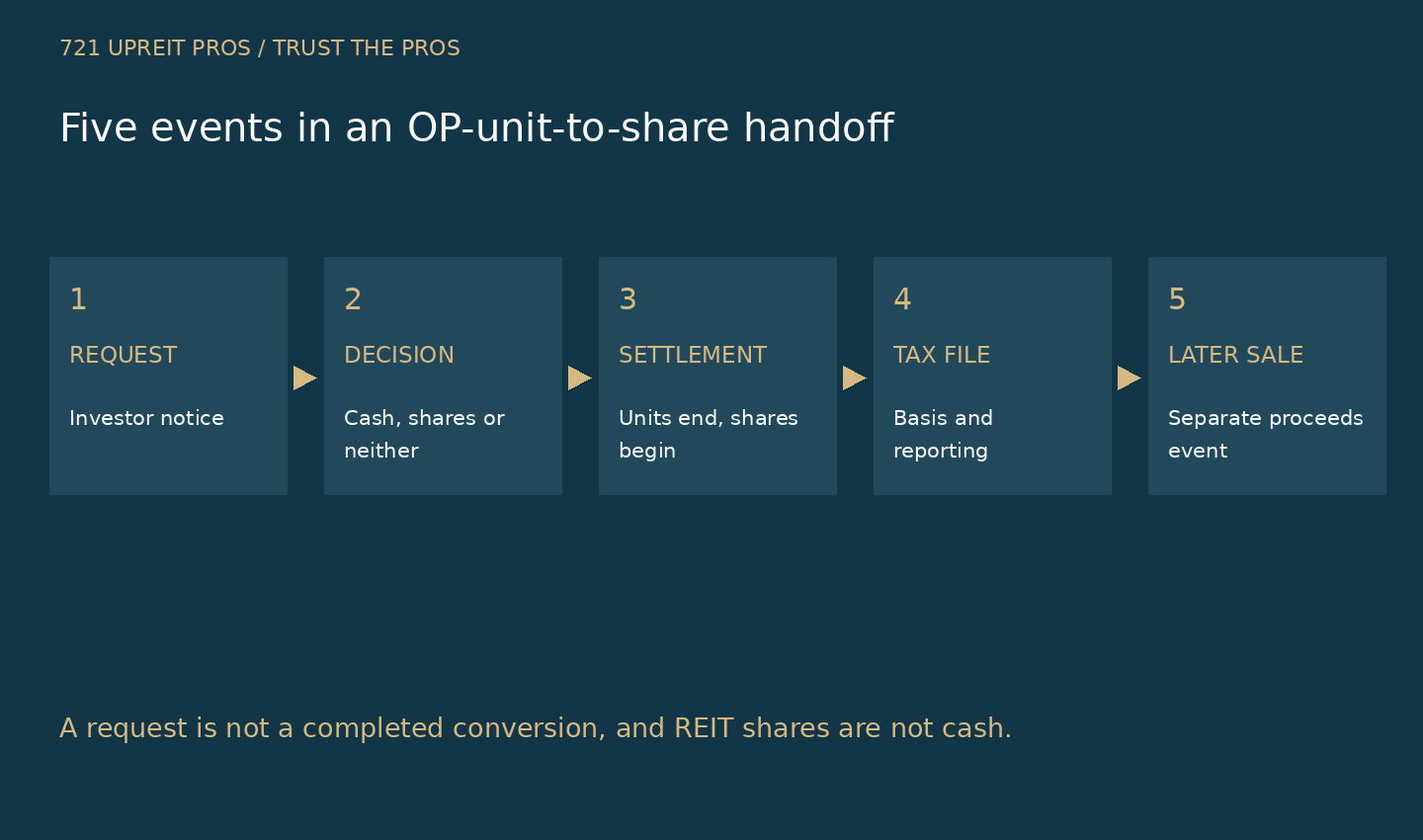
Which five events should the investor track?
Use five event folders instead of one generic conversion folder. Each event needs its own date, source document, quantity and unresolved questions.
| Event | Evidence to retain | Question it answers |
|---|---|---|
| 1. Request or election | Current agreement, amendments, eligibility confirmation, signed notice and delivery receipt | What did the investor request, under which provision and for how many units? |
| 2. Settlement decision | Issuer response identifying cash, shares, a combination, deferral, rejection or withdrawal | Who chose the settlement form and what conditions remain? |
| 3. Unit cancellation and share issuance | Closing statement, exchange ratio, pricing or NAV date, unit-class cancellation and share-class statement | How many OP units stopped and exactly what shares began? |
| 4. Tax and basis record | Prior basis schedule, K-1, liability schedule, transaction statement and tax forms or issuer reporting | How is the exchange reported and what basis and holding-period records carry to the shares? |
| 5. Later share disposition | Broker or transfer-agent statement, repurchase notice, trade confirmation and proceeds record | Was there a later sale, tender or repurchase, and what separate gain, loss or restriction applies? |
Do not backfill the first four events from a later account screen. A screen showing a share count may not establish the governing clause, settlement date, exchange ratio, tax characterization or basis. Request the closing record when it is issued and reconcile it while the people involved can still answer questions.
Who chooses cash or REIT shares?
The agreement decides who has the choice. Do not assume that selecting “redemption” means the investor selected cash. A September 25, 2024 Brookfield REIT operating partnership agreement filed with the SEC provides one dated example. Section 8.5 describes a limited partner's request, gives the partnership discretion over whether to redeem, and describes a general-partner or REIT election to acquire tendered units for cash, REIT shares or a combination. The filing also describes class matching, a special conversion rate for certain units and restrictions on the received shares.
This is a historical public-document example, not a description of every UPREIT, a current offering or your rights. Your agreement may use different defined terms, waiting periods, minimums, valuation dates, conversion rates, issuer discretion and tax language. Read the definitions together with the operative section and every amendment. See the SEC-filed agreement, especially Section 8.5.
Contract terms to copy into the worksheet
- The eligible holder, eligible unit class, minimum quantity and holding period.
- The exact notice form, delivery address, receipt standard and withdrawal deadline.
- Whether the investor, partnership, general partner or REIT chooses the settlement form.
- The exchange ratio, conversion-rate adjustment, valuation date and treatment of fractional shares.
- The scheduled settlement date and the issuer's rights to defer, reduce, suspend or reject the request.
- The received share class, registration status, ownership limits, transfer restrictions and repurchase terms.
- The agreement's description of tax treatment, withholding and required representations.
Does receiving REIT shares mean the investment is liquid?
No. Liquidity depends on the received shares and the market or program available to them. Publicly traded, SEC-registered non-traded and private REIT shares can have very different transfer, pricing and repurchase features. Even a registered share can be subject to ownership limits, holding periods, securities-law restrictions or account-processing steps.
A REIT share repurchase plan is also different from the OP-unit redemption right that produced the shares. Review the current plan separately. A plan may use caps, queues, discounts, eligibility periods, pricing conventions, suspensions or board discretion. A published NAV is not a promise that the holder can sell every share for that amount on demand.
| Topic | Document or confirmation | Planning mistake to avoid |
|---|---|---|
| Share class | Issuance statement, charter, prospectus and class supplement | Assuming every class has the same fees, rights or repurchase treatment |
| Trading venue | Exchange listing or written confirmation that the shares are not exchange traded | Treating “REIT share” as a synonym for a freely tradable listed stock |
| Transfer restrictions | Legend, registration status, ownership limits and transfer-agent requirements | Projecting a sale before checking whether the transfer can be completed |
| Repurchase program | Current plan, latest suspension notice, caps, timing and price formula | Counting a voluntary program as guaranteed cash access |
| Cash planning | Separate reserve and spending schedule | Using a share value to fund a known bill before proceeds are settled |
DST Experts provides a related overview of 721 UPREIT exit-strategy questions and a separate discussion of basis, debt and exit-tax records. Use those resources to frame questions, then rely on the current documents and professional analysis for the actual interest.
Is the OP-unit-to-share exchange tax free?
Do not assume that the original Section 721 treatment carries through to a later OP-unit exchange for REIT shares. Section 721 generally addresses gain or loss when property is contributed to a partnership for a partnership interest. A later transfer or redemption is a different event and must be analyzed under its own facts and tax provisions.
Partnership-distribution rules, sale or exchange rules, debt allocations, tax-protection agreements and the issuer's transaction structure can all matter. The Brookfield agreement example expressly describes one share-settled transaction as a transfer of tendered units to the general partner or REIT in exchange for shares. That contract language is a reason to obtain transaction-specific tax advice, not a conclusion about another agreement.
Internal Revenue Code Section 721 covers qualifying contributions to a partnership. Section 731 addresses gain or loss on certain partnership distributions, and IRS Publication 541 summarizes partnership basis, distributions and transfers. These general sources do not calculate the result for a specific OP-unit settlement.
Records for the CPA
- The original contribution agreement and closing statement.
- All Schedules K-1 and the maintained outside-basis workpaper through the settlement date.
- Partner liability allocations before and after the event.
- The redemption or exchange notice, issuer response and settlement confirmation.
- The number and class of units surrendered and shares received.
- Any cash, fractional-share payment, fee, withholding or other property.
- The issuer's tax statement and later Form 1099-B or other disposition reporting, if applicable.
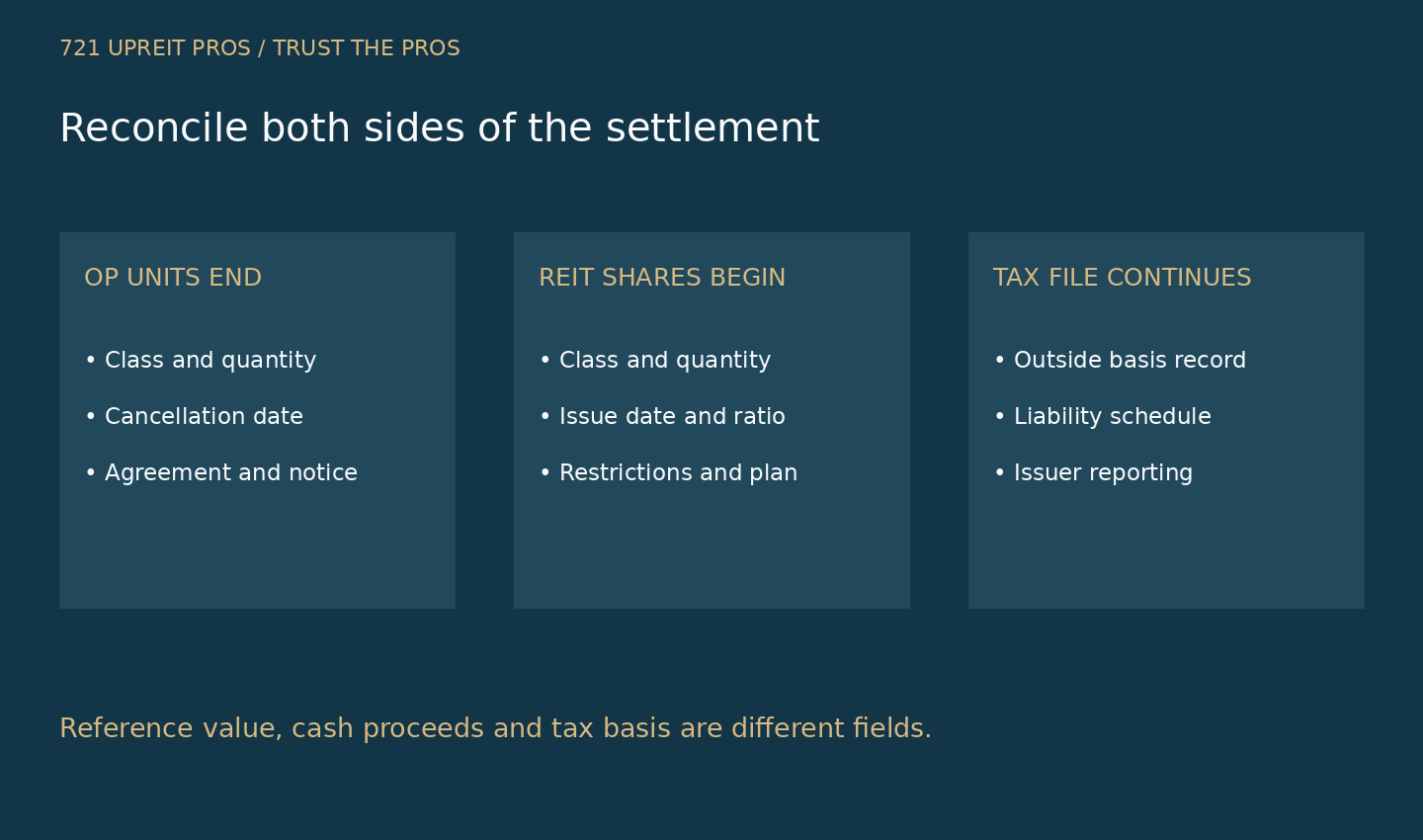
How should an investor reconcile the share count?
Assume a hypothetical holder submits 40,000 eligible OP units. The current agreement and written response say the issuer will settle entirely in one stated REIT share class. The agreement uses a 1.00 share-per-unit exchange ratio for this class, with no fractional-share payment in this example. The settlement confirmation should show 40,000 units surrendered and 40,000 shares issued.
If the applicable conversion rate were 0.98 instead, the same 40,000 units would produce 39,200 shares. That difference should come from the identified formula and inputs, not from a verbal estimate. If the shares have a stated value or NAV of $24.50 on the relevant date, 40,000 shares times $24.50 equals a $980,000 reference value. It is not automatically a cash proceeds amount, an available repurchase amount, a tax basis or a guaranteed sale price.
| Record | Illustrative amount | What it does not prove |
|---|---|---|
| OP units surrendered | 40,000 | That a cash redemption occurred |
| Contract exchange ratio | 1.00 share per unit | That every class or agreement uses 1:1 |
| REIT shares issued | 40,000 of the confirmed class | That the shares are listed or immediately repurchasable |
| Reference share value | $24.50, if supported by the designated source and date | That $980,000 can be received in cash |
| Tax basis and holding period | CPA calculation pending | That NAV equals basis or that no gain can arise |
Now assume the holder later sells or tenders 5,000 shares for $26 each and receives $130,000 of gross proceeds before any fees or withholding. That later disposition is a new event. The tax calculation compares the proceeds with the basis allocated to those shares under the applicable rules and records. It does not reuse $24.50 automatically, and it does not become tax free merely because the property originally entered the operating partnership through a Section 721 contribution.
What should be complete before relying on the conversion?
- Authority: Identify the exact clause, eligible holder and person who controls the settlement form.
- Notice: Save the signed request, delivery evidence, issuer response and withdrawal terms.
- Ratio: Recalculate the unit-to-share result from the stated formula, class and valuation date.
- Handoff: Match the OP-unit cancellation and REIT-share issuance on the same record date.
- Rights: Read the received class's charter, prospectus, legends, ownership limits and transfer provisions.
- Liquidity: Separate exchange listing, transferability and any voluntary repurchase plan.
- Tax file: Give the CPA the basis, liability, K-1, settlement and issuer-reporting package.
- Later sale: Open a new record for any share sale, tender or repurchase and do not mix it with the OP-unit settlement.
Use the complete 721 UPREIT guide for the broader structure and the 721 UPREIT risk review for liquidity, control, debt and tax questions. The post-contribution ownership-stage guide explains why OP units and REIT shares are not treated as direct real property in a personal Section 1031 exchange. When you are ready to connect the documents to your objectives, talk to a 721 UPREIT advisor.
One-minute briefing and downloadable worksheet
Download the conversion checklist
Read video transcript
0:00 · A redemption request may not be a cash election.
Read who chooses cash, shares or a combination. Save the agreement, notice and written response.
0:12 · Recalculate the unit-to-share exchange.
Confirm the unit class, share class, ratio and date. Record every adjustment and fractional-share term.
0:24 · REIT shares do not guarantee liquidity.
Check listing status, legends, ownership limits and transfers. Read any share repurchase plan separately.
0:36 · Keep the tax record separate from account value.
Preserve K-1, outside basis, liability and settlement records. Ask the CPA how the specific event is reported.
0:48 · Treat a later share sale as a new event.
Retain the sale or repurchase confirmation and proceeds. Do not use NAV as tax basis without support.
Sources checked September 22, 2026. General education by 721 UPREIT Pros with AI assistance. No independent expert review is represented. The agreement is a dated example, not a current offering or universal term. The numbers are hypothetical. Share issuance, liquidity, value, distributions and tax treatment are not guaranteed. Consult your own legal, tax and investment professionals.
BEFORE YOUR ADVISOR CONVERSATION
Three questions before you commit
This companion briefing covers the professional's identity, compensation and how restrictions fit your cash needs. Use it alongside this article's specific document checks.
Loading the video connects to YouTube. Watch on YouTube · 721 UPREIT Pros channel · Read the full advisor checklist.
Read video transcript
Before you hire a seven twenty-one UPREIT advisor, ask these three questions.
First: who exactly am I hiring? Get the professional's legal name, firm and registration information. Check the record through Investor dot gov and read the firm's relationship summary where applicable. Ask whether this conversation involves brokerage services, investment advice, or both. A marketing title alone does not answer that question.
Second: who gets paid, and how much? Request a written cost breakdown in dollars. Identify the payer, calculation base, payment timing and ongoing charges. Include product expenses and embedded compensation. No separate advisor invoice does not mean there are no costs.
Third: how does this fit my cash needs? Review the actual agreements. Ask who controls a possible conversion and what happens if it does not occur. Separate permission to request redemption from approval, pricing and payment. Do not assume a fixed cash-out date.
Then agree on responsibilities. Your investment professional, CPA, attorney and qualified intermediary can have different roles. Put continuing service and unresolved questions in writing.
Read the complete advisor checklist using the article link in the description. Seven twenty-one UPREIT Pros. Trust the Pros. Educational only. Investments involve risk and may be illiquid. Tax treatment depends on your circumstances.
Educational only. Investments involve risk and may be illiquid. Footage is illustrative; narration is synthetic.
TALK TO A 721 UPREIT ADVISOR
Ready to discuss your 721 options?
Request a callback to discuss the questions raised by this article, your timing and what to ask before you commit. Share your name, email and phone below to start the conversation.
No investment commitment or financial documents required. A callback request does not book an appointment or establish an advisory relationship.