
721 UPREIT PROS / AGREEMENT REVIEW
721 UPREIT tax protection agreements: what is actually protected?
A 721 UPREIT tax protection agreement is a negotiated contract addressing specified tax consequences, not a blanket promise that an investor will never owe tax. Before relying on it, match the protected investor, property, event, time period, conditions and remedy to the actual signed documents.
By 721 UPREIT Pros · September 18, 2026 · Agreement-review worksheet

The practical question is not simply whether a sponsor mentions tax protection. It is: if a particular event happens to my investment, what must someone do, and what evidence would I need? This guide supplies an original coverage matrix and a hypothetical timing test to help you prepare that discussion with your attorney and CPA.
Is tax protection the same as Section 721 tax deferral?
No. Section 721's contribution rules and a contractual promise between parties are different layers. A contract does not replace the tax law or establish that the original transaction qualifies.
TALK TO A 721 UPREIT ADVISOR
Talk to a 721 UPREIT advisor
Request a callback to discuss the questions raised by this article, your timing and what to ask before you commit. Share your name, email and phone below to start the conversation.
No investment commitment or financial documents required. A callback request does not book an appointment or establish an advisory relationship.
IRS Publication 541, revised December 2025, explains that property contributions for partnership interests generally do not produce recognized gain or loss, subject to exceptions. It also explains contributed-property gain allocations and the treatment of a decrease in a partner's share of liabilities. Later transactions can have tax consequences even when an initial contribution qualifies. Your own basis and transaction facts remain necessary.
For the overall structure, start with the 721 UPREIT guide and investor planner. An earlier 1031 exchange into a qualifying DST is separate from a potential later contribution to an operating partnership. Neither DST ownership nor a planned conversion establishes that you are a beneficiary of a tax protection agreement.
What should your tax-protection coverage matrix contain?
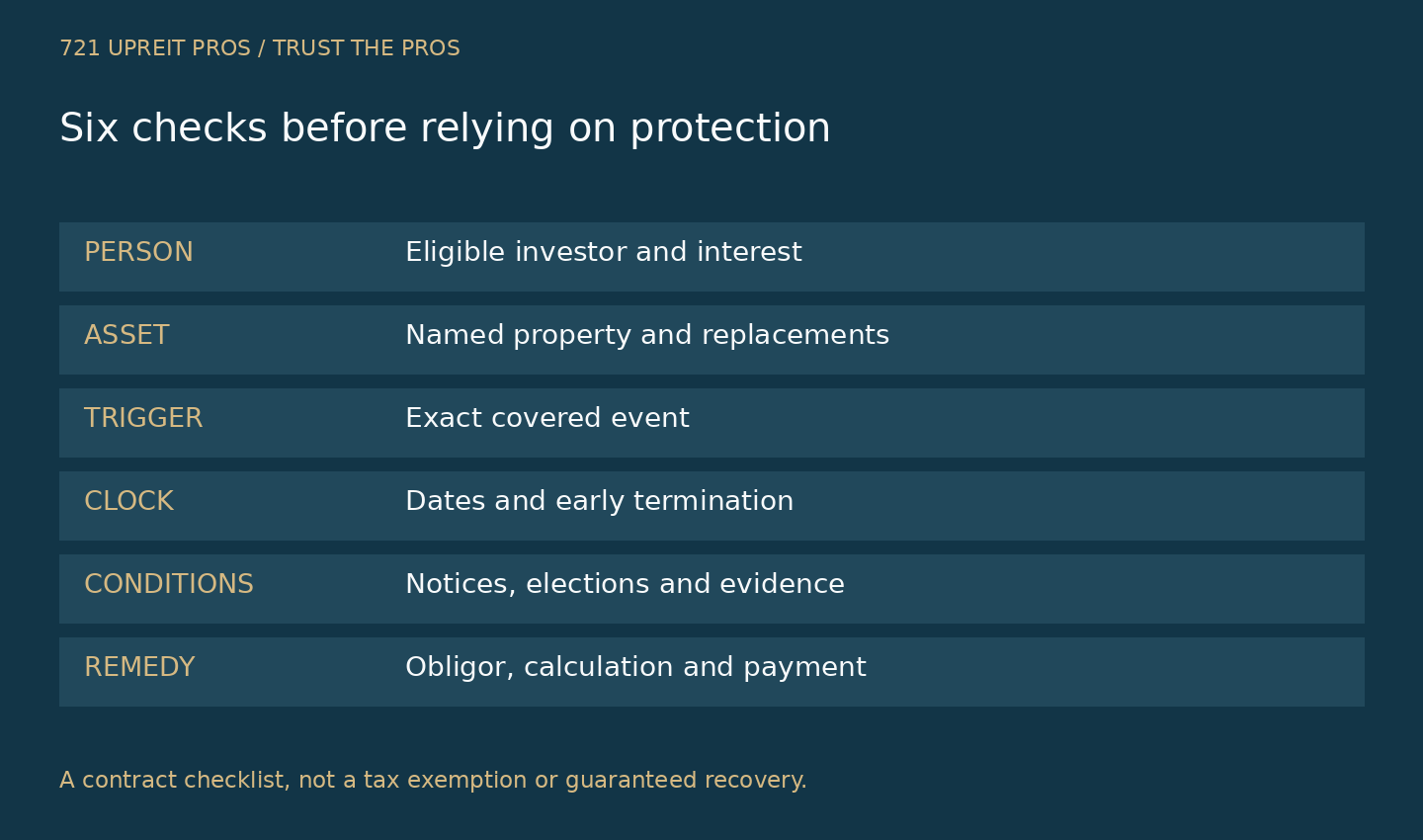
Create one row for each event you are worried about, not one checkbox for the entire investment. Mark missing evidence as unresolved rather than treating marketing language as confirmation.
| Check | What to record | Question that exposes a gap |
|---|---|---|
| Protected person | Exact holder, eligible interest, schedule and any successor rules | Am I covered directly, through another entity, or not at all? |
| Protected asset | Property/entity identifier and treatment of replacements | Does the protection follow a replacement asset or stop at this property? |
| Trigger | Covered sale, liability event or other specified action | Does the actual event meet every part of the definition? |
| Clock | Effective date, end date and early-termination events | Which clock applies to this investor and this obligation? |
| Conditions | Consent, notice, election and required supporting records | Who must act next, by when and through which delivery method? |
| Remedy | Obligor, formula, exclusions, timing and dispute procedure | Is there a payment obligation, a prevention covenant, or only an opportunity to participate? |
What do actual filed agreements demonstrate?
They demonstrate that the definitions and conditions matter. The following are historical contract examples, not current offerings or a statement that their protections apply to you.
Phillips Edison: different obligations within one agreement
The Phillips Edison agreement signed July 19, 2021 defines a protection period ending on the fourth anniversary of its Effective Date, with early-termination provisions. Sections 2.1 and 2.2 address specified taxable transfers and payments. Section 2.4 separately addresses liability maintenance, notices and opportunities to guarantee debt. Section 3.6 excludes indemnification arising solely from specified changes in tax law or its interpretation. Those distinctions show why a general statement about a protected holding period is insufficient.
Rayonier: eligibility and exceptions must be checked first
The Rayonier agreement dated May 8, 2020 defines a protected partner using an ownership threshold of 525,000 Opco Units immediately after its specified merger, including its beneficial-ownership definition. It defines a five-year protected period with early termination after specified dispositions or death, and separately defines exempt events including casualty and condemnation. These are transaction-specific terms, not minimum investment or holding-period rules for the UPREIT industry.
Do not use either historical duration as a current promise. Obtain the complete current agreement for the proposed transaction. If a presentation and contract appear inconsistent, request a written explanation before signing rather than averaging the two descriptions.
How can the same event have different coverage outcomes?
A simple timing test can reveal unanswered questions before you need to make a claim. The following example is invented for planning and does not describe either filed agreement above.
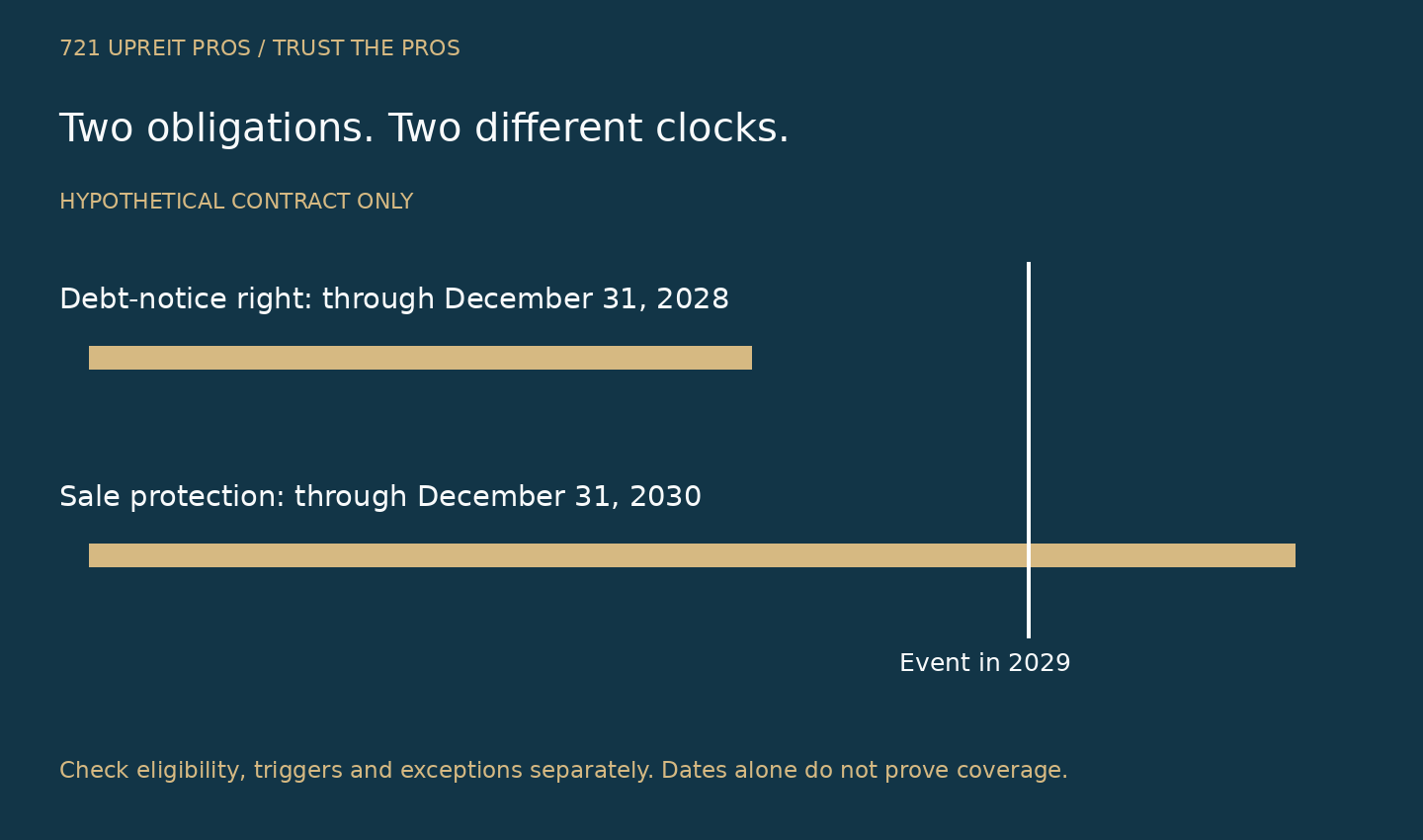
Assume a hypothetical signed contract states that a named investor's covered-sale protection runs through December 31, 2030, but the investor's separate debt-notice right ends December 31, 2028. Also assume both rights depend on the investor retaining an eligible interest. Do not infer these periods from the Section 721 label.
| Proposed event | Initial observation | Next evidence needed |
|---|---|---|
| Covered property sale on June 30, 2029 | Inside the assumed sale-protection dates | Investor eligibility, covered gain, exceptions and remedy formula |
| Refinancing on June 30, 2029 | After the assumed debt-notice right expires | Other surviving rights and the CPA's actual liability/basis analysis |
| Investor transfers units before either event | Coverage cannot be inferred from the original dates | Transfer, successor and early-termination clauses |
“Within the period” is only one input. It does not establish that a tax bill exists or that reimbursement is owed. Conversely, an expired clause does not itself calculate a tax liability. Keep the coverage decision and the tax calculation as separate workstreams.
Does a debt guarantee eliminate the problem?
Do not assume that signing a guarantee is either required or sufficient. First ask your attorney what legal exposure you would accept and your CPA whether the arrangement achieves the intended liability allocation under the applicable rules.
Use the OP-unit debt-change and outside-basis worksheet to organize the numbers separately. Record the proposed guarantee amount, duration, lender, recourse terms, replacement requirements and the response deadline. Do not sign a document merely because its label says it protects tax deferral. This article is not a recommendation to guarantee debt.
What is the difference between indemnification and available cash?
A contractual payment claim is not cash already in your account. Confirm who owes the payment, how it is calculated, when it becomes due and how a disagreement is resolved.
Ask whether the formula uses actual or assumed tax rates, addresses tax on the payment itself, includes interest or penalties, and requires supporting calculations. Also ask what happens if the paying entity cannot perform. Do not count an unconfirmed reimbursement as money available for an estimated tax payment. The separate redemption-request checklist covers principal-access questions; a tax-protection claim and an OP-unit redemption are not the same request.
Which questions should you resolve before signing?
- Show me the executed or proposed clause naming the covered investor, interests and properties.
- Which dates and early-termination events apply to each obligation?
- Who can approve a waiver, amendment, sale or other action, and what happens to my rights?
- Which events are excluded, including voluntary investor actions and changes in law?
- What notice, election or supporting calculation must I supply, and to whom?
- Who pays a covered claim, using what formula and timetable?
- What remains unresolved after my attorney and CPA review the documents?
For broader tax context beyond this contract checklist, see DST Experts' guide to contribution, basis and exit-event taxes. For the earlier investment selection, its DST risk and due-diligence discussion addresses a different stage. These are related educational resources, not evidence of your contractual coverage.
Watch the one-minute review and download the matrix
Download the protection-review worksheet ↓
Original silent explainer with on-screen text, English captions and a complete expandable transcript.
Read video transcript
0:00 · A contract is not a tax exemption.
A 721 tax protection agreement covers defined risks. It does not promise that you will never owe tax.
0:12 · Match the person, asset and event.
Find the eligible holder and protected property. Match the actual event to the contract definition.
0:24 · Check each clock separately.
Sale protection and debt rights can have different dates. Transfers or other events can end protection early.
0:36 · Read the conditions and remedy.
Record notice deadlines, elections and the paying entity. A possible reimbursement is not cash already received.
0:48 · Bring the gaps to your professionals.
Use the coverage matrix with your attorney and CPA. Keep contract coverage separate from the tax calculation.
Sources checked September 18, 2026. General education by 721 UPREIT Pros with AI assistance. No independent expert review is represented. Hypothetical examples are not offerings, contract interpretations or individualized tax/legal advice. Tax outcomes, payments, liquidity and investment results are not guaranteed.
BEFORE YOUR ADVISOR CONVERSATION
Three questions before you commit
This companion briefing covers the professional's identity, compensation and how restrictions fit your cash needs. Use it alongside this article's specific document checks.
Loading the video connects to YouTube. Watch on YouTube · 721 UPREIT Pros channel · Read the full advisor checklist.
Read video transcript
Before you hire a seven twenty-one UPREIT advisor, ask these three questions.
First: who exactly am I hiring? Get the professional's legal name, firm and registration information. Check the record through Investor dot gov and read the firm's relationship summary where applicable. Ask whether this conversation involves brokerage services, investment advice, or both. A marketing title alone does not answer that question.
Second: who gets paid, and how much? Request a written cost breakdown in dollars. Identify the payer, calculation base, payment timing and ongoing charges. Include product expenses and embedded compensation. No separate advisor invoice does not mean there are no costs.
Third: how does this fit my cash needs? Review the actual agreements. Ask who controls a possible conversion and what happens if it does not occur. Separate permission to request redemption from approval, pricing and payment. Do not assume a fixed cash-out date.
Then agree on responsibilities. Your investment professional, CPA, attorney and qualified intermediary can have different roles. Put continuing service and unresolved questions in writing.
Read the complete advisor checklist using the article link in the description. Seven twenty-one UPREIT Pros. Trust the Pros. Educational only. Investments involve risk and may be illiquid. Tax treatment depends on your circumstances.
Educational only. Investments involve risk and may be illiquid. Footage is illustrative; narration is synthetic.
TALK TO A 721 UPREIT ADVISOR
Ready to discuss your 721 options?
Request a callback to discuss the questions raised by this article, your timing and what to ask before you commit. Share your name, email and phone below to start the conversation.
No investment commitment or financial documents required. A callback request does not book an appointment or establish an advisory relationship.