
721 UPREIT PROS / MULTISTATE TAX RECORDS
OP-unit multistate K-1 records: what to send your preparer
Send the complete federal Schedule K-1 package, every attached statement, each state partner schedule, separate withholding or estimated-payment forms, and a short jurisdiction control sheet. Do not decide that a state return is required, or unnecessary, from the property list alone. Your preparer needs the actual state allocations, your residence history, payments and prior-year records.
By 721 UPREIT Pros · September 26, 2026 · Original multistate document handoff map

This guide answers one operational question: how should an OP-unit holder organize a multistate tax package before sending it to a preparer? It supports the 721 UPREIT process guide and does not determine where an individual must file.
What should an OP-unit holder send with a multistate K-1?
Send the K-1 as a package, not as a single page. The IRS says Schedule K-1 reports a partner's share of partnership income, deductions, credits and other items. Attached statements can supply details needed to report those items correctly. Keep the original package intact and give the preparer a complete copy. See the IRS partner instructions for Schedule K-1.
TALK TO A 721 UPREIT ADVISOR
Talk to a 721 UPREIT advisor
Request a callback to discuss the questions raised by this article, your timing and what to ask before you commit. Share your name, email and phone below to start the conversation.
No investment commitment or financial documents required. A callback request does not book an appointment or establish an advisory relationship.
For state work, add any partner schedule issued by the partnership. New York, for example, uses Form IT-204-IP to report a partner's state information. California partnership materials can include a Schedule K-1 (565), while California withholding evidence may arrive separately. The California Franchise Tax Board states that withholding shown on a K-1 still must be reported using Form 592, and the payee receives Form 592-B. See FTB Publication 1017.
A state schedule is evidence, not a filing conclusion
The presence of a state amount does not by itself answer whether a return is required. The preparer may need to test residency, source, thresholds, withholding, composite-return participation, pass-through entity tax credits, reciprocity and other state-specific rules. A property map is not a substitute for that analysis.
Build five folders for the preparer
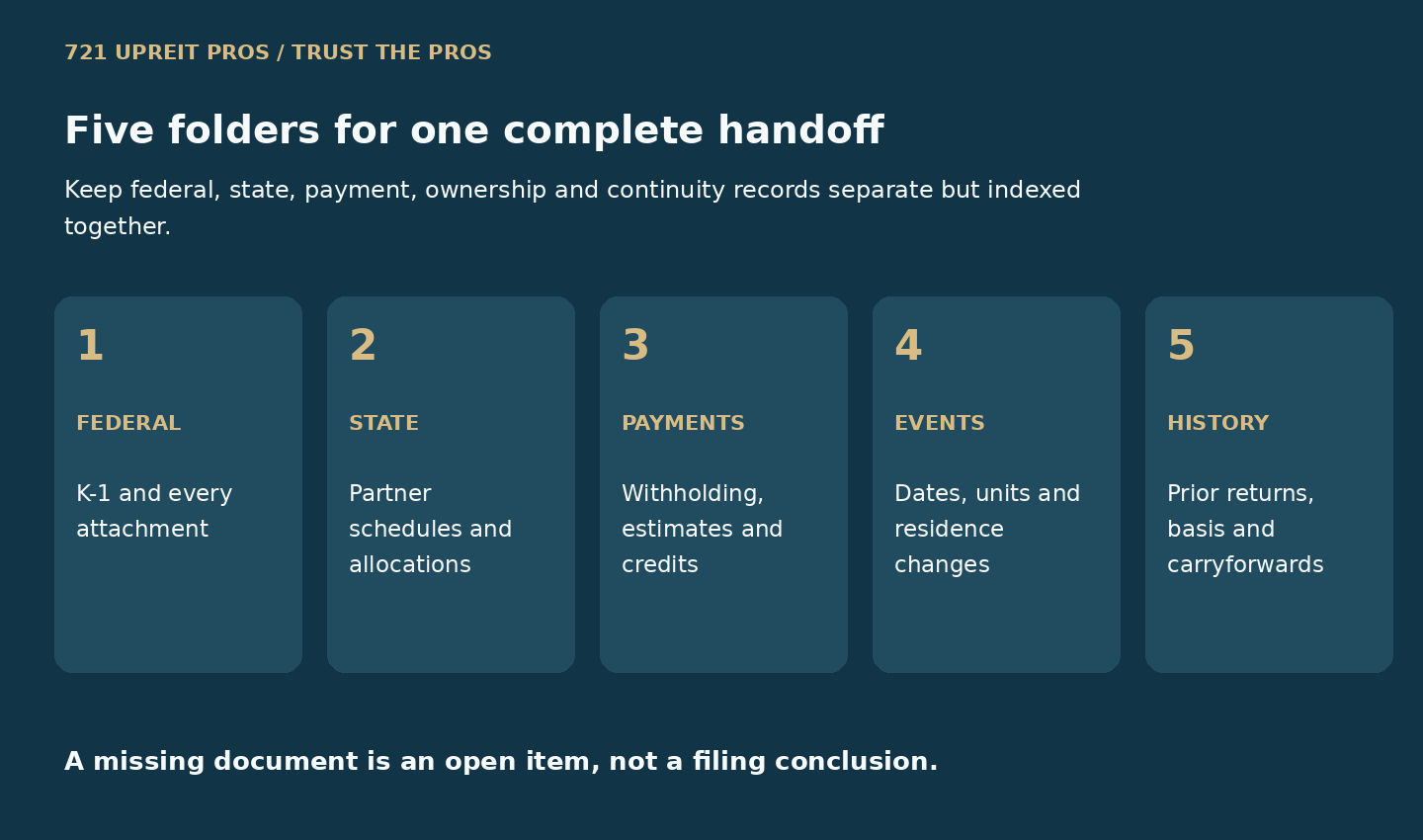
| Folder | Include | Why it matters |
|---|---|---|
| 1. Federal package | Every page of Schedule K-1, attached statements, corrected versions and issuer cover letter | Establishes entity, partner, tax year and federal items that may have state counterparts |
| 2. State schedules | Every state partner schedule and state allocation statement, even for a state you did not expect | Shows what the partnership reported by jurisdiction |
| 3. Payments and credits | Withholding forms, estimated-payment notices, composite-return statements and PTE-tax credit documents | Helps prevent a payment or credit from being omitted or counted twice |
| 4. Ownership and events | Acquisition or contribution date, unit changes, redemption or conversion notices, sale records and residence changes | Defines the period and events the preparer must reconcile |
| 5. Prior-year continuity | Prior returns, basis schedule, suspended losses, state carryforwards and last year's K-1 package | Preserves items that cannot be reconstructed safely from the current K-1 alone |
Name files consistently, such as 2025_ExampleOPLP_CA_592-B.pdf. Do not combine unrelated entities into one unlabeled PDF. If the issuer later supplies a corrected K-1, retain the original, mark it superseded and record the date the correction arrived.
This handoff is different from the earlier stage of identifying whether a DST issues a K-1. For that distinction, use DST Experts' guide to DST tax packages and K-1s. For a broader preparer packet, see its DST tax-document and multistate preparation guide.
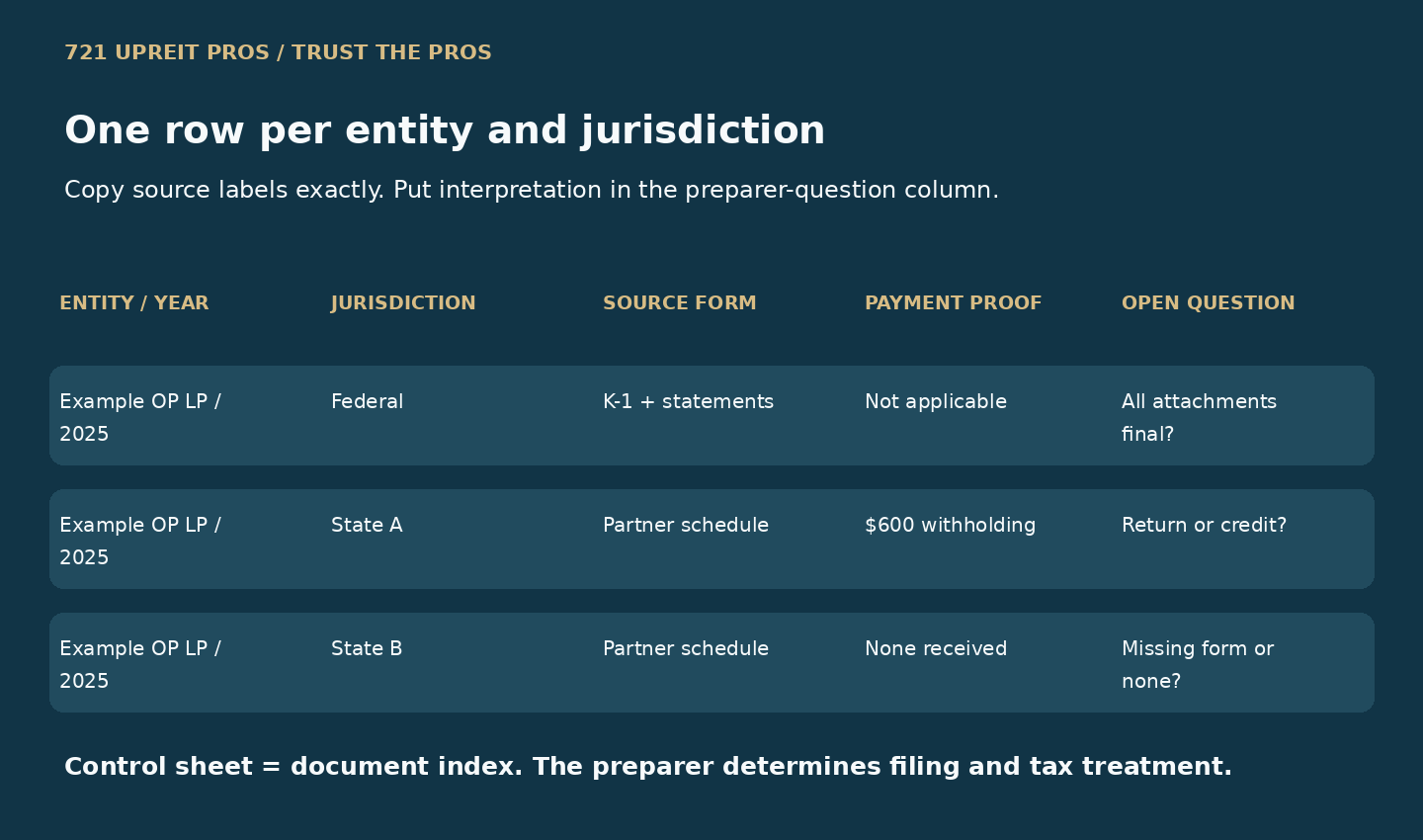
Create a jurisdiction control sheet before uploading documents
The control sheet is an index, not a tax return. Use one row per entity and jurisdiction. Record exactly what the tax package shows, then add a separate preparer question. Do not rewrite source amounts to match what you think should have been reported.
| Field | Record |
|---|---|
| Entity and EIN suffix | Legal entity name and last four EIN digits from the tax package |
| Tax year and version | Year, original or corrected, and received date |
| Jurisdiction | Federal, resident state or each state shown in the package |
| Source document | Exact form or statement name and page |
| Reported amount | Amount and label exactly as shown, without reclassification |
| Payment evidence | Withholding, estimated payment, composite payment or PTE-tax credit document |
| Open question | Filing, credit, threshold, residency, allocation or missing-document question for the preparer |
Download the multistate K-1 handoff worksheet
Worked example: three jurisdictions, no assumed filing result
This example is invented and does not determine a filing obligation. Assume the tax package for Example OP LP contains a federal K-1, a State A partner schedule showing $12,000 of source income and a State B schedule showing $4,000. The investor lived in State R throughout the year. The package also contains a $600 State A withholding form but no payment document for State B.
The investor should not send only the federal K-1 or assume that the $600 settles State A. The preparer receives the complete federal package, both state schedules, the State A payment evidence, residence information, the prior-year returns and a control sheet with three unresolved questions:
- Does State A require a nonresident return after applying its current thresholds and withholding rules?
- Does State B require a filing, composite election review or other action despite no separate payment document?
- How does State R treat the income and any allowable credit for taxes paid to another state?
The preparer may answer those questions differently based on entity type, taxpayer type, sourcing rules and current law. The original value of the worksheet is that it exposes missing evidence and prevents silent assumptions. It does not select forms or calculate tax.
Do not use the K-1 capital account as a substitute for an outside-basis schedule. Do not mix annual state filing questions with a 1031 exchange report or the original Section 721 contribution analysis. If a liability change also affects the file, use the separate OP-unit debt and CPA worksheet. If allocated income exceeds accessible cash, use the K-1 cash-tax reserve worksheet.
Why can withholding arrive on a separate form?
States can use forms that are separate from the partner schedule. California's FTB explains that a K-1 entry does not replace Form 592 reporting and the payee copy on Form 592-B. The preparer therefore needs both the allocation schedule and the payment evidence. A payment shown on one form should not be entered twice because it is also referenced elsewhere.
New York's current partner instructions likewise direct individuals to use all Forms IT-204-IP and separately identify estimated tax payments made on a partner's behalf. These examples show why an investor should preserve jurisdiction-specific forms, not that California or New York rules apply to every OP-unit holder.
Questions to resolve before the return is finalized
- Did the issuer provide every federal attachment and state partner schedule for the final version?
- Which jurisdictions appear in the package, and which are present only in property or portfolio materials?
- Was any withholding or estimated payment made on the investor's behalf? Which form proves it?
- Did the investor move, change ownership, contribute property, convert units or receive a correction during the year?
- Are there prior-year state losses, credits, overpayments or basis records that must carry forward?
- Is an extension needed because a package is late or incomplete? What payment estimate is required despite the extension?
Keep a dated open-items list. “Asked sponsor” is not the same status as “received and verified.” Record who supplied the answer, the source document and the date. Store sensitive tax files only through the preparer's approved secure method, not ordinary email unless the preparer confirms an appropriate protected process.
When should the packet be refreshed?
Refresh the control sheet when a corrected K-1 arrives, the partnership supplies a new state schedule, a preparer identifies a missing payment form, residence changes or units are redeemed or converted. Preserve the prior version and mark the replacement. The IRS partner instructions say to ask the partnership for a corrected K-1 rather than changing the form yourself.
Watch: organize a multistate K-1 handoff
A one-minute silent explainer with English captions. The complete transcript is available below.
Read video transcript
0:00 · Do not send only page one
A multistate K-1 handoff starts with the complete federal package. Keep attached statements and corrected versions.
0:12 · Add every state schedule
Preserve each partner schedule and allocation statement. A state document is evidence, not an automatic filing conclusion.
0:24 · Match payments separately
Include withholding, estimated-payment and credit forms. Do not count one payment twice because two documents mention it.
0:36 · Build a control sheet
Use one row per entity, tax year and jurisdiction. Record the source form, amount, payment proof and open question.
0:48 · Let the preparer decide
Residency, source, thresholds and credits can change the answer. Refresh the packet when corrected documents arrive.
Sources and scope
Primary references checked September 26, 2026: 2025 IRS Partner's Instructions for Schedule K-1 (Form 1065), California 2025 Partnership Tax Booklet, California FTB Publication 1017, and 2025 New York Partner's Instructions for Form IT-204-IP. Use the instructions for the actual tax year and the investor's jurisdictions.
General education by 721 UPREIT Pros with AI assistance. No independent professional review is represented. The example is hypothetical and does not determine filing duties, tax due, investment suitability, liquidity or returns.
BEFORE YOUR ADVISOR CONVERSATION
Three questions before you commit
This companion briefing covers the professional's identity, compensation and how restrictions fit your cash needs. Use it alongside this article's specific document checks.
Loading the video connects to YouTube. Watch on YouTube · 721 UPREIT Pros channel · Read the full advisor checklist.
Read video transcript
Before you hire a seven twenty-one UPREIT advisor, ask these three questions.
First: who exactly am I hiring? Get the professional's legal name, firm and registration information. Check the record through Investor dot gov and read the firm's relationship summary where applicable. Ask whether this conversation involves brokerage services, investment advice, or both. A marketing title alone does not answer that question.
Second: who gets paid, and how much? Request a written cost breakdown in dollars. Identify the payer, calculation base, payment timing and ongoing charges. Include product expenses and embedded compensation. No separate advisor invoice does not mean there are no costs.
Third: how does this fit my cash needs? Review the actual agreements. Ask who controls a possible conversion and what happens if it does not occur. Separate permission to request redemption from approval, pricing and payment. Do not assume a fixed cash-out date.
Then agree on responsibilities. Your investment professional, CPA, attorney and qualified intermediary can have different roles. Put continuing service and unresolved questions in writing.
Read the complete advisor checklist using the article link in the description. Seven twenty-one UPREIT Pros. Trust the Pros. Educational only. Investments involve risk and may be illiquid. Tax treatment depends on your circumstances.
Educational only. Investments involve risk and may be illiquid. Footage is illustrative; narration is synthetic.
TALK TO A 721 UPREIT ADVISOR
Ready to discuss your 721 options?
Request a callback to discuss the questions raised by this article, your timing and what to ask before you commit. Share your name, email and phone below to start the conversation.
No investment commitment or financial documents required. A callback request does not book an appointment or establish an advisory relationship.