
721 UPREIT PROS / CASH AND TAX PLANNING
721 UPREIT taxable income without cash: a K-1 reserve worksheet
Yes. An OP-unit holder can owe tax on allocated partnership income even when cash distributions are smaller or zero. A Section 721 contribution does not make future partnership income tax-free. Compare the tax projection with cash you can actually use, then plan any funding gap with your tax professional.
By 721 UPREIT Pros · September 25, 2026 · Original cash-tax reconciliation worksheet

This guide addresses one investor decision: how to prepare for a tax payment that is not covered by accessible distributions. It complements the 721 UPREIT investor guide and risk and due-diligence checklist. It does not calculate your return or replace review of your partnership agreement.
Can I owe tax on OP units without receiving a distribution?
Taxable income allocations and cash distributions are different records. The IRS explains that a partner may owe tax on a share of partnership income whether or not that income is distributed. Schedule K-1 reports income, deductions, credits and other items; the amount deposited into a bank account is not a substitute for it. See the IRS partner instructions for Schedule K-1.
TALK TO A 721 UPREIT ADVISOR
Talk to a 721 UPREIT advisor
Request a callback to discuss the questions raised by this article, your timing and what to ask before you commit. Share your name, email and phone below to start the conversation.
No investment commitment or financial documents required. A callback request does not book an appointment or establish an advisory relationship.
Investors sometimes call this mismatch “phantom income.” The phrase describes a cash-planning problem, not a separate exemption or tax category. A partnership may retain cash, face financing obligations or make payments on a different schedule from its tax allocations. The actual explanation requires the issuer's reports and your tax package. Do not assume a low payment proves a tax loss, or that a positive tax allocation means cash is available for withdrawal.
Likewise, receiving a distribution does not mean the entire payment is current taxable income. Distribution treatment and outside basis require separate analysis. IRS Publication 541 explains partnership distribution and basis rules. This page focuses on funding the tax obligation, not deciding the tax character of each dollar.
Keep contribution deferral separate
Section 721 generally concerns gain or loss on a contribution of property for a partnership interest, subject to exceptions. It does not promise that annual income, later distributions or eventual exits will be tax-free. Start with the statutory contribution rule, then have a CPA examine the later events separately.
Which three records should an investor reconcile?
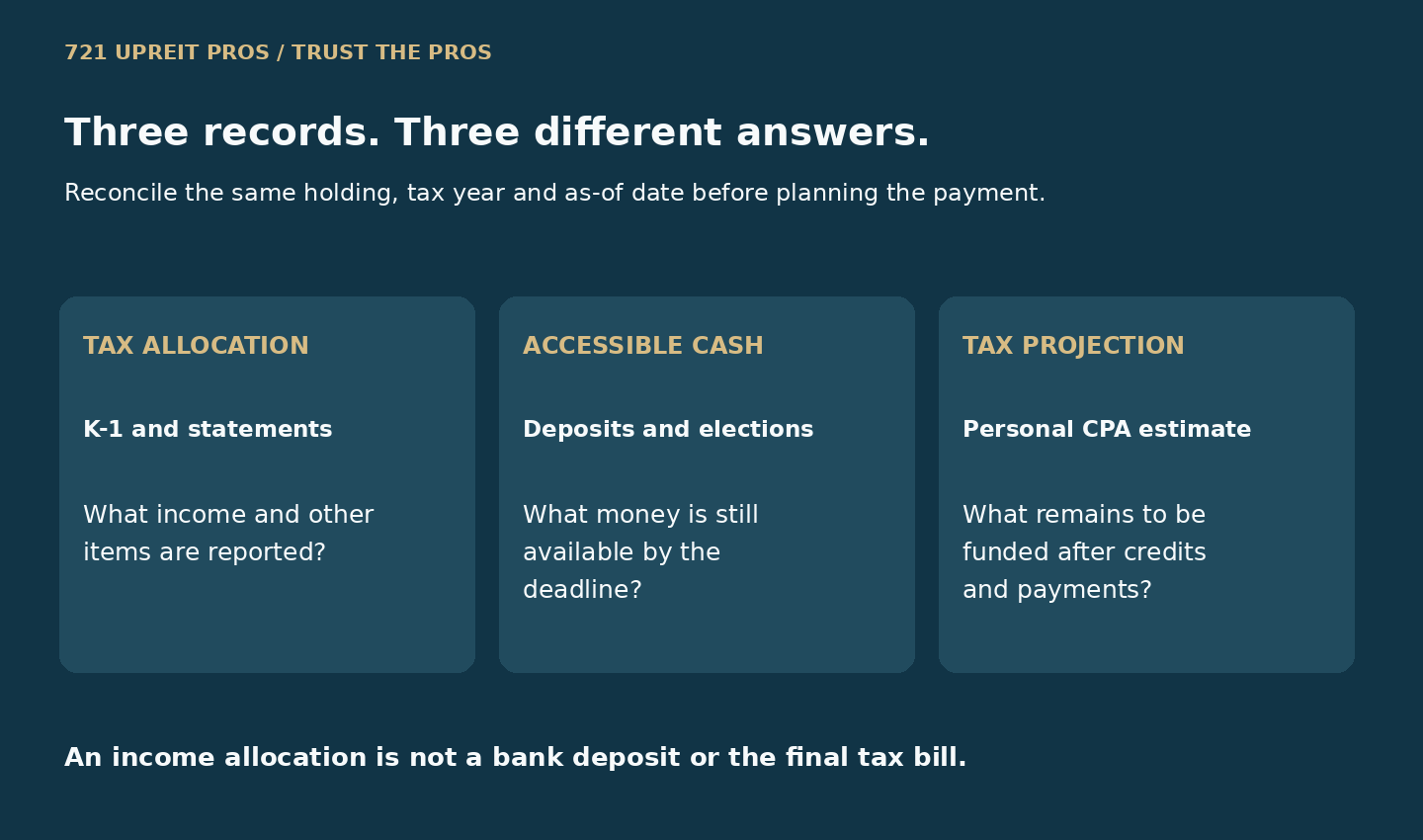
| Record | What to collect | What not to assume |
|---|---|---|
| Tax allocation | Current K-1, attached statements, year-to-date estimate and relevant state information | A single income box captures every tax item or determines the final tax bill |
| Accessible cash | Bank deposits, distribution statements, withholding records and reinvestment elections | A declared payment or reinvested amount is money available to pay taxes today |
| Personal tax projection | CPA estimate of required payments, credits, withholding, prior payments and due dates | One assumed tax rate applies to all items or all investors |
Record the tax year, as-of date and entity name on each document. A calendar-year bank statement and a preliminary partnership estimate may cover different periods. Mark estimates as estimates and replace them when final records arrive. Keep the old version so an unexpected change can be traced rather than silently overwritten.
For a transition from a DST, identify the date and entity for each stage. A qualifying grantor-trust DST package is not automatically a partnership K-1. The relevant follow-up is DST Experts' explanation of DST tax packages versus K-1s. Use your actual tax documents, not the marketing label, to identify the reporting pathway.
Worked example: a $2,000 cash gap despite $6,000 distributed
The following is invented educational arithmetic, not a forecast or tax calculation. Assume an OP-unit investor has a preliminary $30,000 income allocation. After reviewing the investor's circumstances and other tax items, the CPA estimates $8,000 of remaining tax funding attributable to this investment for the period, after applicable payments and credits. This $8,000 is an assumed input, not $30,000 multiplied by a recommended tax rate.
The investor received $6,000 in cash, kept all of it available and has no separate tax reserve. The funding gap is $8,000 minus $6,000, or $2,000. The $24,000 difference between income allocation and cash distributed is not the tax due. It is simply the difference between two records that measure different things.
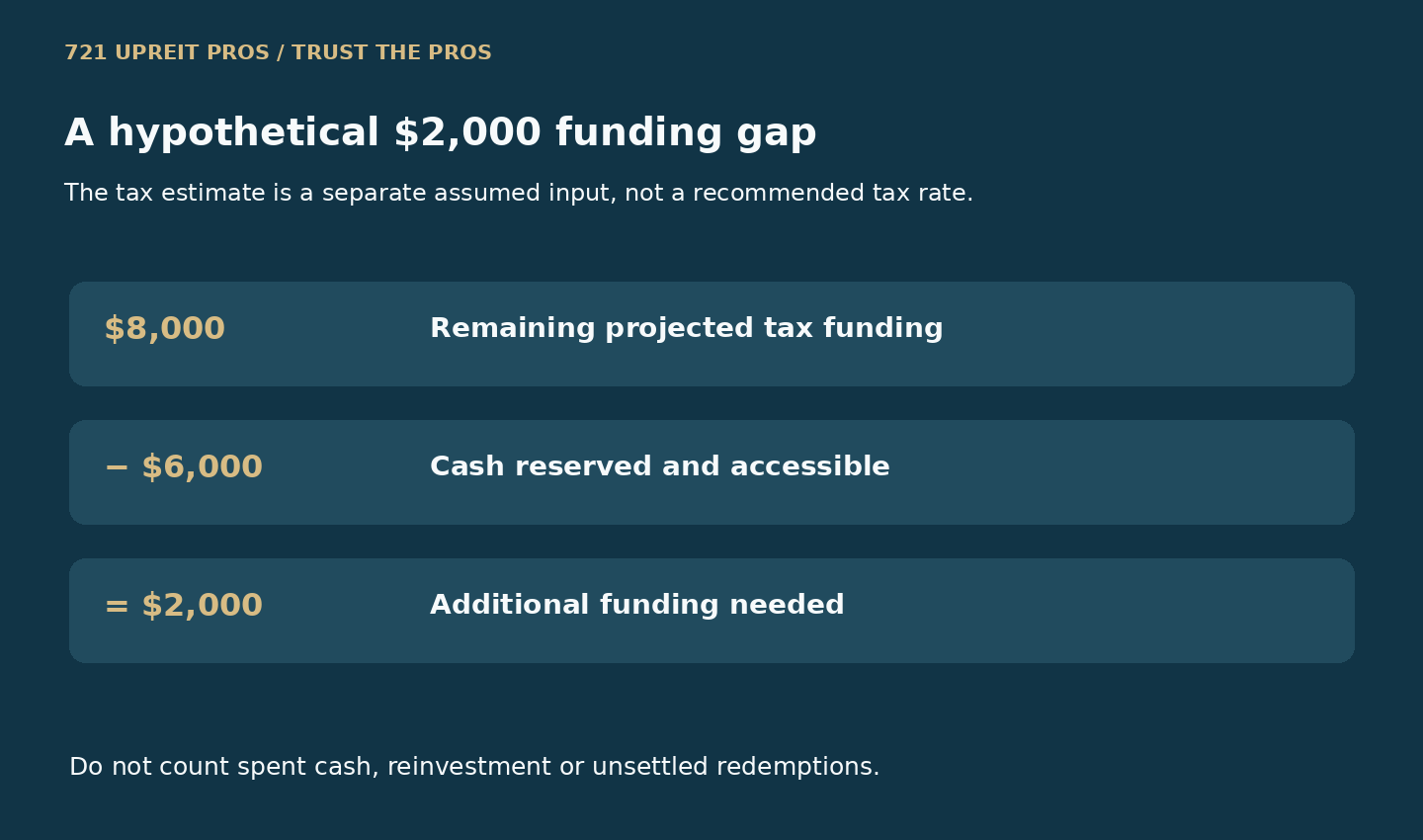
| Cash situation | Cash reserved and accessible | Additional funding needed |
|---|---|---|
| $6,000 received and retained | $6,000 | $2,000 |
| $6,000 received, $4,000 already spent | $2,000 | $6,000 |
| No distribution received | $0 | $8,000 |
| $6,000 retained plus a $3,000 outside reserve | $9,000 | $0, with $1,000 remaining |
Do not count the same dollar as both a distribution reserve and an outside reserve. A payment already reflected in the CPA's remaining-funding estimate should not be subtracted again. Reinvested distributions, unsettled redemption requests and estimated unit values do not count as cash available by the payment deadline.
This is different from comparing an advertised distribution rate with cash received. Use the distribution-rate and actual-dollars example for that question. Use the OP-unit debt and outside-basis worksheet when liability changes are part of the tax analysis.
Build a reserve worksheet before the payment date
- Identify the holding. Record legal entity, unit class, tax year, ownership dates and the person responsible for delivering estimates.
- Collect the tax inputs. Request available income estimates and state schedules. Give your CPA the full K-1 and attachments when issued, not just a selected income figure.
- Separate money from accounting. Reconcile deposits, withholding and reinvestment. Mark money already spent or committed elsewhere.
- Obtain the remaining-funding estimate. Have the CPA identify the payment amount, relevant jurisdictions, due dates and assumptions. Ask what could change the estimate.
- Compare accessible funds. Subtract only cash genuinely reserved and available in time. Record an outside funding source and transfer lead time for any gap.
- Schedule a refresh. Revisit after a distribution reduction, asset disposition, updated income estimate or final tax package.
Download the cash-tax reserve worksheet
The IRS describes federal tax as pay-as-you-go through withholding or estimated payments. Waiting for an annual K-1 is not a reason to assume there are no earlier payment obligations. Ask your preparer which rules and exceptions apply; this worksheet does not select a safe harbor, payment amount or filing deadline. See the IRS estimated-tax guidance.
What should you ask the sponsor before relying on tax distributions?
Ask for the controlling agreement and the relevant clause, not a verbal assurance that distributions should cover taxes. A contractual tax-distribution provision, if one exists, may use assumed rates and contain conditions that do not match your personal liability.
- Is a tax distribution mandatory, discretionary or absent? Which entity and unit classes does it cover?
- What income definition and assumed rates are used? Are state taxes considered?
- When is it calculated and paid? Can financing restrictions or available-cash limits affect payment?
- Does it reduce later ordinary distributions, and how is any true-up handled?
- Who supplies a revised estimate after a significant event, and when should investors expect it?
- What happens when the contractual calculation is less than the investor's actual tax obligation?
Do not solve a near-term tax shortage by assuming OP units can immediately be redeemed. Eligibility, notice, issuer settlement choices and restrictions may delay or prevent access. Review the redemption-request checklist before counting any proposed proceeds.
Does a K-1 loss eliminate the need for a reserve?
Not necessarily. The IRS partner instructions warn that losses and deductions may be limited. Other separately reported items, personal circumstances and state treatment can also matter. Give the complete package to the preparer rather than assuming one negative box eliminates the tax bill. The same caution applies to depreciation claims or a “tax-deferred” label.
Is a K-1 capital account the same as outside basis?
No. Publication 541 distinguishes the partner's basis from book or capital-account amounts. Keep the CPA's outside-basis schedule separate from this liquidity worksheet. A cash reserve helps fund an obligation; it does not determine basis or establish whether a distribution is taxable.
Watch: reconcile income, cash and tax funding
A one-minute silent explainer with English captions. The complete transcript is available below.
Read video transcript
0:00 · Can tax be due without cash?
OP-unit income allocations and cash distributions can differ. Section 721 does not make future partnership income tax-free.
0:12 · Collect three records
Keep the K-1, accessible cash and personal tax projection separate. Match the entity, tax year and as-of date.
0:24 · Work through the gap
Assume $8,000 of remaining projected tax funding and $6,000 cash reserved. The hypothetical gap is $2,000. This is not a tax-rate calculation.
0:36 · Check the agreement
Ask whether tax distributions are required and which limits apply. Do not assume a pending redemption provides cash in time.
0:48 · Plan and refresh
Ask your CPA about payment amounts, dates and changed estimates. Use the cash-tax worksheet to record the funding source and next review.
Sources and scope
Primary references checked September 25, 2026: 2025 partner instructions for Schedule K-1, Publication 541, revised December 2025, IRS estimated taxes and 26 U.S.C. Section 721. Use the instructions applicable to the actual tax year and verify later changes.
General education by 721 UPREIT Pros with AI assistance. No independent professional review is represented. The example is hypothetical and not an offering, return projection or individualized tax advice. Investment value, distributions, liquidity and tax outcomes are not guaranteed.
Before changing where your next payment goes, use the cash-or-reinvestment election guide to confirm the security purchased, effective payment period and cash reserve.
BEFORE YOUR ADVISOR CONVERSATION
Three questions before you commit
This companion briefing covers the professional's identity, compensation and how restrictions fit your cash needs. Use it alongside this article's specific document checks.
Loading the video connects to YouTube. Watch on YouTube · 721 UPREIT Pros channel · Read the full advisor checklist.
Read video transcript
Before you hire a seven twenty-one UPREIT advisor, ask these three questions.
First: who exactly am I hiring? Get the professional's legal name, firm and registration information. Check the record through Investor dot gov and read the firm's relationship summary where applicable. Ask whether this conversation involves brokerage services, investment advice, or both. A marketing title alone does not answer that question.
Second: who gets paid, and how much? Request a written cost breakdown in dollars. Identify the payer, calculation base, payment timing and ongoing charges. Include product expenses and embedded compensation. No separate advisor invoice does not mean there are no costs.
Third: how does this fit my cash needs? Review the actual agreements. Ask who controls a possible conversion and what happens if it does not occur. Separate permission to request redemption from approval, pricing and payment. Do not assume a fixed cash-out date.
Then agree on responsibilities. Your investment professional, CPA, attorney and qualified intermediary can have different roles. Put continuing service and unresolved questions in writing.
Read the complete advisor checklist using the article link in the description. Seven twenty-one UPREIT Pros. Trust the Pros. Educational only. Investments involve risk and may be illiquid. Tax treatment depends on your circumstances.
Educational only. Investments involve risk and may be illiquid. Footage is illustrative; narration is synthetic.
TALK TO A 721 UPREIT ADVISOR
Ready to discuss your 721 options?
Request a callback to discuss the questions raised by this article, your timing and what to ask before you commit. Share your name, email and phone below to start the conversation.
No investment commitment or financial documents required. A callback request does not book an appointment or establish an advisory relationship.