
721 UPREIT PROS / ESTATE ACCOUNT HANDOFF
OP unit estate checklist: what heirs need before account access
An heir should not assume that inheriting an economic interest creates immediate account authority, full limited-partner rights, cash access or REIT shares. First identify the registered owner and legally authorized fiduciary. Then follow the operating partnership's notice, transfer and admission procedures while preserving the records needed for tax-basis and distribution reporting.
By 721 UPREIT Pros · September 20, 2026 · Estate account-handoff checklist

This guide addresses a practical 721 UPREIT estate-planning question: how should a family, trustee or personal representative organize restricted operating partnership units after an owner's death? It does not determine who inherits, whether a transfer is valid, how state law applies or what any particular agreement requires.
Use the actual partnership agreement, account registration, estate or trust documents and issuer instructions. The terms executor, personal representative, trustee, beneficiary and heir describe different roles. They should not be treated as interchangeable.
TALK TO A 721 UPREIT ADVISOR
Talk to a 721 UPREIT advisor
Request a callback to discuss the questions raised by this article, your timing and what to ask before you commit. Share your name, email and phone below to start the conversation.
No investment commitment or financial documents required. A callback request does not book an appointment or establish an advisory relationship.
Who can act on an OP unit account after the owner dies?
The person named to inherit is not necessarily the person currently authorized to direct the account. Authority depends on the registered owner, governing estate or trust documents, any court appointment, local law and the partnership's procedures. Ask the issuer or administrator what evidence it requires, then have estate counsel confirm who may act.
| Role | What to confirm | What not to assume |
|---|---|---|
| Registered owner | The name and capacity shown on the partnership register and latest statement | That a will or beneficiary form has already changed the register |
| Personal representative | Current appointment, scope of authority and estate tax identification number when required | That presenting a death certificate alone completes a transfer |
| Trustee or successor trustee | Trust ownership, succession documents and powers under the trust | That every interest was properly titled in the trust |
| Beneficiary or heir | The interest, timing and conditions under the governing documents | Immediate account control, redemption rights or admission as a limited partner |
| Partnership administrator | Notice address, required forms, consent process and current status contact | That a general transfer description overrides the signed agreement |
Direct answer
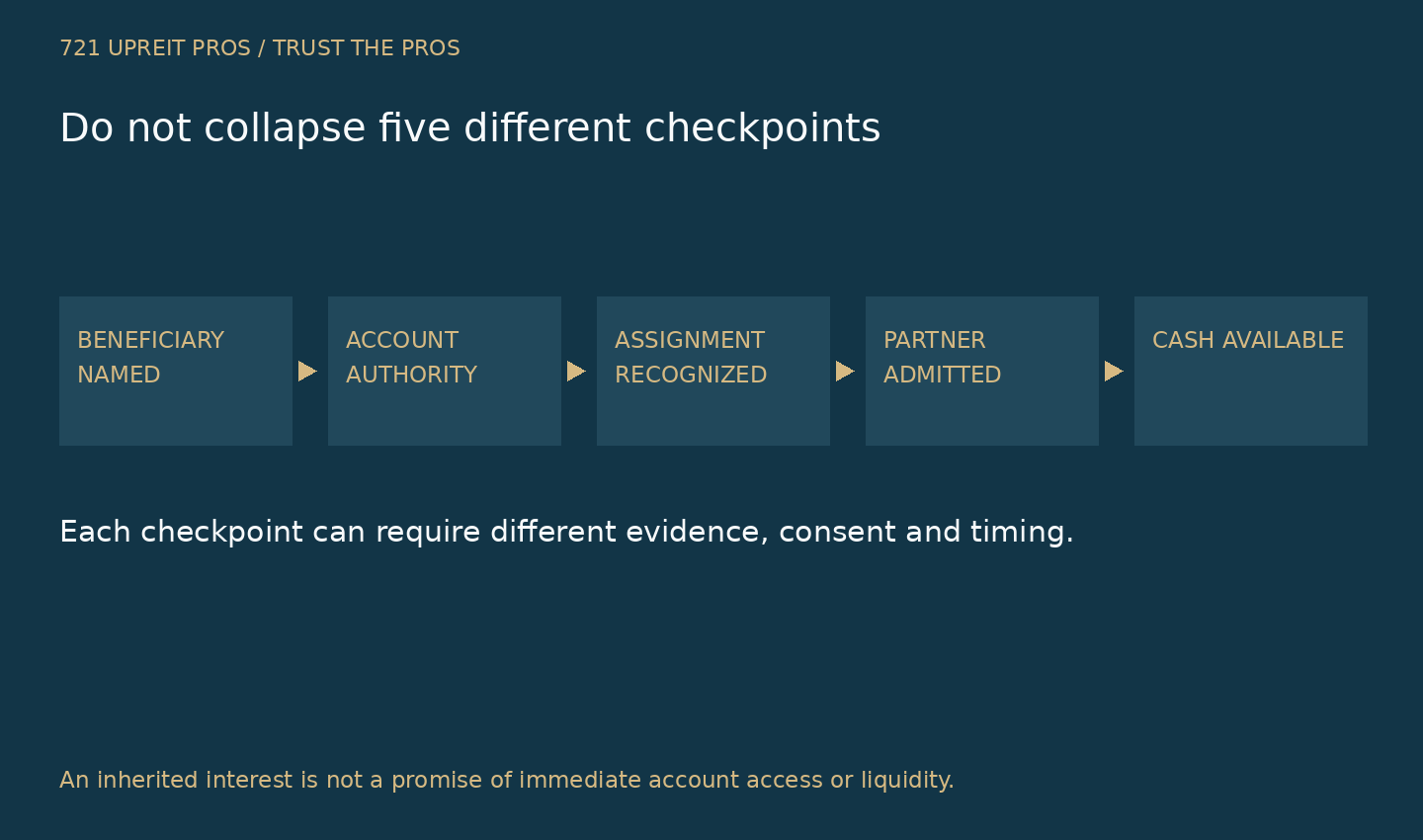
Account authority, economic inheritance, recognition of a transfer and admission as a substituted limited partner can be separate steps. Track each step independently and do not project liquidity until the governing agreement and issuer confirm the available path.

What belongs in an OP unit estate document packet?
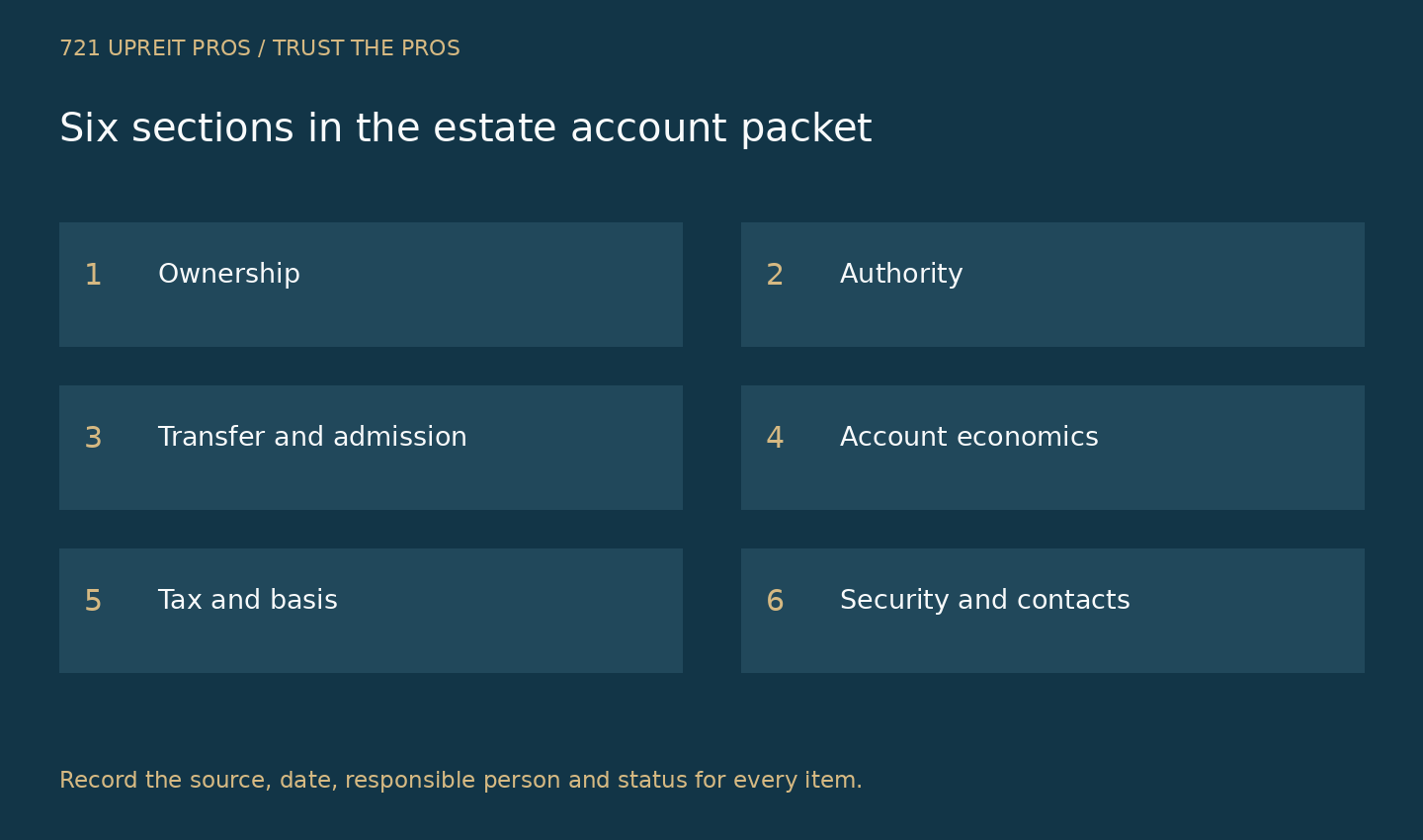
Build one indexed packet and record the source, date, responsible person and status for every item. Do not email tax identification numbers, court papers or signed agreements until the recipient and secure delivery method are verified.
| Packet section | Records and questions | Why it matters |
|---|---|---|
| 1. Ownership | Latest statement, registered name, unit class, unit count, partnership agreement and amendments | Establishes the interest shown in current records |
| 2. Authority | Certified death certificate, court appointment or trust succession evidence, subject to counsel and issuer instructions | Shows who may communicate and sign during administration |
| 3. Transfer and admission | Notice, assignment, consent, signature-guarantee and substituted-partner forms requested by the issuer | Separates an economic assignment from full partnership admission |
| 4. Account economics | Unit count, stated value source and date, distributions, withholding, pending requests and unpaid amounts | Prevents a quoted value or expected payment from being treated as cash |
| 5. Tax and basis | Prior Schedules K-1, outside-basis workpapers, liability allocations, contribution records, date-of-death valuation and applicable estate reporting | Provides inputs for the estate and beneficiary's tax professionals |
| 6. Security and contacts | Verified administrator, transfer agent or custodian, secure upload method, reference number and next checkpoint | Reduces fraud risk and keeps the process auditable |
Why might an heir receive economics before full partner rights?
Partnership agreements can distinguish an assignment of an economic interest from admission as a substituted limited partner. Consent, notice, authority evidence, signatures and other conditions may apply. A beneficiary therefore should not assume that the right to receive an inherited economic interest automatically includes voting, information, conversion or redemption rights.
For example, the September 25, 2024 Brookfield REIT operating partnership agreement says transfers generally require conditions and consent, admission as a substituted limited partner requires specified documents and approval, and an assignment need not be recognized until notice is received. Its death provision preserves the partnership and describes rights of an executor, administrator or trustee for estate administration. This is one dated agreement example, not a universal rule or a current offering recommendation.
What should the family ask about restricted OP units?
- Which provision governs transfers at death, and which amendments are current?
- Who may give notice and receive account information while the estate is open?
- Does the recipient first become an assignee, a substituted limited partner or something else?
- Which consent, eligibility, signature or documentation conditions apply?
- How are distributions and tax forms handled while recognition is pending?
- Do redemption, conversion, lockup or transfer restrictions continue after the transfer?
Read the UPREIT redemption request checklist before treating an inherited interest as available cash. A transfer at death does not, by itself, prove that a redemption will be accepted, priced or paid.
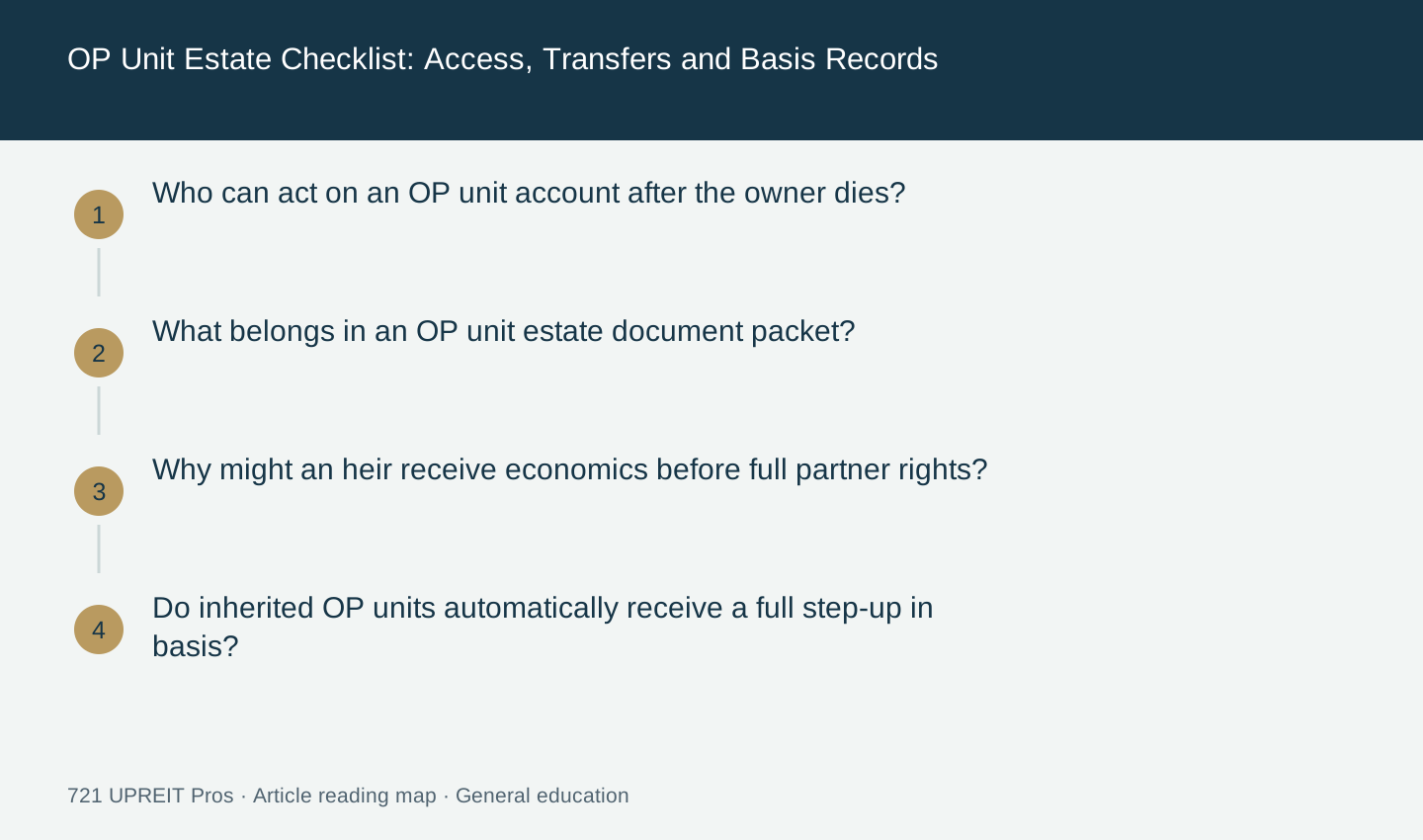
Do inherited OP units automatically receive a full step-up in basis?
Do not use that shortcut. Internal Revenue Code Section 1014 contains basis rules for property acquired from a decedent, but exceptions and reporting rules apply. For a partnership interest, the recipient's outside basis and the partnership's basis in its assets are separate records. Section 743 and a possible Section 754 election can affect whether and how an adjustment is made with respect to a transferee.
The CPA should reconcile the decedent's adjusted outside basis, allocated partnership liabilities, prior contributions and distributions, the date-of-death valuation, estate reporting and the partnership's election status. Preserve prior Schedules K-1 and use the OP unit basis and liability worksheet to organize inputs. Do not treat estate-tax value, account value, outside basis and inside basis as interchangeable numbers.
For the separate tax-record workflow after death, use the post-death OP-unit basis checklist. It organizes valuation, income-in-respect-of-a-decedent questions, Section 754 status and any transferee-specific Section 743(b) adjustment without duplicating this page's authority and account-access steps.
IRS Publication 559 describes the personal representative's federal tax duties and the estate's employer identification number and return process. The Form 8971 instructions explain consistent-basis reporting when that form applies. DST Experts' 721 exchange tax guide provides related contribution and exit context, but the estate's CPA must apply the rules to the actual records.
How can an estate track account access without guessing?
Assume a hypothetical owner dies on October 2, 2026 holding restricted OP units. The family finds an account statement on October 5. A personal representative is appointed on October 12 and gives notice to the partnership on October 15. The administrator sends its required packet on October 22. By November 15, the ownership record, valuation request and tax file are assembled, but admission of the recipient remains pending.
The status file should say:
- Authority: personal representative appointed, with counsel confirming scope.
- Issuer notice: delivered October 15, receipt recorded.
- Transfer packet: forms received October 22, open conditions listed.
- Beneficiary status: economic recipient identified, but current account authority and substituted-partner admission not assumed.
- Tax records: prior K-1s and basis workpapers requested; date-of-death valuation and partnership election status unresolved.
- Liquidity: no cash date projected because transfer and redemption rights remain document-dependent.
This example is a status-control exercise, not an interpretation of state law, a valuation or a predicted timetable. If a deadline or distribution arrives while the transfer is pending, ask the administrator and the estate's professionals whose name and tax identification number should be used and how the payment will be reported.
What should heirs bring to the first advisor meeting?
- The latest partnership statement and complete governing agreement, including amendments.
- The estate or trust authority documents that counsel says are appropriate to share.
- The issuer's transfer, admission and account-change instructions.
- The latest unit value source and date, distribution history and any pending request.
- Prior K-1s, contribution records, outside-basis schedules and liability allocations.
- A list of unresolved legal, tax, timing, security and liquidity questions.
Watch the one-minute estate handoff and download the checklist
Download the estate account checklist ↓
Original silent explainer with on-screen text, English captions and a complete expandable transcript.
A divorce-related division requires a different ownership-change file from an estate transfer. Use the divorce transfer and record-handoff checklist to separate settlement terms, issuer recognition, partner admission and tax continuity.
Read video transcript
0:00 · An heir may not be the current account authority.
Confirm the registered owner and the authorized fiduciary. Estate, trust, state-law and partnership documents control.
0:12 · Build one verified document packet.
Collect ownership, authority and transfer records. Use the issuer-approved secure delivery method.
0:24 · Read the transfer and admission provisions.
An economic assignee may not yet have full partner rights. Record every consent, notice and open condition.
0:36 · Keep tax records separate from account value.
Outside basis, inside basis and estate value are different records. Send K-1, liability and valuation questions to the CPA.
0:48 · Set a dated checkpoint for every open item.
Track authority, issuer status, tax records and liquidity separately. Do not promise timing, cash or tax results.
Sources checked September 20, 2026. General education by 721 UPREIT Pros with AI assistance. No independent expert review is represented. The worked example is hypothetical and is not legal, tax, investment or estate-planning advice. State law, governing documents and individual facts control. Transfer, admission, liquidity, value, distributions and tax treatment are not guaranteed.
BEFORE YOUR ADVISOR CONVERSATION
Three questions before you commit
This companion briefing covers the professional's identity, compensation and how restrictions fit your cash needs. Use it alongside this article's specific document checks.
Loading the video connects to YouTube. Watch on YouTube · 721 UPREIT Pros channel · Read the full advisor checklist.
Read video transcript
Before you hire a seven twenty-one UPREIT advisor, ask these three questions.
First: who exactly am I hiring? Get the professional's legal name, firm and registration information. Check the record through Investor dot gov and read the firm's relationship summary where applicable. Ask whether this conversation involves brokerage services, investment advice, or both. A marketing title alone does not answer that question.
Second: who gets paid, and how much? Request a written cost breakdown in dollars. Identify the payer, calculation base, payment timing and ongoing charges. Include product expenses and embedded compensation. No separate advisor invoice does not mean there are no costs.
Third: how does this fit my cash needs? Review the actual agreements. Ask who controls a possible conversion and what happens if it does not occur. Separate permission to request redemption from approval, pricing and payment. Do not assume a fixed cash-out date.
Then agree on responsibilities. Your investment professional, CPA, attorney and qualified intermediary can have different roles. Put continuing service and unresolved questions in writing.
Read the complete advisor checklist using the article link in the description. Seven twenty-one UPREIT Pros. Trust the Pros. Educational only. Investments involve risk and may be illiquid. Tax treatment depends on your circumstances.
Educational only. Investments involve risk and may be illiquid. Footage is illustrative; narration is synthetic.
TALK TO A 721 UPREIT ADVISOR
Ready to discuss your 721 options?
Request a callback to discuss the questions raised by this article, your timing and what to ask before you commit. Share your name, email and phone below to start the conversation.
No investment commitment or financial documents required. A callback request does not book an appointment or establish an advisory relationship.