
TEXAS PROPERTY TRANSITIONS
Texas Land to 721: Can You Keep Mineral Rights?
Possibly, but a mineral reservation must fit the actual title, contribution agreement and receiving partnership's requirements. Identify what you own, what you would transfer and what income you would retain before discussing tax deferral. A qualifying Section 721 contribution does not automatically shelter royalties from mineral rights you keep.
By 721 UPREIT Pros · Published November 7, 2026 · Educational content with AI assistance. No individual professional review is represented.
Key takeaways
- Surface, mineral and royalty interests need separate ownership evidence.
- A reservation must match the actual contribution agreement and receiving partnership requirements.
- Retained royalties do not automatically become tax-deferred OP-unit income.
- Compare transferred value, retained assets and accessible moving cash without double counting.
A Texas owner moving elsewhere may want to stop managing acreage while keeping a family mineral interest. That is a different decision from contributing everything associated with the tract. Begin with the Texas property-sale and relocation planning guide, then use this rights inventory to prepare questions for your Texas real-estate attorney, CPA and any prospective operating partnership.
The address and acreage do not establish the complete asset being offered. An old deed, later reservation, lease or inherited fractional interest can change the picture. Do not describe a property as including all minerals, or promise to reserve them, until counsel has checked the relevant records. This article is a planning framework, not a title opinion or an offer to acquire your land.
TALK TO A 721 UPREIT ADVISOR
Talk to a 721 UPREIT advisor
Request a callback to discuss the questions raised by this article, your timing and what to ask before you commit. Share your name, email and phone below to start the conversation.
No investment commitment or financial documents required. A callback request does not book an appointment or establish an advisory relationship.

Why separate surface ownership from mineral ownership?
Texas recognizes distinct surface and mineral estates, which can be severed. The Railroad Commission's surface-ownership explanation also describes the mineral estate's dominant status and associated surface-use rights. A reservation can therefore affect more than who receives a future check. Existing exploration, access and production rights may matter to the proposed surface owner's use of the land.
The Texas General Land Office mineral-rights FAQ explains that ownership requires examining deed and lease records. GLO holds original land-grant records; later conveyances are generally found in county deed records. A property-tax account, family recollection or map is useful background, not a substitute for the legal analysis. The FAQ's stated update is 2023; it is not a new 2026 rule.
What belongs in a contribution rights inventory?
Give each interest its own row. For every row, record the legal owner, supporting instrument, proposed disposition, valuation evidence and unresolved consent or title issue. Ask counsel to distinguish mineral ownership from royalty rights, lease rights and surface-access obligations rather than treating those labels as interchangeable.
| Item | Evidence to collect | Decision to document |
|---|---|---|
| Surface and improvements | Deed, legal description, survey and existing occupancy agreements | Exactly which interest the partnership would receive |
| Mineral or royalty interests | Reservations, conveyances, inheritance documents and ownership fractions | What transfers, what remains and who has authority |
| Leases and access burdens | Oil-and-gas leases, amendments, easements and surface-use agreements | Which rights continue to burden the proposed contribution |
| Tax and consideration | Acquisition records, basis adjustments, debt and proposed payments | CPA's treatment of transferred and retained interests separately |
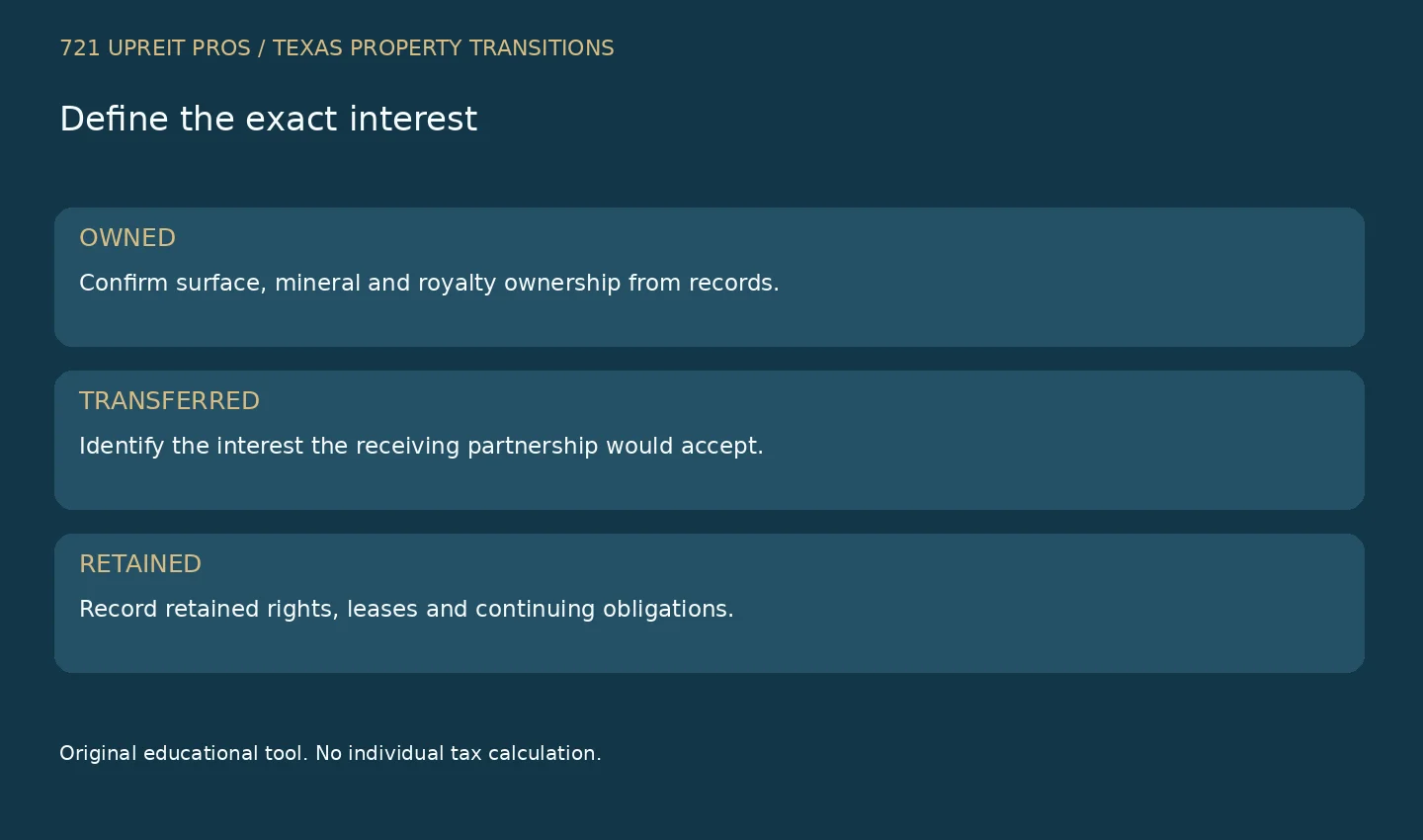
Record a source and responsible reviewer for each answer. If the family owns only a fraction of the minerals, do not put 100 percent in the proposal. If an LLC owns the surface but individuals own minerals, preserve that distinction. Moving out of Texas does not merge those owners or authorize one person to sign for everyone.
Does Section 721 require a sponsor to accept the reservation?
No. Tax treatment and commercial acceptance are separate questions. A receiving operating partnership may reject the property, require a different scope or request more evidence. Ask for written confirmation of the proposed asset, exclusions, title exceptions and conditions. Use the direct-property acceptance checklist for the wider diligence process; a discussion or indicative valuation is not a completed contribution.
IRS Publication 541 describes the general nonrecognition treatment for property contributed in exchange for a partnership interest, with important exceptions. Cash or other consideration, liability changes, disguised-sale rules and the investment-company exception require separate review. Do not assume a mineral reservation makes a transaction tax-free, or that a later investment of cash reverses tax on an already completed sale.
Resolve the transfer scope before relying on a unit estimate. Review the actual documents with counsel, not a hypothetical sponsor policy. If the proposed deal includes money paid to the owner, the contribution-payment evidence checklist helps separate payments from units and identify the questions the CPA must answer.
Hypothetical: the same tract, two different proposals
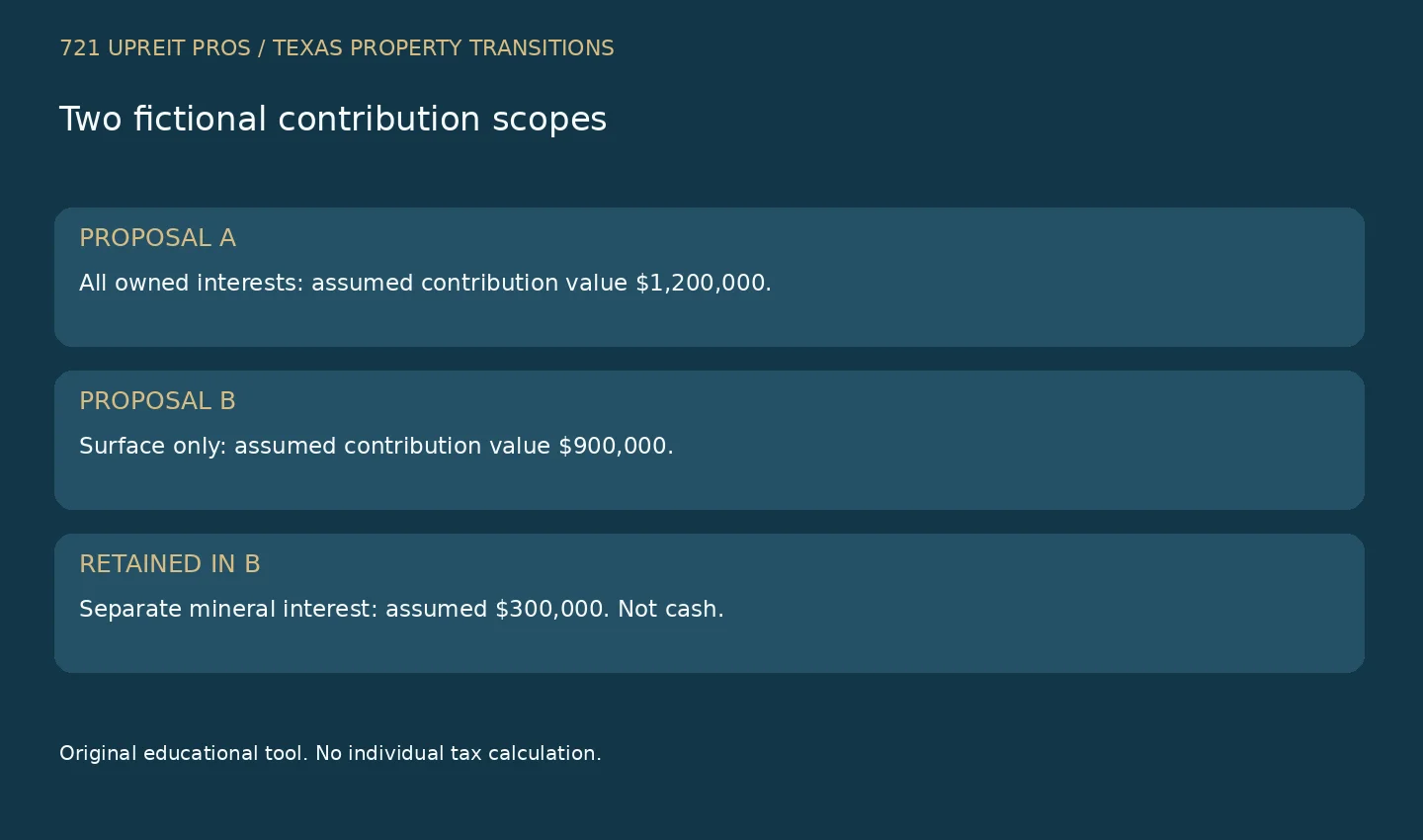
Assume a fictional owner has verified ownership of both estates on investment acreage. Proposal A discusses all owned surface and mineral interests at an assumed $1,200,000 contribution value. Proposal B discusses the surface interest only at an assumed $900,000, with the owner retaining mineral interests assigned an illustrative $300,000 value. These are invented, independently assumed values, not appraisals, offers or a rule for pricing severed interests.
| Question | Proposal A | Proposal B |
|---|---|---|
| Discussed contribution | All owned interests: assumed $1,200,000 | Surface only: assumed $900,000 |
| Retained mineral interest | None under this assumption | Separate assumed $300,000 asset |
| Spendable closing cash | Not established by contribution value | Not established by either value |
| Unresolved gates | Acceptance, title, tax treatment and actual terms | Same gates, plus reservation and surface-use effects |
The useful result is not a preferred proposal. It is the prevention of double counting: the retained $300,000 interest is not also part of the assumed $900,000 contribution. Nor is either amount a bank balance. A CPA must support the basis attributable to the relevant interests, including applicable adjustments; do not attach the entire historical basis to whichever portion happens to be transferred.
What happens to royalties you keep after moving?
Retained royalty income is a separate tax stream. IRS Publication 525 generally treats oil, gas and mineral royalties as ordinary income and distinguishes reporting for operating interests. Contributing a surface interest does not automatically defer income from retained minerals. Preserve royalty statements, ownership records and depletion history for your preparer rather than combining them with OP-unit distributions.
Texas's lack of an individual income tax does not remove federal obligations; see Article VIII, Section 24-a. A sale may involve capital gain, depreciation-related amounts and, where applicable, net investment income tax. Local property taxes are another category, administered through the Texas property-tax system. Have the CPA identify which rules apply to each asset and payment.
Your destination state also needs review. For example, California FTB Publication 1100 distinguishes California-source income during nonresidency from income regardless of source during residency. That is not a calculation for your facts. Coordinate residency dates, retained Texas income and partnership reporting using the multistate OP-unit record checklist. Federal deferral does not settle every state filing or tax obligation.
How does this differ from selling and using a 1031 exchange?
A qualifying Section 1031 exchange concerns business or investment real estate, not an automatic exchange of every asset in a land-sale package. Confirm the precise interest and use with your CPA and qualified intermediary before closing. A personal-use home generally is not eligible; a qualifying home sale may instead receive a separate Section 121 gain exclusion, subject to its requirements.
For a typical delayed exchange, arrange the QI and proceeds restrictions before transfer. Identify replacement property within 45 days and receive it by the earlier of 180 days or the return due date, including extensions. These periods overlap. Actual or constructive receipt can defeat the intended treatment; sending already-controlled sale cash to an intermediary later is not an automatic cure. See the IRS Form 8824 instructions and Publication 544.
An eligible DST interest can play a role under the specific facts addressed by Revenue Ruling 2004-86. Offering eligibility and accreditation requirements, where applicable, are separate checks. A later 721 contribution is a different transaction and is not guaranteed. OP units and ordinary REIT shares generally do not qualify as replacement real estate in your own 1031 exchange.
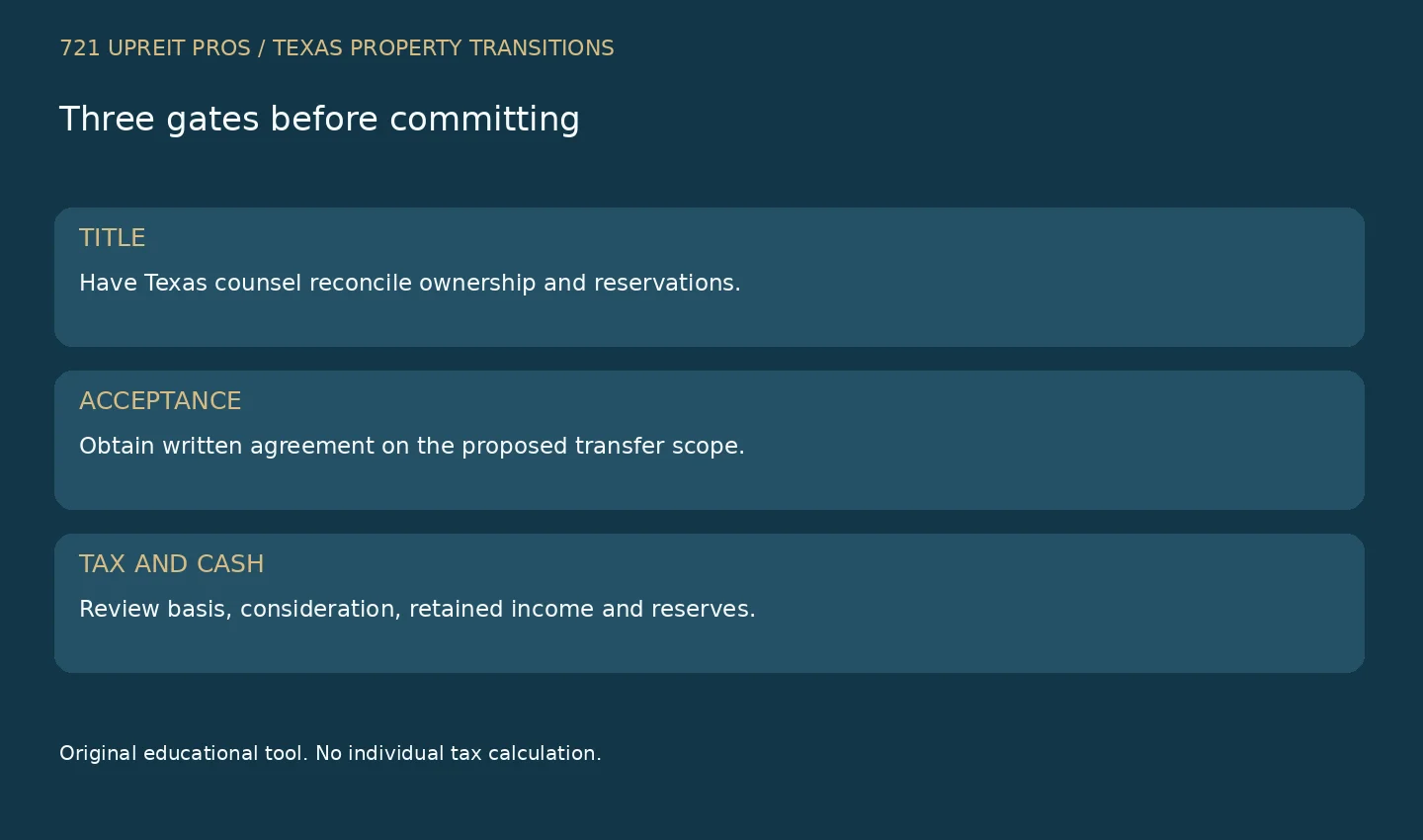
What must be resolved before committing?
Tax deferral is not tax elimination. Keep relocation money outside assumptions about royalty payments, distributions or redemptions. DST interests and OP units can be illiquid; conversion or redemption may trigger tax. Compare fees, leverage, concentration, market risk and sponsor conflicts in the 721 risk guide and the related DST due-diligence checklist. The SEC's REIT overview explains broader non-traded REIT risks; your actual OP agreement governs your rights.
- Confirm each owner and the exact surface, mineral and royalty interests.
- Ask counsel to reconcile deeds, reservations, leases and access burdens.
- Get written agreement on what the proposed contribution includes.
- Obtain support for valuation, basis, debt and consideration separately.
- Map retained income, destination-state obligations and accessible moving reserves.
- Resolve outstanding conditions before signing binding transfer documents.
Use the established advisor contact path to discuss the planning questions. Send deeds and private tax records only through your professionals' secure channels. This article makes no election-result, migration or price prediction and creates no election-based closing deadline. It is general education, not personalized legal, tax or investment advice.
One-minute mineral-rights review
Original silent educational video with English captions and a complete transcript.
Read video transcript
0:00 · One tract, distinct interests
Surface, minerals and royalties need separate ownership evidence.
0:12 · Define the transfer
What you own, contribute and retain are three different questions.
0:24 · Do not double count
Retained mineral value is not part of contributed surface value.
0:36 · Keep income streams separate
Retained royalties do not automatically receive Section 721 deferral.
0:48 · Resolve the actual terms
Review title, acceptance, taxes and moving cash before committing.
Download the rights-inventory checklist
Primary sources checked November 7, 2026 Pacific. Linked IRS publications are the currently posted editions. No actual offering, title opinion or individual professional review is represented. Principal, income, tax treatment, acceptance and liquidity are not guaranteed.
Frequently asked questions
Can I keep mineral rights when contributing Texas land?
It may be possible, depending on what you own, the legal documents and whether the receiving partnership accepts that scope. Have Texas counsel confirm the reservation and continuing surface-use rights. No particular program acceptance or tax outcome is established here.
Does a surface deed prove I own the minerals?
Not necessarily. Prior deeds, reservations, leases or estate transfers may separate ownership. Obtain a title review of the relevant instruments and fractions rather than relying only on acreage, a tax account or family recollection.
Are retained royalty checks deferred under Section 721?
Not automatically. Retained mineral royalties remain a separate income stream; IRS Publication 525 generally treats oil, gas and mineral royalties as ordinary income. Ask your CPA about the specific interest, depletion, reporting and destination-state rules.
Can I use the full property value to estimate my OP units?
Not if that value includes rights you are retaining. Reconcile the exact contributed interest, accepted valuation, debt, fees and unit-pricing terms. The fictional values in this article are not appraisals, proceeds or an estimate of actual units.
Does moving out of Texas end tax obligations on retained rights?
No such blanket result follows from relocating. Review federal income, retained Texas interests, local taxes and destination-state residency or source rules separately. A qualifying contribution does not settle every future filing obligation.
Can my personal home be exchanged into an UPREIT?
A personal-use home generally does not qualify for Section 1031; a qualifying sale may instead receive a Section 121 exclusion. A direct partnership contribution has a different legal and tax analysis and requires actual acceptance. Do not treat it as a workaround without professional advice.
BEFORE YOUR ADVISOR CONVERSATION
Three questions before you commit
This companion briefing covers the professional's identity, compensation and how restrictions fit your cash needs. Use it alongside this article's specific document checks.
Loading the video connects to YouTube. Watch on YouTube · 721 UPREIT Pros channel · Read the full advisor checklist.
Read video transcript
Before you hire a seven twenty-one UPREIT advisor, ask these three questions.
First: who exactly am I hiring? Get the professional's legal name, firm and registration information. Check the record through Investor dot gov and read the firm's relationship summary where applicable. Ask whether this conversation involves brokerage services, investment advice, or both. A marketing title alone does not answer that question.
Second: who gets paid, and how much? Request a written cost breakdown in dollars. Identify the payer, calculation base, payment timing and ongoing charges. Include product expenses and embedded compensation. No separate advisor invoice does not mean there are no costs.
Third: how does this fit my cash needs? Review the actual agreements. Ask who controls a possible conversion and what happens if it does not occur. Separate permission to request redemption from approval, pricing and payment. Do not assume a fixed cash-out date.
Then agree on responsibilities. Your investment professional, CPA, attorney and qualified intermediary can have different roles. Put continuing service and unresolved questions in writing.
Read the complete advisor checklist using the article link in the description. Seven twenty-one UPREIT Pros. Trust the Pros. Educational only. Investments involve risk and may be illiquid. Tax treatment depends on your circumstances.
Educational only. Investments involve risk and may be illiquid. Footage is illustrative; narration is synthetic.
TALK TO A 721 UPREIT ADVISOR
Ready to discuss your 721 options?
Request a callback to discuss the questions raised by this article, your timing and what to ask before you commit. Share your name, email and phone below to start the conversation.
No investment commitment or financial documents required. A callback request does not book an appointment or establish an advisory relationship.