
TEXAS PROPERTY TRANSITIONS
Texas Ag Land to 721: Who Pays a Rollback Tax?
A qualifying Section 721 contribution may defer federal gain, but it does not cancel Texas agricultural rollback tax. For 1-d-1 land, a change to nonagricultural use can create a separate property-tax bill. Before contributing, verify the appraisal category, planned land use, contractual responsibility and cash available to pay any obligation.
By 721 UPREIT Pros · Published November 9, 2026 · Educational content with AI assistance. No individual professional review is represented.
Key takeaways
- Confirm which agricultural appraisal category applies.
- Identify whether and when the land's actual use would change.
- Separate the tax lien and legal liability from a contract's reimbursement promise.
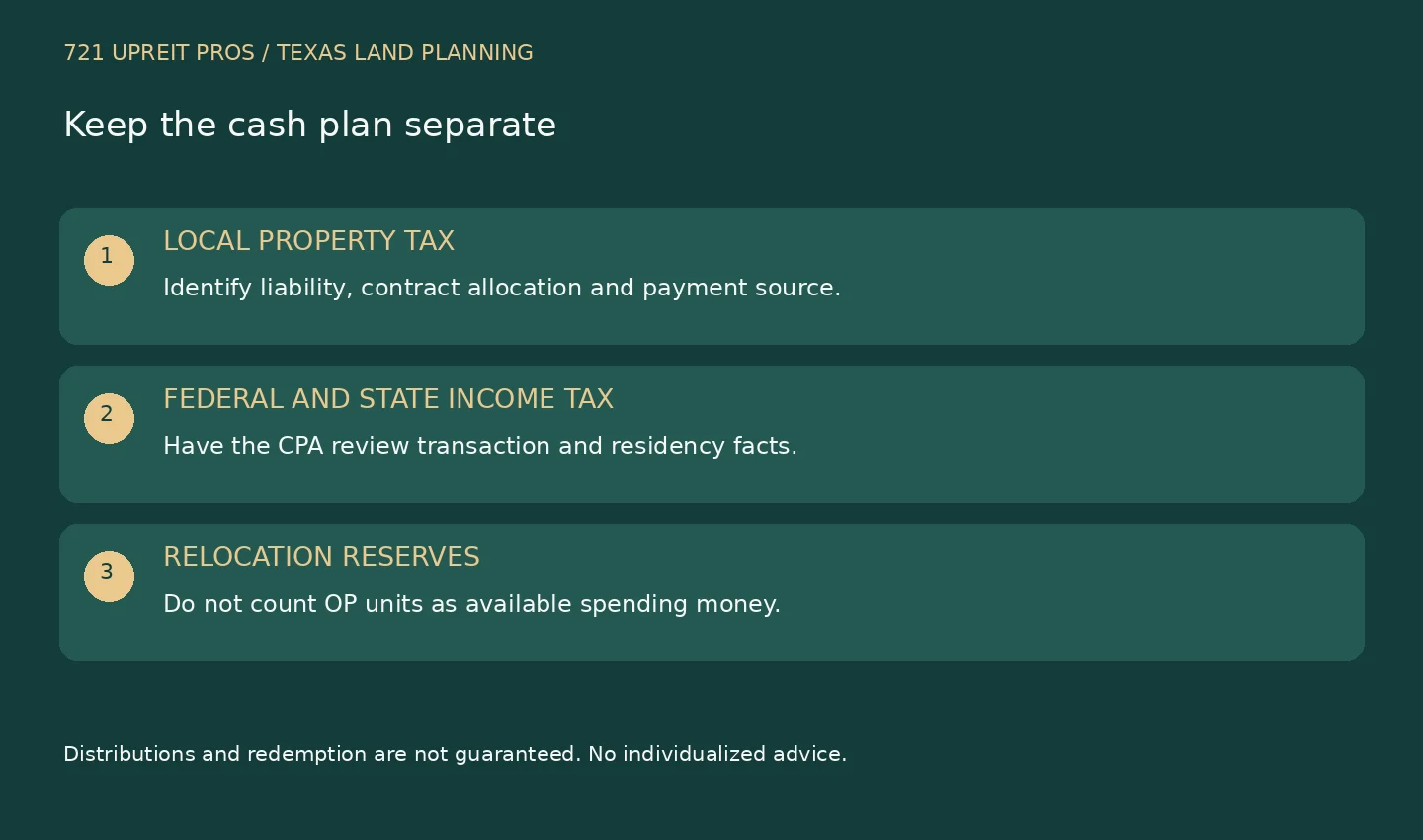
- Reserve spendable money rather than counting illiquid OP units as cash.
Moving away from Texas does not make every cost of a land transition disappear. Owners sometimes describe acreage as “ag exempt” and assume a tax-deferred contribution carries that status forward automatically. The better starting point is the actual appraisal record and the receiving partnership's intended use. Our Texas property-sale and relocation guide compares the broader sale, exchange and contribution paths.
This article addresses land receiving Texas 1-d-1 open-space agricultural appraisal. It is not a determination of your parcel's eligibility, a legal allocation of liability or a promise that an UPREIT will accept agricultural land. Use the worksheet below with Texas property-tax counsel, your CPA, the appraisal district and the proposed transaction's closing team before signing.
TALK TO A 721 UPREIT ADVISOR
Talk to a 721 UPREIT advisor
Request a callback to discuss the questions raised by this article, your timing and what to ask before you commit. Share your name, email and phone below to start the conversation.
No investment commitment or financial documents required. A callback request does not book an appointment or establish an advisory relationship.

What does Texas agricultural appraisal actually change?
Qualifying agricultural land can be appraised using its agricultural productivity rather than ordinary market value. This is a property-tax valuation method, not a blanket exemption from taxes. The Texas Comptroller's agricultural appraisal guidance distinguishes open-space appraisal under 1-d-1 from the separate 1-d category. Identify the classification on the district's records, not merely the wording in an advertisement.
Those categories matter. The Comptroller explains that 1-d land can incur rollback tax and interest upon a sale or discontinuation of agricultural use. For the 1-d-1 framework discussed here, the central rollback trigger is a qualifying change of use. Do not import rules about timberland, wildlife management, a homestead or 1-d land into a 1-d-1 analysis without checking the applicable requirements and exceptions.
Does a contribution itself trigger the rollback?
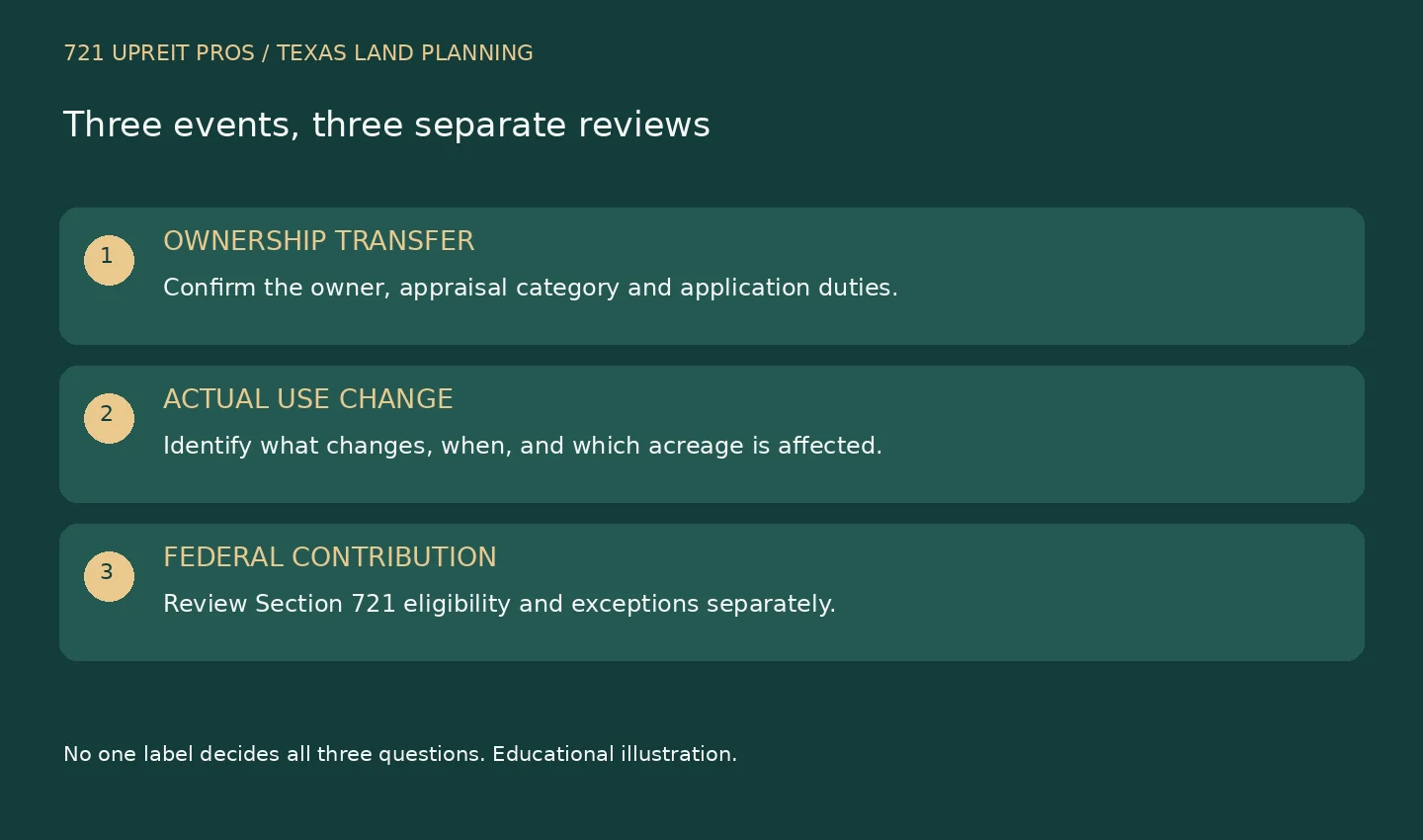
A change of ownership and a change of use are different events. Section 23.55 addresses land whose qualifying use changes. An ownership transfer alone should not be treated as proof that a 1-d-1 rollback has occurred. Equally, a transfer labeled “721” does not establish that the agricultural use continues. Ask what will actually happen to the tract before closing, at closing and afterward.
The application also needs attention. Under Texas Tax Code Section 23.54, ownership changes affect the continuing application framework. Have the new owner confirm its filing requirements, dates and any statutory ownership-transfer exception with the chief appraiser. A missed application and a change-of-use determination are not interchangeable findings. Separate late-filing or failure-to-notify penalties may apply; ask about those too. Do not assume that keeping cattle on the property resolves every eligibility or filing requirement. The amendment effective January 1, 2026 includes an application exception for previously appraised land transferred to a new owner who uses it materially the same way, with the same individuals overseeing or conducting that use. Do not assume a partnership contribution meets those facts.
Who owes the tax, and what can the contract change?
The Comptroller says the property owner who changes the use owes the rollback tax. Section 23.55 also provides for a lien attaching to the land when the change occurs. The Comptroller's agricultural appraisal manual distinguishes contractual payment allocation from the land lien. A clause assigning a cost between contributor and partnership is a separate contractual question. It does not, by itself, erase a taxing unit's lien or replace the statutory analysis.
Have counsel examine indemnities, prorations, escrows, notice requirements and survival periods. Does an agreement cover a pre-closing use change, a post-closing change, or both? Who must deliver a later bill, fund payment, contest an assessment and retain records? A reimbursement right is only as useful as its actual terms and enforceability. Do not assume a standard “tax protection” agreement covers this local property-tax exposure.
| Question | Evidence | Person to resolve it |
|---|---|---|
| What appraisal applies? | Parcel account, approved application and annual notices | Appraisal district and Texas counsel |
| What use will change? | Lease, operating plan, permits and transition dates | Owner, receiving partnership and counsel |
| Who bears each cost? | Contribution agreement, indemnity and escrow terms | Transaction counsel and closing team |
| What pays the bill? | Cash reserve, documented funding obligation and due date | Owner, partnership and CPA |
Compare this worksheet with the direct-property acceptance checklist and the tax-protection agreement review. Those address different decisions. Neither an acceptance letter nor a federal gain-protection provision substitutes for resolving the local tax question.
How large could a separate rollback bill be?
For the current 1-d-1 rule, the additional tax generally compares agricultural-value taxes with market-value taxes for each of the three preceding years in which the land received that appraisal. It is not a percentage of the seller's capital gain. Section 23.55 addresses partial-parcel changes and exceptions; the district and relevant tax offices must determine the applicable land, years and amounts. Delinquent payment can add penalties and interest.
Fictional arithmetic, not a parcel estimate: assume a taxable change of use occurs in 2026, the entire tract qualified in all three preceding years, and no exception applies. Suppose the confirmed tax differences would be $8,000 for 2023, $9,000 for 2024 and $10,000 for 2025. Their sum is $27,000. These invented inputs illustrate the calculation's structure only; they do not establish anyone's assessment, liability or deadline.
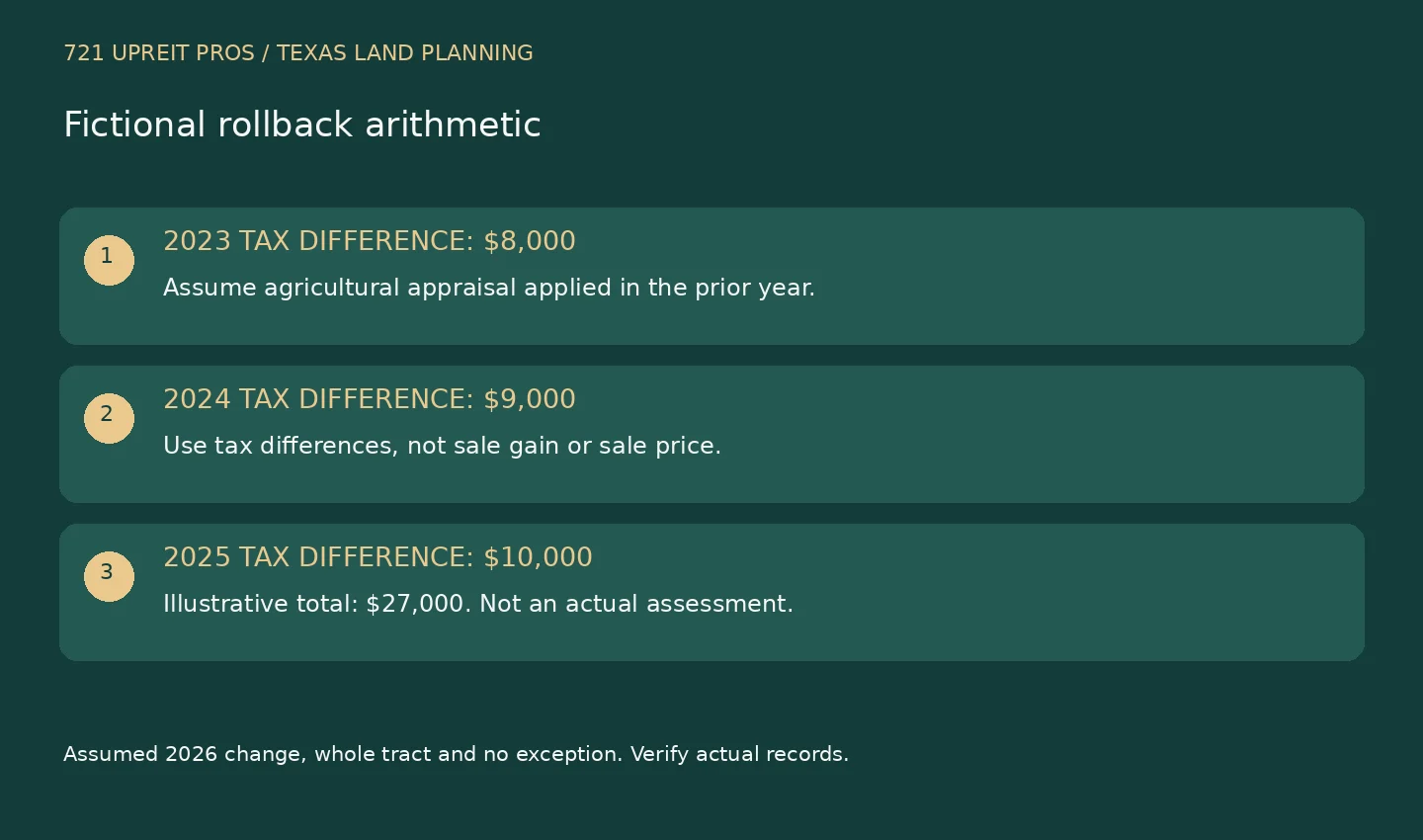
Now assume the owner has $45,000 of separate liquid savings and expects $12,000 of moving expenses. Reserving the illustrative $27,000 would leave $6,000 before federal or other state taxes, household needs and additional costs. This is a cash stress test, not advice to pay a tax the owner does not owe. If the contract assigns payment elsewhere, verify the obligation and funding before removing the reserve from the plan.
Why does Section 721 not settle this bill?
IRS Publication 541 describes the general nonrecognition rule for property contributed in exchange for a partnership interest. It also discusses exceptions and related rules, including disguised sales and investment-company contributions. Debt shifts, money received and the full transaction need CPA review. Deferring federal gain does not create an exemption from a separate Texas change-of-use property tax.
An UPREIT contribution normally exchanges the contributed property for partnership ownership rather than unrestricted sale proceeds. Acceptance, valuation and terms remain program-specific. Review the 721 guide and investment risks: fees, debt, concentrated exposure, sponsor decisions and market losses can affect the outcome. Distributions, redemption, conversion and a future exit are not guaranteed. A contractual promise is not cash in your bank account. Deferral is not tax elimination: a later sale, conversion or redemption can create tax. OP units and ordinary REIT shares generally do not qualify for your own later 1031 exchange. The SEC REIT overview provides broader non-traded REIT risk context; actual OP-unit rights depend on the governing agreement.
Would selling through a 1031 exchange be different?
A qualifying 1031 exchange may defer gain on real estate held for business or investment, but it does not cancel a Texas rollback obligation either. Arrange qualified-intermediary planning before closing and avoid actual or constructive receipt of proceeds. The Form 8824 instructions explain the 45-day identification period and completion by the earlier of 180 days or the return due date, including extensions. Later investing cash already received does not automatically repair a failed exchange.
A qualifying DST interest may serve as replacement real estate under the specific conditions addressed in Revenue Ruling 2004-86. A later 721 transaction is separate and not assured. Offering-specific eligibility and accreditation requirements may apply, and illiquidity remains important. For a separate review of land-related liabilities, see the educational environmental due-diligence guide. It does not determine property-tax treatment.
Your personal-use home generally does not qualify for Section 1031. Section 121 home-sale exclusion rules are different. Federal capital gains, depreciation-related tax and possible net investment income tax also require their own calculations. Texas's lack of individual income tax does not remove federal tax. A destination state may tax income or later recognized gain under its rules; California's residency guidance illustrates why moving dates alone do not settle that issue.
What should be resolved before committing?
- Obtain the district's actual appraisal classification, parcel boundaries and relevant prior-year records.
- Document existing agricultural operations, leases and any planned change of use.
- Ask the new owner to confirm application duties and operational continuity.
- Have Texas counsel separate statutory exposure, lien questions and negotiated reimbursement terms.
- Ask the CPA to model federal and state income taxes separately from local property tax.
- Identify who receives notices, makes payments and retains records after the move.
- Test liquid reserves without assumed distributions or redemptions.
Download the agricultural appraisal and contribution worksheet. Use it alongside the cash-needs and control worksheet. Obtain transaction-specific advice before choosing a sale, exchange or contribution.
One-minute agricultural tax review
Original silent educational video with English captions and a complete transcript.
Read video transcript
0:00 · Appraisal is not exemption
Start with the actual Texas agricultural appraisal category.
0:12 · Track the use of the land
Ownership and use changes are separate questions.
0:24 · Calculate the right cost
The fictional tax differences total $27,000, not sale gain.
0:36 · Read the responsibility terms
A contract promise does not erase the statutory land lien.
0:48 · Keep liquid reserves
Review local tax, federal tax and moving cash separately.
Primary sources checked November 9, 2026. This article makes no election-result, migration, property-price or future-tax-law prediction. It is general education, not individualized tax, legal or investment advice. Consult qualified professionals about the actual property, transaction and residency facts.
Frequently asked questions
Is an “ag exemption” the same as no property tax?
No. Agricultural appraisal generally changes the valuation basis for qualifying land. It does not exempt every improvement or eliminate all property taxes. Confirm the exact approved category and acreage.
Does leaving Texas automatically end 1-d-1 appraisal?
A personal move and the land's actual use are separate facts. Continued qualification depends on the applicable requirements, operations and filings. Ask the district rather than assuming either automatic continuation or automatic loss.
Can a partnership accept land and keep agricultural use?
It may propose to do so, but neither acceptance nor continued appraisal is assured. Review the specific entity, use plan, leases and application requirements. Obtain written answers instead of relying on a marketing description.
Can only part of a tract generate rollback tax?
Section 23.55 addresses changes affecting only part of a parcel. Have the district and counsel establish the affected area and supporting records. Do not apply a whole-parcel illustration to a partial change.
Will a 721 tax-protection agreement reimburse this cost?
Only its actual terms can answer that question. A provision about federal built-in gain is not necessarily a local property-tax indemnity. Ask counsel to identify covered events, exclusions, claimant rights and payment obligations.
Can OP units cover a bill due after closing?
Do not assume they can be sold or redeemed on demand. Transfers and redemptions may be restricted, and distributions can change. Identify separate liquid funding and review any proposed cash consideration with the CPA.
BEFORE YOUR ADVISOR CONVERSATION
Three questions before you commit
This companion briefing covers the professional's identity, compensation and how restrictions fit your cash needs. Use it alongside this article's specific document checks.
Loading the video connects to YouTube. Watch on YouTube · 721 UPREIT Pros channel · Read the full advisor checklist.
Read video transcript
Before you hire a seven twenty-one UPREIT advisor, ask these three questions.
First: who exactly am I hiring? Get the professional's legal name, firm and registration information. Check the record through Investor dot gov and read the firm's relationship summary where applicable. Ask whether this conversation involves brokerage services, investment advice, or both. A marketing title alone does not answer that question.
Second: who gets paid, and how much? Request a written cost breakdown in dollars. Identify the payer, calculation base, payment timing and ongoing charges. Include product expenses and embedded compensation. No separate advisor invoice does not mean there are no costs.
Third: how does this fit my cash needs? Review the actual agreements. Ask who controls a possible conversion and what happens if it does not occur. Separate permission to request redemption from approval, pricing and payment. Do not assume a fixed cash-out date.
Then agree on responsibilities. Your investment professional, CPA, attorney and qualified intermediary can have different roles. Put continuing service and unresolved questions in writing.
Read the complete advisor checklist using the article link in the description. Seven twenty-one UPREIT Pros. Trust the Pros. Educational only. Investments involve risk and may be illiquid. Tax treatment depends on your circumstances.
Educational only. Investments involve risk and may be illiquid. Footage is illustrative; narration is synthetic.
TALK TO A 721 UPREIT ADVISOR
Ready to discuss your 721 options?
Request a callback to discuss the questions raised by this article, your timing and what to ask before you commit. Share your name, email and phone below to start the conversation.
No investment commitment or financial documents required. A callback request does not book an appointment or establish an advisory relationship.