
721 UPREIT PROS / POST-CONTRIBUTION EXIT OPTIONS
Can you do another 1031 exchange after a 721 contribution?
Usually not with the OP units or REIT shares received after the contribution. Section 1031 applies to qualifying real property, while an OP unit is a partnership interest and a REIT share is stock. A separate property you still own, or a qualifying real-property interest you have not contributed, may require its own Section 1031 analysis.
Prepared by 721 UPREIT Pros · Published October 4, 2026 · General education

This article answers the ownership-stage question that often follows a Section 721 contribution. It supports the 721 transaction sequence and does not replace the broader 721 UPREIT guide. The decisive first question is not whether you once completed a 1031 exchange. It is what legal asset the taxpayer owns and proposes to transfer now.
Can OP units or REIT shares go into a 1031 exchange?
Generally, no. Treasury Regulation 1.1031(a)-3 says interests in a partnership are not real property for Section 1031, apart from a narrow Section 761(a) election exception that should not be assumed. The same regulation says ordinary stock and other securities are not real property. OP units are partnership interests. REIT shares are corporate stock. Calling either one “real estate exposure” does not convert the security into real property for Section 1031.
TALK TO A 721 UPREIT ADVISOR
Talk to a 721 UPREIT advisor
Request a callback to discuss the questions raised by this article, your timing and what to ask before you commit. Share your name, email and phone below to start the conversation.
No investment commitment or financial documents required. A callback request does not book an appointment or establish an advisory relationship.
IRS like-kind exchange guidance states that Section 1031 now applies only to exchanges of real property. The 2025 Instructions for Form 8824, updated April 30, 2026, also identify partnership interests among the intangible assets that are not real property for this purpose. The actual taxpayer, asset, use, transfer structure and replacement property still require transaction-specific review.
“After a 721” can describe three different events
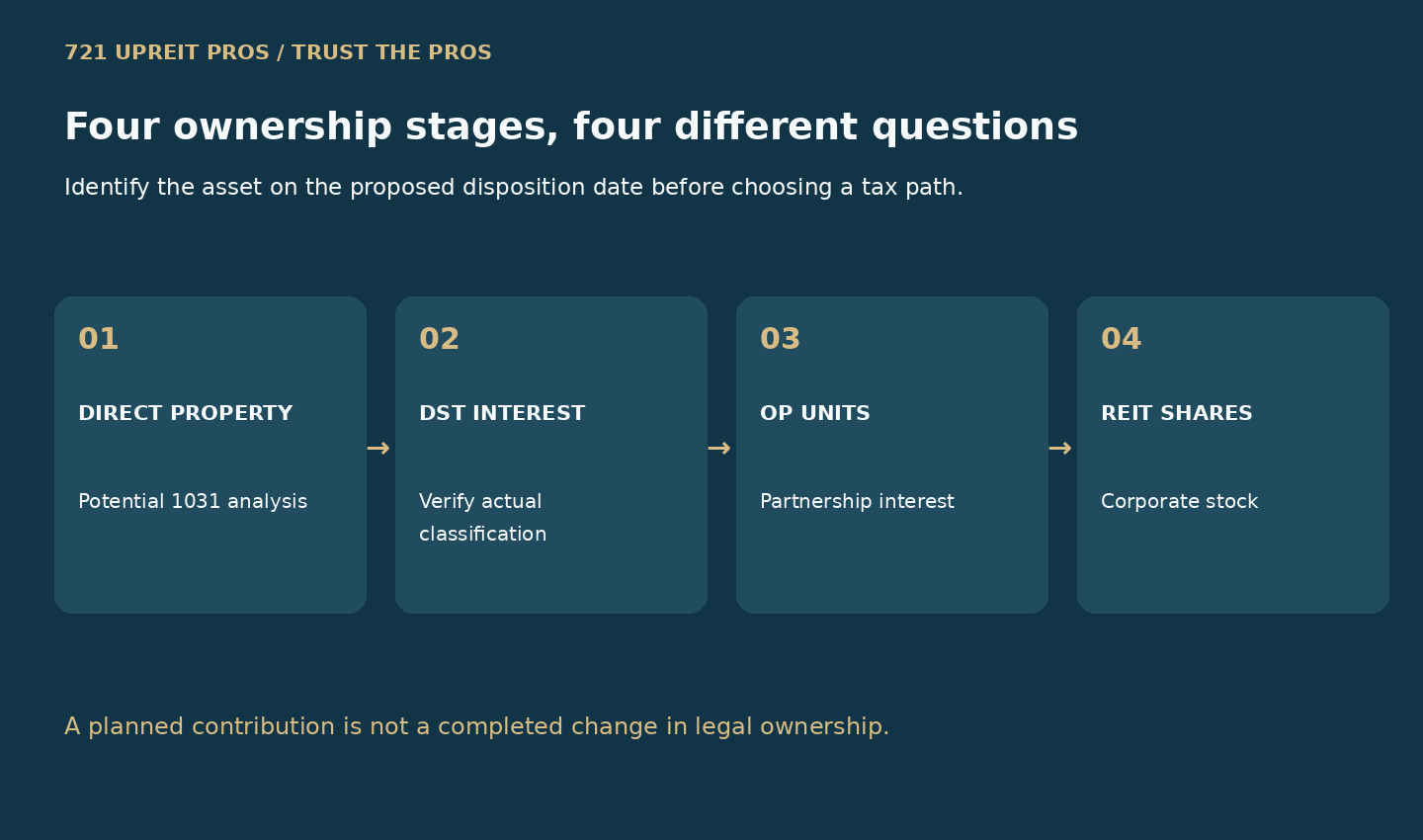
You may still own a DST interest while a future contribution is only contemplated. You may already hold OP units after a completed contribution. Or you may hold REIT shares after a later redemption or conversion. Those are different assets with different transfer rights and tax questions.
Start with the asset on the proposed disposition date
| What you own now | Is Section 1031 potentially relevant? | What must be verified |
|---|---|---|
| Direct investment or business real property | Potentially, if a qualifying exchange of real property is structured and all requirements are met | Taxpayer identity, held-for use, timing, qualified-intermediary structure and replacement property |
| Beneficial interest in a DST | Possibly, but only if the actual interest and transaction are treated as real property | Trust powers, tax classification, governing documents and the exact disposition path |
| UPREIT OP units | Generally no for an exchange of the units themselves | Partnership agreement, transfer or redemption rights and the separate tax result of the proposed disposition |
| REIT shares | Generally no for an exchange of the shares themselves | Share-sale or redemption mechanics, basis and tax reporting, not a real-property exchange |
Revenue Ruling 2004-86 reached a real-property conclusion for the particular Delaware statutory trust and restricted powers described in that ruling. It does not make every DST interest eligible, and it does not extend that conclusion to OP units or REIT shares. Review the actual trust and exit documents before relying on the label “DST.”
Use a disposition-path decision tree
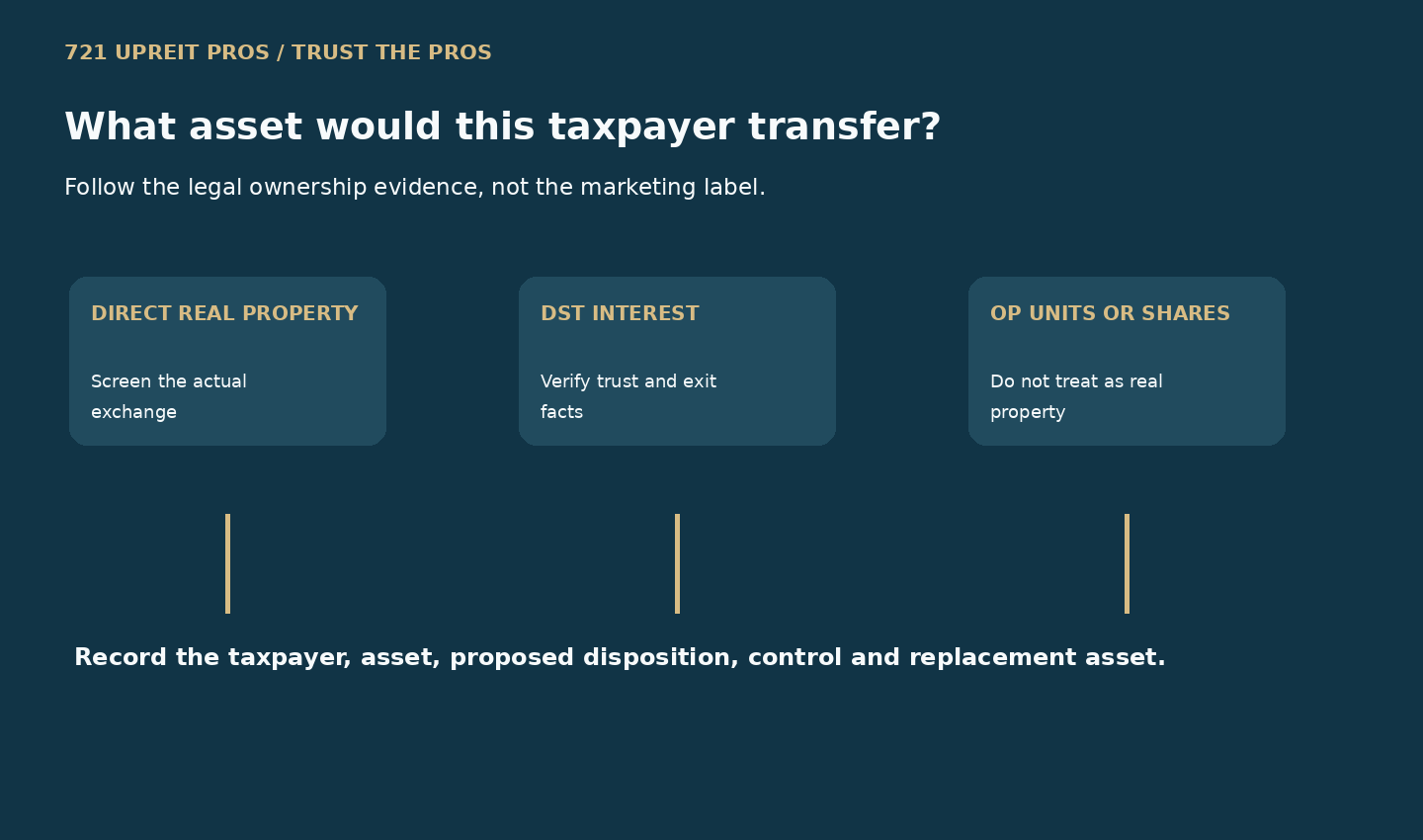
- Name the taxpayer. Record the person or entity that owns the asset now. Do not assume the taxpayer from an earlier property sale is unchanged.
- Name the legal asset. Use the deed, DST records, partnership agreement, unit statement or brokerage statement, not a marketing description.
- Name the proposed disposition. Distinguish a direct property sale, trust-level sale, transfer of a DST interest, partnership property sale, OP-unit transfer or redemption, and REIT-share sale.
- Name the replacement asset, if any. Section 1031 requires real property for real property. A plan to buy securities after receiving cash is not the same transaction.
- Confirm control and timing. Identify who can cause the transaction, whether the investor receives cash, and whether a qualified intermediary must be engaged before a transfer.
Download the ownership-stage checklist
What if the operating partnership sells the real estate?
A property sale by the operating partnership does not mean an OP-unit holder personally sold direct real property. The partnership owns and disposes of its property. The partner owns a partnership interest and receives partnership reporting. The partnership may consider its own exchange strategy, but that is different from an individual unit holder placing OP units into a personal 1031 exchange.
If contributed property is sold, use the separate contributed-property sale tax-record checklist to connect the sale, Section 704(c) workpaper, partner allocation and tax character. If OP units may later become shares or cash, use the OP-unit conversion checklist. Neither event recreates direct ownership of the original building.
Worked example: one owner, two properties, two paths
This is a fictional ownership example, not a tax recommendation. Morgan owned Building A and Building B. Building A was contributed to an operating partnership in a completed Section 721 transaction, and Morgan now holds OP units. Building B remains directly owned and is rented to tenants.
Morgan wants to sell both positions and asks whether “another 1031” is available. The answer must be split:
| Position | Current asset | Relevant next analysis |
|---|---|---|
| Building A history | OP units, not the former building | Partnership transfer, redemption or conversion terms and the tax result of that unit-level event. Do not treat the units as relinquished real property. |
| Building B | Direct rental real property | A separate Section 1031 review may be relevant before sale, including the taxpayer, held-for-investment use, qualified intermediary and replacement real property. |
The earlier Section 721 contribution does not prevent Morgan from evaluating Building B under Section 1031. It also does not make the OP units eligible. Two positions held by the same investor can require different tax frameworks on the same day.
Eight questions before relying on another 1031 exchange
- Who is the current tax owner of the asset proposed for transfer?
- Does the evidence show direct real property, a DST beneficial interest, OP units or REIT shares?
- Is a DST contribution only planned, or has it legally closed?
- Who controls the next sale, redemption, conversion or transfer?
- Will this taxpayer transfer qualifying real property or receive sale proceeds?
- What do the partnership, trust and offering documents say about transfer and exit rights?
- Does a qualified intermediary need to be engaged before the real-property transfer?
- Which CPA, tax attorney and qualified intermediary will document the conclusion before action?
For the possible DST stage, DST 1031 Experts provides a broader 1031, DST and potential 721 pathway overview. Treat it as background, not proof that a particular trust, contribution or later exchange qualifies. Then talk to a 721 UPREIT advisor with the ownership-stage checklist and current documents.
One-minute video: identify the asset before the tax path
Read video transcript
General education by 721 UPREIT Pros with AI assistance. No independent professional review is represented. This page does not determine whether any asset, DST interest, exchange, contribution, redemption, conversion, partnership action or replacement property qualifies for tax deferral. It does not predict tax, liquidity, timing, acceptance, return or investment suitability.
BEFORE YOUR ADVISOR CONVERSATION
Three questions before you commit
This companion briefing covers the professional's identity, compensation and how restrictions fit your cash needs. Use it alongside this article's specific document checks.
Loading the video connects to YouTube. Watch on YouTube · 721 UPREIT Pros channel · Read the full advisor checklist.
Read video transcript
Before you hire a seven twenty-one UPREIT advisor, ask these three questions.
First: who exactly am I hiring? Get the professional's legal name, firm and registration information. Check the record through Investor dot gov and read the firm's relationship summary where applicable. Ask whether this conversation involves brokerage services, investment advice, or both. A marketing title alone does not answer that question.
Second: who gets paid, and how much? Request a written cost breakdown in dollars. Identify the payer, calculation base, payment timing and ongoing charges. Include product expenses and embedded compensation. No separate advisor invoice does not mean there are no costs.
Third: how does this fit my cash needs? Review the actual agreements. Ask who controls a possible conversion and what happens if it does not occur. Separate permission to request redemption from approval, pricing and payment. Do not assume a fixed cash-out date.
Then agree on responsibilities. Your investment professional, CPA, attorney and qualified intermediary can have different roles. Put continuing service and unresolved questions in writing.
Read the complete advisor checklist using the article link in the description. Seven twenty-one UPREIT Pros. Trust the Pros. Educational only. Investments involve risk and may be illiquid. Tax treatment depends on your circumstances.
Educational only. Investments involve risk and may be illiquid. Footage is illustrative; narration is synthetic.
TALK TO A 721 UPREIT ADVISOR
Ready to discuss your 721 options?
Request a callback to discuss the questions raised by this article, your timing and what to ask before you commit. Share your name, email and phone below to start the conversation.
No investment commitment or financial documents required. A callback request does not book an appointment or establish an advisory relationship.