
721 UPREIT PROS / NEW CAPITAL REVIEW
721 UPREIT Dilution: What Does New Capital Change?
New capital in a 721 UPREIT can reduce your ownership percentage without necessarily reducing the economic value of each unit. Compare what the partnership receives with the units and rights it issues. Pricing, expenses, senior claims and use of proceeds matter; a larger property portfolio alone does not establish a better investment.
By 721 UPREIT Pros · Published October 20, 2026 · Updated October 26, 2026 · Original hypothetical issuance comparison
Key takeaways
- Separate ownership percentage, value per unit and contractual priority.
- Compare net capital received with new interests issued, not just total asset growth.
- Verify issuance authority and investor rights in current controlling documents.
- New capital does not guarantee distributions, liquidity, returns or tax results.
If you are considering a property contribution, ask what may be issued after you join, not only how many units you receive at closing. If you already own OP units, an issuance notice calls for the same review. Start with the actual issuer and security in the 721 UPREIT guide; do not treat REIT shares and partnership interests as identical.
The useful decision is whether the new capital changes your economic position, rights or cash expectations in a way you understand. A percentage on an account statement is only one input. Request a dated before-and-after comparison and keep unknown items visible instead of assuming that every new unit either harms or benefits existing investors.
TALK TO A 721 UPREIT ADVISOR
Talk to a 721 UPREIT advisor
Request a callback to discuss the questions raised by this article, your timing and what to ask before you commit. Share your name, email and phone below to start the conversation.
No investment commitment or financial documents required. A callback request does not book an appointment or establish an advisory relationship.

Separate issuance economics from an investor funding obligation. Authority to issue more units does not, by itself, answer whether an existing holder must contribute money. Reconcile paid commitments, additional-contribution exceptions and amendment or separate-agreement terms using the capital-call obligation and notice review.
Which meanings of dilution should you separate?
Use three separate questions: does your percentage ownership fall, does the economic value attributable to each existing unit fall, and do new interests change payment priority or control? These questions can have different answers. A lower percentage in a larger pool does not, by itself, establish a loss. Equal unit counts do not establish equal rights across different classes.
| Question | Evidence needed | Shortcut to avoid |
|---|---|---|
| Ownership percentage | Comparable units outstanding before and after issuance | My unchanged unit count means nothing changed |
| Value per unit | Comparable equity values, net contributions and issuance costs | More total assets must mean more value per unit |
| Rights and priority | Current class terms, distribution waterfall and consent provisions | All new units participate on the same basis |
The unit-class comparison addresses choosing among actual classes. Here the focus is subsequent issuance and the position of existing holders. Do not combine unlike classes into a simple denominator unless the administrator explains the appropriate equivalent-unit calculation and its limitations.

Can ownership fall while value per unit stays unchanged?
Consider a deliberately simplified hypothetical partnership with $10 million of economic equity value and one million identical common units. Each unit represents $10 of that assumed value. An investor owns 50,000 units, or 5%, with an illustrated value of $500,000. There are no preferred claims, taxes, debt changes, operating changes or transaction costs in the starting model.
Compare three independent scenarios, all starting from that same position. In A, the partnership receives $2 million in cash for 200,000 new identical units. In B, it receives the same cash for 250,000 units. In C, it issues 200,000 units for $2 million gross cash but incurs $100,000 of costs that reduce economic equity dollar for dollar. Nothing else changes.
| Measure | Before | A: matched price | B: more units | C: costs reduce equity |
|---|---|---|---|---|
| Economic equity | $10,000,000 | $12,000,000 | $12,000,000 | $11,900,000 |
| Total common units | 1,000,000 | 1,200,000 | 1,250,000 | 1,200,000 |
| Investor ownership | 5.00% | 4.17% | 4.00% | 4.17% |
| Value per unit | $10.00 | $10.00 | $9.60 | About $9.9167 |
| 50,000 units' value | $500,000 | $500,000 | $480,000 | About $495,833 |
Scenario A demonstrates percentage dilution without an immediate per-unit value reduction under the stated assumptions. Scenario B uses an $8 issue price, while the starting assumed value is $10; additional units divide the enlarged equity pool more finely. Scenario C isolates transaction costs. These are illustrations of different inputs, not evidence that any sponsor is underpricing securities or that a particular transaction is fair.
Actual valuations may be uncertain, assets may change value between measurement dates, and different rights can invalidate this simple division. A contributed property is not cash: its supported net value, liabilities, expenses and operating prospects need separate review. The contribution-value reconciliation covers the earlier step of translating agreed value into units.

Can new interests be issued without your approval?
Read the agreement rather than assuming a vote or a right to buy enough new units to maintain your percentage. In a dated example, JLL Income Property Trust's October 7, 2025 supplement describes additional units and classes with potentially superior rights, no limited-partner consent for such issuance, and no preemptive rights. This is a specific historical disclosure, not a statement about every UPREIT or today's available investments.
A second example, ERP Operating Limited Partnership's Exhibit 4.3 filed in 2024, describes additional-unit issuance and its effect on percentage interests. It also discusses preference and incentive interests. Ask counsel to identify the corresponding current provisions, amendments and any investor-specific terms for your own partnership. A summary exhibit is not the entire agreement.
Separate issuance authority from amendment rights, notice requirements and conflicts procedures. Even where management can issue interests without an individual vote, the pricing process, permitted consideration and class protections still need review. Do not assume that receiving a notice grants a veto or that an anti-dilution adjustment for a unit split protects against every later capital issuance.
What does the partnership actually receive and do with it?
Ask for gross proceeds, expenses, net retained capital and the intended use. An issuance may finance an acquisition, support operations, repay debt or address another stated purpose. Units issued for services or compensation do not bring the same cash inflow as a cash subscription. Identify who receives the new interests and whether related-party arrangements require additional scrutiny.
Then test the explanation against evidence. For a proposed acquisition, request the valuation basis, financing and material assumptions. For repairs or operating needs, request a budget and timing. For debt repayment, distinguish lower debt from a promised increase in distributions. The DST reserve and capital-repair review provides related background for the earlier DST stage; its trust constraints are not the same as an operating partnership's issuance powers.
Portfolio growth is not itself a per-unit performance measure. Ask whether the comparison uses gross property value or equity after liabilities and senior claims. Also ask whether a quoted improvement is before or after fees, based on forecasts or observed results, and measured over a consistent period. Leave unsupported projections labeled as projections.
Does new capital settle distribution, liquidity or tax questions?
No. A new capital receipt is not a promise of higher investor payments or an accepted redemption request. Review distributions and cash access separately, using the redemption request checklist. The SEC's REIT investor guidance highlights liquidity limitations of non-traded REITs; your current OP interest requires its own contractual review.
Economic value is also not tax basis. IRS Publication 541, revised December 2025, explains the general partnership-contribution framework, exceptions, basis and contributed-property allocations. Give your CPA the actual transaction and liability changes. This worksheet does not determine whether you owe tax, establish a basis step-up or turn OP units into direct Section 1031 replacement real property.
What should you verify before relying on an issuance claim?
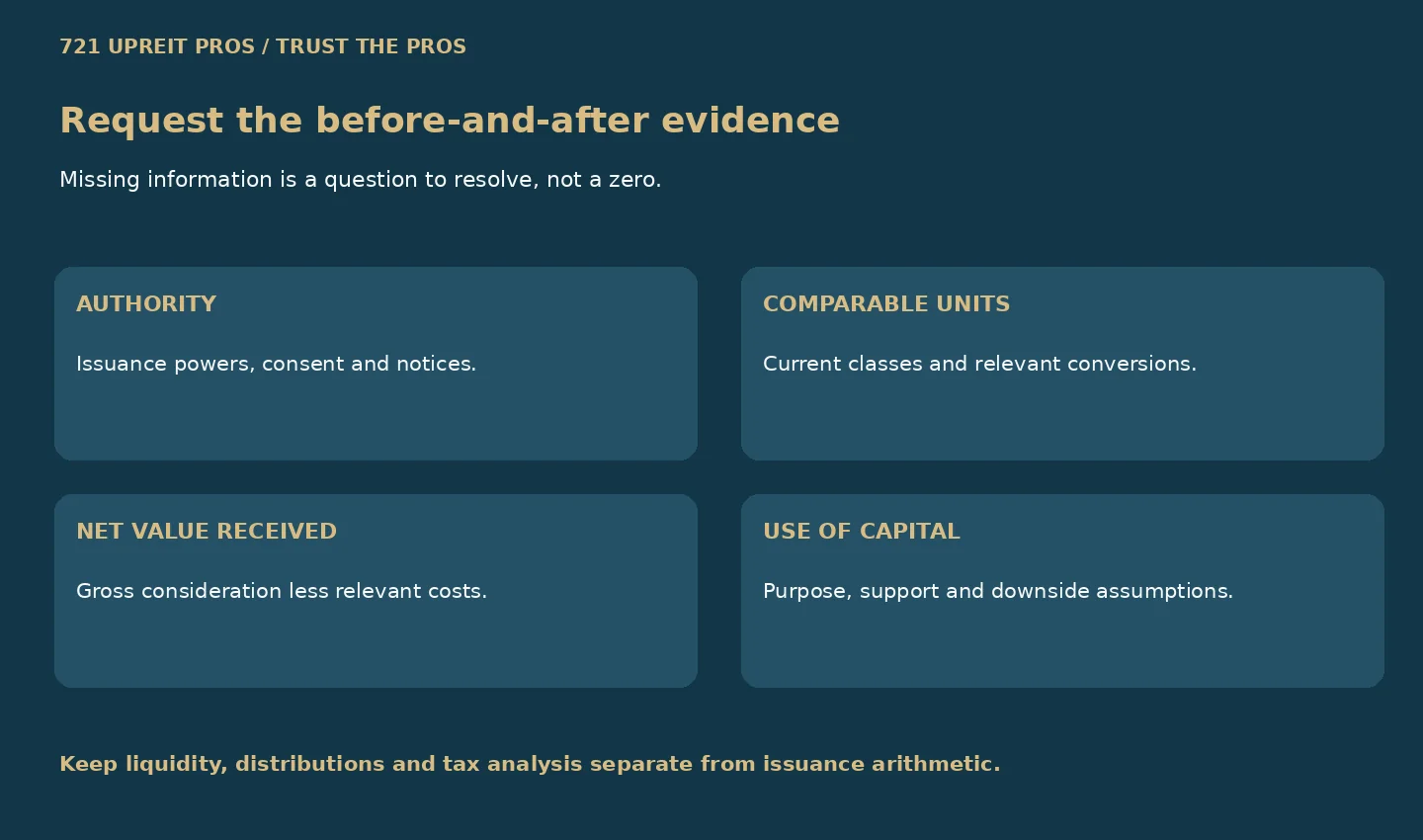
- Identify the issuer, affected interest, proposed class and transaction date.
- Obtain current issuance authority, consent provisions and any preemptive rights.
- Reconcile comparable units outstanding before and after, including relevant convertible interests.
- Document gross consideration, net economic value received, costs and valuation dates.
- Compare payment priority and rights before applying a single-class formula.
- Review the use of capital, assumptions, conflicts and downside scenarios.
- Keep your cash plan and tax analysis separate; record unresolved evidence and responsible follow-up.
Bring that comparison to your investment professional and legal or tax advisors as appropriate. If material inputs are unavailable, identify what cannot be concluded. Use the broader 721 UPREIT risk framework and talk to a 721 UPREIT advisor about the decision. Do not send account numbers or tax documents through a general contact form.
Watch the one-minute new-capital comparison
This original silent video has English captions and a complete transcript. The figures are hypothetical, not an investment forecast.
Read video transcript
0:00 · 721 UPREIT new capital
What changes when more interests are issued?
0:12 · Separate three questions
Ownership percentage, value per unit, and contractual rights can differ.
0:24 · Compare the actual inputs
Fictional matched-price issuance: lower percentage, unchanged value.
0:36 · Costs and pricing matter
More units or transaction costs can change the illustrated result.
0:48 · Ask for current evidence
Verify authority, value and rights. No liquidity or return is guaranteed.
Download the new-capital comparison worksheet
Sources checked October 20, 2026. Dated issuer examples are not current offering recommendations. Educational only, not tax, legal or investment advice.
Frequently asked questions
Does every new OP-unit issuance reduce my investment value?
No. In a simplified equal-rights model, capital received at the existing assumed per-unit value can preserve immediate value per unit even while your ownership percentage falls. Actual pricing, expenses, rights and valuation uncertainty change the analysis.
What if my own unit count stays the same?
Your percentage can still change when the total comparable units increase. Reconcile your quantity with the correct denominator and separately compare economic value and rights.
Can I buy additional units to maintain my percentage?
Only if the applicable documents and transaction permit it. Do not assume you have preemptive rights, that participation is available, or that investing more is appropriate.
Does new issuance mean I must contribute more cash?
Issuance to other investors and a contractual obligation for you to fund additional capital are different questions. Have counsel identify any actual funding obligation; do not infer one solely from an issuance notice.
Can preferred interests be included in the simple example?
Not without revising the model for their rights. Payment priorities, conversion features and participation terms can make a single common-unit division misleading.
Which evidence should I ask for first?
Request a dated before-and-after capitalization schedule, net consideration and cost bridge, valuation basis, class terms and permitted use of capital. Ask who prepared each figure and which assumptions remain unresolved.
TALK TO A 721 UPREIT ADVISOR
Ready to discuss your 721 options?
Request a callback to discuss the questions raised by this article, your timing and what to ask before you commit. Share your name, email and phone below to start the conversation.
No investment commitment or financial documents required. A callback request does not book an appointment or establish an advisory relationship.