
721 UPREIT PROS / INCAPACITY CONTINUITY
What happens to OP units if the owner becomes incapacitated?
Incapacity does not automatically transfer, redeem or liquidate OP units. The immediate risk is operational: legal authority, issuer recognition, account access, distribution instructions, tax-document delivery and response deadlines can fall out of sync.
Prepared by 721 UPREIT Pros · Published October 13, 2026 · General education

This guide owns one narrow question: how can an OP-unit account keep functioning when the owner is living but may no longer be able to manage it? It does not determine incapacity, interpret a power of attorney, establish fiduciary authority, require an issuer to accept a document, or decide whether any transfer or redemption is available.
Use the separate OP-unit estate access checklist after death. Use the post-death basis record guide for valuation, inherited outside basis and partnership-adjustment records. Incapacity is not death, and neither event should be treated as an automatic liquidity event.
TALK TO A 721 UPREIT ADVISOR
Talk to a 721 UPREIT advisor
Request a callback to discuss the questions raised by this article, your timing and what to ask before you commit. Share your name, email and phone below to start the conversation.
No investment commitment or financial documents required. A callback request does not book an appointment or establish an advisory relationship.
Do OP units move automatically when an owner becomes incapacitated?
Usually, no automatic ownership change should be assumed. Start by identifying who owns the interest, who has legal authority to act, what the issuer or transfer agent recognizes, and which actions that recognized person may take. The governing partnership agreement, account records, applicable state law and the issuer's current procedures control.
A power of attorney is a legal document that can authorize another person to act, but its effect, durability, scope and activation depend on the document and applicable law. A trustee acts under a trust. A guardian or conservator acts under a court appointment. These roles are not interchangeable, and possession of a document does not prove that an issuer has accepted it for a particular account or action.
The four-status rule
Record separately: who is named, what the legal document appears to authorize, what the issuer has recognized, and what action is currently permitted. Do not collapse those four statuses into “has access.”
What is the authority chain for an OP-unit account?
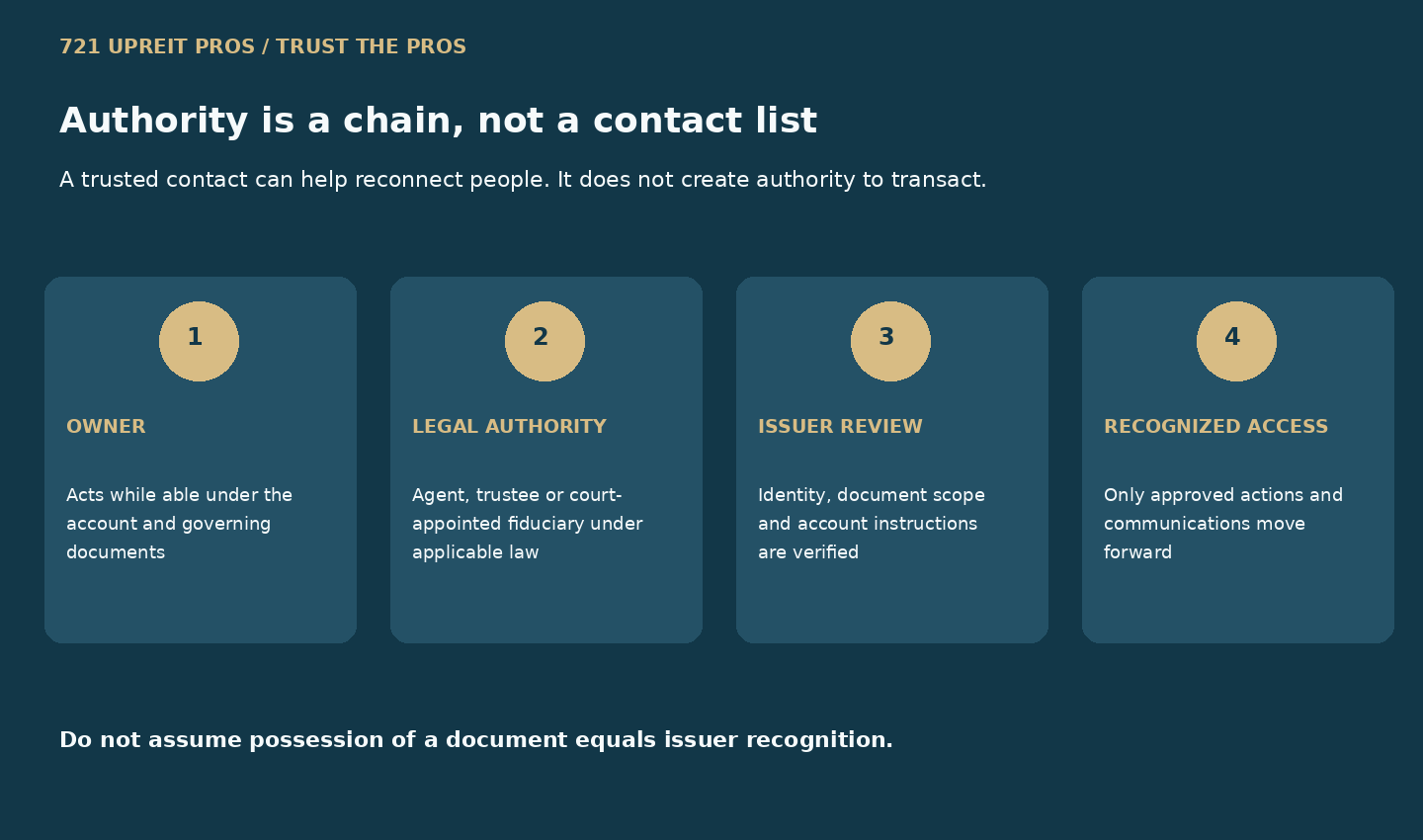
| Status | What it may accomplish | What it does not prove |
|---|---|---|
| Trusted contact | May help an investment professional reconnect with the owner, reach a family member or verify the identity of a possible fiduciary | No authority to act, execute transactions or make decisions merely because the person is listed |
| Agent under a power of attorney | May have authority described by a valid document and applicable law | Does not prove the document is effective, durable, broad enough or accepted by the issuer |
| Trustee | May act for assets actually held in the trust under the trust instrument | Does not prove the OP units are trust property or that a successor trustee is recognized |
| Guardian or conservator | May have court-ordered authority over specified property or financial matters | Does not expand beyond the order or bypass issuer identity and document review |
Investor.gov's trusted-contact guidance says that naming a trusted contact does not give that person authority to act, execute transactions or engage in account activity. The Consumer Financial Protection Bureau's power-of-attorney explanation describes a POA as a legal document that allows another person to act on someone's behalf. Actual authority still requires document-specific and state-law review.
Do not confuse the owner's personal authority plan with a partnership agreement's separate appointment of the general partner as attorney-in-fact for partnership filings. For example, Section 8.2 of the Brookfield REIT Operating Partnership agreement dated September 25, 2024 grants a limited-partner power of attorney for specified partnership purposes and says that appointment survives a partner's incapacity. That clause does not appoint the owner's family member or personal agent to manage the owner's account.
Which six continuity lanes should be tested?
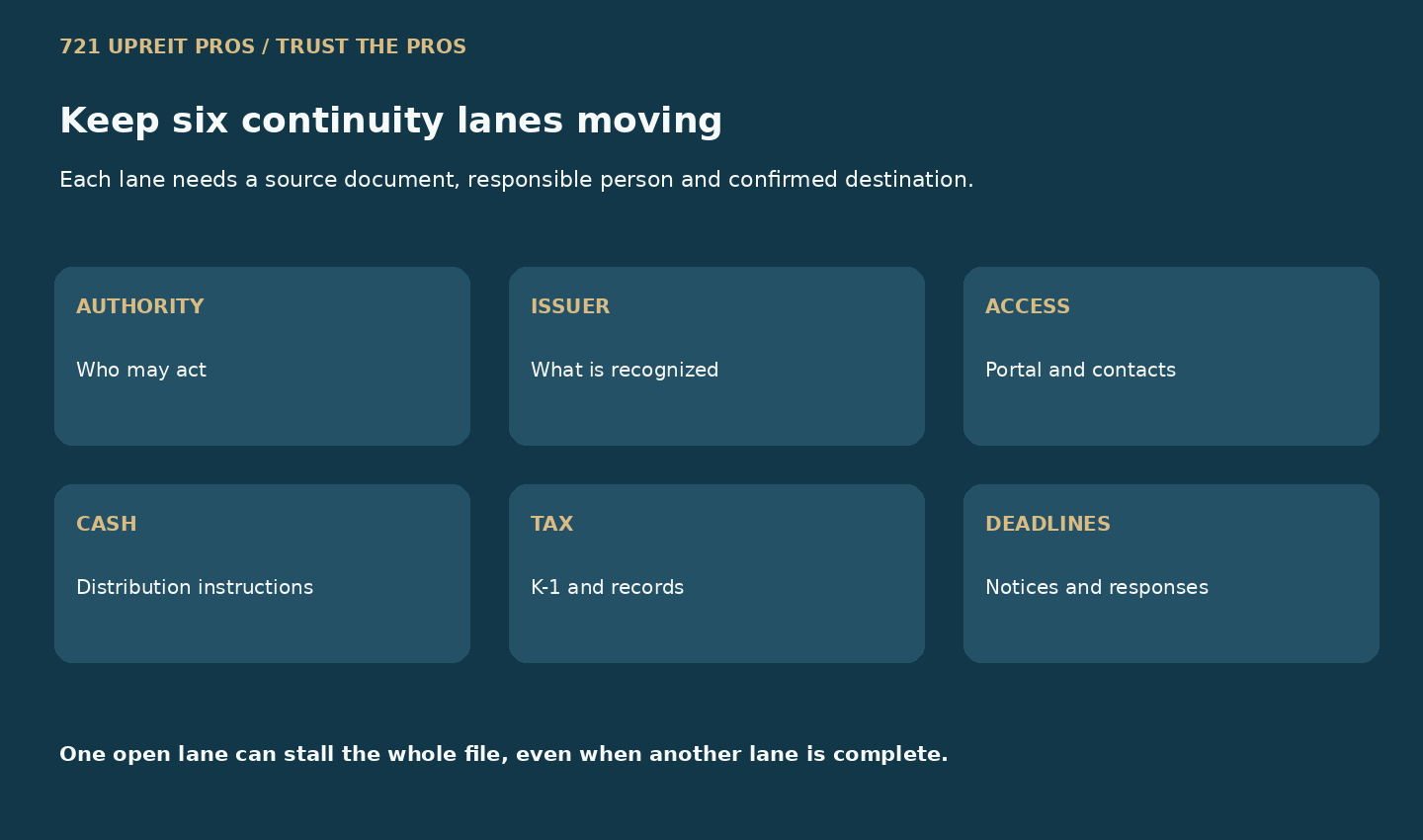
- Legal authority. Locate the current POA, trust instrument or court order. Have qualified counsel determine whether it is valid, effective and broad enough for the requested action.
- Issuer recognition. Ask the issuer or transfer agent for its current incapacity and fiduciary-review process. Record required certifications, identity checks, signature forms, review status and permitted actions.
- Account and communication. Confirm the mailing address, email, telephone number, portal recovery process and who may receive information. Do not share credentials or place another person on the owner's account informally.
- Distribution instructions. Verify where current distributions are sent, whether any payment failed, and the secure process for changing instructions. Treat an urgent bank-change request as a fraud-control event.
- Tax documents and records. Preserve K-1 delivery, prior returns, outside-basis workpapers, liability schedules and the partnership tax contact. A tax preparer's authority to discuss a return with the IRS is a separate question from authority over the OP-unit account.
- Notices and deadlines. Route redemption notices, elections, consents, tax-information requests and other time-sensitive communications to a named owner. Save the complete notice, sent date, response date and receipt.
The lanes can move at different speeds. An agent can have a legally effective POA while an issuer's review remains incomplete. The owner can still receive distributions while portal access is unresolved. A tax preparer can hold prior K-1s without authority to change an account. The continuity log should show these differences instead of reporting a single “complete” status.
What should be in the authority and account matrix?
| Question | Best source record | Status to record | Escalation owner |
|---|---|---|---|
| Who legally owns the OP units? | Issuer register, latest unit statement and governing documents | Owner name, legal entity, class and units | Issuer or transfer agent |
| Who may act? | Current POA, trust instrument or court order | Legal review open or complete | Owner's qualified counsel |
| What has the issuer accepted? | Written issuer confirmation and fiduciary forms | Accepted, rejected, incomplete or under review | Issuer fiduciary-review team |
| Who may receive information? | Account authorization and privacy records | Information-only or transactional authority | Issuer service team |
| Where do payments go? | Confirmed account instruction on file | Active, rejected or change pending | Issuer operations and fiduciary |
| Where do tax records go? | K-1 delivery profile and tax contact | Portal, mail or secure delivery confirmed | Partnership tax team and preparer |
The CFPB's fiduciary guidance says a fiduciary should act in the owner's best interest, manage carefully, keep the owner's money separate and keep complete records. A continuity file should therefore retain the reason for each action, supporting documents, issuer communications and receipts, not just the final result.
Keep IRS representation separate. IRS Form 2848 authorizes an eligible individual to represent a taxpayer before the IRS for specified matters. It does not by itself establish authority over an operating partnership's investor account, and an issuer's acceptance of a POA does not by itself authorize IRS representation.
How should a time-sensitive notice be handled?
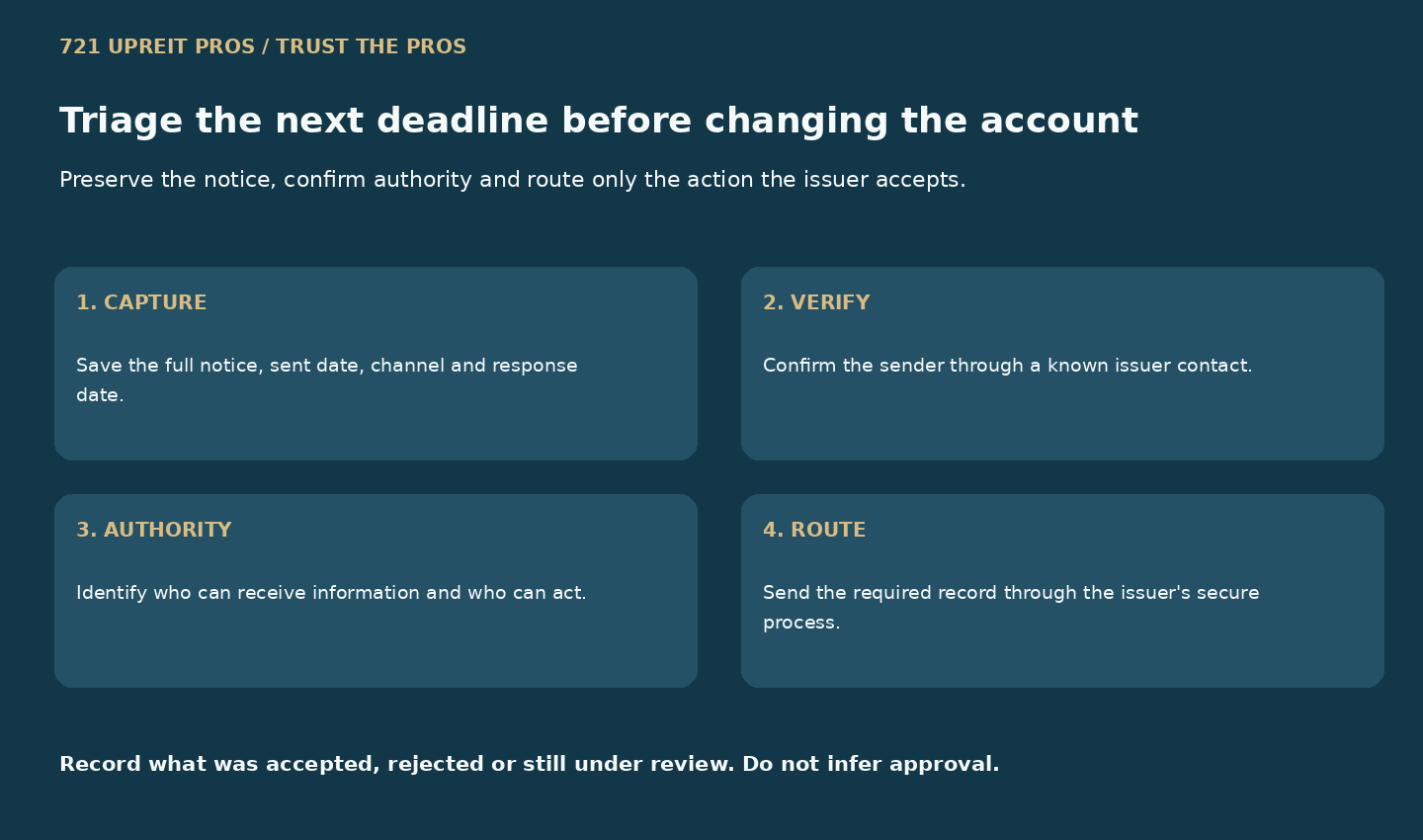
- Capture the notice. Save the complete document or message, attachments, envelope or headers, sent date, received date, delivery channel and stated response date.
- Verify the sender. Contact the issuer or transfer agent through a known website, statement or governing document, not through a new number or link in an unexpected message.
- Match the authority to the action. Receiving information, changing a mailing address, changing bank instructions, submitting a consent and requesting redemption can require different evidence and approval.
- Route and record. Use the issuer's secure channel, obtain a receipt, and write down whether the request was accepted, rejected, incomplete or remains under review.
A response date can be contractual rather than statutory, and different documents can use different delivery rules. The Brookfield agreement dated September 25, 2024 is one dated example: it addresses partner notices, annual reports, tax information and incapacity in separate provisions. It is evidence that the topics are document-specific, not a template for every OP-unit program. Review the current agreement and account procedures for the actual interest.
Fictional example: a deadline arrives while authority is under review
This is a continuity exercise, not a legal conclusion. An owner holds OP units and has a durable financial POA in a secure file. On March 3, the family finds an issuer notice with a March 20 response date. The account still sends distributions to the owner's existing bank instruction. The owner's tax preparer has prior K-1s but no current portal access.
The named agent contacts the issuer through the telephone number on the latest statement, requests the fiduciary-review checklist, and sends documents through the issuer's secure upload process. The trusted contact helps the issuer reach the family but does not submit the response. On March 8, the issuer confirms receipt but marks the POA “under review.” The continuity log therefore does not say “agent approved.” It assigns four parallel actions:
| Lane | Confirmed fact | Open question or next action |
|---|---|---|
| Authority | A POA document exists and was securely delivered | Counsel reviews effectiveness; issuer review is pending |
| Deadline | The full notice and March 20 date are preserved | Ask the issuer in writing what can be done while review is pending |
| Cash | Current distribution instruction remains on file | Do not change it merely to “test” access |
| Tax | Prior K-1s are stored securely | Confirm current-year delivery and information authorization |
The example does not assume the POA is valid, the issuer must accept it, the response period will be extended, or any requested transaction is available. Its useful output is a dated record of facts, unanswered questions and assigned owners.
What belongs in an OP-unit incapacity continuity packet?
- The legal issuer, operating partnership, unit class, account identifier and current governing agreement.
- The owner's current contact details and the issuer's known service and fiduciary-review contacts.
- The current POA, trust or court document stored securely, with legal-review notes and effective dates.
- A separate trusted-contact record that clearly says it is not transaction authority.
- The issuer's current fiduciary forms, identity requirements, secure submission method and written status.
- Current distribution destination, recent payment status and fraud-controlled change procedure.
- Prior K-1 packages, outside-basis records, tax delivery method and partnership tax-team contact.
- A notice register with sent, received, response and completion dates.
- A decision log showing what was requested, who approved it, supporting evidence and receipt.
- A later-succession folder kept separate from the living-owner file for use only if death or a recognized transfer later occurs.
For investment-side questions, talk to a 721 UPREIT advisor. Questions about incapacity, document validity, fiduciary authority and state law belong with qualified counsel. Account recognition belongs with the actual issuer or transfer agent, and tax representation belongs with the owner's qualified tax professional.
For broader structure background, see the independent DST 1031 Experts 721 UPREIT guide. Its brief incapacity discussion does not replace an account-specific authority and continuity file.
Watch the continuity briefing and download the checklist
The original one-minute captioned video explains the authority chain, six continuity lanes, deadline triage and acceptance log. It is a silent visual explainer, not legal, tax or investment advice.
Read video transcript
0:00 · Incapacity does not automatically move or liquidate OP units
The owner and interest may remain the same. The operational risk is a broken authority chain.
0:12 · Separate contact from authority
A trusted contact may help reconnect people. Only valid legal and issuer-recognized authority can act.
0:24 · Protect six continuity lanes
Track access, cash instructions and tax delivery. Give every lane a record owner.
0:36 · Triage the next deadline
Capture and verify the notice first. Route only what the issuer requests securely.
0:48 · Keep a dated acceptance log
Record what is accepted or still under review. Do not treat silence as recognition.
Download the OP-unit incapacity continuity checklist. Use it to inventory authority, issuer review, account access, distributions, tax records and deadlines.
Primary sources and review limits
Sources checked October 13, 2026. Governing documents, procedures and state law can change. This educational workflow has not received a named advisor, attorney, CPA or issuer review.
- Consumer Financial Protection Bureau, Managing Someone Else's Money: role-specific guides for agents under a POA, guardians, trustees and government fiduciaries.
- CFPB, What is a fiduciary?, last reviewed August 28, 2026: duties to act in the owner's interest, manage carefully, keep property separate and keep complete records.
- CFPB, What is a power of attorney? and What is a guardian of property?: different sources of authority.
- Investor.gov, Trusted Contact and updated trusted-contact bulletin: a trusted contact has no authority to act or transact merely from being named.
- Investor.gov, Planning for Diminished Capacity and Illness: advance planning, current account contacts and legal authority for investment actions.
- IRS Form 2848, page updated July 8, 2026: IRS-specific representative authorization.
- Brookfield REIT Operating Partnership, Fourth Amended and Restated Limited Partnership Agreement dated September 25, 2024: one dated SEC-filed example addressing partnership power of attorney, incapacity, tax information and notices. It is not a universal term sheet, and later amendments or restatements may apply.
OP units can lose value and may be illiquid. Incapacity planning does not create redemption rights, transfer approval, account access, tax authority or a guaranteed outcome. The actual legal documents, governing agreement, issuer procedures and applicable law control.
BEFORE YOUR ADVISOR CONVERSATION
Three questions before you commit
This companion briefing covers the professional's identity, compensation and how restrictions fit your cash needs. Use it alongside this article's specific document checks.
Loading the video connects to YouTube. Watch on YouTube · 721 UPREIT Pros channel · Read the full advisor checklist.
Read video transcript
Before you hire a seven twenty-one UPREIT advisor, ask these three questions.
First: who exactly am I hiring? Get the professional's legal name, firm and registration information. Check the record through Investor dot gov and read the firm's relationship summary where applicable. Ask whether this conversation involves brokerage services, investment advice, or both. A marketing title alone does not answer that question.
Second: who gets paid, and how much? Request a written cost breakdown in dollars. Identify the payer, calculation base, payment timing and ongoing charges. Include product expenses and embedded compensation. No separate advisor invoice does not mean there are no costs.
Third: how does this fit my cash needs? Review the actual agreements. Ask who controls a possible conversion and what happens if it does not occur. Separate permission to request redemption from approval, pricing and payment. Do not assume a fixed cash-out date.
Then agree on responsibilities. Your investment professional, CPA, attorney and qualified intermediary can have different roles. Put continuing service and unresolved questions in writing.
Read the complete advisor checklist using the article link in the description. Seven twenty-one UPREIT Pros. Trust the Pros. Educational only. Investments involve risk and may be illiquid. Tax treatment depends on your circumstances.
Educational only. Investments involve risk and may be illiquid. Footage is illustrative; narration is synthetic.
TALK TO A 721 UPREIT ADVISOR
Ready to discuss your 721 options?
Request a callback to discuss the questions raised by this article, your timing and what to ask before you commit. Share your name, email and phone below to start the conversation.
No investment commitment or financial documents required. A callback request does not book an appointment or establish an advisory relationship.