
721 UPREIT PROS / CONTRIBUTED PROPERTY SALE RECORDS
When contributed property is sold: the Section 704(c) tax-record handoff
If an operating partnership sells property you previously contributed, preserve the property identity, sale notice, closing economics, tax-basis schedule, Section 704(c) allocation detail and tax-character statements as one event file. Sale proceeds, debt payoff, cash distributions and taxable gain are different records.
Prepared by 721 UPREIT Pros · Published October 3, 2026 · General education

This guide answers one narrow question: what should an OP-unit holder collect when the operating partnership reports that previously contributed real estate has been sold? It supports the 721 UPREIT risk and due-diligence guide and continues the earlier annual Section 704(c) record checklist. It does not calculate a return, determine tax character, predict a distribution or establish that a tax-protection agreement applies.
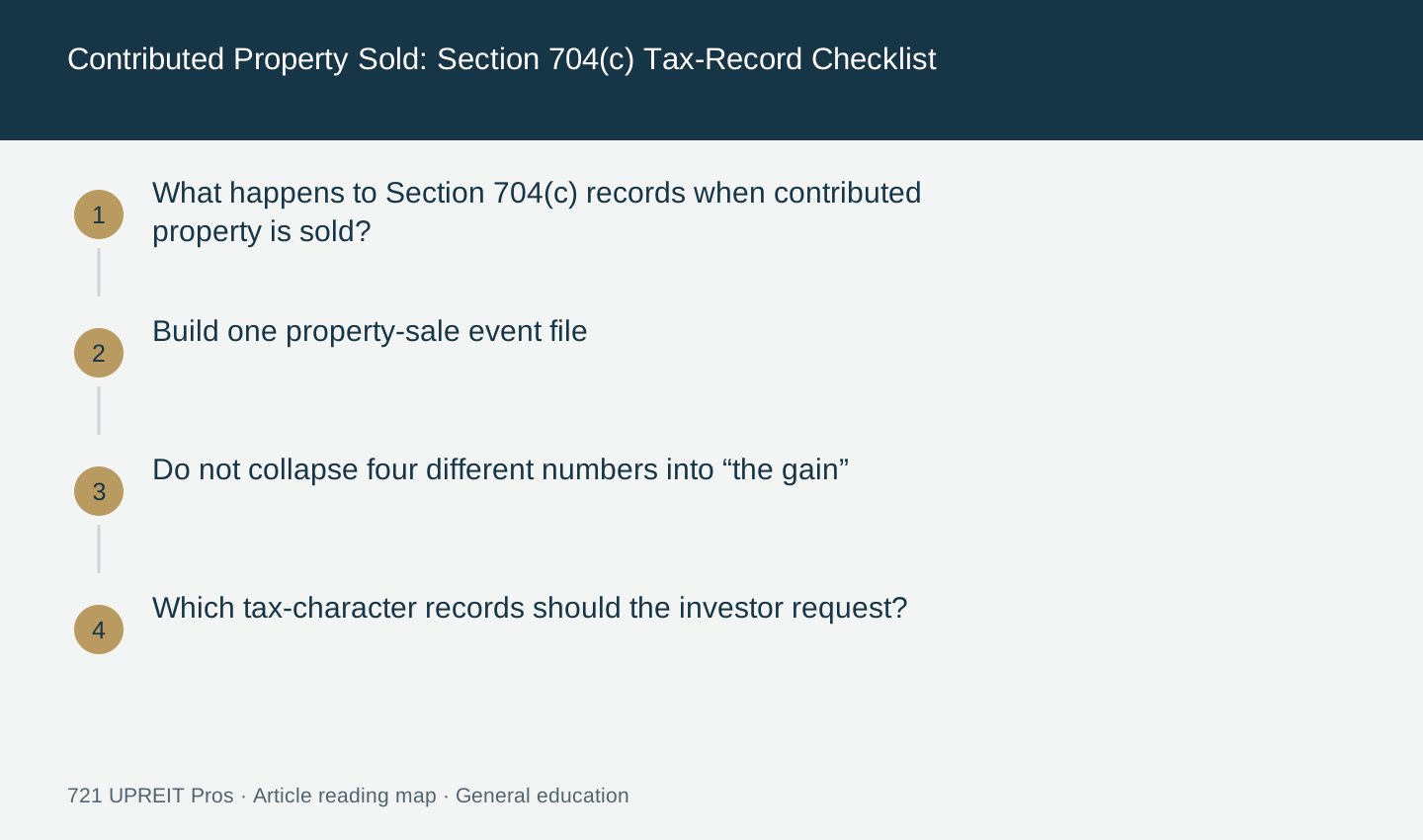
What happens to Section 704(c) records when contributed property is sold?
The sale can turn part or all of a property's remaining book-tax difference into current partnership tax items. IRS Publication 541 explains that when a partnership sells contributed property and recognizes gain or loss, built-in gain or loss is allocated to the contributing partner. The investor should collect the complete sale-year package and have a tax professional connect it to the contribution-date record, annual Item N history and the partnership's allocation method.
TALK TO A 721 UPREIT ADVISOR
Talk to a 721 UPREIT advisor
Request a callback to discuss the questions raised by this article, your timing and what to ask before you commit. Share your name, email and phone below to start the conversation.
No investment commitment or financial documents required. A callback request does not book an appointment or establish an advisory relationship.
IRS Publication 541, revised December 2025, also explains that the partnership generally carries the contributing partner's adjusted basis into the property and must account for the difference between basis and fair market value at contribution. Treasury Regulation 1.704-3 requires a reasonable, consistently applied method for the property and contains detailed rules for allocations, cost recovery and later disposition.
A sale by the partnership is not a sale of your OP units
The operating partnership may sell a building while you continue to own the same partnership units. The property sale, any cash distribution, a liability reallocation, a later unit redemption and a conversion into REIT shares are separate events. Record each one by date and governing document.
Build one property-sale event file
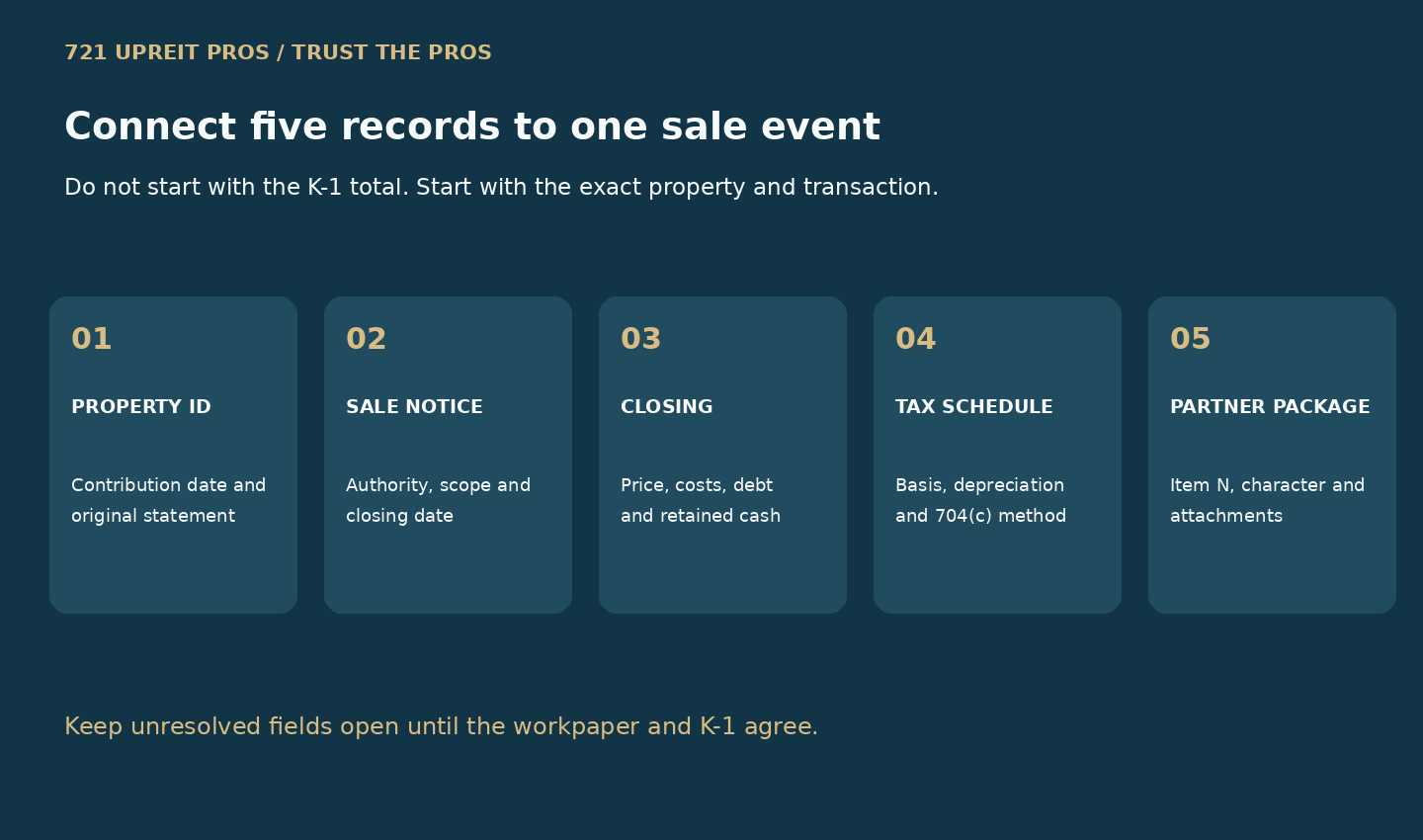
- Property identity. Record the legal owner, street or portfolio identifier, original contributing entity, contribution date and the exact Item M or closing statement that established the original built-in gain or loss.
- Sale notice and authority. Retain the notice, governing provision, approval record where provided, contract date, closing date and whether the transaction covered all or only part of the contributed asset.
- Closing economics. Keep gross price, selling expenses, prorations, debt payoff, reserves and net cash retained or distributed by the partnership. These explain cash movement, not the partner's tax result by themselves.
- Property tax schedule. Request the partnership's adjusted tax basis immediately before sale, accumulated depreciation or other cost recovery, capital additions, allocation method and the calculation of remaining Section 704(c) built-in gain or loss.
- Partner tax package. Preserve the complete Schedule K-1, Item N, Box 9c, Box 10, Box 20 code AA and every attached sale, depreciation, state and character statement that applies. The relevant fields vary with the property and facts.
Download the sale-event worksheet
Do not collapse four different numbers into “the gain”
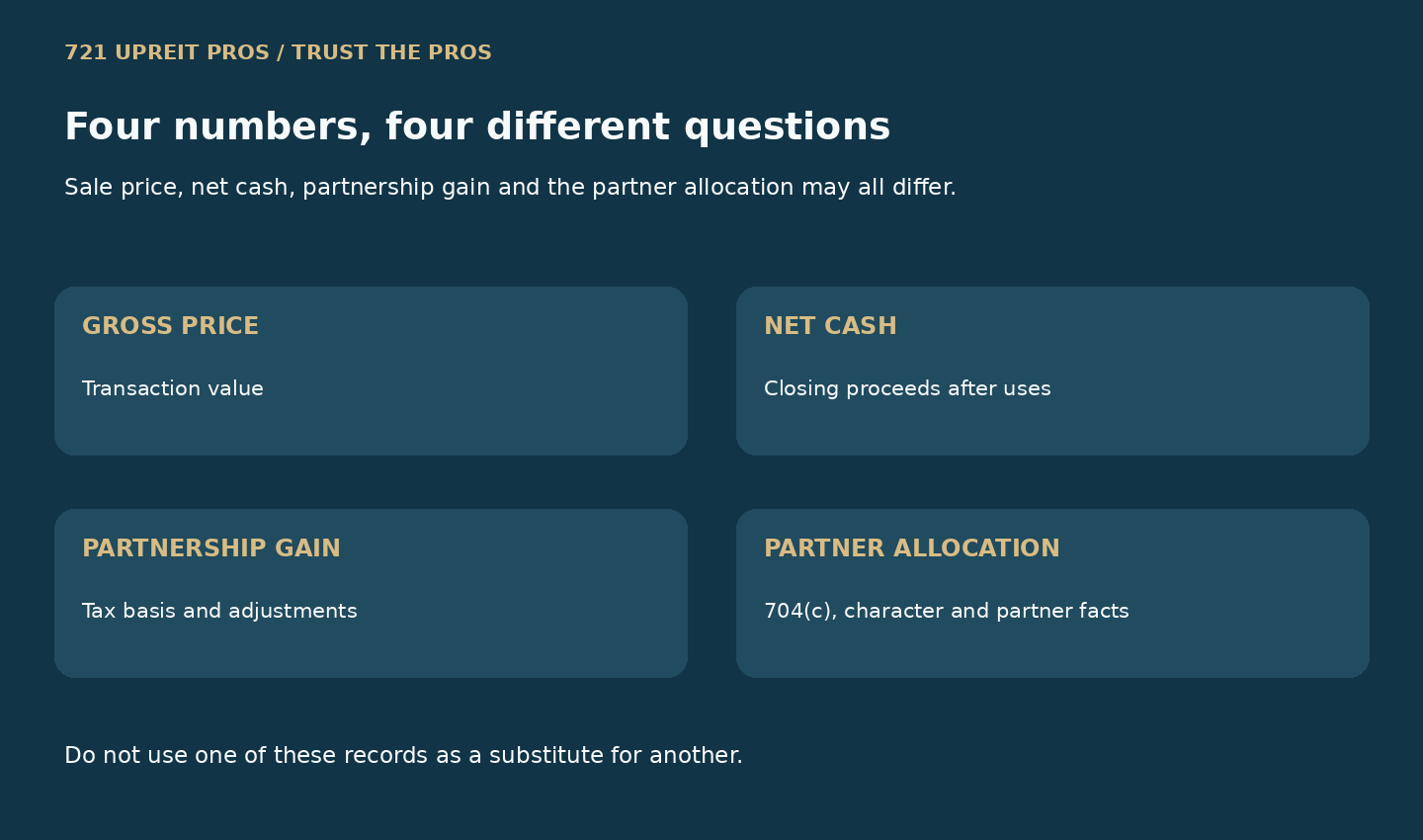
| Record | What it answers | Primary evidence |
|---|---|---|
| Gross price or amount realized | What the partnership received or is treated as receiving for the property | Closing statement and tax workpapers |
| Net property cash | What remains after selling costs, debt payoff and other closing uses | Settlement statement and bank or escrow records |
| Partnership tax gain or loss | The partnership-level result after tax basis and applicable adjustments | Partnership return and property-disposition schedule |
| Partner allocation and character | What reaches this partner's return and how it is classified | Complete K-1 package, Section 704(c) workpaper and partner facts |
A debt payoff can reduce cash without reducing taxable amount realized in the same way. A partnership can retain sale proceeds rather than distribute them. A partner can receive an allocation of taxable income without receiving matching cash. Conversely, a later distribution may require its own outside-basis and liability analysis. Keep the records separate until the preparer reconciles them.
Which tax-character records should the investor request?
The 2025 Partner's Instructions for Schedule K-1, checked October 3, 2026, show why the full package matters. Box 10 can report net Section 1231 gain or loss. Box 9c can report unrecaptured Section 1250 gain. Box 20 code AA identifies income or deductions allocated under Section 704(c), but those items are also reported elsewhere on the K-1. A property with a passed-through Section 179 deduction can require additional disposition information under Box 20 code L. These are examples, not a promise that every field appears.
- Ask for the property description and sale date used in the tax workpaper.
- Ask how adjusted basis, depreciation allowed or allowable, improvements and selling expenses were determined.
- Ask which portion of the partner's allocation is Section 1231, unrecaptured Section 1250, ordinary, capital or another category, and where each amount appears.
- Ask how the sale changed Item N and why that movement may not equal one K-1 line or Box 20 code AA.
- Ask whether a partial sale, installment payment, casualty, state adjustment or corrected package creates a continuing record after the closing year.
Tax character depends on the property, holding and depreciation history, applicable recapture rules, the partnership's method and partner-level facts. Do not describe the entire result as capital gain, depreciation recapture or deferred gain based on a sales summary.
Use the separate depreciation and property-history checklist to preserve the asset-level schedules needed before the partnership or preparer assigns Section 1245, Section 1250 or other character.
Worked example: a sale notice arrives before the K-1
This is a fictional recordkeeping example, not a tax calculation. Harbor Ridge Operating Partnership sends an August notice stating that it sold a building originally contributed by Investor A. Investor A's contribution file shows a $2,400,000 fair market value, $900,000 adjusted tax basis and $1,500,000 initial built-in gain. The most recent K-1 shows $1,150,000 of ending net unrecognized Section 704(c) gain.
The notice also says the property sold for $2,850,000, the related loan was paid off and some proceeds will remain in the partnership. Those facts do not establish Investor A's taxable allocation. The preparer still needs the sale closing statement, property tax basis immediately before sale, depreciation and improvement schedule, Section 704(c) method, current-year allocation workpaper, liability changes and the complete sale-year K-1 package.
| Known | Still missing | Do not infer |
|---|---|---|
| Original contribution facts and latest Item N | Sale-year Item N bridge and allocation workpaper | That $1,150,000 is automatically the current taxable gain |
| Stated gross sale price | Tax amount realized, selling costs and final basis | That price equals partnership gain or partner cash |
| Loan payoff and retained proceeds | Partner liability allocation and distribution records | That no basis or Section 752 analysis is needed |
| Sale completed in August | Final K-1, state statements and any later correction | That a press release or portal notice is a complete tax package |
The seven-question preparer handoff
- Does the sale notice identify the same legal property and entity as the original contribution record?
- Was all of the property sold, or only a component, interest or replacement asset?
- What was the partnership's adjusted tax basis immediately before sale, and what supports it?
- Which Section 704(c) method applied, and how did the sale move the investor's Item N balance?
- Where are the investor's allocated sale items reported on the K-1 and attached statements?
- How are depreciation, unrecaptured Section 1250 gain, Section 1231 treatment and other character items documented?
- Did the sale also change liabilities, distributions, tax-protection rights, installment records or state reporting?
For liability changes, continue with the OP-unit debt and basis worksheet. For contract coverage, use the tax-protection agreement matrix. For broader background, DST 1031 Experts explains 721 tax deferral, basis and trade-offs. None of those pages replaces the sale-year partnership workpaper.
One-minute video: build the property-sale event file
Read video transcript
General education by 721 UPREIT Pros with AI assistance. No independent professional review is represented. The example is fictional and does not determine Section 721 treatment, a Section 704(c) allocation, tax character, depreciation recapture, outside basis, liability treatment, a distribution, tax-protection coverage, investment suitability, liquidity or return.
BEFORE YOUR ADVISOR CONVERSATION
Three questions before you commit
This companion briefing covers the professional's identity, compensation and how restrictions fit your cash needs. Use it alongside this article's specific document checks.
Loading the video connects to YouTube. Watch on YouTube · 721 UPREIT Pros channel · Read the full advisor checklist.
Read video transcript
Before you hire a seven twenty-one UPREIT advisor, ask these three questions.
First: who exactly am I hiring? Get the professional's legal name, firm and registration information. Check the record through Investor dot gov and read the firm's relationship summary where applicable. Ask whether this conversation involves brokerage services, investment advice, or both. A marketing title alone does not answer that question.
Second: who gets paid, and how much? Request a written cost breakdown in dollars. Identify the payer, calculation base, payment timing and ongoing charges. Include product expenses and embedded compensation. No separate advisor invoice does not mean there are no costs.
Third: how does this fit my cash needs? Review the actual agreements. Ask who controls a possible conversion and what happens if it does not occur. Separate permission to request redemption from approval, pricing and payment. Do not assume a fixed cash-out date.
Then agree on responsibilities. Your investment professional, CPA, attorney and qualified intermediary can have different roles. Put continuing service and unresolved questions in writing.
Read the complete advisor checklist using the article link in the description. Seven twenty-one UPREIT Pros. Trust the Pros. Educational only. Investments involve risk and may be illiquid. Tax treatment depends on your circumstances.
Educational only. Investments involve risk and may be illiquid. Footage is illustrative; narration is synthetic.
TALK TO A 721 UPREIT ADVISOR
Ready to discuss your 721 options?
Request a callback to discuss the questions raised by this article, your timing and what to ask before you commit. Share your name, email and phone below to start the conversation.
No investment commitment or financial documents required. A callback request does not book an appointment or establish an advisory relationship.